by Sam McBride
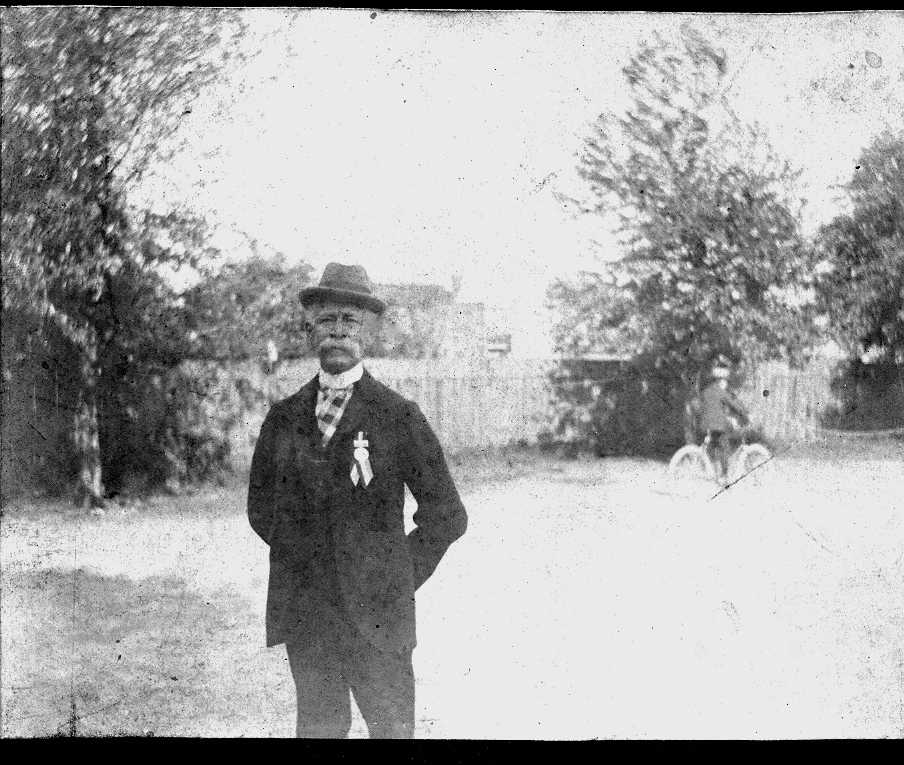
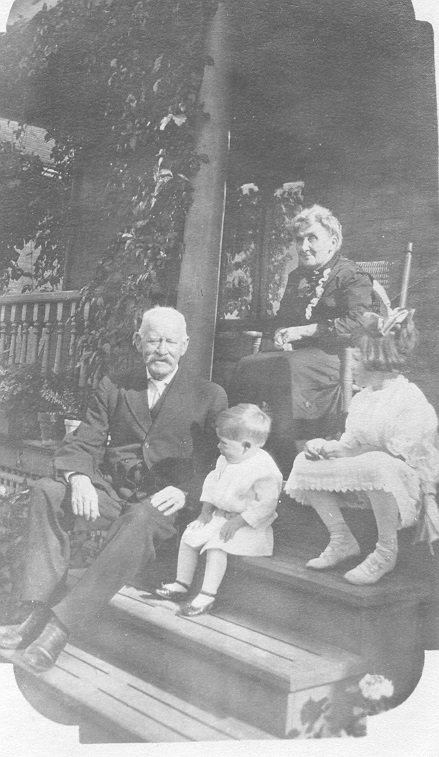
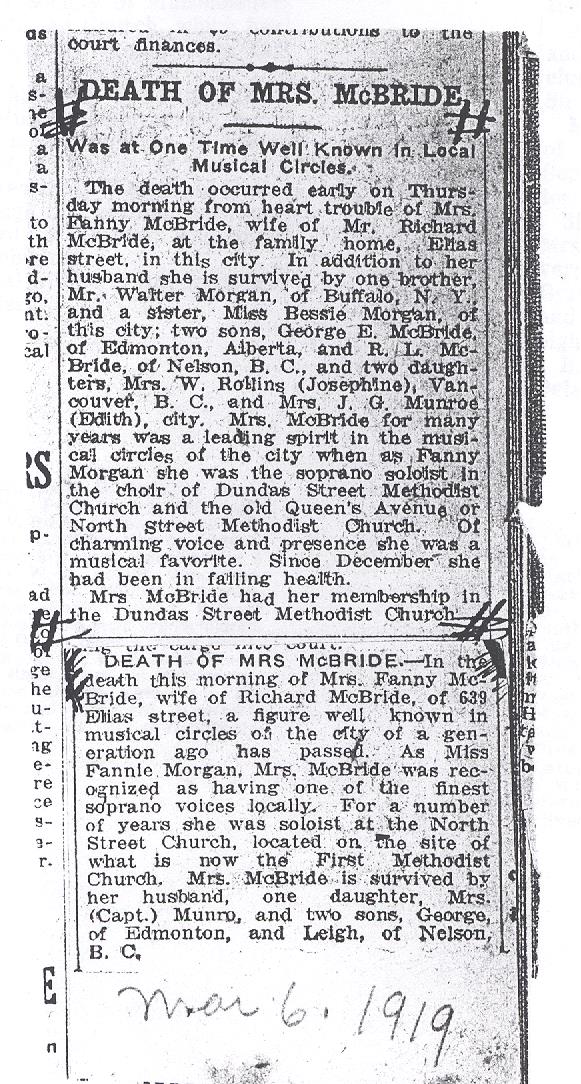
My great-grandparents Richard “Dick” McBride (1843-1921) and Fanny Morgan (1848-1919) were well-known and popular residents of London, Ontario for many years.
Dick was born in London, son of Samuel McBride and Elizabeth Webster, and lived there for the rest of his life, except for the final year when he lived with daughter Edith’s family in Montreal. Fanny was born in Abergavenny, Wales, eldest daughter of James Morgan and Margaret Hanbury. She arrived in London with her emigrating Morgan family in about 1850 as a toddler, and died there shortly after the end of World War One.

Dick was a volunteer fireman in London for many years, before the city had its own fire department. His father Samuel McBride (1819-1905) trained him in his trade of tinsmith, and hired him to help with a stove-manufacturing business in London, Ontario. He served in the militia established in 1866 to protect the city against a feared invasion by Fenians – Irish-rooted veterans of the U.S. Civil War who demanded that Ireland be free of subjugation by Britain. As it turned out, the disorganized Fenians only made minor incursions into New Brunswick, and did not make it to London.
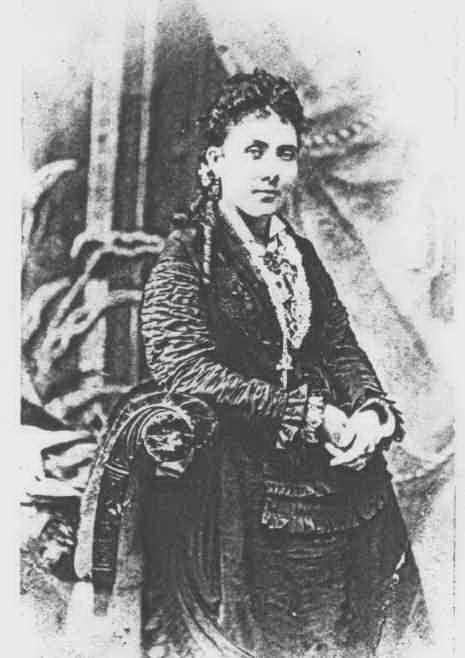
Writing a family history in 1928, Dick’s cousin Harry Bapty of London noted that Dick “was a friend of everyone and a good-natured and lovable man”, – a “Hail Fellow, Well Met.” Based on this and other documents of the time, I get the feeling that Dick was recognized more for his friendliness and personality than for his work as a tinsmith or businessman.
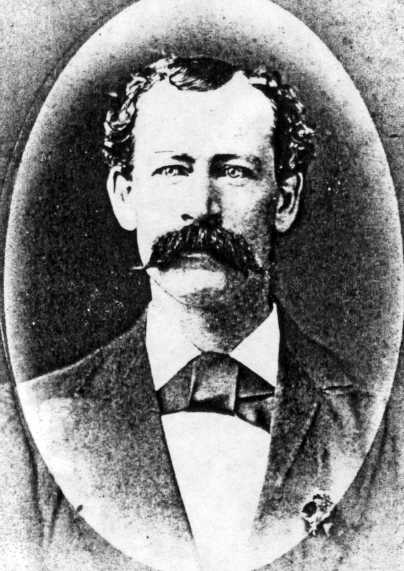
In response to a request from his niece Edith McBride for memories of the family’s early days in London, her younger brother Walter Clement Morgan (1861-1940) of Buffalo, New York said in a letter that Fanny and eldest brother Fred went to a school on Hamilton Road in London, and it was either close to the Black Horse Tavern, or in it, while Walter and other younger siblings went to the Adelaide Street school between York and King. Fanny worked at times as a dressmaker, and as a concert singer. “She had innumerable admirers, and the house was cluttered up with them almost every evening,” according to Walter. Any man among them who was shorter than six feet in height was invariably referred to by Fanny as “Little So-and-so”, such as Little Fewings, Little Johnny Traher and Little Tommy Martindale. In contrast, she called the tall and handsome Richard McBride (her future husband) “The Lovely Dick”.
Fanny worked part-time as a dressmaker and was renowned for her superb soprano singing voice. Unfortunately, the society of the day had low regard for women who were professional entertainers, and she was discouraged from a professional career. Walter noted she was able to earn money for singing at certain events and occasions, such as the St. George’s, St. Andrews and St. Patrick’s Day celebrations for which she was paid an amount never less than ten dollars. She would also perform at nearby communities such as Wardsville, and Glencoe where she sang for a fee and expenses. “She was a great favourite,” Walter wrote, noting that John Mills gave him a job when he told him Fanny was his sister.
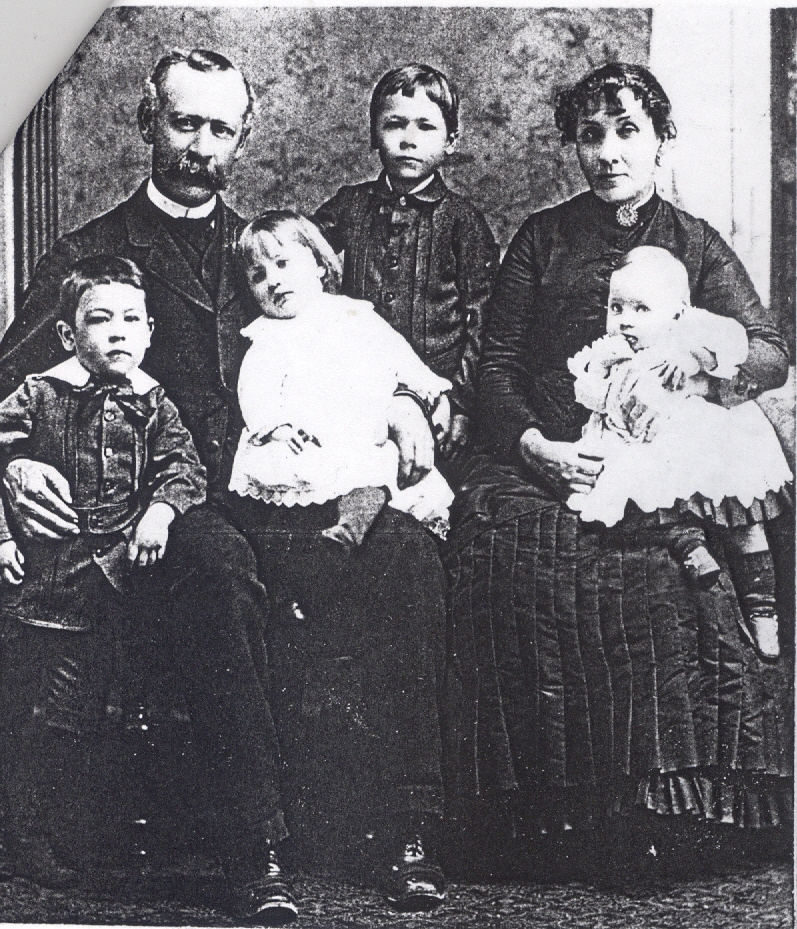
Fanny and Richard married on September 27, 1876 in London. The ceremony was at the Morgan residence, with Rev. James Graham presiding. Their children included George Everett McBride (1877-1954) who settled with wife Mabel Staples in Edmonton, Roland Leigh McBride (1881-1959), who settled with wife Winnifred Foote in Nelson, B.C., Josephine Fanny Rollins (1883-1965), who settled with husband William Rollins in Vancouver, B.C., and Edith Marjorie Monroe (1884-1965), who settled in London and later Quebec with husband Dr. Garfield Monroe.
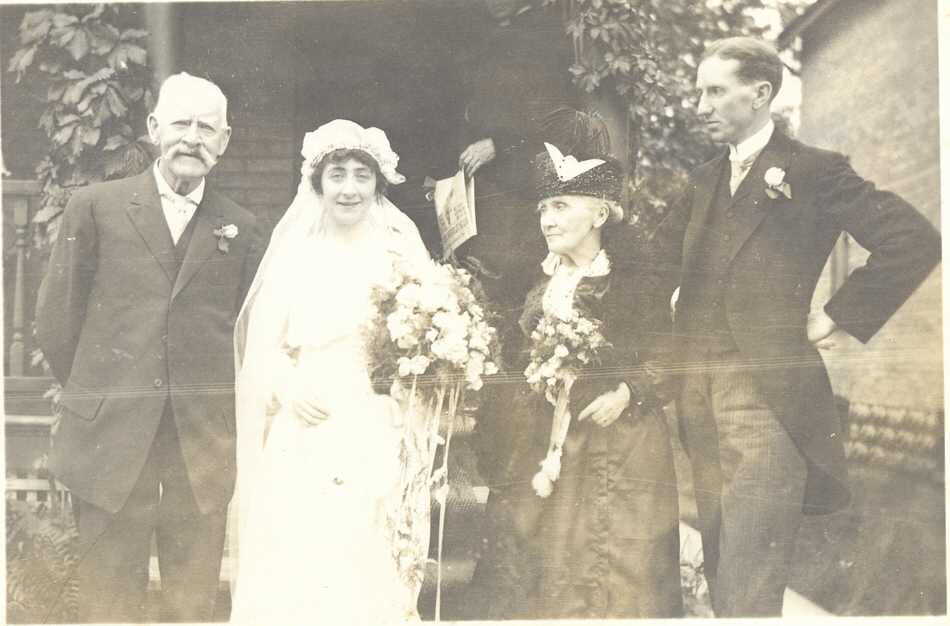
Both Fanny and Richard travelled once to my old home town of Nelson in the West Kootenay region of southeastern B.C. British Columbia where their son Roland Leigh McBride moved in 1904 and remained for the rest of this life. Fanny came to Nelson with daughter Edith and niece Ina in September 1911 for the wedding of R.L. McBride and Eva Mackay Hume at the Hume summer residence known as Killarney-on-the-Lake in what Eva’s sister Freeda described years later as “the social event of the year” in Nelson. Fourteen months later Eva died of childbirth complications at their home at 824 Mill Street. In the bedroom supporting her as she was dying were her sisters, husband and best friend Winnifred Mae Foote (1889-1960). Among her last words were encouragement for Winnie and R.L. to marry, which they did two years later, settling at 708 Hoover Street.
Richard travelled to Nelson some time after wife Fanny’s death in March 1919, and was photographed by Winnie beside Kootenay Lake with son R.L. and toddler grandson Leigh Morgan McBride (1917-1995). R.L. and Win’s other son would be Kenneth Gilbert McBride (1920-1944), who was an exceptional athlete and sportsman in Nelson and later at UBC before joining Leigh as an officer with the Seaforth Highlanders of Canada in 1942. Ken was killed in action on September 16, 1944 near Rimini, Italy. Leigh, who had been seriously wounded in the attack on the Hitler Line on May 24, 1944, including the loss of his right eye, was found unconscious by German troops and taken to a German hospital for medical treatment, and then to a succession of German prisoner-of-war camps before he returned to Canada in late January 1945 on the Swedish ship “Gripsholm” in a prisoner exchange. In 1948 Leigh married Rose Pamela “Dee Dee” Dewdney and they had sons Ken and Sam and daughter Eve.
In their final years R.L. and Win enjoyed regular visits from Leigh and his family.
When R.L. McBride was manager of the Wood Vallance Hardware Company in the 1920s he encouraged his cousins in London, Ontario Walter and Keith Kettlewell to move to Nelson and work for him. The other cousin to settle in Nelson was Helen Jennejohn, daughter of \George and Mabel McBride, who married Dr. Norman Jennejohn and they came to Nelson where he established a dental practice, and they had sons Bob, Bill and Bruce.
 thebravestcanadian