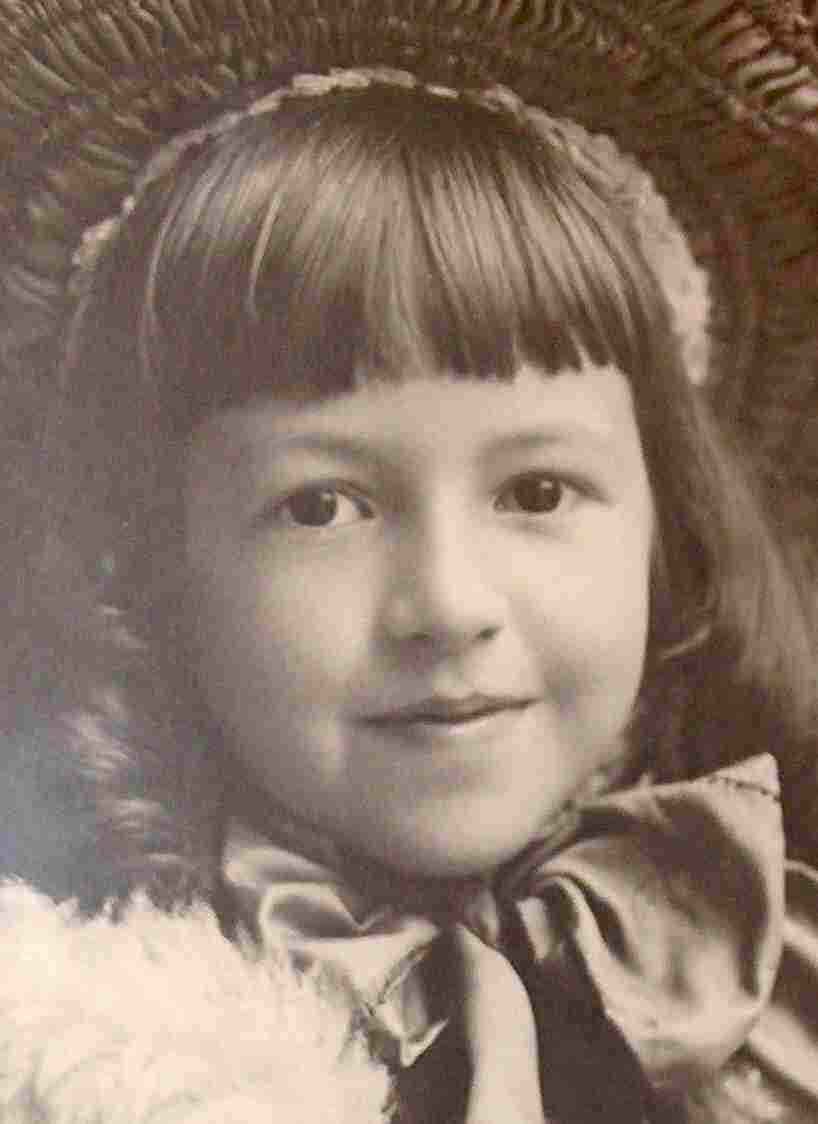
70 Years Ago Gen. Eisenhower Awarded U.S. DSC to Capt. Frederic Thornton Peters

Leave a comment

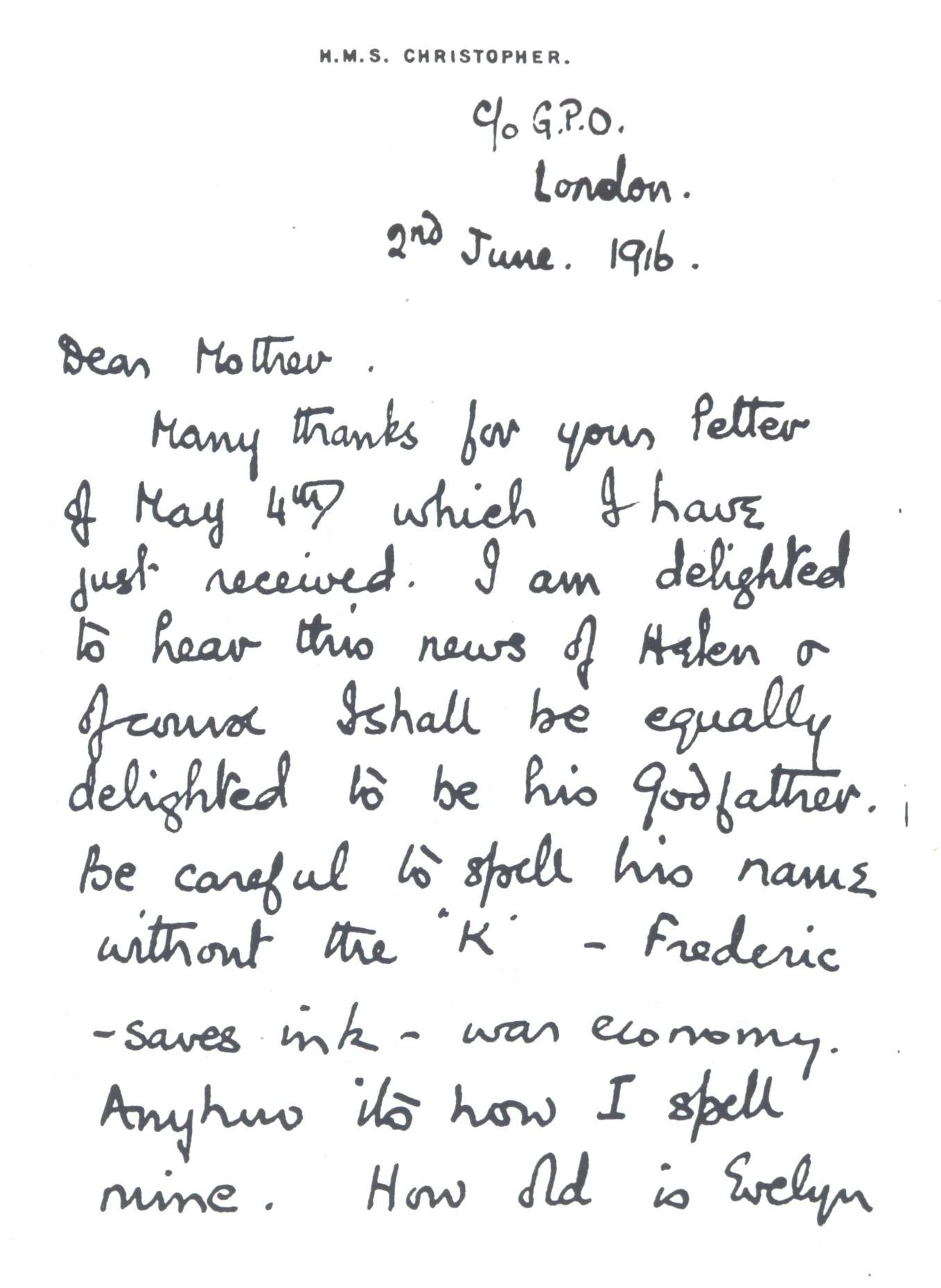
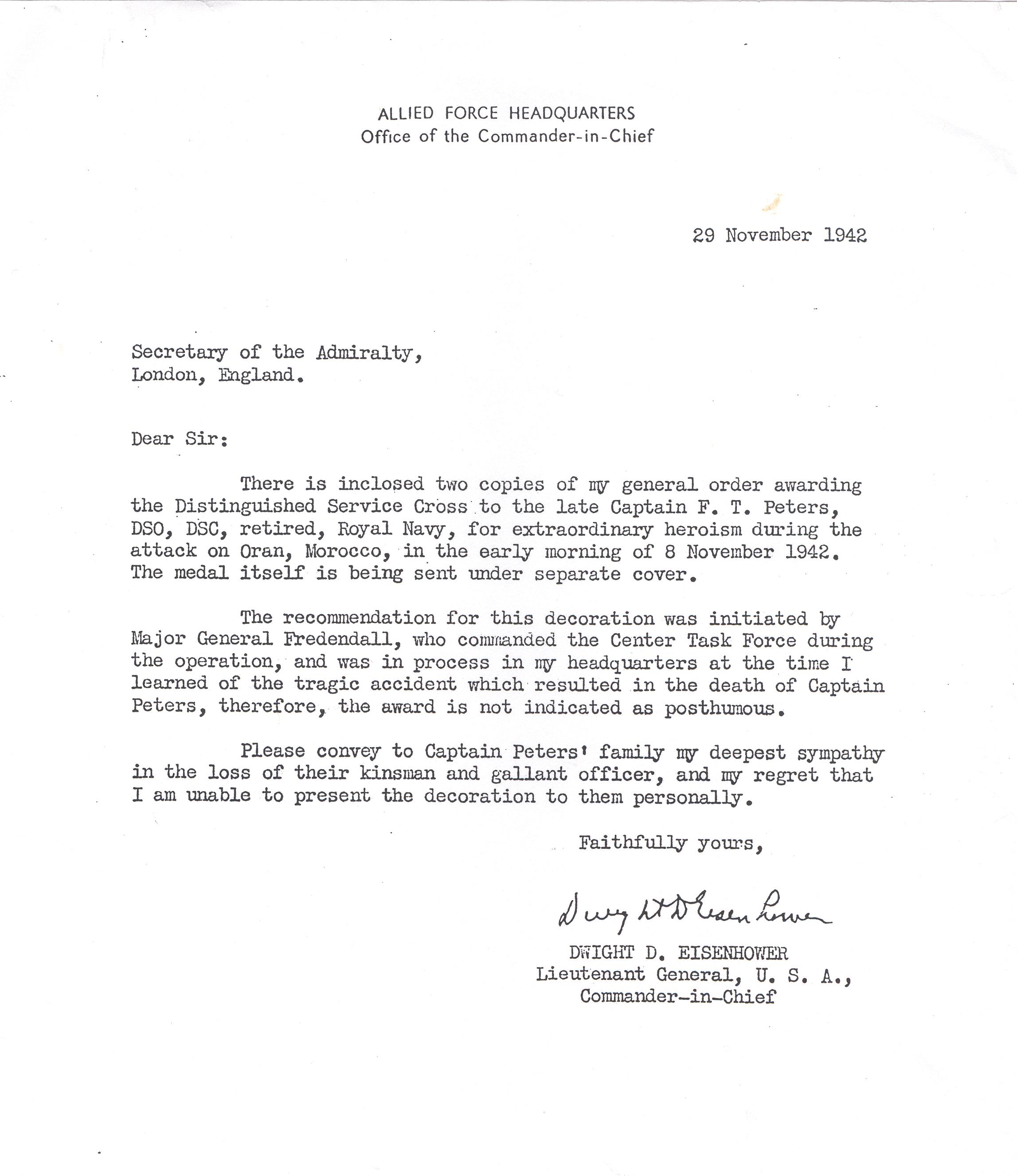
ABOVE: Nov. 29, 1942 letter from Eisenhower (Peters Family Papers).

In the letter above, dated Nov. 29, 1942, Lt. Gen. Dwight D. Eisenhower, overall commander of Operation Torch, the Allied invasion of North Africa, advises the British Admiralty that he is awarding the U.S. Distinguished Service Cross to Acting Captain Frederic Thornton “Fritz” Peters of the Royal Navy.

The letter was forwarded to Peters’ mother as next-of-kin as a memento of her son who tragically died when the flying boat transporting him back to England crashed in heavy fog in Plymouth Sound in the evening of Nov. 13, 1942. It was likely sent to Mrs. Peters in 1943 by either Adm. A.M. Peters (no relation to Fritz) or Adm. Sir Frederick Dalrymple-Hamilton, both of whom served terms as Secretary of the Admiralty and wrote letters to Mrs. Peters in response to her inquiries after Fritz’s death. While A.M. Peters was a casual acquaintance of Fritz, Dalrymple-Hamilton was a longstanding friend and naval colleague who was a fellow student with Fritz at Cordwalles Boys School in Maidenhead in the 1901-1904 period. The letter was retained by Mrs. Peters and her descendants, and is part of the Peters Family Papers on which the new book “The Bravest Canadian — Fritz Peters, VC: The Making of a Hero of Two World Wars” is based.

In the letter Eisenhower applauds Peters for “extraordinary heroism during the attack on Oran, Morocco in the early morning of 8 November 1942”. It is interesting that Eisenhower mistakenly says Oran is in Morocco, when it is actually the second largest city of Algeria. This may have just been a clerical oversight, or it may be a reflection of Eisenhower’s poor knowledge of North Africa geography.

It is also interesting that Eisenhower says Gen. Lloyd Fredendall, in command of the Centre Task Force to capture Oran in Operation Torch, had made the recommendation for Fritz’s American DSC medal. Fredendall strongly disliked his British allies and encouraged his staff to mock them with fake English accents. At the time this letter was written, Eisenhower was still a strong supporter of Fredendall, but in February 1943, after the humiliating defeat at Kasserine Pass, Fredendall was replaced as commander of II Corps by Gen. George S. Patton, and sent back to the States.

Oak Bay News reports on “The Bravest Canadian”

1 Comment

by Sam McBride

The October 20, 2012 issue of the Oak Bay News has a feature titled “Oak Bay Man a Forgotten Hero” about the new biography “The Bravest Canadian — Fritz Peters, VC: The Making of a Hero of Two World Wars”.

See the story at the following link:
http://www.oakbaynews.com/community/175002621.html

The community of Oak Bay, located immediately east of Victoria on the southeastern top of Vancouver Island in British Columbia, Canada, has a significant connection to the Fritz Peters story because he moved there from his native Prince Edward Island at age eight in 1898 with his family when his father Frederick Peters moved west to establish a law partnership in Victoria with fellow lawyer and politician Sir Charles Hibbert Tupper. Fritz lived in Oak Bay until joining the Royal Navy at age 15 in 1905, aside from time in England at the Bedford and Cordwalles boys’ schools.

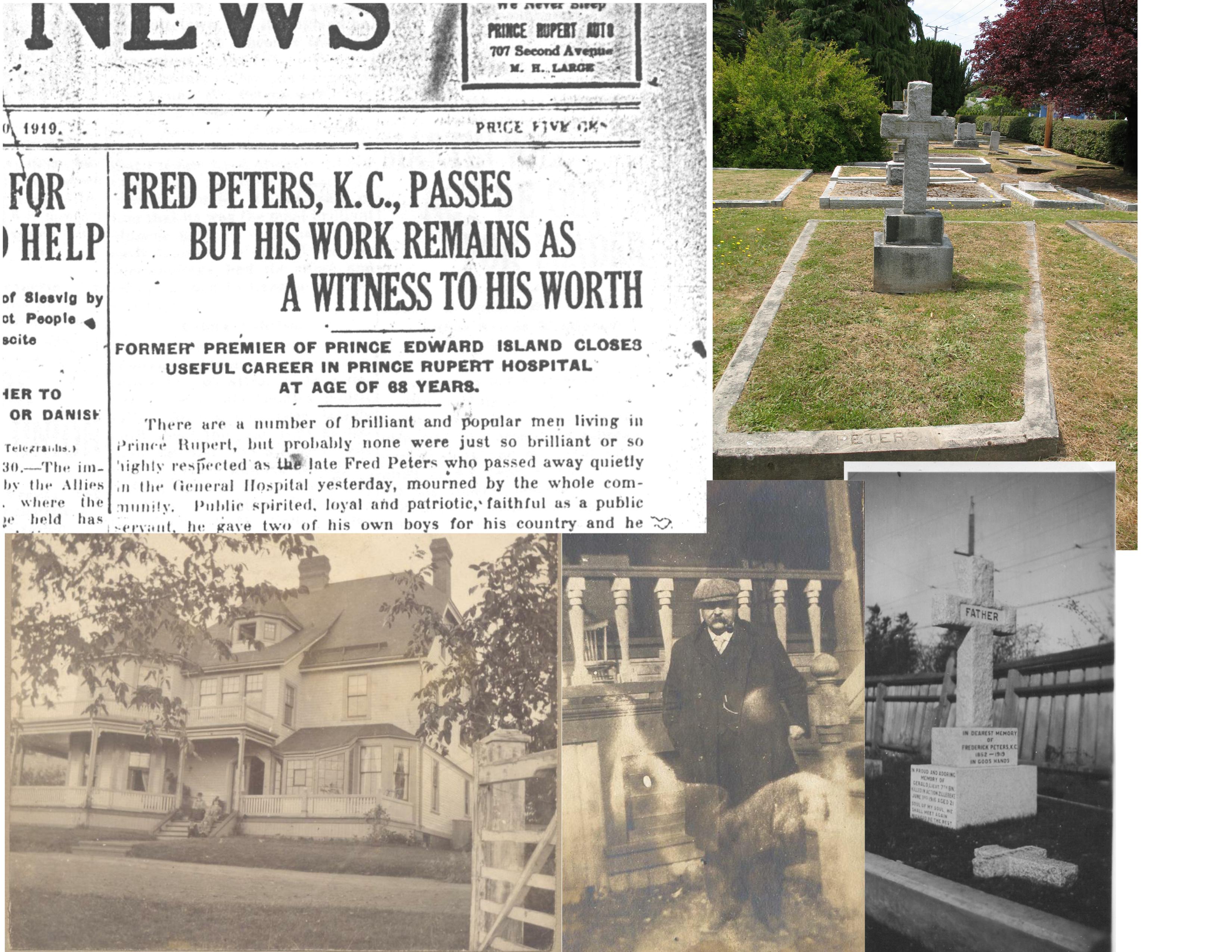
Peters and Tupper built complementary, adjoining houses near York Place at Prospect Point in a new property recently developed by renowned architect Francis Rattenbury. J.R. Tiarks of the Rattenbury firm designed the Tupper and Peters house. The Tupper home took the name of “Annandale” and the Peters home was “Garrison House”. The family sold the house in about 1908 and moved to Esquimalt, and then three years later to Prince Rupert.

Seventieth Anniversary of Fritz Peters’ Victoria Cross Action of Nov. 8, 1942

Leave a comment

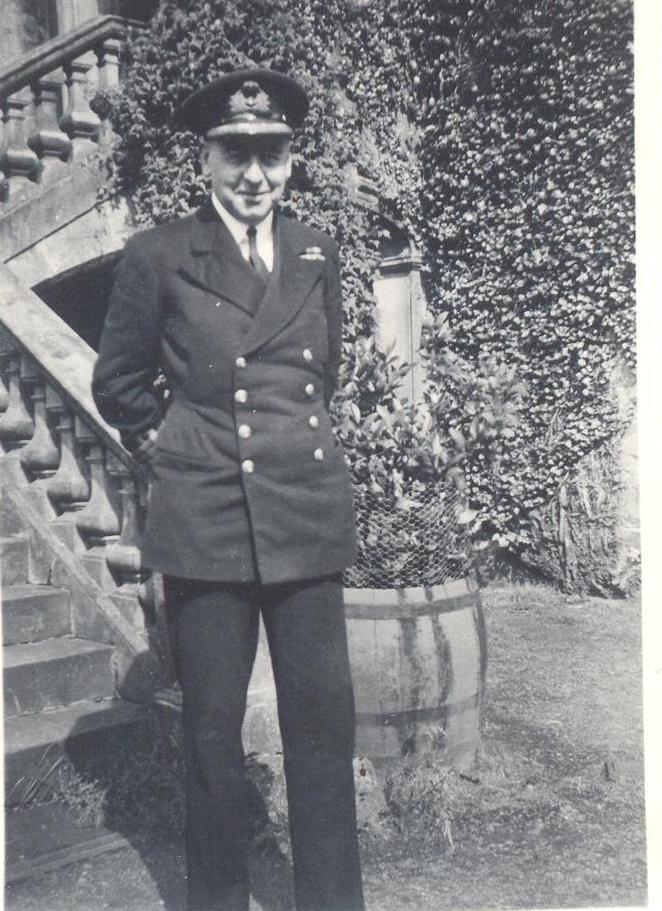
Capt. Frederic Thornton “Fritz” Peters, at Cleish Castle in Scotland, circa spring 1942. (McBride Collection)

November 8, 2012 will mark the 70th anniversary of the Allied invasion of North Africa, code-named Operation Torch, a turning point in the Second World War.

The date is also the 70th anniversary of the action in the harbour of Oran, Algeria which earned Canadian Capt. Frederic Thornton “Fritz” Peters, VC, DSO, DSC and bar, DSC (U.S.), RN the Victoria Cross and the U.S. Distinguished Service Cross – the highest awards for valour offered by Britain and the United States.

Born in Charlottetown, Prince Edward Island and raised in Victoria, British Columbia before joining the Royal Navy at age 15 in 1905, Peters is unique among Canadian war heroes in receiving multiple awards for valour in both World War One and World War Two.

The story of Fritz Peters is told in the new biography “The Bravest Canadian – Fritz Peters, VC: The Making of a Hero of Two World Wars”, by Trail, B.C. writer Sam McBride. The main sources used by the author are a recently-discovered collection of personal letters, photographs and other documents that reveal Peters’ personality, motivations and remarkable fearlessness and cool demeanor in battle.

Published by Granville Island Publishing of Vancouver, B.C., the book will be available in book stores, through amazon.com and in electronic formats in November 2012.

The invasion of Vichy French territory was the first large combined operation of British and American forces. The initial targets of the invasion were the two largest cities and ports in Algeria, Oran and Algiers, as well as Casablanca in Morocco.

The harbour attack began on Sunday, November 8, 1942 at 3 am — two hours after the first Allied troops landed on beaches on the west and east flanks of Oran — as the cutter HMS Walney at top speed smashed through the harbor boom, followed immediately by its sister ship HMS Hartland. Despite heavy fire from all directions and 90 per cent casualties among the crew, Peters was able to maneuver Walney close to its target landing site a mile and a half within the congested harbour.

Peters and other survivors were taken prisoner by the French defenders, but released two days later when the city surrendered to advancing American troops. Peters was carried through the streets of Oran as a hero, but tragically he died in the evening of Friday, November 13, 1942 when the flying boat transporting him back to England to report on the action to Prince Minister Winston Churchill crashed in heavy fog in Plymouth Sound.

The surrender of the last Nazi forces in North Africa in May 1943 in the French colony of Tunisia secured Allied shipping lanes in the Mediterranean and gave the Allies bases for subsequent invasions of Sicily, mainland Italy and France.

Biography of Canadian War Hero Fritz Peters ,VC

1 Comment

A new book tells the story of one of Canada’s most decorated – and least known — military heroes, Capt. Frederic Thornton “Fritz” Peters, VC, DSO, DSC and bar, DSC (U.S.), RN.

Previous attempts at biographies of Peters were stymied by a lack of information in official records, but The Bravest Canadian – Fritz Peters, VC: the Making of a Hero of Two World Wars by Sam McBride is based on a collection of recently-discovered personal letters that reveal his personality, motivations and chivalric ideals.   They also answer many questions about his mysterious life, including service with Britain’s Secret Intelligence Service, exploits in the Gold Coast colony of west Africa in the inter-war years, three stints of Royal Navy service over a 37-year period, and his tragic death in a flying boat crash returning to England after miraculously surviving heavy fire from all directions when he led a charge into the Vichy French-held Algerian port of Oran.

Published by Granville Island Publishing, The Bravest Canadian will be released in print and online in Canada and internationally in November 2012.

Book release coincides with 70th anniversary of Operation Torch

November 8, 2012 will mark the 70th anniversary of the Allied invasion of North Africa, code-named Operation Torch.  The invasion of Vichy French territory was the first large combined operation of British and American forces, and would prove to be a turning point in the war against Nazi Germany.   The initial targets of the invasion were Oran and Algiers in Algeria, and Casablanca in Morocco.

Fritz Peters’ courage in leading an attack by two converted Coast Guard cutters though barriers and inside Oran harbor at 3 a.m. on Nov. 8, 1942 in the face of point blank fire from French shore batteries and moored warships was honored with the highest awards for valor offered by Britain and the United States.

The surrender of the last Nazi forces in North Africa in May 1943 secured Allied shipping lanes in the Mediterranean and gave the Allies bases for subsequent invasions of Sicily, mainland Italy and France.

Born in Charlottetown, Prince Edward Island in 1889, Peters moved with his family in 1898 to Victoria, B.C., where he lived until joining the Royal Navy in 1905, aside from time in England at naval prep school.

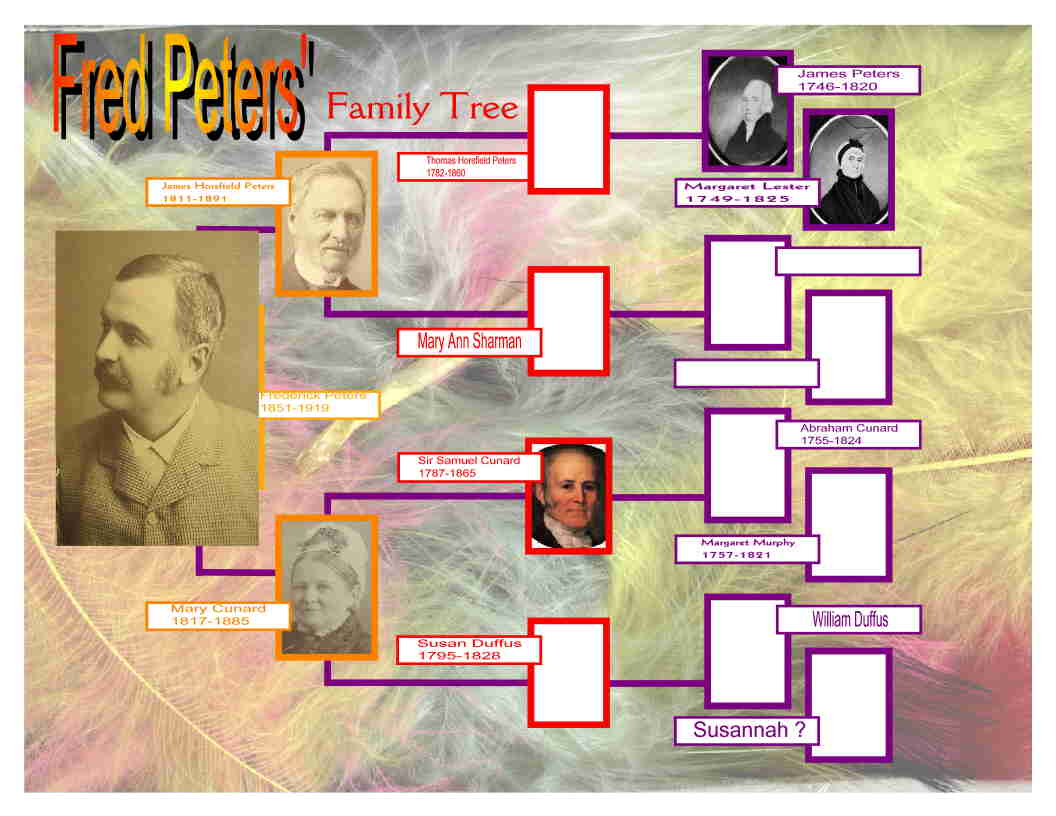
He was determined to live up to his family’s tradition of military leadership and courage in battle, going back to United Empire Loyalist leaders in the Revolutionary War, a heroic general of the Crimean War, and his maternal grandfather Col. John Hamilton Gray, who was a career officer in the British Army before taking on a central role in the founding of Canada as a P.E.I. Father of Confederation and chairman of the Charlottetown Conference of 1864.   Peters’ father, P.E.I. Premier Frederick Peters, was a close grandson of shipping magnate Sir Samuel Cunard, one of the reasons why his son Fritz chose a career in the navy.

Image

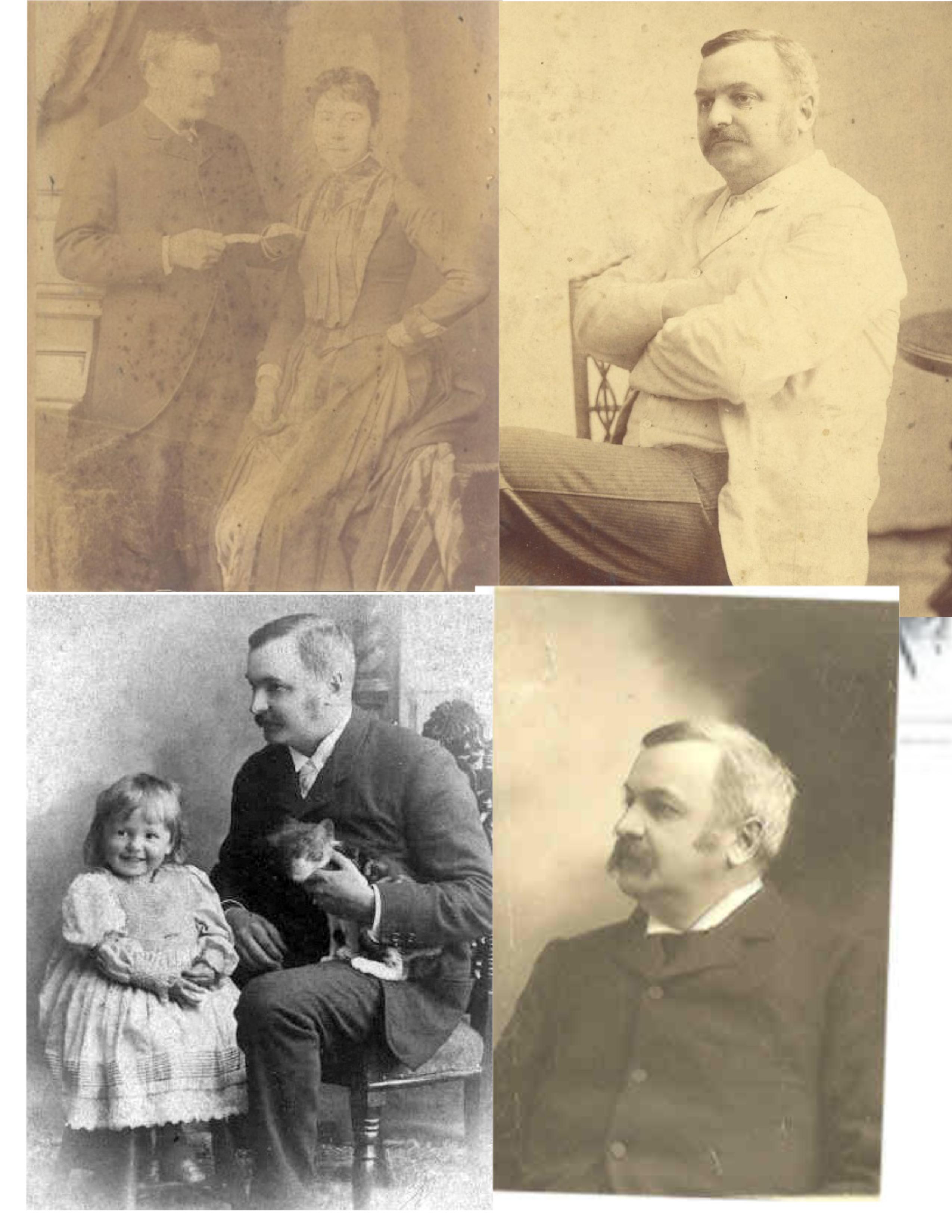
ABOVE: clockwise from top left, Fritz as a baby in 1889; Fritz at right with sister Helen and baby brother Jack in 1892; two photos of him as a young naval cadet in about 1906; and in Bedford, England in about 1900.  (McBride Collection)

At age 53 in 1942, Fritz Peters was the oldest Victoria Cross (VC) recipient in the Second World War.  Twenty-seven years earlier, in January 1915, he received the Distinguished Service Order (DSO) medal, second only to the VC as an award for valor in battle.  He was also Mentioned in Dispatches, earned a British Distinguished Service Cross (DSC) in 1918, and then a bar to his DSC in 1940.  His Oran gallantry was recognized with the Victoria Cross and the U.S. Distinguished Service Cross, the highest medal for valor awarded by the U.S. to non-Americans.

In the inter-war years he developed technology for miniature submarines, and was an early user of plastic explosives and time-delay fuses in his work with secret intelligence.  In 1940 he commanded a school for spies and industrial sabotage for expatriates who later returned to their native countries in Occupied Europe to fight the Germans from within.  His staff at the school included the Soviet spies Kim Philby and Guy Burgess, who liked and admired their commander despite their personal political differences.  Philby’s memoirs are a major source on Peters as a planner, colleague and leader.

Peters’ admirers also included Prime Minister Winston Churchill, Allied commander-in-chief U.S. General Dwight Eisenhower, and British naval commander Admiral Sir Andrew Cunningham.  However, several of Eisenhower’s American underlings were bitter opponents of Peters in the planning and carrying out of the Oran harbor attack, and blamed him for heavy casualties suffered by U.S. troops.

Tragically, Peters died before he had a chance to tell his side of the story.  Later, British authorities chose to downplay the Oran action to avoid antagonizing the French when they resumed as allies against the Nazis.  Some government documents were destroyed, and others were kept secret for 30 years.  As a result, the personal story of Fritz Peters – recipient of six medals for valor in two world wars – remained a mystery until the author’s discovery of the Peters Family Papers.

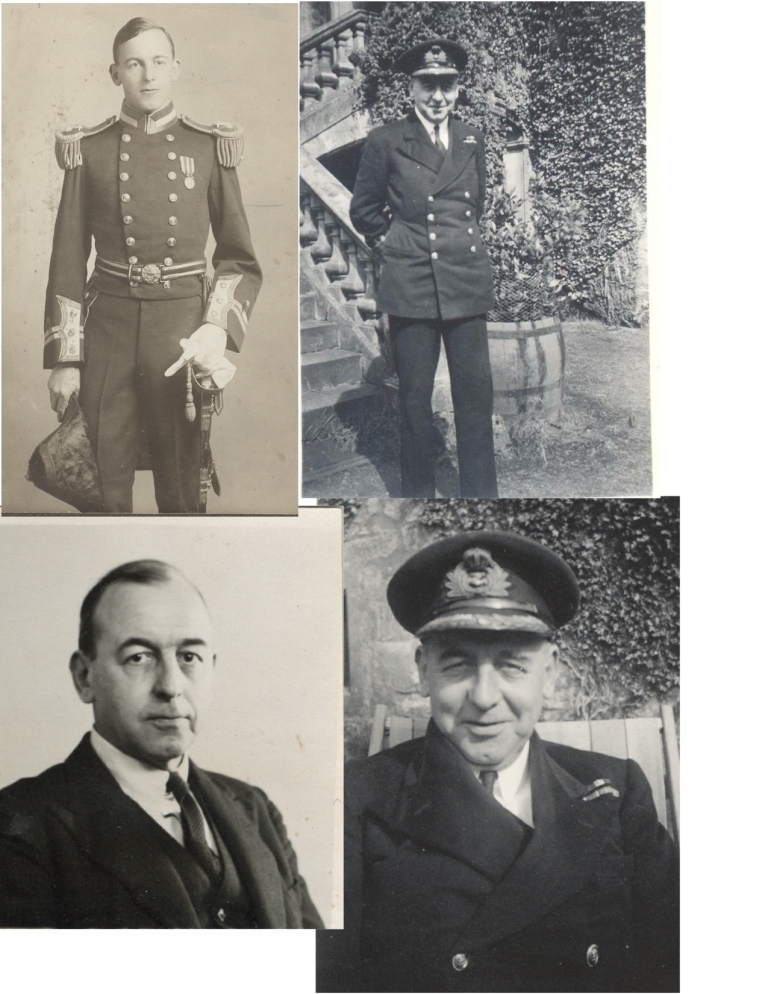
Clockwise from top left: Fritz as a lieutenant in about 1912; Fritz at Cleish Castle; photo of him soon before his final mission in 1942; and Fritz in about 1930. (McBride Collection)

Implications of the sinking of “Titanic” in the Fritz Peters story

2 Comments

by Sam McBride

When the supposedly unsinkable RMS Titanic sank off the coast of Newfoundland during the evening of April 15, 1912 after hitting an iceberg, Frederic Thornton “Fritz” Peters was a 22-year-old newly-commissioned lieutenant at the Royal Navy’s China Station in the British colony of Weihaiwei on the northeast China coast.

While none of Fritz’s close relatives died in the Titanic disaster and he never mentioned the sinking in his letters home between 1914 and 1942, the disaster had a significant impact on his family.  His father, former Prince Edward Island premier Frederick Peters, abandoned his law practice in Victoria in 1911 to move north to the new community of Prince Rupert to take up the position of city solicitor.  He made the move at age 59 confident that he was getting in on the ground floor of boom town.  He had lost money in mining-related investments, and was hoping to get back on track financially in a thriving frontier economy.

Led by CEO Charles Melville Hays, the Grand Trunk Railway was going full speed in its program to develop Prince Rupert as a Pacific port to match thriving Vancouver.  Another booster of the Grand Trunk Railway and Prince Rupert was Frederick Peters’ longtime political ally, Prime Minister Sir Wilfrid Laurier, who visited Prince Rupert in 1910 and expressed his government’s support for port development.

The death of Hays in the Titanic disaster was a major blow to Prince Rupert, as he championed the port development project and had not shared his detailed plans for it with anyone else before his death.  Frederick Peters would spend the last seven years of his life working to keep the fledgling Prince Rupert community from bankruptcy.   When Fritz retired from the Royal Navy in 1913 he said the main reason was to “add to my family’s coffers”.

His father Frederick Peters’ finances were reduced to the point that his wife Bertha needed to collect contributions from her sons’ military pay so she could travel to England during the war years to be close to her sons fighting in the First World War.

The Peters family would also have taken a great interest in the Titanic story because of their heritage as descendants of steamship magnate Sir Samuel Cunard.  Fritz’s father Frederick Peters knew his grandfather Samuel Cunard well from Cunard’s many visits to Charlottetown before his death in 1865 when Frederick was 13.

Titanic was built and operated by the White Star Line, which was the chief rival of the Cunard company in trans-Atlantic travel.   Titanic and its sister ships Olympic and Britannic were built in response to the Cunarders RMS Mauretania, which began service in 1906, and RMS Lusitania, launched in 1907.

A key reason for the success of the Cunard company since its inception in 1840 was its commitment to safety as top priority.  The sinking of Titanic was one more instance of loss of life by Cunard competitors obsessed with speed or otherwise careless about safety.  In the 19th century the U.S. Congress provided grants towards establishing the Collins company as a dominant force in trans-Atlantic travel, but it was devastated by many well-publicized wrecks and fatalities at sea.

The exception to the Cunard record of safety was during wartime, when many Cunard vessels were seconded for British use in the war.  Half of the Cunard fleet was sunk by German u-boats in the First World War, including Lusitania and RMS Carpathia, which rescued the Titanic survivors in 1912.

Fritz’s Cunard cousins ceased being involved in the management of the company in the 1920s.

One of the jobs Fritz had after his first retirement from the Royal Navy in 1913 was as third engineer with Canadian Pacific Railway ships in the interior of British Columbia.  He left that position when he rejoined the Royal Navy in August 1914 at the outbreak of the First World War.  There is no record of him returning to civilian service at sea after retiring a second time from the Royal Navy in 1920.

In 1934 White Star merged with Cunard in a new company called Cunard White Star Limited.  By 1949 Cunard had acquired all of White Star’s assets, and reverted to using the single name “Cunard”.  Today, Cunard is a subsidiary of Carnival Corporation and PLC.

Sources: Peters Family Papers, “Steam Lion: a Biography of Samuel Cunard” by John G. Langley, unpublished memoirs of Commander David Joel, RN.

Peters Family Papers: Family History Documents

2 Comments

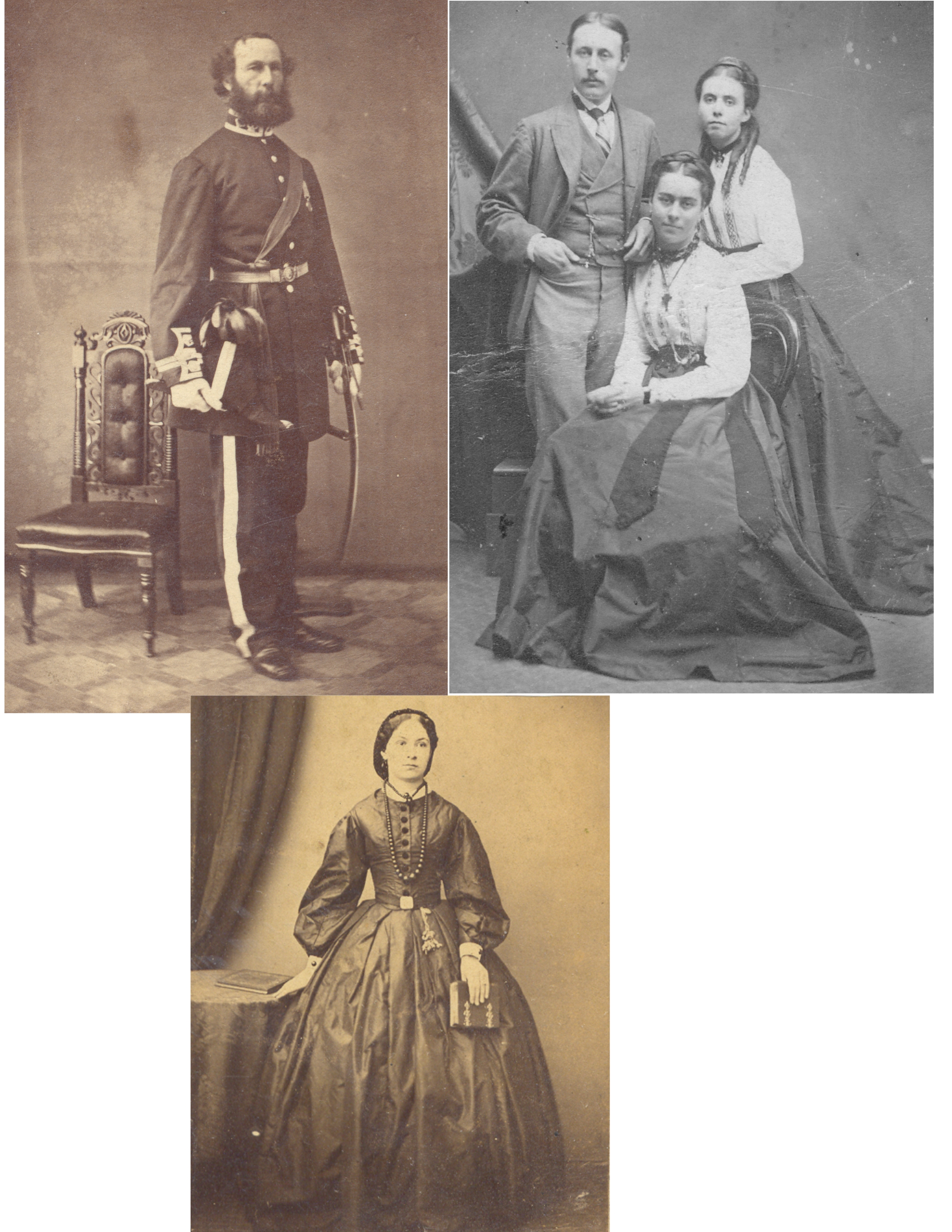
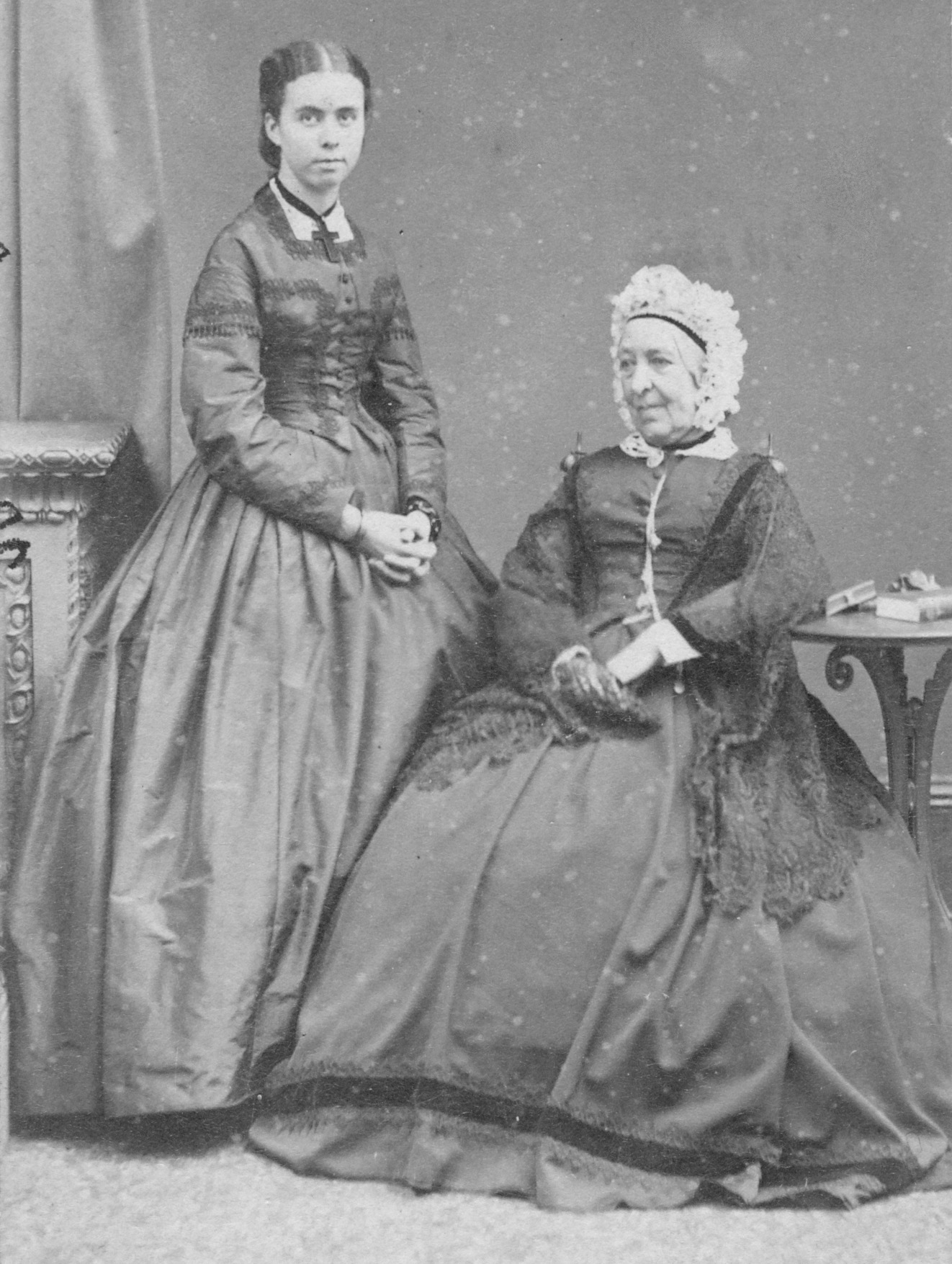
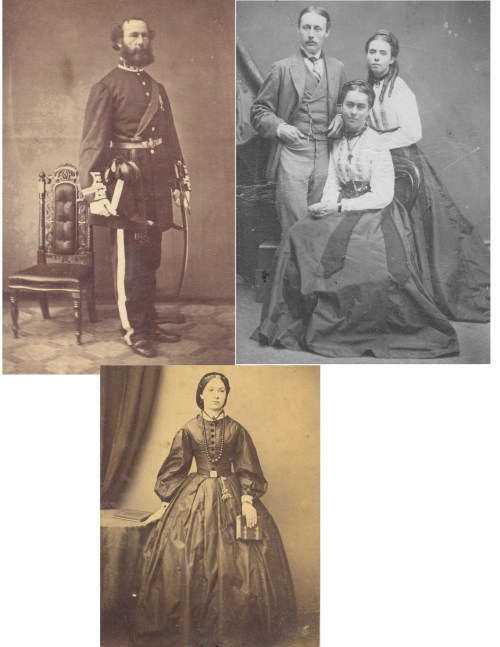
Photo collage above: clockwise, from top left — Col. John Hamilton Gray, c. 1860; sisters Margaret Gray (sitting) and Florence Gray, with cousin Edward Jarvis at left, in 1868; and lower photo is their elder sister Harriet Gray, dated 1864. (McBride Collection)

by Sam McBride

The following documents are transcriptions of handwritten letters or notes about the Peters and Gray ancestors going back to the 1700’s.  Some are first-person accounts and other documents are copies (in handwriting) of correspondence among cousins.

#1 – Notes on the Gray ancestors by Florence Gray Poole

This letter, written in about 1919 by Bertha’s older sister Florence for her children, has interesting information about 1) John Hamilton Gray’s grandfather George Burns; 2) Gray’s grandmother Mary Stukeley’s family in England; 3) Gray’s mother Mary and his brothers and sisters; 4) Gray’s experience in the British military, including service in India and South Africa; 5) Gray’s attitude towards politics on Prince Edward Island
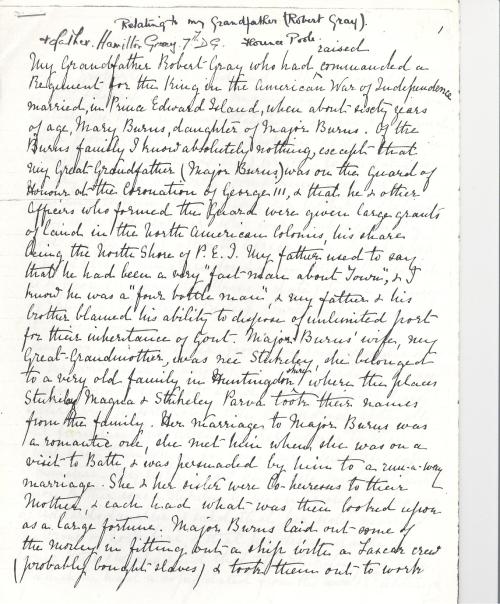
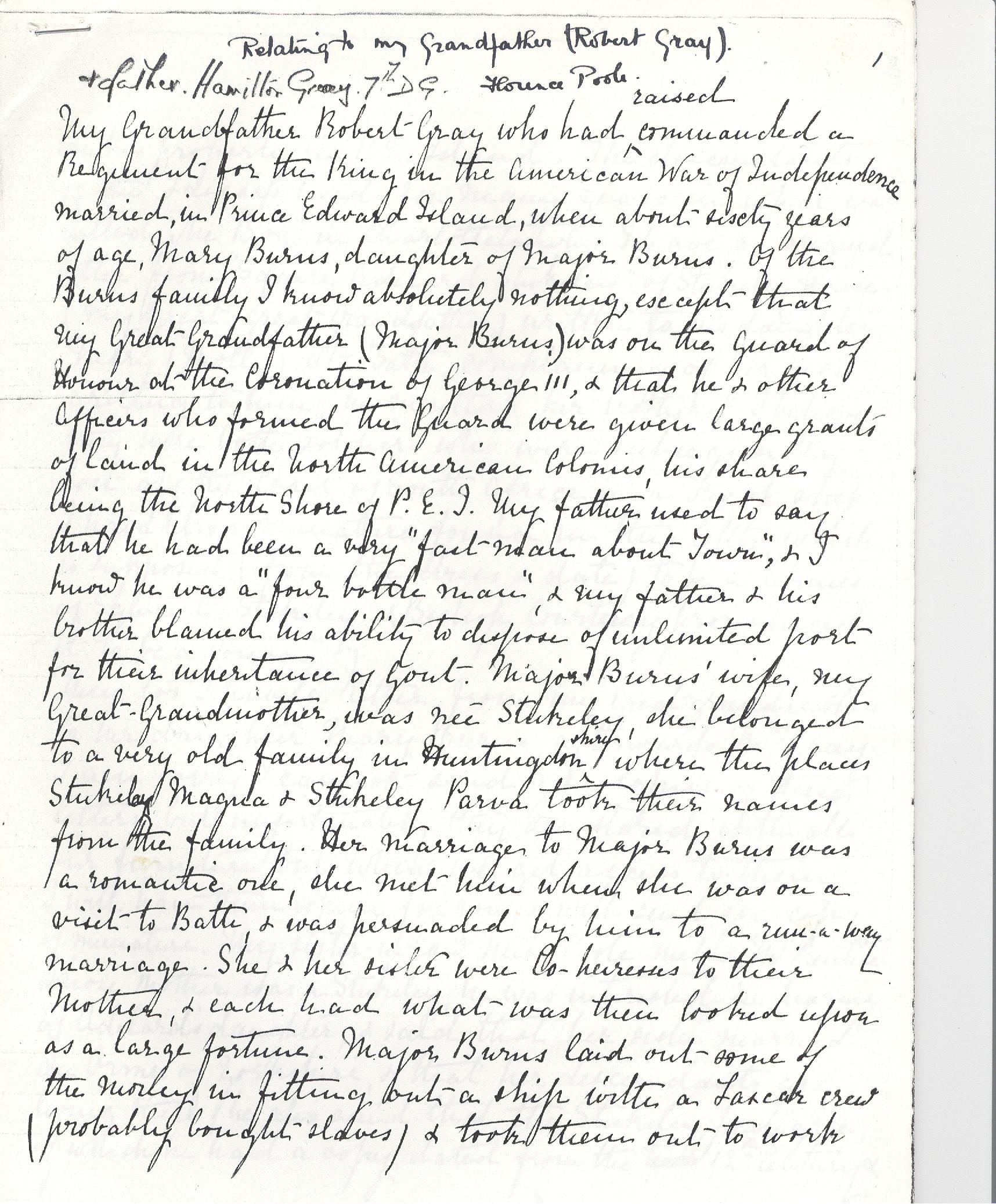
This is the first page of the Florence Poole document, as copied in her sister Bertha Gray Peters' handwriting.

My grandfather Robert Gray, who had raised and commanded a Regiment for the King in the American War of Independence, married, in Prince Edward Island, when about 60 years of age, Mary Burns, daughter of Major Burns.  Of the Burns family I know absolutely nothing, except that my great-grandfather (Major Burns) was on the Guard of Honour of the Coronation of George the Third, and that he and other officers who formed the Guard were given large grants of land in the North American colonies, his share being the north shore of P.E.I.

My father used to say that he (Burns) had been a very “fast man about town”, and I know he had been a “four bottle man”, and my father and his brother blamed his ability to dispose of unlimited port for their inheritance of gout.  Major Burns’ wife, my great-grandmother, was nee Stukeley.  She belonged to a very old family in Huntingtonshire, where the places Stukeley Magna and Stukeley Parva took their names from the family.  Her marriage to Major Burns was a romantic one.  She met him when she was on a visit to Bath, and was persuaded by him to a runaway marriage.  She and her sister were co-heiresses to their mother, and each had what was then looked upon as a large fortune.

Major Burns laid out some of the money in fitting out a ship with a Lancar crew (probably bought slaves) and took them out to work on his property in Prince Edward Island.  The descendants of the Lancars lived for many years in what was called “The Bog” in Charlottetown.  I have an original letter from Squire Adelard Stukeley of Stukeley House (my great-great-grandfather) written to his daughter Mary (“Molly”) at Bath, complaining of her not writing to him.  He mentioned her “brothers” – I believe they were both soldiers who were subsequently lost off the coast of South Africa in a troop ship.  I also have a miniature, found in this letter, which is supposed (from the dress and date) to be a likeness of Squire A. Stukeley (Bishop Courtey pronounced it to be a “Cosway”).

Then too I have a letter from my great-grandmother to her daughter Mary Burns, afterwards Mrs. Gray.  I am sorry I cannot send you copies of these letters, but unfortunately they are stored with all our furniture, but when we get access to these letters I will have them copied for you, and will send you a copy of the miniature.  My sister in law Miss Poole met a Mr. Prentice whose mother was a Stukeley.  He was interested in hearing of Adelard’s daughter, and said that her sister married an Orme of Yorkshire, and that her descendants are living there.  He also said the Stukeley pedigree, of which he had a copy, dated from the 12th century, and he very kindly sent me a drawing of the Stukeley coat of arms.  I tried to get a copy of the pedigree, but my sister in law had met Mr. Prentice at a County Archaelogical Society, and he did not turn up at their next meeting.  I have his letter to her, with the information I have given you; it is stored with the rest of my papers.

My father’s mother died young, leaving two sons and three daughters — the eldest, Uncle Robert, lived nearly all his life in London.  He managed the Worral and Fanning Estates.  He died unmarried at age 94.  One daughter, Aunt Elizabeth, married in P.E.I. Chief Justice Jarvis and left one son, who died unmarried.  Another daughter married a W. Cambridge (uncle of my stepmother) and had several children, all dead.  Aunt Stukeley lived in Ebury Street in London and died unmarried.

My father was sent to England very young as his father had been promised a commission for him.  I suppose the Stukeleys had forgiven his grandmother’s runaway marriage, as he stopped often at Stukeley House.  I remember his telling me he was taken to see an aged nurse who welcomed him as “Miss Molly’s boy”.  For a few months my father was in a Hussar regiment (18th I think) and there was a cornet in the 7th Dragoon guards, and was nearly 20 years a captain in that regiment.  Promotion in those days was by purchase, and as many of the men were rich it was unusually slow.  My father married when very young a Mrs. Chamier, sister of Sir William Sewell.  She died shortly after their marriage, and he was a widower many years until he met my mother, a young girl of 17, in India, she was just out from school.
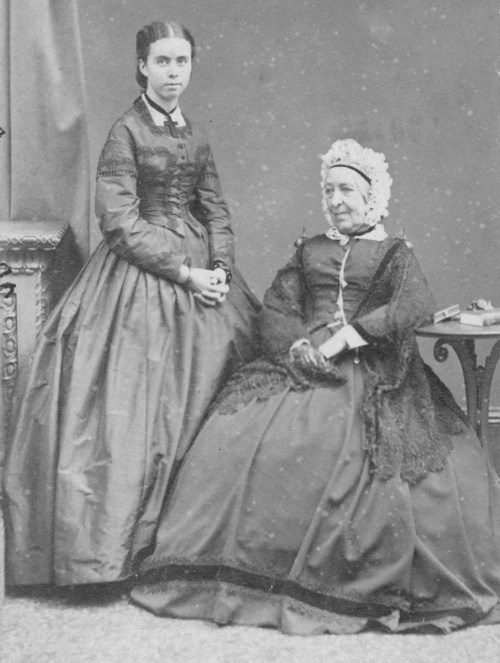
Florence Gray with her grandmother, Lady Pennefather (Margaret Carr Bartley) - McBride Collection

My grandmother (Pennefather) used to tell me that my father was a very distinguished man, and his entertainments etc. much talked about in the Cantonment.  The men in the regiment were a very smart set.  My father’s principal friend was Capt. Bentund (father of the present Duke of Portland).  Sir George Walker and Sir Harry Darrel were also great friends, and many tales were told of their joint escapades.  The only one of my father’s brother officers who came to Canada was Gen. Sir Graham Montgomery-Moore, who commanded in Halifax.  I knew him well there, and he liked talking of the old days in the 7th D.G.  He told me that when as a young Cornet he stood before his Captain, he thought him the realization of his idea of a soldier!  Capt. Hamilton Gray was a “splendid figure”, he said.  He also told me my father fought a sensational duel and “winged his man”.  In those days dueling was encouraged, and every man who joined a crack corps like the “Black Horse” was given a pair of dueling pistols to uphold the honour of the regiment.  Soon after my father’s marriage the regiment was ordered out to South   Africa, and my eldest sister was born in a troop ship in the Red Sea!
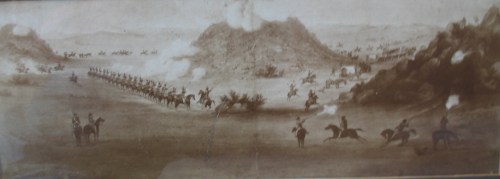
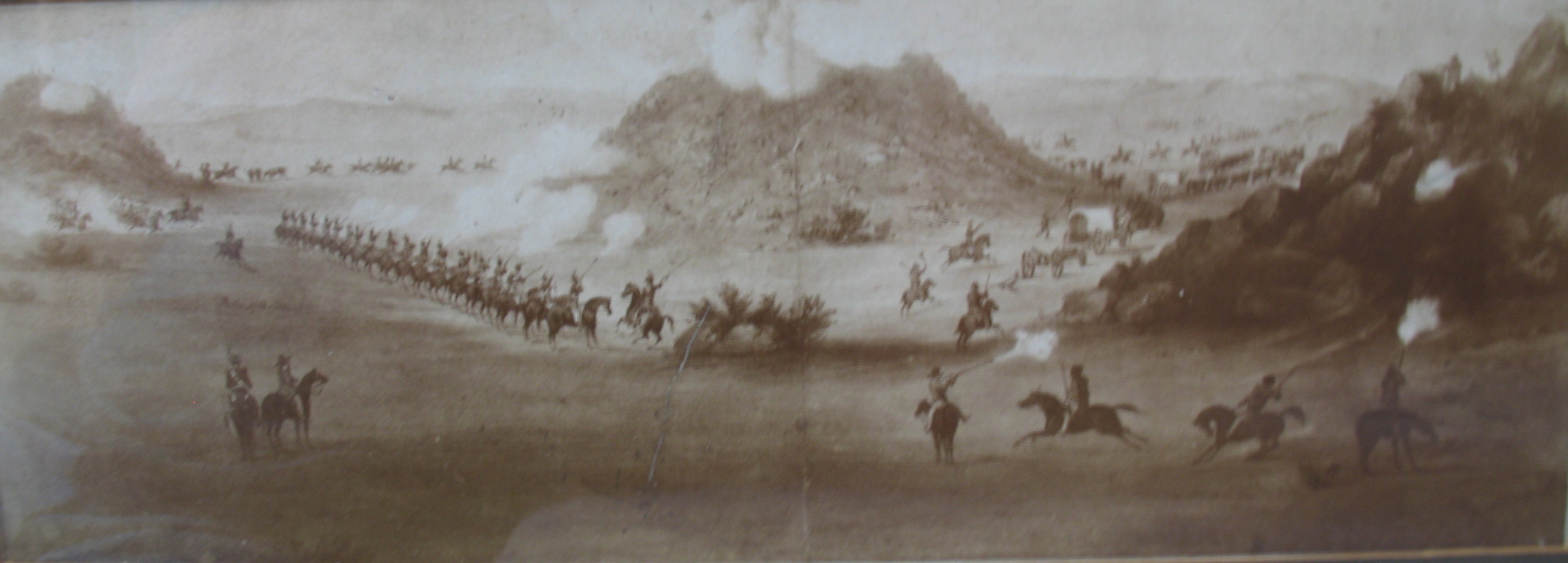
Photograph of Sir Harry Darrel's depiction of the action in South Africa where Col. John Hamilton Gray led a charge of mounted policemen against a gun emplacement.

The first Boer War was going on then, and my father performed an act of gallantry which would in these days have won a Victoria Cross.  The general described it to me.  The regiment was drawn up in line in a place surrounded by Kopjes, concealed Burghers were potting them on all sides, and a machine gun in a narrow lane was turned on the unlucky cavalry and they were simply mown down, unable to charge or use their sabres.  My father took four mounted police men and galloped to the gun, spiked it and cut down the gunners, and two of the police men were killed.  Sir Harry Darrel who was an artist painted two pictures of this incident, and for years one hung in the D.G. mess.  I have a photo of it, which is fortunate as your Uncle Arthur had the original, and it, with everything else he owned was destroyed in the Halifax explosion during the war.

There was a long period of peace after the war in South Africa, and every one of the wiseacres prophesied that there would never be another war.  My father tired of inaction, and having also kept memories of the fine sport in P.E.I., sold out of the service just the year before the Crimean War and went back to P.E.I.   A year later when war broke out he was desperate and did his best to get back to his regiment, but he had received ₤9,000  for his Troop, and in those days a man who sold out could not get back in.  Then he went on my grandfather Pennefather’s staff hoping to get out to the seat of war, but the “extra” A.D.C.’s had no chance and peace came before he could arrange to enter another regiment.  Highly disgusted, he returned finally to P.E.I. where he ended his days.  He tried to take an interest in politics, but I don’t think he ever cared for a politician’s life.  The only thing that interested him was the Confederation of the Maritime   provinces.  My mother’s death occurred soon after Confederation and he retired from “The House”.

#2 – A short account of his life by Col. Robert Gray,

King’s American Regiment

This short autobiography by John Hamilton Gray’s father Robert has interesting information about 1) his roots in Scotland, among many Grays near Glasgow, 2) the origin of the “Hamilton” name, in honour of the mentor who helped him get established in business, 3) the loss of his property in Virginia in the Revolutionary War, and 4) details of his arrival as a Loyalist in the Maritimes and how he was rewarded with land and appointments.

As it may afford some satisfaction to my dear children to know something of the early life of their father, I have put in writing the following brief memoirs:

I was born on the 7th Sept. 1747 (old style) in Dunbartonshire, Parish of Kirkentilloch1 in my father’s house, a place rented by him but which had belonged to my ancestors, but sold through reverse of fortune by my grandfather to Robert Gray, a distant relation.  My father’s name was Andrew, my mother’s Jean (of the Grays of Lanarkshire, cousins).  In a circuit of many miles both in Dunbartonshire and Lanarkshire, many of the principal families were Grays and nearly related to my family by blood or marriage.  My father being far from affluent, I was articles for four years to John Hamilton Esq. of Dowan to go to Virginia where his four nephews (sons of Thomas Hamilton of Overton) carried on an extensive mercantile business.

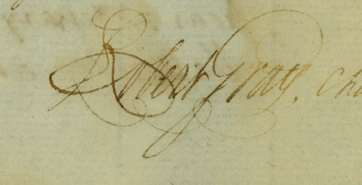
signature of Robert Gray.

The same Thomas Hamilton raised a regiment during the American rebellion (now called the Revolutionary War) and was distinguished for his gallant conduct at the battle of Camden where he was severely wounded.  He was afterwards for 22 years His Majesty’s consul for Virginia, and was godfather to my youngest son John Hamilton, and to my deep and undying regret died in London 1816.  These gentlemen, the Hamiltons, being anxious to open an establishment in Norfolk, Virginia, I was taken into partnership and for four years carried on a successful business by sea and land, until the breaking out of the American rebellion.  Towards the end of the year 1776 all business being at a standstill, Lord Dunsmore the Governor of Virginia, having removed the seat of government from Williamsburg to Norfolk, I entered a corps of volunteers which he was forming to co-operate with His Majesty’s 14th Regt-of-foot in checking the progress of the rebels.  In the course of this service I was dangerously wounded, being shot in two places, the rebels having obtained the ascendancy by land.  His Majesty’s loyal subjects and the troops embarked on board the shipping in Norfolk Harbour.  The Town was soon afterwards burnt to ashes by the damned Rebels, and all the valuable property in our warehouses consumed in the flames or plundered by the enemy.  I remained in Virginia with Lord Dunsmore on the fleet carrying on a predatory war against the enemy till the month of July when we sailed for New York where Sir William Howe had arrived with a large army.  There I met Col. – now General – Fanning, who being about to raise a regiment for His Majesty, appointed me to command a company and also to be paymaster to the King’s American Regiment.  I remained with the Regt in various parts of North America, from Rhode Island to Georgia both inclusive.  I was in several actions at the siege of Rhode Island and commanded the Fort-of Goal-Island when it was cannonaded by the French fleet under Count D’Estaing.  I was also honoured with the command of Port Georgetown when it was evacuated.  At the end of the war 1783 the Regt being reduced I was placed on half pay.

In the autumn of 1783 I arrived inHalifaxand in the following spring was sent with a commission of “Surveyor of Land” to superintend the settlement of the Loyalists in thecounty of Shelburne,Nova Scotia, where I was employed for three years having 13 deputy surveyors under me.

In 1787 I received pressing invitations and flattering promises from Gen. Fanning who had been appointed Governor of Prince Edward Island.  I arrived in Charlottetownon the 11th July that year, and was appointed Judge of the Supreme Court – a member of His Majesty’s council and private secretary to Gen. Fanning.  In 1790 I went to London by way of Portugal on private affairs and returned at the end of the year.  In 1792 I was sent to London with full powers to conduct the defence of Gen. Fanning and other Crown officers against complaints preferred against them and having successfully performed my mission returned in 1793.  Next year I had the principal share in raising a corps of men for the defence of theIsland, which I commanded until the Peace of Amiens in August 1792.

#3 – “Relating to my Mother” by Florence Gray Poole

My mother, Susan Ellen Bartley, was an only child.  Her father, a Lieut. In the 22nd Regiment, died at a very early age (about the year 1825) when quartered in Jamaica.  His widow married Major Pennefather, also of the 22nd Regt, and afterwards General and G.C.B.  There was no second family, and Maj. Pennefather treated my mother as his own child.  I believe she did not know of the “step” relationship until she married.
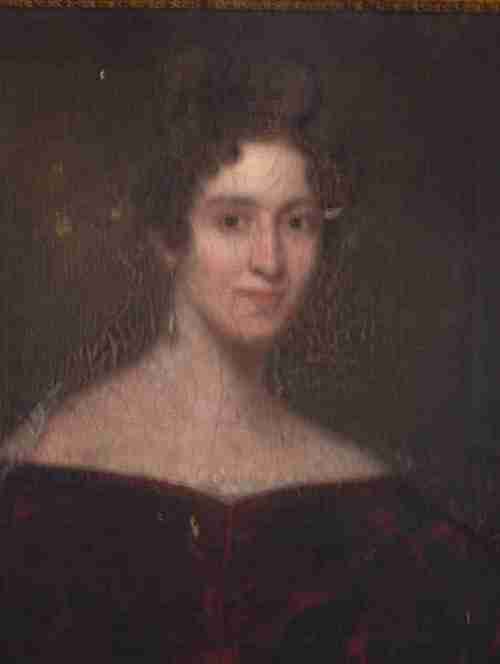
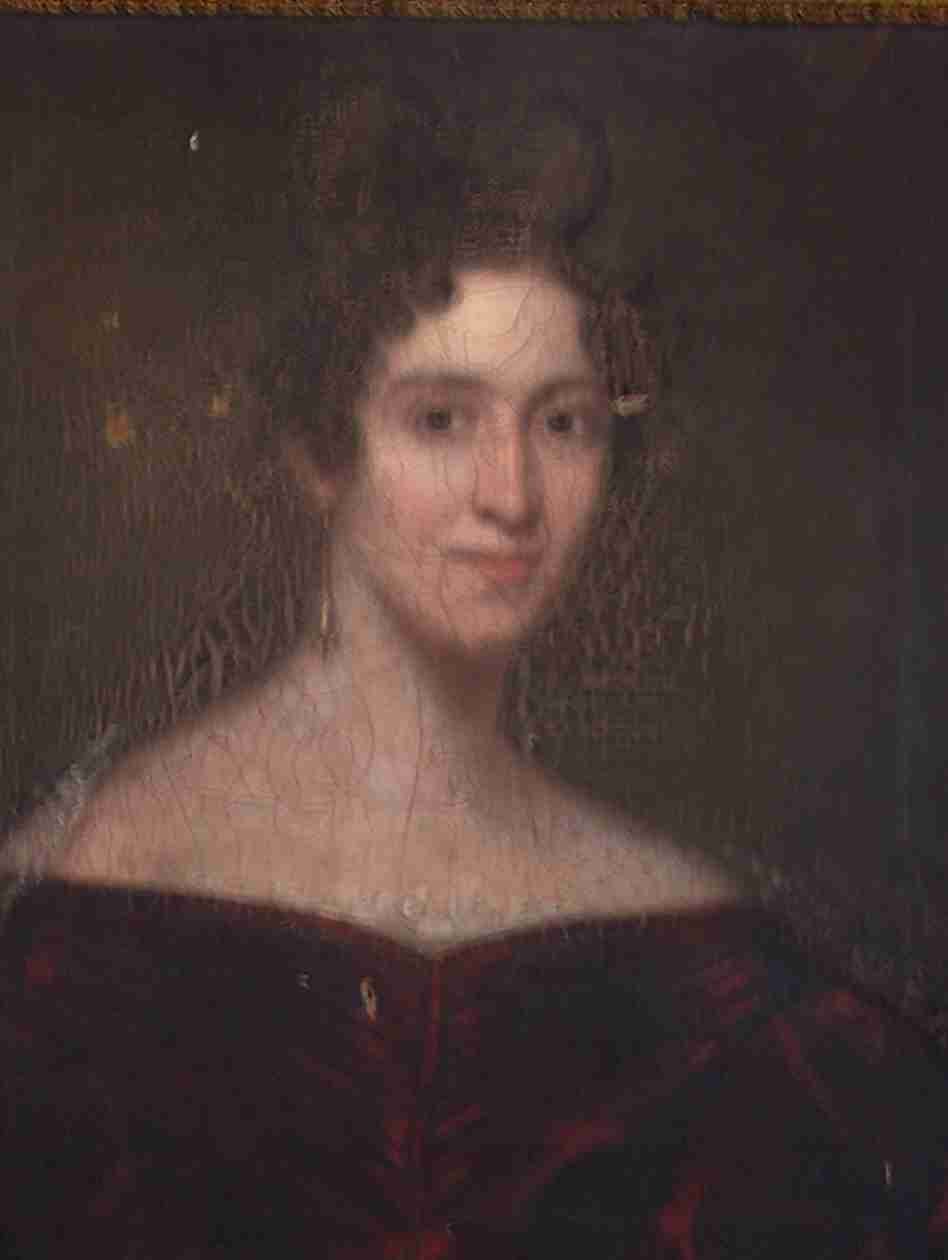
Painting of Margaret Carr Bartley c. 1830, around the time of her marriage to Major Sir John Lysaght Pennefather

One of my grandfather’s brothers, Sir Robert Bartley, was a distinguished soldier in the Peninsular War.  There is a monument to his memory in some English, or Irish, cathedral or church.  I remember a print of it hanging in my mother’s bedroom in Prince Edward Island.  I have tried by writing to Notes and Queries to find out where this monument is but without success.  The man who answered my question knew all about Robert’s fame and wrote that he died at sea on his way home, but did not know where the monument is.  It would be interesting to find it.

The only Bartley relation I ever saw was my “Great Aunt Jessie”.  I was taken to see her when a small child in Dublin.  It is a pity that my mother did not correspond with this aunt, as I have been told that she lived to a great age, and either not knowing or forgetting that she had four grand-nieces in Prince Edward Island, left her money, or a fair amount I believe to her companion!

One of the Bartleys married a Cowell.  Their grandson Major Cowell was Governor to Prince Alfred (the Duke of Edinburgh) and afterwards when Sir John for many years “Controller of the Household” to QueenVictoria.  Sir John was with the Duke of Edinburgh when he visited Canada.  I remember his coming to see my mother, incidentally bringing the Prince to the great wonderment of the P.E. Islanders.  We knew Sir John’s sisters, one married a Major Beadon, but I have never met any of the present generation.  One of Sir John’s daughters married Admiral Curzon-Howe.  I think I have told you now all I know.

Your great-grandmother’s maiden name was Carr.  She and her sister were orphans when very young and were brought up by an uncle at his place inTipperary “Little Island”.  Another uncle was named Senior – any of their descendants of whom I have heard were soldiers.

My grandmother’s sister married a Carr cousin.  His grandson I have known since we were children.  Lt. Col. Lawless R.A.M.C. is the only survivor of a family of cousins.  He has interesting miniatures of the Carr family.  One (an aunt of my grandmother) has a romantic story.  She was a beauty and toast in Dublin…

#4 – Letter from Florence Gray to G.E. Lawless

This letter was written by Bertha’s sister who had taken an interest in the family history.  She is corresponding with a distant cousin.   The main focus of this letter is the Bartley side of the family. Florence’s maternal grandmother was Margaret Carr, who married Lieut. William Bartley and had a child Susan before he died of illness while serving inJamaicain the 1820’s.  Margaret later married William’s commanding officer General Sir John Pennefather and became “Lady Pennefather”.  Susan married John Hamilton Gray.

I am afraid I cannot tell you very much about your mother’s people – I wish I had listened more attentively when  my grandmother discoursed about her “young days”, for of course during my 30 years in Canada I lost sight of my Irish connections.  Our grandmothers, Margaret and Ellen Carr, were sisters; their parents died when they and their brother Richard were young.  The girls were brought up by their maternal uncle Morton of “Little Island” Tipperary, Richard being sent to a London Counting house to make his way.

From what my grandmother used to say, I think “Little Island” was a family place of some importance, and the girls went out a great deal.  Your grandmother married her first cousin William Carr; my grandmother married Wm. Bartley, Lieut. In the 22nd Regiment and went to Jamaica, where my mother was born and my father died very young.  His brother officer Major Pennefather brought my grandmother and her child home, and a year later they were married.  My mother was sent to a French convent while her parents were in India.  She used to spend her holidays with your grandparents, and she and your mother, both called Susan after their grandmother, were great friends.

Your grandparents were very well off then, and I well remember my mother’s grief when she heard of your grandfather’s loss of fortune and a little later of his death.  I do not know the particulars, but remember that my father and mother often spoke of “Uncle William” having been exceptionally honourable.  My grandmother often talked of another uncle called Senior, I think he was in the Service.  I know some of his sons and grandsons were soldiers.

I only met one first cousin of our grandmothers, a perfectly delightful old lady, Mrs. Fitzgerald.  She spent a winter in London when we were in Crawley Place.  Her son, or nephew, Capt. Fitzgerald (known to us as Dicky) afterwards commanded the 69th Regiment.  I have tried to find him.  I think he must be dead.  I have a photo of a very good looking Anna Maria Morton, granddaughter of Morton of Little Island.  She married a man in the service whose name I forget, and went toIndia, I think she was the last of the Mortons of Little Island.

          My grandmother and her husband Gen. Pennefather objected to the “step” connection known.  I believe that my mother did not know of it until she married.
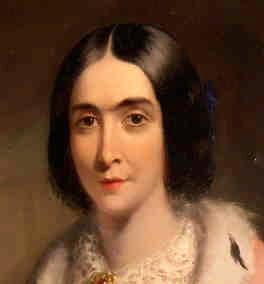
Susan Bartley Pennefather Gray

This has been rather hard on us, as we have never been in touch with our grandfather’s relations (with the exception of the Cowels who claimed cousinship), and your sister in law tells me that our grandfather’s youngest sister died a few years ago, leaving a large fortune to her companion as she had “no near relations”.  The silence about our grandfather was so marked that I fancied all sorts of things and was relieved when dear George told me that when he first went to Newfoundland 40 years ago he dined with the Governor (whose name he did not remember) and the subject of Jamaica coming up, the Governor told him his dearest friend “young Bartley of the 22nd regiment was buried there, and that he was the nicest fellow he ever knew.

#5 –  Letter from Prentice to Miss Ellen Poole      March 25, 1899

62 Shrewbury Road,Birkenhead

Dear Miss Poole:

I have read with great interest the notes you have kindly sent me about the Stukeleys and you will be glad to hear that I can give you their pedigree back to about 1150 and a good deal of information about the family.

A.S. Stukeley (Adlard Squier Stukeley) the father of Mary (Mrs. Florence Poole’s great-grandmother) was brother to my progenitrise Margaret Stukeley, so curiously enough Mrs. Poole and I are far away cousins.

The Stukeleys came originally from Great Little Stukeley in County Huntington and one of the family about 350 years ago marrying the heiress of the Fleets of Fleet in County Lincoln settled at Holbeach, close to where they owned considerable estates, their residence was at Stukeley house, where my mother was often resident with her grandmother Mrs. Sturton (her husband was Private Secretary to the Marquis of Rockingham when Prime Minister and first cousin of Mary Stukeley) and my cousins the Stukeleys still live at Holbeach.  The Stukeley house has, I am sorry to say, changed hands.  Dr. William Stukeley the famous antiquarian was of the Holbeach branch and was born there.

It has always been a mystery to us what became of the other Stukeleys after leaving Holbeach, as they were supposed to be fairly well off and they seemed to have suddenly disappeared, the information contained in Mrs. Poole’s notes evidently solves the mystery.

Mary Stukeley’s (baptized at Holbeach 13 March 1744) sister Sarah married Walden Orme of Peterborough and left issue, something about them I might be able to trace.

There is a splendid old church at Holbeach where most of the Stukeleys were buried, and in it remain some of their monumental inscriptions.  I was there about 4 years ago.

As I think Mary and Sarah Stukeley were the only surviving issue (of a large family) and eventually co-heiresses of Adlard Squier Stukeley they would carry the arms of Stukeley quartering Fleet in to their husbands’ families. …it is just possible therefore that failing surviving male issue of the Burns and Gray being the descendants of Mary, your brother’s (he means Henry Poole) children may be entitled to quarter these arms with those ofPoole.

#6 – Helen Dewdney’s family history notes     c. 1950’s

Judge Peters was my grandfather.  He died when I was three years old but I remember him perfectly.  He seemed to always be in bed.  A fine-looking man with quantities of white hair.
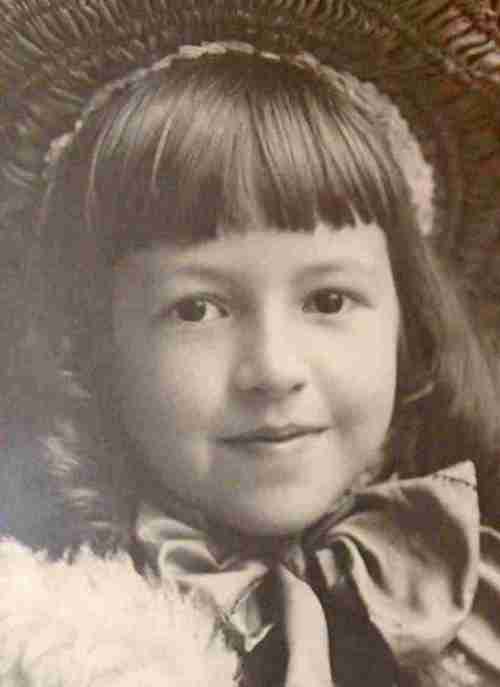
Helen Peters in about 1895 in Charlottetown when her father Frederick Peters was premier of Prince Edward Island.

His youngest daughter Maggie – who adored him – was always fussing over him.  The old doctor was generally in attendance, but Maggie insisted on another opinion.  He was 85 – had Aunt Maggie never heard of old age?  …The judge was very fond of his dogs.  He had three of them.  One bit a grandchild and Aunt Janie was upset and said “the dog must be shot!”.  “What!”, cried the judge, “if any shooting is to be done, it won’t be a dog.”  So nothing was shot.  But I think he must have been pretty nice.

He was very fond of his daughter Carry (Caroline), and when she was going to marry a Bayfield he thought it would be a kind gesture to have the wedding in the Bayfield Church.  It was Anglican as was the Peters’ church, but very “low” whereas St. Peters was very “high”

#7 – Notes of Helen Dewdney                              c. 1970

She was apparently writing on note paper while waiting in a doctor’s office.  She had just read a book called “My First Hundred Years” (not sure of the author or date of publication, but it would be some time before she died in November 1976)

“…She called her Father ‘Papa’ and her mother ‘Mamma” just as my mother did, except my mother always referred to her mother as ‘my dear little Mamma”.  Dear little momma, my grandmother, lived in London with her father and mother in one of those old-fashioned London houses.

Her father was General Sir John Pennyfeather.  She was the only child.  I have her picture painted by a wonderful artist.  Only 16, a beautiful face, with dark curtains of hair on each side making her look about 30.  At 16 John Hamilton Gray met her and married her.  He was much older than she and an officer in the army.

He took her to various places, and she had a baby in so many different places.  I don’t think there was one born where another was.  First there was my aunt Harriet.  Later my great-grandmother Lady Pennyfeather adopted aunt Harriet and left her everything she had.  Lady P lived till she was 98.  Her eyesight and hearing were perfect, but she did admit the stairs tired her a little.  Aunt Harriet married when she was older.  I never did know what age.  When I was young it wasn’t considered quite nice.  I never knew my mother’s.  In any case she died a few months after Great-grandma, and everything went to the husband as the child died too.  So we don’t have many mementos of Great-grandma.  Well, anyway, after Aunt Harriet came Aunt Margaret who lived and died in Charlottetown– much loved and living until she was 98.

Then came Aunt Florence who married Henry Poole a mining engineer.  Six children they had – three boys and three girls.  I remember staying with them once when I was 7 or 8 along with Fritz my brother (who was) 2 years younger.  He cried so much they were obliged to send him home to theIsland(P.E.Island) where we lived.  I remember feeling it a pity he had no bravery.  Funny isn’t it… he lost his life and received the V.C. in Oran in Africa, his seventh decoration.  No bravery, eh.

Uncle Henry Poole was 6 ft 3 inches or so tall and had a beard and moustache.  I was simply terrified of him.  He was a very honorable man and brought up his six children with a very high sense of honour.  He was a very good father.  If he loved one more than another it was Edward, who was brilliantly clever.  He passed first in Kingston, became a mining engineer and went up to some lovely spot up north where almost immediately he contracted typhoid and died very quickly.  A young man he scarcely knew happened to be there.  “Stay with me,” said Edward, “till it’s over”.  It seemed so sad – so young, and he must have put so much effort in being first and all.  Just seems like wasted.  Uncle Henry was walking along in a railway station and he received this telegram: “your son is dead, what shall we do with remains?”  He fell in a dead faint.

Edward’s twin sister Dorothy was beautiful, not just pretty.  I knew her when she was 19.  She stayed with us in Victoria.  Great dark eyes and hair reddy brown wavy luxuriant.  Lucy her sister was rather plain, but if there was a crowd anywhere laughing and talking vociferously, you’d know Lucy would be in the middle.  Uncle Henry would say “The men come for Dorothy but stay for Lucy.”

After Florence, John Hamilton Gray and Susan Pennyfeather had two more daughters: Mim (who married Abbott) and Mother.

The Pooles for a while lived in Stellerton, a mining town in the East.  They also had a son Ray who had a son and daughter; Evelyn who died; Dorothy who died; Eric who died; Edward who died.  Lucy married a man called Kenneway who was quite well off and in later years became stone deaf from the guns in a war.  Someone once asked me which war was it, the first or second?  I said it was the Boer War … I forget I am so old.  The Kenneways had a son who was killed in war and a girl Monica.

…The judge (James Horsfield Peters, father of Frederick) must have been a dear, but quite an autocrat around the home and I think at times he bore down on Sarah the cook a bit.  Sarah would sniff and say she’d better be leaving , she couldn’t stay in a place where she didn’t give satisfaction.  I am sure she never would have left.   She loved Grandmama and Grandmama would slip a five dollar bill in her hand.  “Oh Sarah, pay no attention to the judge.  You know how he is.  He’s just like that.  He’ll get over it.”  And Sarah allowed herself to be comforted by just about the sweetest person who ever lived – Mary Peters, born Mary Cunard.  Granted the five dollars came easily (her father Sir Samuel Cunard died a millionaire), but the sweet and lovely way she did it to Sarah was her own.  When she died, she died in Sarah’s arms.  You can see in her photograph that she was overweight and probably no exercise – in those days they just didn’t know…

My mother used to love going over to the Peters house.  It was so different from her own.  There were always 3 puddings on the table, because Fred was so fond of one thing, and Uncle Spruce and Uncle Thom could not be without their so and so.

…The Mellish family was in Hodsock Priory, Worksop, Nottinghamshire.  There was Henry Mellish, Agnes Mellish and Evy Mellish.  The last I heard of the place it was empty.  So sad.  I always thought Cousin Aggie was so pretty.  They were Father’s relations – Cunards
Family of Frederic Thornton Peters — Part Four: brother John Francklyn “Jack” Peters

Leave a comment

by Sam McBride

John Francklyn “Jack” Peters was born October 19. 1892, the middle child of Frederick Peters and Bertha Gray of Charlottetown, Prince Edward Island.  Sister Helen Peters was five years older and brother Frederic Thornton “Fritz” Peters was three when Jack was born at the Peters family home known as Sidmount House.  At the time of Jack`s arrival, his father was the Hon. Frederick Peters, premier and attorney general of Prince Edward Island for more than a year.

Clockwise, from bottom left: baby Jack with sister Helen and brother Fritz, 1892; Jack as a toddler; Helen with Gerald (left) and Jack; Jack at about age 15 (McBride Collection)

Two years later in 1894, fraternal twin brothers Gerald Hamilton Peters and Noel Quintan Peters were born.  In 1899, after the family had moved across the continent to Victoria, British Columbia, sister Violet Avis Peters was born, seven years younger than Jack.  His father had resigned as premier in October 1897, and moved his family to Victoria where he established a law practice with another well-known departing Maritimer, Sir Charles Hibbert Tupper.

Jack attended school in Victoria, and then in 1900 he went to England with other family members.  They resided at Bedford, north of London, where his mother Bertha`s stepmother moved after the death of her husband John Hamilton Gray in 1887.  Jack and brother Fritz were students at the Bedford Grammar School in the 1900-01 school year, and sister Helen attended the Bedford School for Girls.  The following year Fritz transferred to Cordwalles School in Maidenhead, known as a preparatory school for future Royal Navy officers, in line with Fritz`s dream of a naval career.  Jack continued at Bedford Grammar school for another two years.  We do not have details of his further schooling, but it appears from his letters that he returned to Victoria where he attended school and participated in militia training.  In January 1905 brother Fritz enlisted in the Royal Navy, and in November 1905 younger sister Violet died in a fireplace accident in the family home in Oak Bay, immediately east of Victoria.

In 1911 Jack moved with the family to the north coastal town of Prince Rupert where his father took the family when he accepted the position of Solicitor (lawyer) for the City of Prince Rupert.   At the time, it appeared Prince Rupert was going to be a boom town, and a port to rival Vancouver.   The following year sister Helen married Edgar Edwin Lawrence “Ted” Dewdney in Esquimalt, and the couple moved to Vernon where Ted was an accountant with the Bank of Montreal, with whom he had worked since 1897.  Perhaps assisted – or at least inspired – by brother-in-law Ted Dewdney, Jack went to work as a clerk at the Bank of Montreal branch in Prince Rupert.  About the same time, brother Gerald was employed as a clerk with the Union Bank in Prince Rupert.  Jack, Gerald and Noel all served in the Earl Grey`s Own  Rifles militia in Prince Rupert.

At the outbreak of the Great War in 1914 he and brothers Gerald and Noel rushed to enlist, but only Jack was accepted for war service.   Like Jack, Gerald was tall at 6 foot, one and a half inches, but Gerald`s chest measurement was below the army standard, so he was rejected.  Gerald later travelled to Montreal to enlist there, and this time passed the physical exam.   Noel was rejected because of a slight, but noticeable, mental disability, and was not accepted for military service until he was allowed to join the Canadian Forestry Corps in Britain in May 1917.

Jack was in the First Contingent of the Canadian Expeditionary Force, serving with the 7th British Columbia/Duke of Connaught battalion.   He trained at the Valcartier base in Quebec and then went overseas to England where he trained in Salisbury Plain with other Empire troops in the wettest winter weather on record.   He arrived in France in late February and was in minor trench action for the next couple of months, including the Battle of Neuve Chapelle.

In a letter home to his mother in January 1915 he said “You needn’t worry about me because I don’t intend to put my head up above the trench to shoot the Germans.  Me for where the earth is thickest and highest.” He was happy to let his brother Fritz be the war hero of the family.

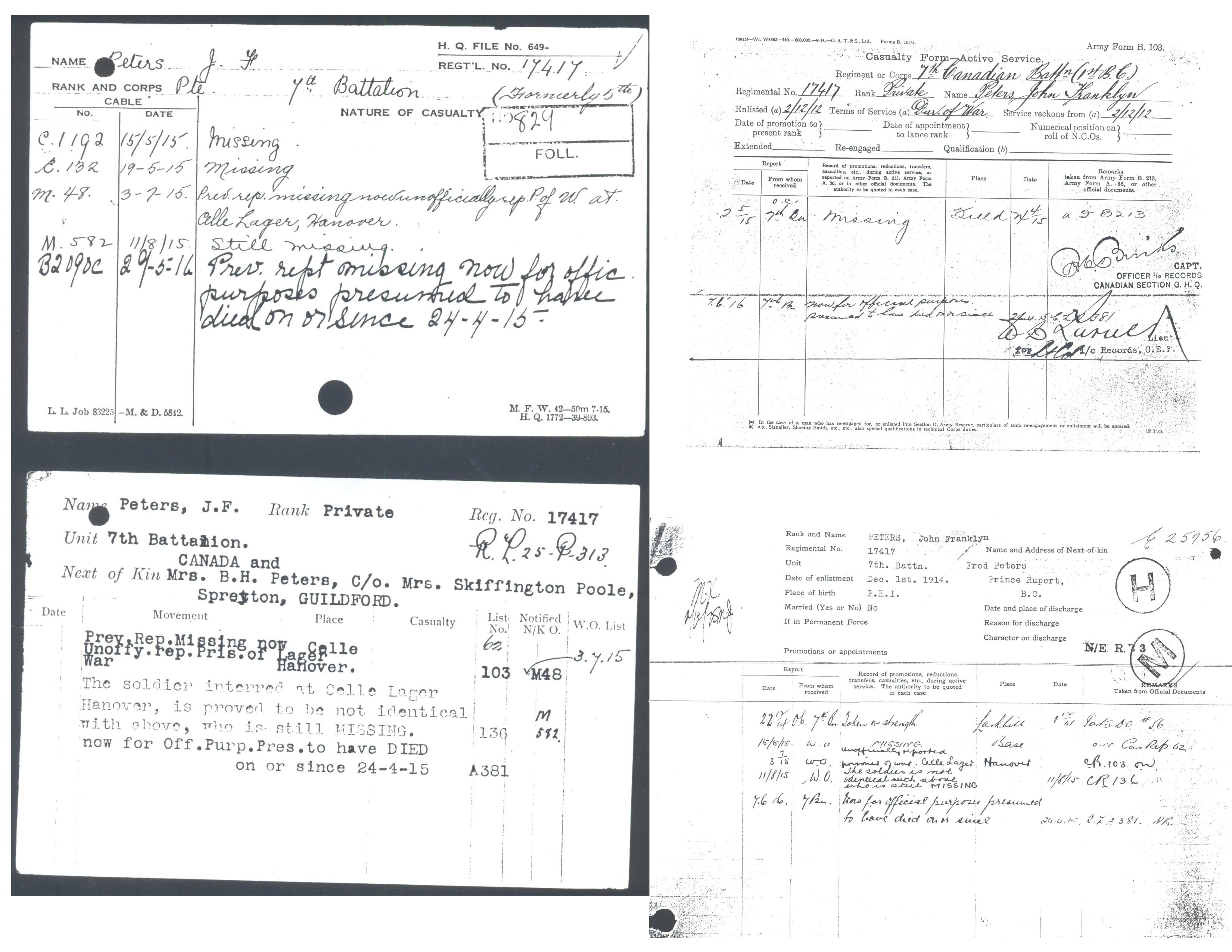
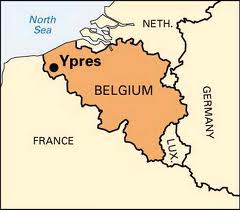
However, Jack would be the first of three Peters brothers to die in the world wars of the 20th century.  He was killed on Saturday, April 24, 1915 in the 2nd Battle of Ypres when Canadian troops made a courageous stand against a massive German attack that used poison gas for the first time on the Western Front.

The use of poison gas in artillery shells was forbidden by the Hague Conventions which both sides had agreed to in 1899 and 1906, but the German commander at Ypres thought he could get away with spreading the gas directly from canisters and piping from their own trenches, depending on the wind to take it to the enemy.  The completely surprised French colonial troops on the Canadians’ left panicked and ran away from their positions upon experiencing the greenish-yellow cloud of chlorine gas late in the afternoon of April 22nd, which left the inexperienced Canadians to fill a four-mile gap in the Allied line protecting the headquarters at Ypres and the coastal ports.

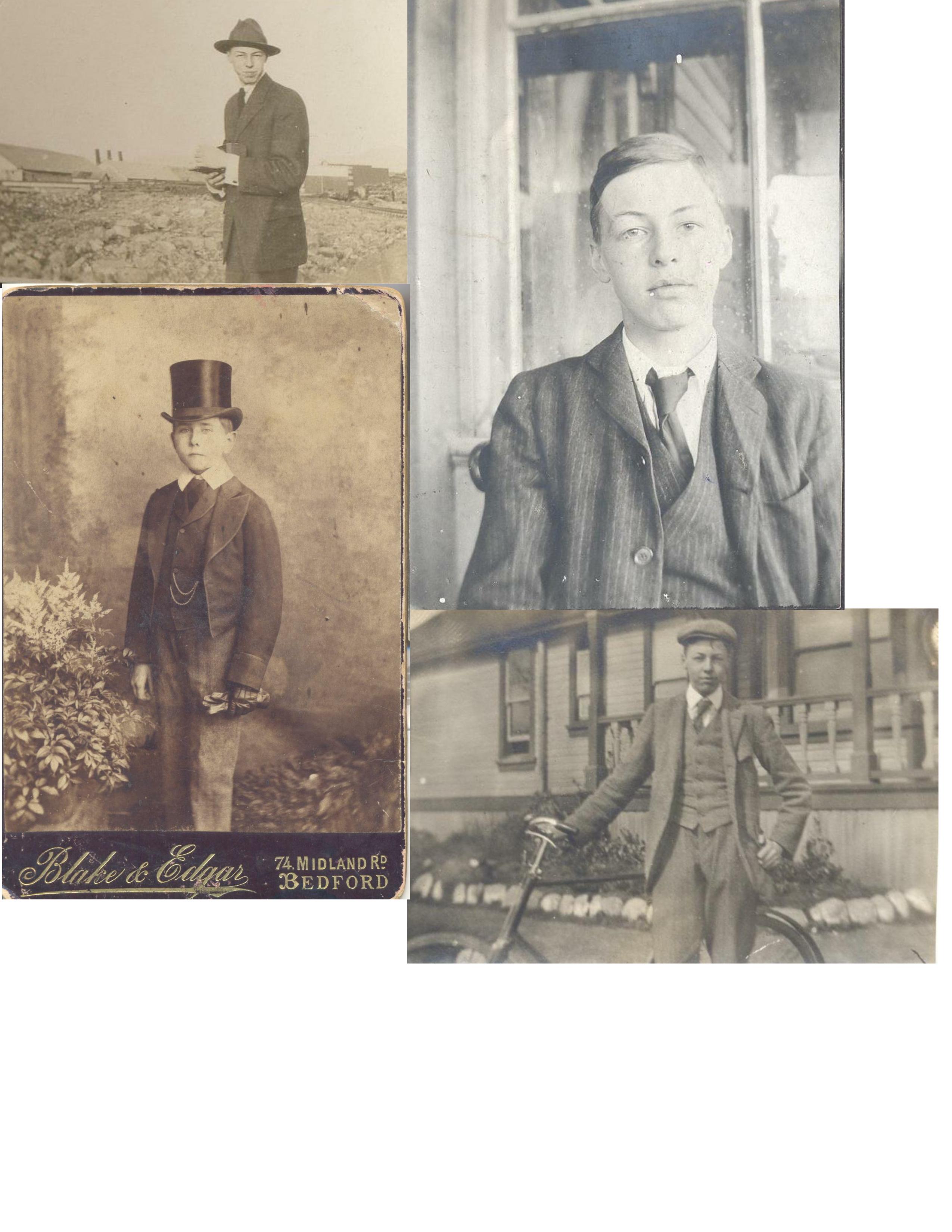
from bottom left: Jack at Bedford, England; Jack in Prince Rupert; as a teen; with his bicycle (McBride Collection)

Reinforcements promised by the French never arrived.  The Germans did not expect the gas to have such a dramatic impact – wind conditions and temperature were ideal for distribution of the heavier-than-air gas, unlike a previous attempt to use poison gas on the Russian front — and were not prepared with reserves to immediately take advantage of the break in the line.  They were ready by the early morning of Saturday, April 24th, launching a full-scale offensive with gas directly against the Canadians.

Jack in the 7th battalion would have been right in the middle of the vicious battle.  The Canadians found they could function somewhat under the gas by holding urine-soaked handkerchiefs against their faces and partially neutralizing the chlorine.  Records show that relatively few soldiers died from just the poison gas; they would be hit by bullets and shells when drawn away from their trenches by the gas and unable to defend themselves.  Flame-throwers were also introduced for the first time in the offensive, making a horrific situation even worse for the defenders.

If the Canadians had not held the new battle line, the enemy could have easily encircled 50,000 Allied troops and marched to the North Sea to capture ports (as happened at Dunkirk in May 1940 in the Second World War), which would have been a devastating blow to the Allies.  British General Sir John French gave the Canadians credit for extraordinary bravery and said they “saved the situation”.  The Germans began respecting Canadians as adversaries after this battle.

While we don’t know exactly what happened to Jack in the battle (witnesses died too), it is noteworthy that he was a part of what was arguably the most important defensive stand in Canadian history.

There were hundreds of Canadian prisoners taken in the shifting front that day, and for a period the military authorities thought Jack might be among prisoners in Belgium or Germany.  Dozens of soldiers of the 7th Battalion were taken prisoner after the Germans surrounded and captured the small village of St. Julien.  The Peters family felt 100% sure that Jack was safe as a prisoner, largely because Fred`s cousin Helen Francklyn in Bristol said a friend of hers in Switzerland found out that Jack was at the Celle Lager prison in Hanover.   However, the Red Cross found that the prisoner in question in Hanover was in fact someone else, so on May 29, 1916 Jack was officially presumed to have died “on or after April 24, 1915”.  Of 900 men and 24 officers in Jack’s battalion, 580 men and 18 officers were casualties in the 100 hours of frantic action that followed the first gas attack.  Four Victoria Crosses were awarded to Canadians in the battle, including Lieutenant Edward Bellew of Jack’s 7th battalion.  John McCrae, a surgeon in charge of a field hospital, wrote his famous poem “In Flanders Fields” on May 3, 1915, inspired by the death of a close friend in the same battle in which Jack died.

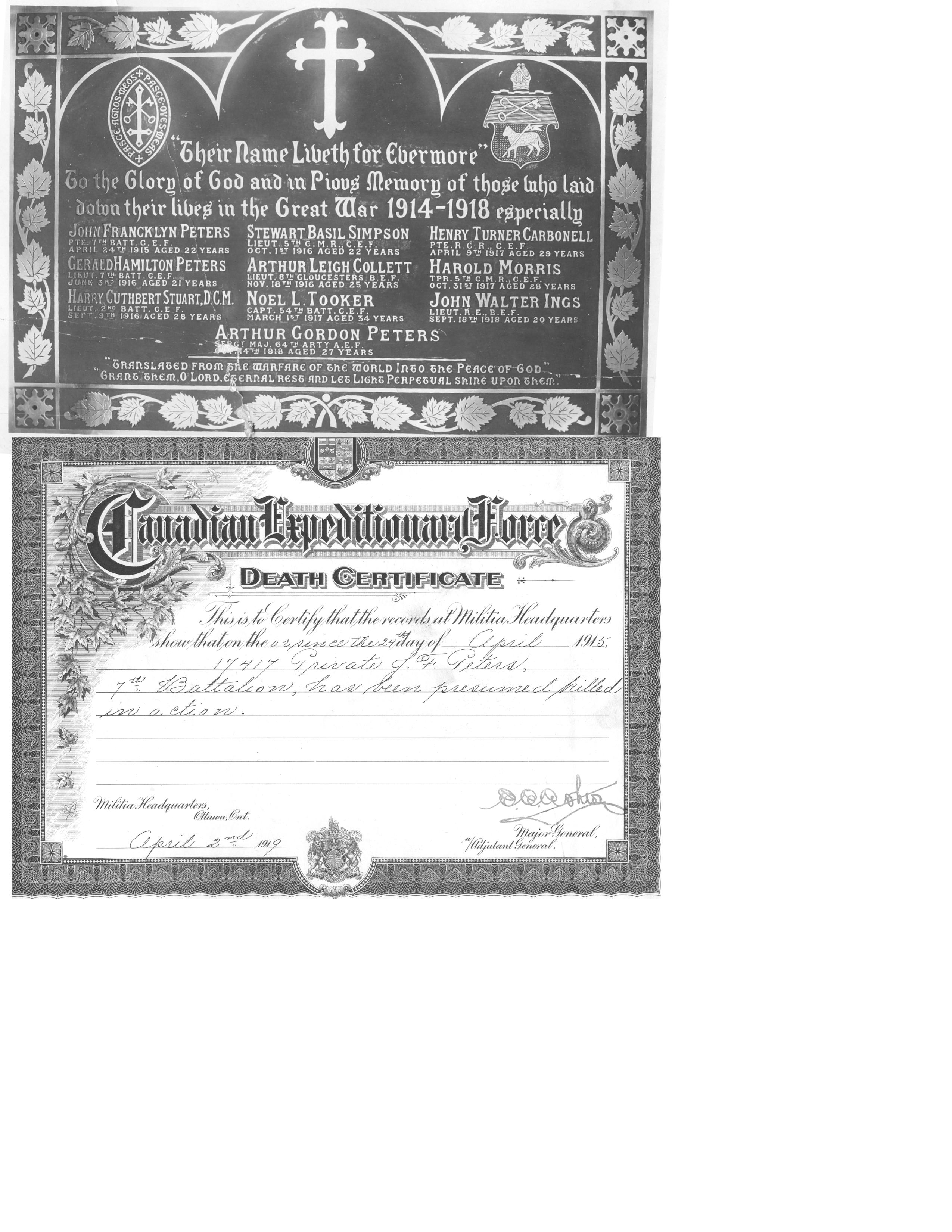
After being assured for so long that Jack was safe, his mother Bertha refused to believe he had died.   She did not accept his death until the war was over, and no further information on Jack had emerged.  She grieved much more for son Gerald, who died in the Battle of Mount Sorrel in June 1916.  Gerald was her favourite child, and they were exceptionally close.   A memorial plaque (image below) with the names of Jack Peters, Gerald Peters, their cousin Arthur Gordon Peters, and seven other Charlottetown boys who died in the war was installed at St. Paul`s Anglican Church in Charlottetown.  The names of Jack and Gerald Peters are also listed on the Menin Gate memorial in Ypres that includes the names of thousands of Allied soldiers who died at Ypres with no identified remains.

The letter below was the first of six letters from Jack in the Peters Family Papers that have been kept safe over the years, first by his mother Bertha, then by his sister Helen Dewdney, and most recently by his niece Dee Dee McBride.  His last letter, dated April 13, 1915, was mailed to his cousin Evelyn Poole in Guildford, Surrey, southeast of London, who passed it on to his family in British Columbia.   The letters were handwritten in pencil, often with smudges of dirt from the trenches.

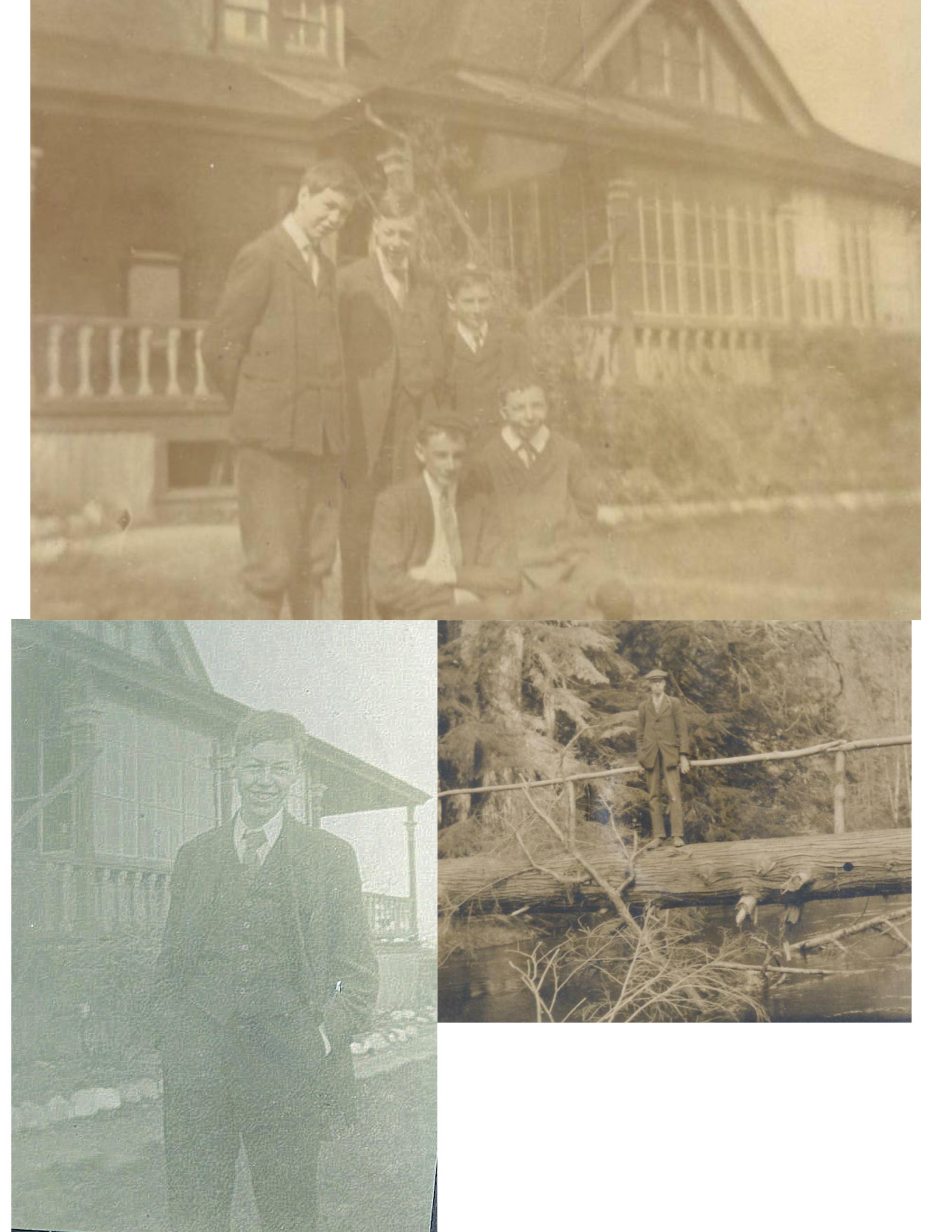
from bottom left: Jack; Jack second from top left in a group that includes Gerald (to his left), Noel (bottom right) and two unidentified boys; and Jack on a log (McBride Collection)

Private Jack Peters to his family in Prince Rupert, dated December 18, 1914

{sent from England}

Just received yours of Nov. 23rd.  As it is pouring with rain we can’t go out on parade so I’ve got a chance to answer it.

Capt. Harvey1 gave us a lecture on attacking a fortified position between 9 and 10 this morning.  About which he doesn’t know much.  All the old soldiers are busy imitating him now.  They, of course, know what a real attack is like.  Although, as a rule, they don’t say much about the Boer War. 

I was very glad it rained today as I was feeling tired after a day’s work digging on the railway about five miles away from here.  The pick and shovel work caused many casualties amongst the company.  Mostly, the “lurking fever”.  They all claimed it was vaccination, but the hard-hearted doctor sent them all back to work.  Except one to whom he gave some medicine.  The others all agree that it is lucky that he took it first before they tried it.  My arm hasn’t bothered me at all.  I hope to escape inoculation.

It’s awful to be ill at camp.  “Sick Parade” sounds at 7:15and you have to parade at the doctor’s tent then await his pleasure.  Needless to say, it prevents anyone from going sick when they aren’t.  The ones who really are ill, generally die.  I believe I’m feeling quite well, so far.  Eric Poole2 is in hospital as a result of trench digging on a wet night.  Ray3 is a major now.  We are all a bit excited owing to the bombardment of the East Coast.  One fellow in the next hut whose house is inScarborough had his home destroyed, and feels that his people may have been killed.  The general nervousness in camp is not owing to anything like that, but whether Christmas leave will be stopped.  All the old soldiers live for the huge bust that they go on when on leave.

I am down for leave from Dec. 30 to Jan. 4. I expect I’ll go up to Hodsocks4 and have a cheap holiday. London is a little expensive.  I arrived in camp with 1/35.  If I hadn’t been taken I would have had to work with pick and shovel to enable me to get back toLondon.

I feel sure that we will be in Franceby the time you get this.  Of course, we will be at least eight weeks at the base or on the lines of communication.  The 1st B.C. regiment are the cracks of the Contingent.  Some of the Eastern men are awful looking mutts quite on a par with Kitchener’s rather scraggy army.

I’ll send you a photograph as soon as I can.  My uniform will soon be all messed up.  They provide us with slacks and a khaki shirt which I generally wear.

(continued Sunday)

We had parade on Friday afternoon.  I saw the biggest aeroplane that I have ever seen.  The plains are alive with them.  They have a Union Jack painted on the bottom of the planes.  I’ve seen as many as 5 in the air at once.

Saturday morning was the hardest on record.  We paraded at 8:30 but had to go on fatigue instead and help the engineers build a heavy truck road.  I had the job of carrying ties about 8 feet long weighing a terrific amount.  It was pouring with coldsleet and rain as well.  We labored for 3 hours.  The hardest in my life.  I was over to see Harris on Friday evening.  The 72nd are about a mile away from here.  I got lost coming back in the dark.  Hundreds of huts all looking the same.

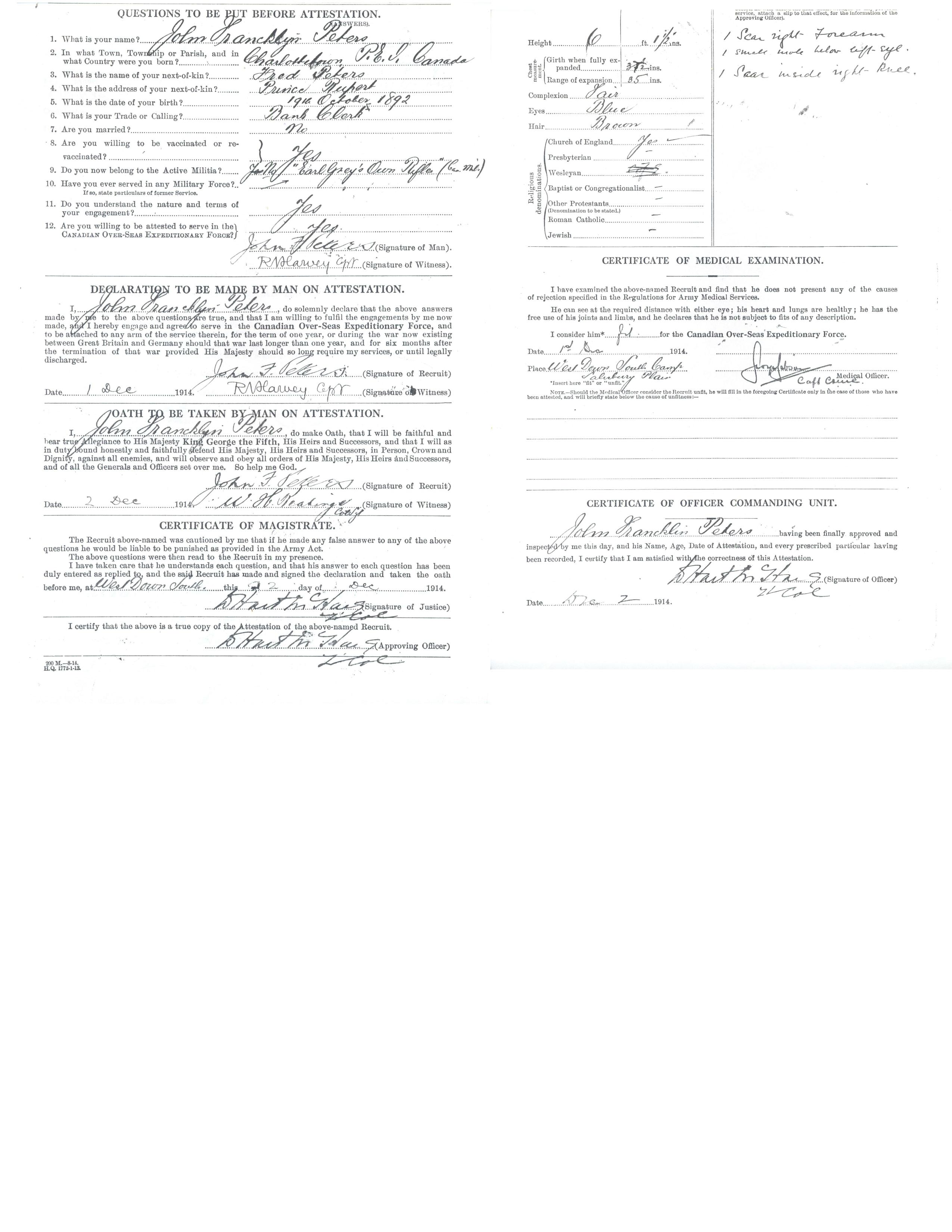
Jack`s attestation papers. Note the signatures of Captain Harvey and Colonel Hart-McHarg, both of whom were men of distinction who died in the Second Battle of Ypres along with Jack.

I had a two hour job finding my own hut.  Harris goes on his holiday this week.  So I can’t go to Yorkshire with him.  Gus Lyons of Victoria fame is in the 50th Highlanders right near us.  I haven’t found Willie Abbott6 yet. 

We had a church parade this morning for the first time since my arrival.  Mr. Barton I believe is our chaplain.  It was cold out in the open air.  I didn’t envy him in his thin surplice.

Fritz has written to me several times since I came.  He can’t give any news.

The war in the opinion of most people will last for 18 months at least.  The Russians have just been badly beaten by Von Hindenburg.  The Germans again threaten Warsaw.  So it is up to Kitchener to finish the war as neither France or Russia can.  I expect you don’t hear anything about the Russian defeat in Rupert.

Kitchener rules…

1 Captain Rupert (aka Robert) Valentine Harvey (1872-1915) was born in Liverpool and taught school there before moving to Canada in 1899 to teach at Queen’s School in Vancouver.  In 1901 he took over as headmaster and then in 1908 merged his school with UniversitySchoolin Victoriathat had been founded two years before by Rev. W.W. Bolton (who had taught Fritz Peters at his school on Belcher   Avenuein Victoriabefore Fritz went to Englandfor preparatory school in 1900) and J.C. Barnicle.  Harveybecame Warden of the UniversitySchool(now known as St. Michael’s UniversitySchool, the largest residential school in B.C.).  In a 1917 letter to his father, Fritz Peters mentioned meeting Harvey several years earlier and discussing schoolmastering with him, which Fritz was considering as a career at the time.  Harvey was a strong believer in cadet corps and scouting, but he didn’t serve in the Boer War.  In 1914 he left with his regiment, the 7th Battalion, as Captain for overseas duty.  On April 24, 1915 in the Second Battle of Ypres he and the No. 3 Company he commanded were surrounded by Germans in their full-scale assault on Canadian forces.  Harvey was seriously wounded but refused medical treatment until injured men in his company were taken care of.  He was taken prisoner, and died in a prison hospital in Germany on May 8, 1915.[i]   Captain Harvey’s signature is on Jack Peters’ attestation papers.

2 – Jack’s cousin Eric Skeffington Poole was a son of Bertha’s sister Florence Gray Poole.  He was born inNova Scotiaand lived inEnglandafter the family moved there in 1905.  He was a Second Lieutenant with the West Yorkshire Regiment in July 1916 when he suffered from shell shock during theBattleof theSomme.  He had recurring periods of confusion after returning from medical treatment, and then onOctober 5, 1916he wandered away from his platoon at the front.  He was arrested by military police and faced a court martial for desertion.  Despite evidence that he was still suffering from the shell shock (or what today could be referred to as Post-Traumatic Stress Disorder) which made him anxious and confused, he was found guilty and sentenced to death by firing squad.  British Field Marshall Douglas Haig could have commuted the sentence, but chose to make an example of him to demonstrate that officers were subject to the same basic military rules as their men.  In his diary entry ofDec. 6, 1916Haig wrote “it is highly important that all ranks should realize that the laws is the same for an officer as a private.”  Eric was shot at dawn on December 10, 1916 at Poperinghe, Belgium, about 10 km west of where his cousins Jack and Gerald Peters had died earlier in battles near Ypres.  He was the first British officer to be executed for desertion.  The trial and execution were not publicized in the press at the time, apparently in deference to Eric’s father Henry Skeffington Poole who had aristocratic connections and was ill at the time of the court martial and would die in March 1917.  It is possible that the family agreed to not contest the verdict if authorities kept it secret.  The fact that Jack would comment on Eric being in hospital in a 1914 letter – two years before the “desertion” incident – is interesting because it shows that Eric had longstanding health problems.

3 – Major Henry Raynauld (Ray)Poole was Eric’s older brother.  The obituary published after the funeral of his mother, Florence Poole, in 1923 listed a surviving son Major H. R. Poole, DSO, MBE, indicating he won the Distinguished Service Order medal and was accepted as a Member of the British Empire.

4 – Hodsock Priory, a stately manor and estate in Nottinghamshire, was the residence of Col. Henry Mellish, a bachelor who was an expert sharpshooter and enthusiastic amateur meteorologist.  Mellish’s mother was Margaret Cunard, a daughter of Sir Samuel Cunard and sister of Fred’s mother Mary, so he and Fred Peters were cousins.  One of the envelopes of letters that Fritz sent to Bertha in 1916 was addressed to her at Hodsock Priory, which was one of several addresses Bertha had while inEnglandwhen she was there for about a year during the First World War.  From these letters, the Peters family members appear to have had an open invitation to stay at the huge Hodsock estate virtually whenever they desired.

5 – The standard for stating British currency at the time (pounds/shillings).

6 – William Hamilton “Willie” Abbott was Jack`s cousin.  His mother was Mary Stukeley Hamilton Gray, sister of Jack`s mother Bertha Gray.  His father was William Abbott, son of the Canadian Prime Minister John Abbott.  The Abbott home in Montreal was a regular stop for members of the Peters family travelling by rail to or from England.  Willie, a civil engineer, survived the war.  He was interviewed by the  Montreal Gazette in 1943 after his cousin Fritz Peters received the Victoria Cross.  Willie was a greatuncle of the Canadian actor Christopher Plummer.

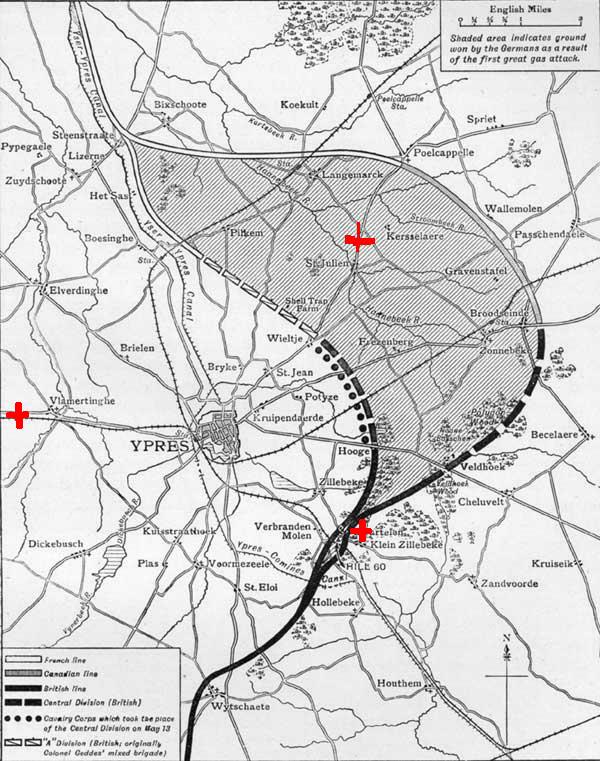
Map of Ypres battle area. Top cross is approximately where Jack died; cross at right is where Gerald died; and cross at left is on the road to Poperinghe, Belgium where their cousin Eric Poole was buried after execution for desertion.


Family of Frederic Thornton Peters — Part Three: his sister Helen Dewdney

Leave a comment

by Sam McBride

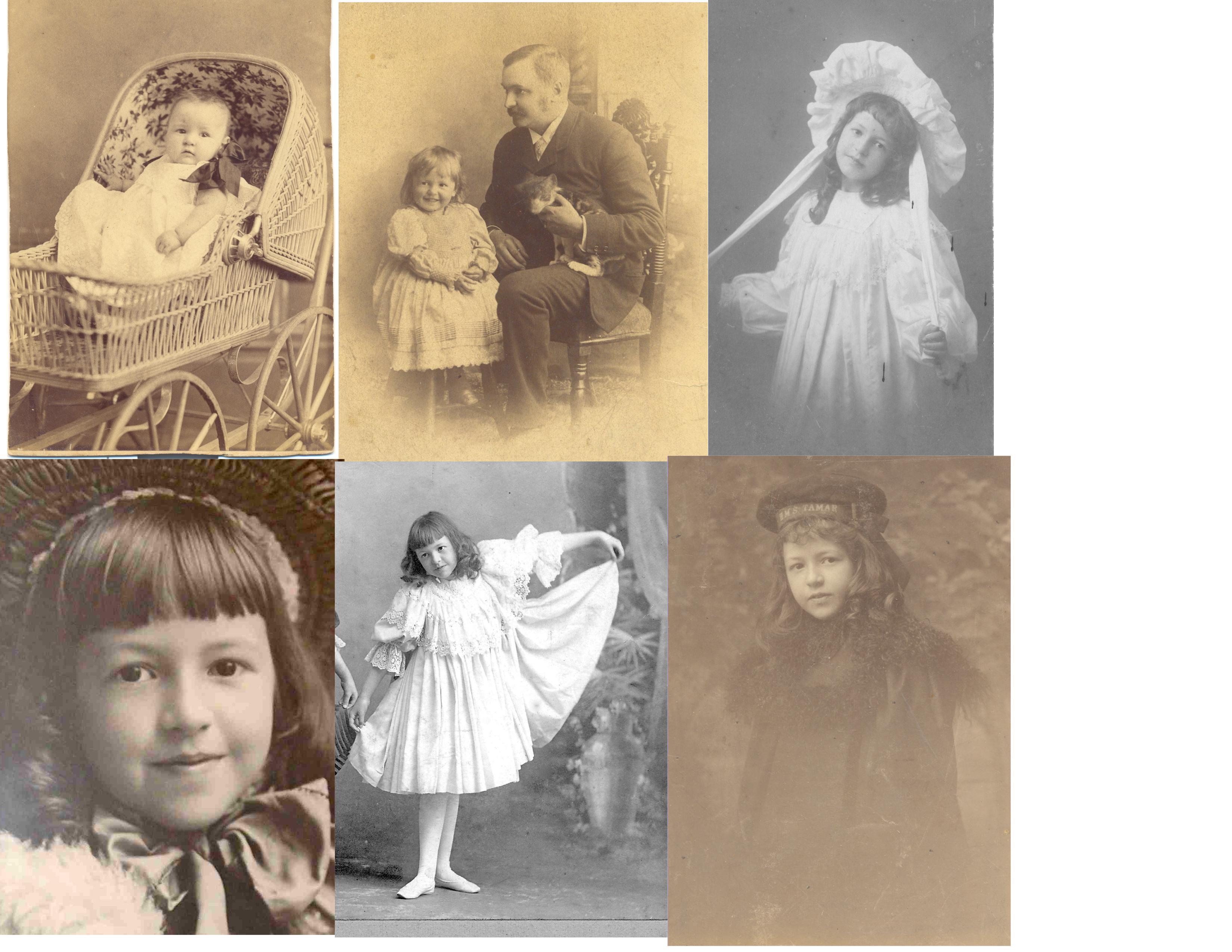
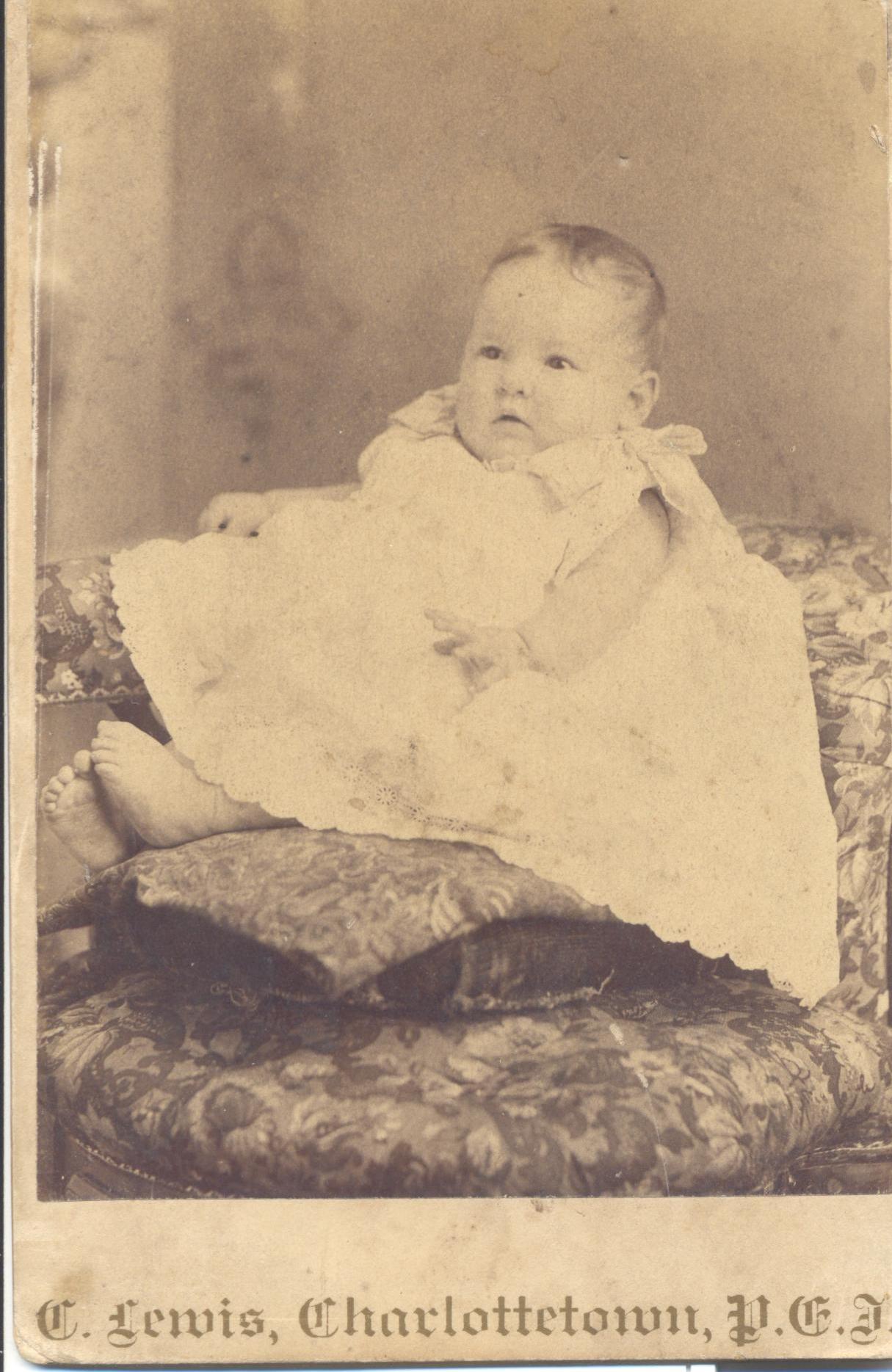
clockwise, from top left: baby Helen, 1887; with her father Fred and a cat, 1889; and four images of her as a young girl in Charlottetown (McBride Collection)

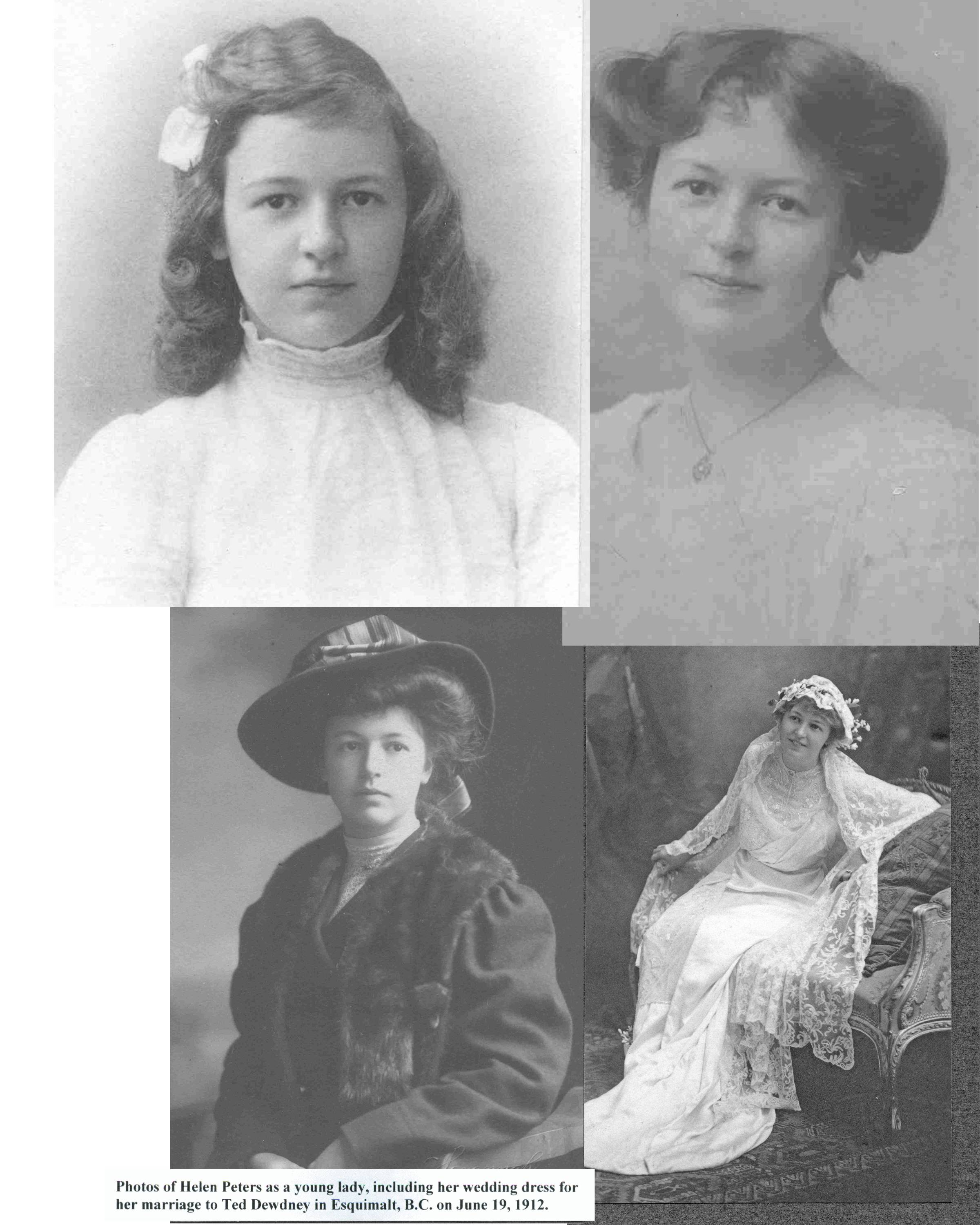
Mary Helen Peters was born in Charlottetown, Prince Edward Island on August 31, 1887.  She was always known as Helen by friends and in the family, and in later years was known as Gran to her three children and ten grandchildren and many of her younger friends.  The first of six children, she outlived all of them, including a younger sister who died in a fireplace accident, three brothers who died in the world wars, and another brother who had a mental disability.

At age eight in early 1898 she moved with her family across Canada by boat, trains and boat again to Victoria on Vancouver Island.  The sea was a constant in her youth, as she went from an Atlantic island to a Pacific island.

She went to schools in Charlottetown and Victoria, and then in 1900 went to Bedford in north London, England where she attended the Bedford School for Girls.  At the same time, her brothers Fritz and Jack attended the Bedford Grammar School.  It is likely they all stayed at the home of their mother Bertha`s stepmother, Sarah Caroline Cambridge Gray, who moved there after the death of her husband, John Hamilton Gray in 1887.  One of Helen`s memories from her time at Bedford was watching with her brothers on a London street in January 1901 as the funeral procession for Queen Victoria solemnly passed by.

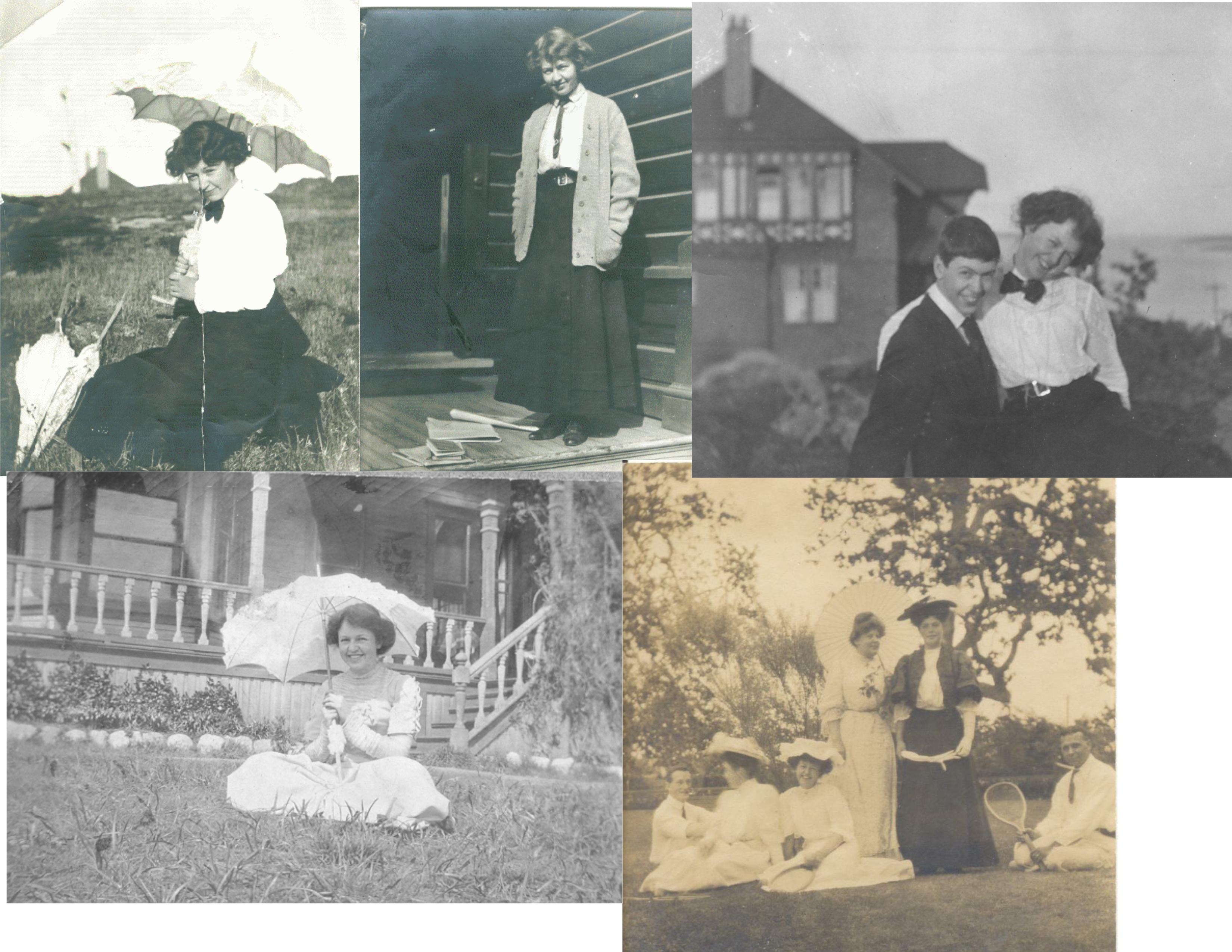
clockwise, from bottom left: three images of Helen as a young lady in Victoria; with her brother Gerald in the yard of their Oak Bay home; seen with tennis friends (McBride Collection)

Helen studied piano and music at the Royal Conservatory of Music in London, and became an accomplished pianist.

One of her father`s partners in business ventures in Victoria was the Hon. Edgar Dewdney, the former trail-builder, federal cabinet minister and B.C. lieutenant governor.  Dewdney was uncle and guardian of Edgar Edwin Lawrence “Ted” Dewdney, born December 26, 1880 in Victoria.  Ted`s mother Caroline Leigh died when Ted was four and his father Walter Dewdney died when Ted was 11.  Ted lived with his uncle Edgar and aunt Jane between 1892 and 1897 at Cary Castle in Victoria when it was the official residence of the Lieutenant Governor.

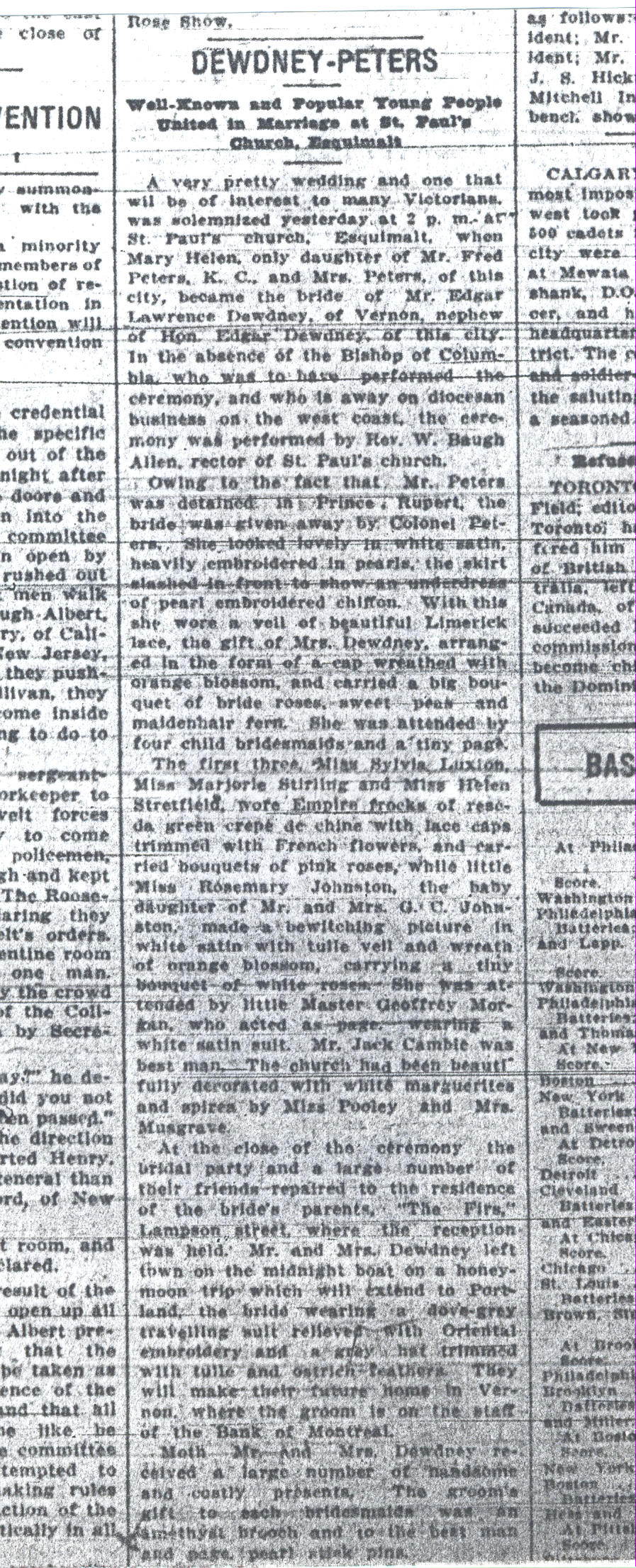
Victoria newspaper report of her wedding

A  keen student of history and literature, Ted wanted to go to university, but his uncle insisted he enter the banking world at an early age.  Ted began as a clerk for the Bank of Montreal in Victoria in December 1897, and was subsequently transferred to the bank branches in New Westminster, Greenwood, Rossland and Armstrong before returning to Victoria in 1908.

Ted was athletic and an outstanding tennis player, winning the West Kootenay Tennis Championship three times in the early 1900s while residing in Rossland.  Helen was also a keen tennis player and participant in tennis-related social events in Victoria.  It is likely that the pair got to know each other in tennis activities or through the Anglican Church.

Ted and Helen married June 19, 1912 at St. Paul`s Anglican Church in Esquimalt, adjacent  to Victoria.  Her father Frederick Peters could not attend because he was tied up with his work in Prince Rupert.  He asked his cousin, Colonel James Peters, to fill in for him in “giving the bride away”.  Col. Peters had retired recently after an eventful 42-year career with the Canadian military, including many years in charge of West Coast defence.  When he arrived in Victoria in command of the first battery to defend Victoria and the Esquimalt Naval Base he was the first of the Peters clan to settle in B.C.  The wedding reception may have been something of a reunion for Col. Peters and another prominent guest, the Hon. Edgar Dewdney.  Twenty-five years earlier Dewdney was Lieutenant Governor of the Northwest Territories and Minister of Indian Affairs during the Riel Northwest Rebellion, in which Col. Peters (then a captain) was in charge of an artillery battery and was honoured with a Mention in Dispatches.  For further information on Col. Peters, see http://www.navalandmilitarymuseum.org/resource_pages/coastal_defence/james_peters.html.

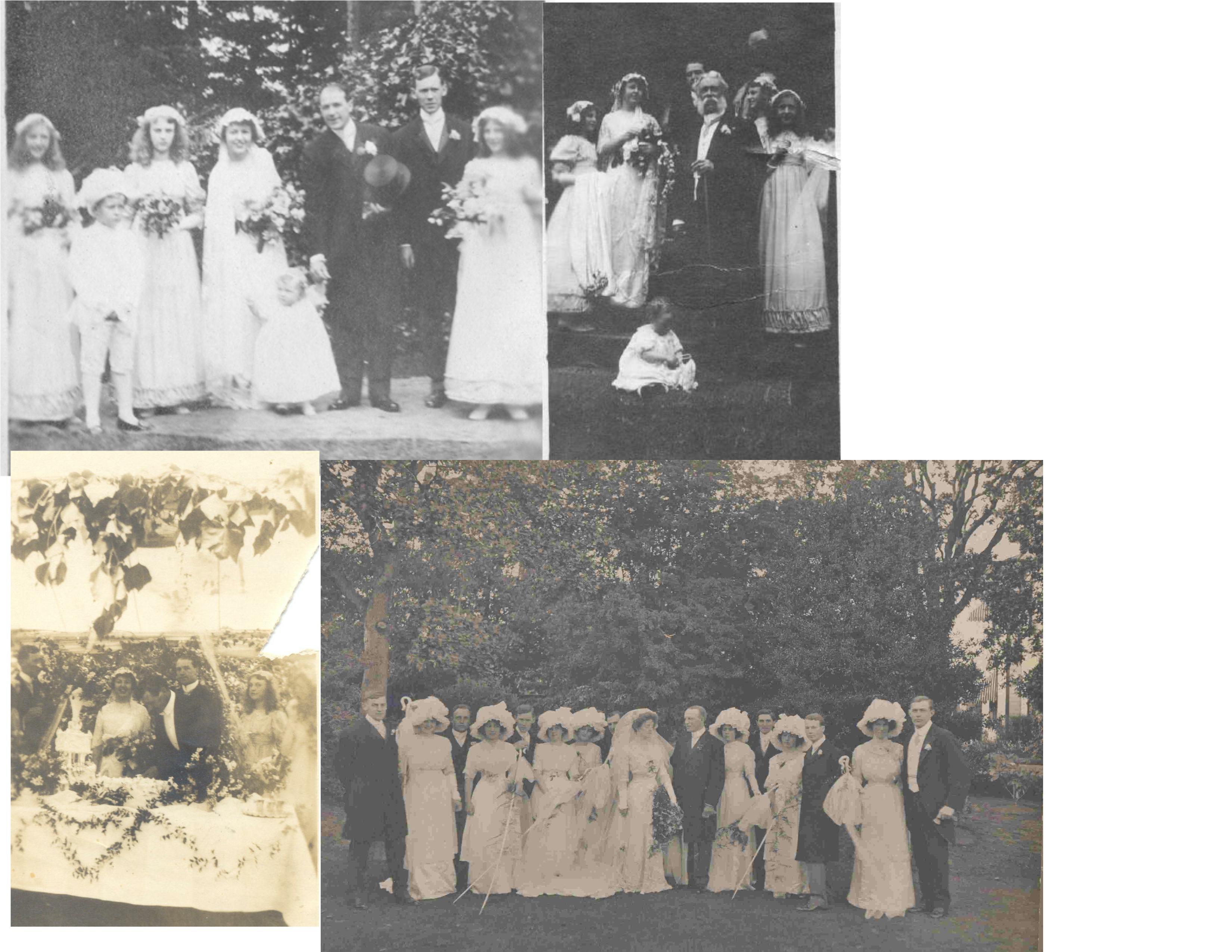
from bottom left: cutting the cake; the wedding party; Helen beside Ted`s uncle, Edgar Dewdney; Helen (fourth from right) as a bridesmaid for a friend`s wedding (McBride Collection)

Ted and Helen moved to Vernon in the Okanagan region of central B.C., where Ted worked as an accountant with the Bank of Montreal.   On Dec. 6, 1913, their first child, Evelyn Mary “Eve” Dewdney was born.

They were in Vernon at the outbreak of the First World War in August 1914.

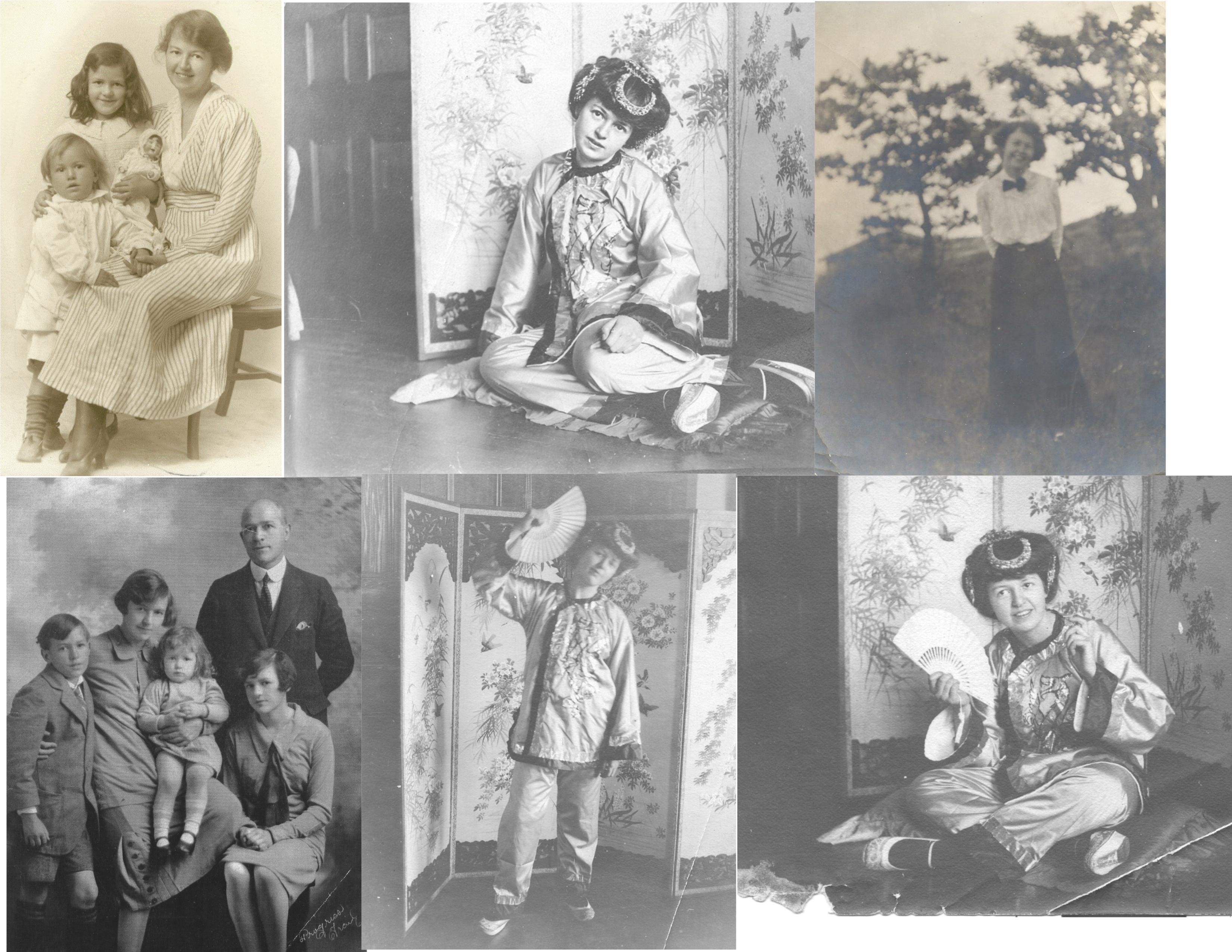
from bottom left: Helen and Ted with children Eve, Peter and Dee Dee, 1925; four images of Helen, including her costumes for local productions of Gilbert and Sullivan`s Mikado (McBride Collection)

Her brother Fritz had left the Royal Navy in 1913 after eight years of service.  With war declared, he caught a ride on a steamer going to Britain to rejoin the navy.  Her other brothers Jack, Gerald and Noel had all taken militia training in Victoria and later in Prince Rupert with the Earl Grey Rifles.  Each of them went to enlist in the army but only Jack was accepted.  Tall and thin, Gerald`s chest measurement was below army standards so he failed the physical examination.  Noel was rejected because of his mental disability, which was actually not as bad as it seemed in his appearance.  Gerald went to Montreal to try to enlist, and this time he was accepted.  Noel wasn`t accepted for service until May 1917 when he joined the Canadian Forestry Corps in Britain.  At 33, Ted Dewdney was past ideal age for enlistment, and he was supporting a wife and child, so he did enlist.  If the war had come while he was still a bachelor, he would have rushed to enlist, as he had been extremely active in the Rocky Mountain Rangers militia when he was working as a bank clerk in Rossland in the early 1900s.
In 1915 Ted the Bank of Montreal  transferred Ted to its branch in Greenwood, a small mining community near the U.S. border and on the west edge of the West Kootenay region.  This was his first appointment as branch manager.  A year later he was transferred to manage the New Denver branch in the famous Silvery Slocan district.  Housing for the manager and his family was provided in quarters above the bank, which today serves as the community`s museum.

The period from late May 1916 to late July 1916 was a time of anxiety and sorrow for the Dewdney family.  First they heard that Helen`s brother Jack was not a prisoner of war as previously reported, and was now assumed to have died in April 1915 in the Second Battle of Ypres.  A couple of weeks later they heard that Gerald was missing, and by early July it was confirmed that he had died in the Battle of Mount Sorrel.  Helen`s mother Bertha, who had been residing in England since the late spring of 1915 so as to be close to her boys, was devastated by the deaths of two sons, particularly Gerald, with whom she was particularly close.  She felt she could not return to the house in Prince Rupert with so many memories of Gerald, so she went to live with Helen`s family in New Denver.  This arrangement would continue for 30 years until Bertha`s death at age 84 in 1946.

Their first and only son, Frederic Hamilton Bruce Dewdney, was born May 2, 1917 in New Denver.  He was named after his uncle Fritz, and Fritz was his godfather.  At an early age the boy picked up the nickname “Peter”, and he was known by that name the rest of his life.  As an adult he had his name officially changed to “Frederic Hamilton Peter Dewdney”.  He went by the name “F.H. Peter Dewdney” when he was the Progressive Conservative candidate in three federal elections in the Diefenbaker era.  Each time he was defeated by the popular NDP incumbent MP, Bert Herridge.

The Dewdney family moved to Rossland in 1920 when Ted was transferred to manage the Rossland branch.  A second daughter, Rose Pamela Dewdney, was born in Rossland June 29, 1924.  She acquired the nickname “Dee Dee” and was known by that name as a teenager and throughout her adult life.

The family moved to Trail in 1927 in line with Ted`s appointment there, and then to Nelson in 1929, where Ted retired from the bank in 1940 after 42 years of service.

In each community Helen was active in organizing musical and theatrical productions using local talent.  She would direct, act and play piano; Ted would be stage manager and treasurer for the productions; and they would enlist the help of people throughout the community to participate on stage or behind the scenes.

Throughout her life Helen was an ardent bridge player.  She and her mother rated each community in the West Kootenay region by the quality of its bridge players.

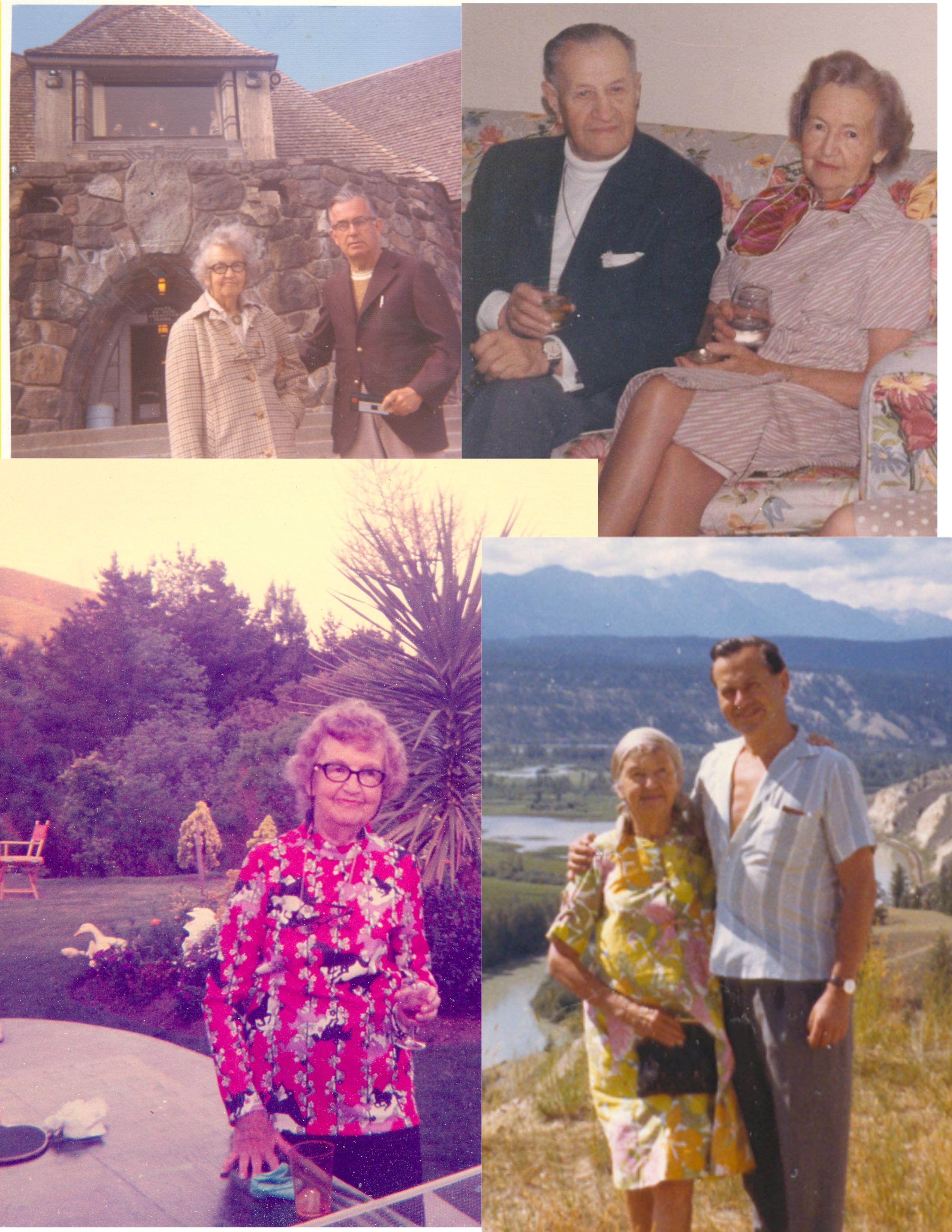
from top left: with Leigh McBride at Banff Springs Hotel; with Herbert Forbes-Roberts, father of Peter`s wife Maxine; with Peter; and in California (McBride Collection)

When Ted retired, the family had to leave the Bank House in Nelson, so he purchased a house at 820 Stanley Street in Nelson.  Eve had left home in 1933 when she married Sandon, B.C.-born mining engineer Jack Fingland and moved with him to Kimberley.  In 1935 Peter began studies at the University of Alberta, where he earned a bachelor’s degree and then a law degree in 1942.

from top left: Dee Dee, Ted and Helen; Ted and Helen; Helen with baby; Helen on visit to Mexico in 1950s; Helen and Eve in the Stanley Street home in Nelson. (McBride Collection)

After graduation he enlisted in the Royal Canadian Navy and trained at HMS Royal Roads on Vancouver Island.  In the war Lieut. Peter Dewdney served as an officer and commander of Fairmile motor launches in anti-U-Boat operations off Canada`s east coast.

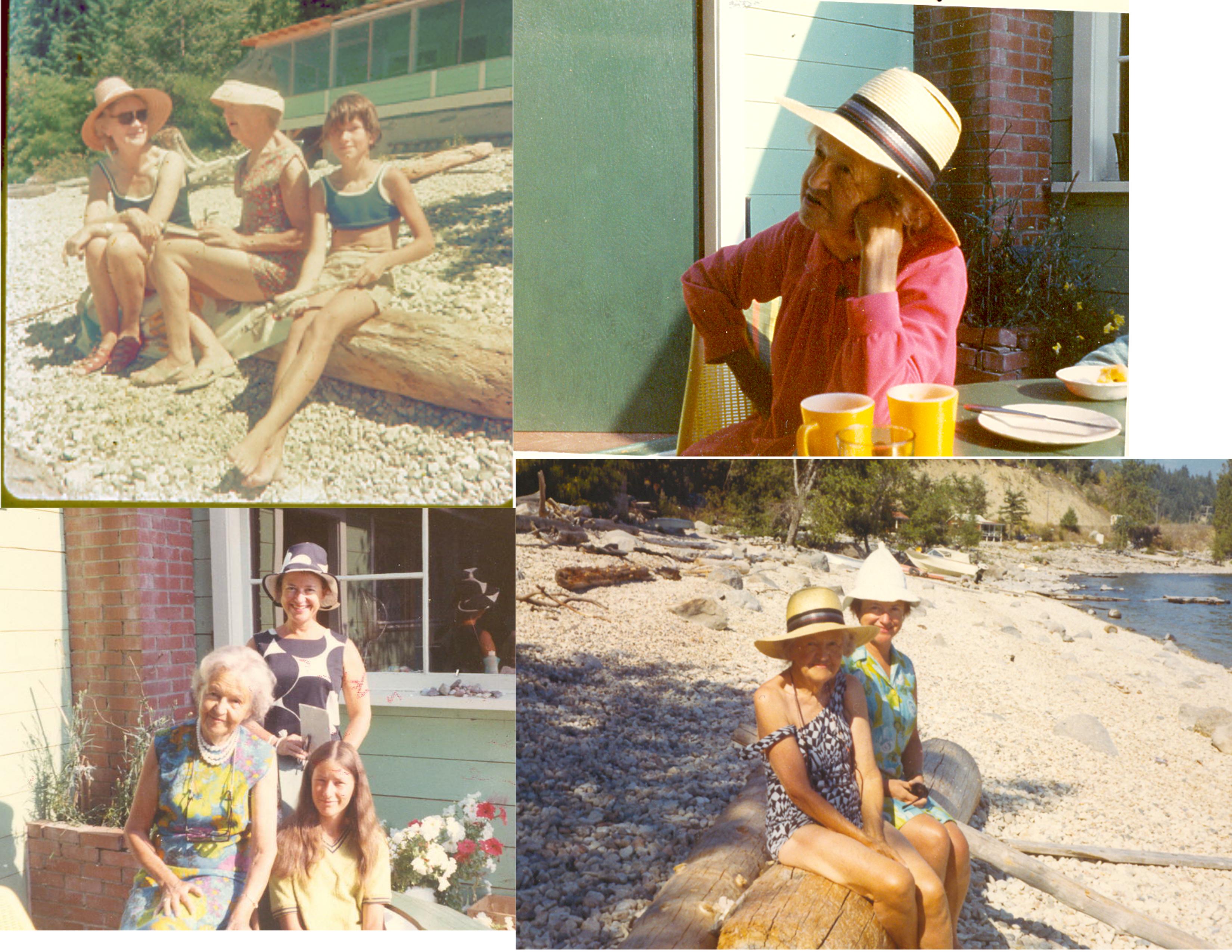
Helen with Dee Dee, granddaughter Eve and a visitor at the McBride cabin and beach at Queen`s Bay, near Balfour (McBride Collection)

Dee Dee earned a bachelor of arts degree at UBC and then a professional librarian certificate at the University of Toronto.   In 1944 Peter married Maxine Forbes-Roberts of St. John`s, Newfoundland, and in 1948 Dee Dee married Nelson lawyer Leigh McBride, who had served as a major in the Seaforth Highlander regiment of the Canadian Army in the Allied invasions of Sicily and Italy.

After Ted Dewdney`s death in 1952, Helen came to live with her daughter Dee Dee McBride`s family.  Helen moved with the McBrides to nearby Trail in 1969 when Leigh began working in the law department of Cominco Ltd.

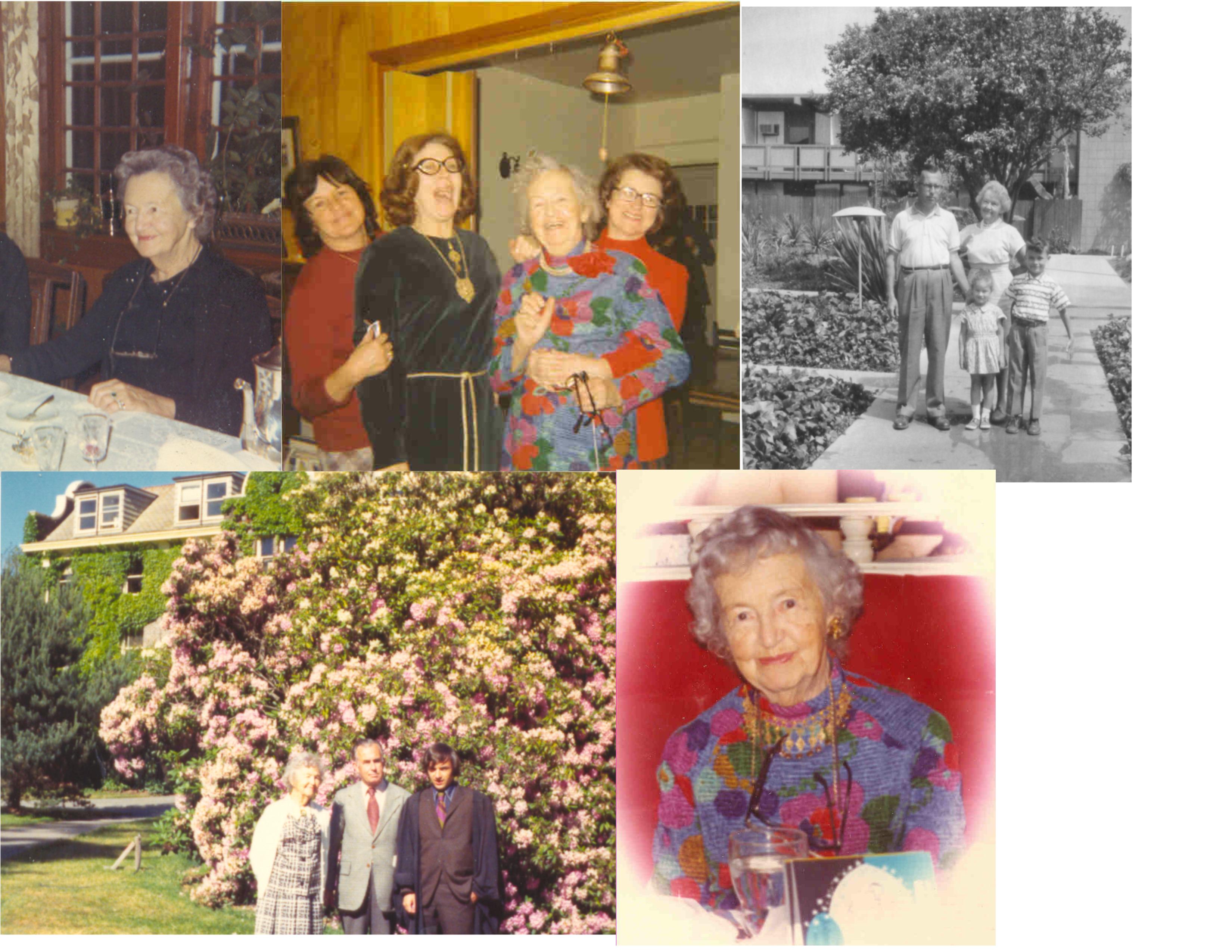
Helen with Leigh and Sam at University of Oregon graduation, 1973; Helen; Eve, Maxine, Helen and Dee Dee; Helen and Leigh with Sam and Eve; Helen in Las Vegas in early 1970s (McBride Collection)

Helen had several bouts with cancer in her last decade, and died in Trail November 27, 1976.

Family of Frederic Thornton Peters — Part One: his father, the Hon. Frederick Peters, Q.C.

5 Comments

by Sam McBride

Frederick Peters was born Charlottetown on April 8, 1851, the son of Judge James H. Peters of the Supreme Court of Prince Edward Island, and Mary Cunard, eldest daughter of Sir Samuel Cunard. He received his early education in Charlottetown schools and at Prince of Wales College before gaining a Bachelor of Arts degree from King’s College in Nova Scotia.


Following his graduation, Peters studied law in England and later returned to Charlottetown where he set up his first law practice. He was called to the bar at the Inner Temple, London in 1876, and to the bar of Prince Edward Island and Nova Scotia the same year.  In England he articled under Lord Alverstone, who later said Peters was the most brilliant student he ever had.  He established a law practice in Charlottetown with his brother Arthur Peters, who followed Fred`s schooling and legal career, almost step for step.

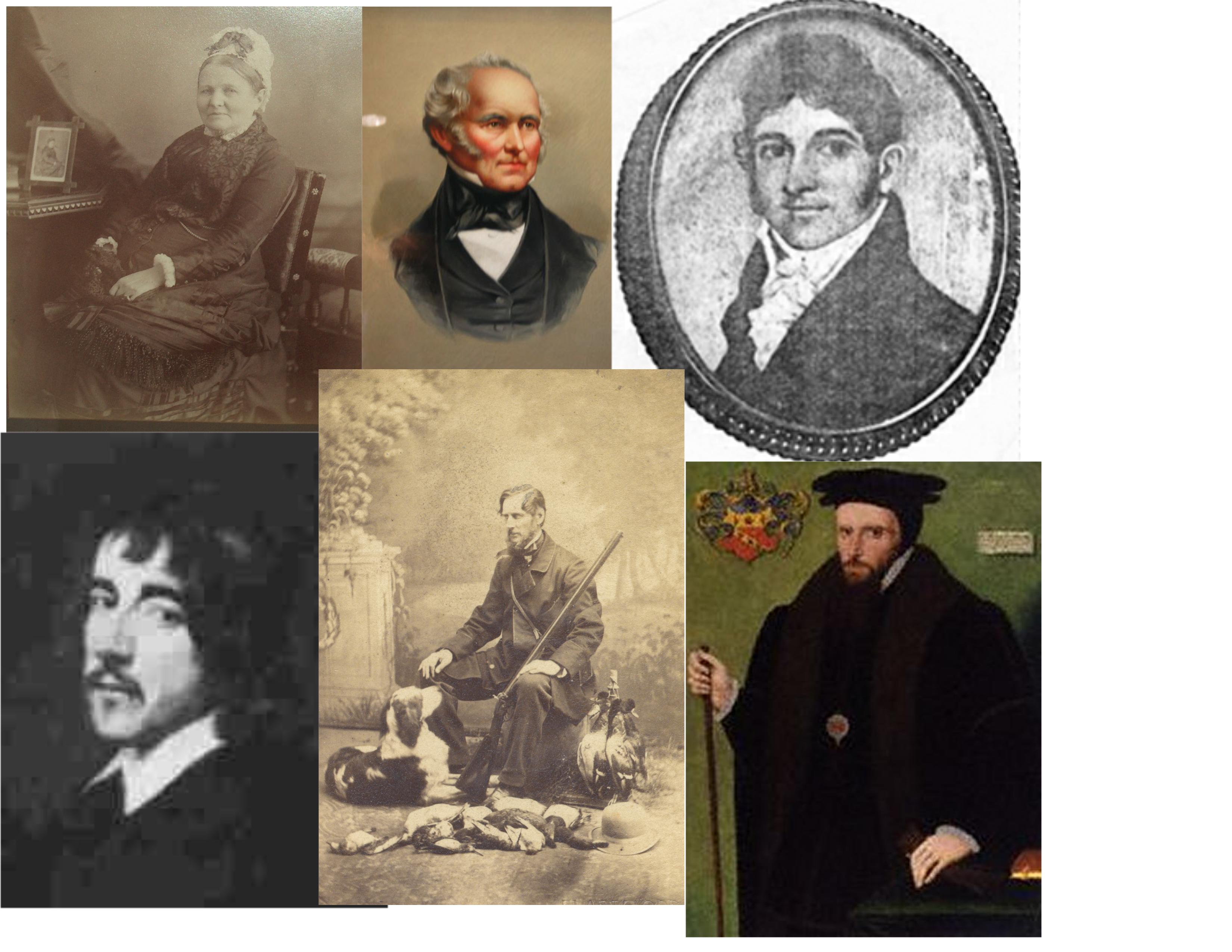
Famous ancestors, from top left: Mary Cunard, Sir Samuel Cunard, Loyalist James Peters, Tudor secretary of state William Petre, Judge James Horsfield Peters, the Rev. Hugh Peters, (McBride Collection)

Always a supporter of the Liberal Party, Peters was first elected to the House of Assembly in 1890. One year later, after a series of by-elections, the government of Neil McLeod found itself in a minority position and Peters was asked to take over the Premiership and form a government.  He became PEI`s sixth premier since Confederation, serving also as attorney general.  He was the first Liberal to lead the province.
Perhaps the most significant act during his term as Premier of Prince Edward Island was a bill changing the form of the Island Legislature. Previous to his administration, the Legislature consisted of two houses, a Legislative Council and a House of Assembly, much the same as the Senate and the House of Commons in the federal government of today. This system became unnecessary in Prince Edward Island and abolition of the Legislative Council was seriously looked at as a solution. However, such a bill did not have a chance of passing the Upper House so Premier Peters offered a compromise by abolishing both Houses and creating a Legislative Assembly in which members were referred to as Councillors and Assemblymen.

He served as premier and attorney general until resigning in October 1897 to move to British Columbia.  He retained his seat in the Prince Edward Island legislature until 1899 despite no longer residing in the province.  His brother Arthur became premier and attorney general in 1901, serving until his death in office in 1907.

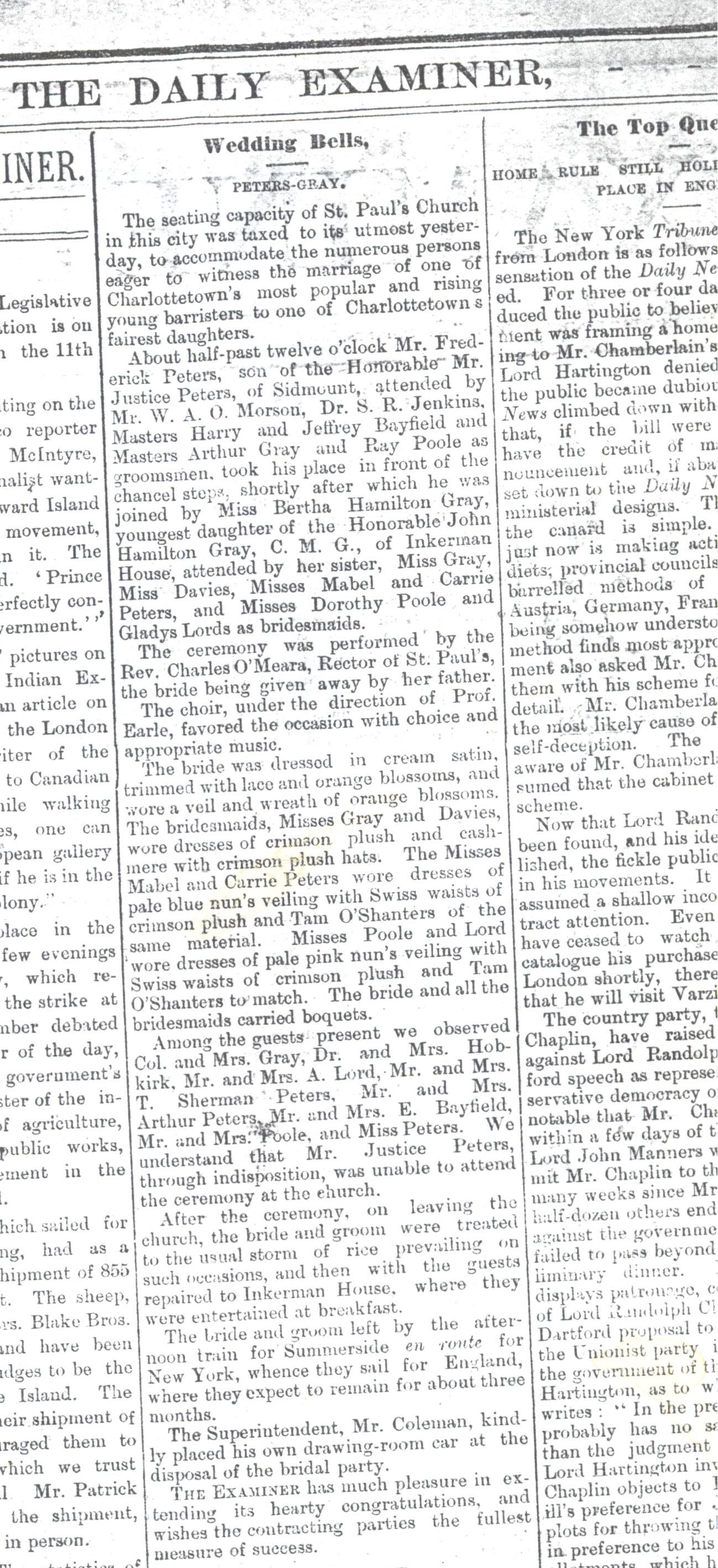
Charlottetown newspaper report of his 1886 marriage to Bertha Gray

Fred Peters was senior counsel for Great Britain against the United States of America in the Behring Sea Sealing Dispute.  Americans laid claim to all seal harvesting in the Bering Sea based on their purchase of Alaska from the Russians, but this was disputed by Britain, Canada and other countries. Peters` co-counsel was federal Conservative Marine and Fisheries Minister Charles Hibbert Tupper of Halifax. Tupper was a son of the Nova Scotia Premier and Father of Confederation Sir Charles Tupper who served briefly as Prime Minister of Canada in 1896. The August 1893 decision of an international arbitration panel solidly in favour of Britain’s position was a feather in the cap for Peters and Tupper, who was knighted.  Peters and Tupper also subsequently served as counsel in the Bering Sea Claims Commission.

In 1896 Frederick Peters attended the founding meeting of the Canadian Bar Association in Montreal and was elected as a vice president of the new organization.

While in Victoria, British Columbia for hearings in the Bering Sea sealing case, Peters and Tupper were impressed with the city`s scenery, mild weather and positive economic prospects, and vowed to move there some time in the future with their families.  Their plan to move across the continent and establish a law practice in Victoria was speeded up by excitement associated with the Klondike Gold Rush in the Yukon in the spring of 1897.  The paid wanted to get in on the prosperity of the gold rush in some way. They saw that the city of Victoria stood to gain as a supply point for people and goods going to and from the Klondike. Peters resigned as premier as of October 27, 1897.  He and Hibbert Tupper crossed Canada by train and arrived in Victoria on November 11, 1897.  Their law firm in the west coast capital was established as Tupper, Peters & Potts.

Clockwise, from top left: Fred and Bertha as a young couple, two photographs of Fred, and Fred shown in about 1889 with his daughter Helen and a cat. (McBride Collection)

Impressive homes were built on adjoining lots in 1898 for the Tupper and Peters families in the recently-developed community of Oak Bay, east of Victoria.

Peters invested heavily in mining ventures which faded away as the stampeders left the Yukon for new gold finds in Alaska. This was the start of money problems that would dog him and his family for the rest of his life. By 1902, Peters and Tupper had parted ways in their law firm.

The outcome of the Alaska Boundary Dispute in October 1903 was a huge disappointment for Canadians, especially for Peters, whose reputation suffered because of his involvement with the case as a researcher and his longtime association with Britain’s arbitrator Lord Alverstone, who stunned Canadians by casting the deciding vote for the Americans, who were still angry about losing the seal hunt arbitration a decade earlier.  U.S. President Theodore Roosevelt had threatened to send in the marines if the boundary dispute did not go his way, and Britain was not interested in battling the Americans so far away at a time when their focus was on the rising power of Germany close to home.

Peters found his law work bringing in much less income than he expected and needed, particularly as his wife Bertha wanted their children to attend private school in England.  In 1911 Peters took a job as Solicitor (lawyer) for the new city of Prince Rupert, which looked like it was about to boom as a result of the Grand Trunk Railway establishing a major port that would rival Vancouver in the extent of its business.   However, the boom never happened, and Peters found himself struggling each year to keep Prince Rupert from bankruptcy.  He took on the higher position of City Clerk in 1916.

Clockwise, from centre bottom, Fred in about 1917 visiting his wife and daughter in New Denver; the Peters home in Oak Bay named Garrison House, c. 1900; Prince Rupert newspaper announces his death; his faded tombstone at Ross Bay Cemetery in Victoria in 2008; the tombstone when he was buried in 1919. (McBride Collection)

During the Great War Peters was regularly called upon to deliver speeches supporting the war effort to Prince Rupert community groups.  While he was proud of the honours won during the war by his eldest son Frederic Thornton “Fritz” Peters serving with the Royal Navy, the war hit his family hard, as son Private John Francklyn “Jack” Peters died in the Second Battle of Ypres in April 1915 and son Lieutenant Gerald Hamilton Peters died a year later in the Battle of Mount Sorrel.  His wife Bertha was in England when she learned of the death of her sons.  Instead of returning to Prince Rupert, where she would be haunted by the memories of her dead sons, she chose to live with her daughter Helen Dewdney in New Denver, B.C.  Fred Peters visited his wife at least once in New Denver, and the couple got together for a short holiday in the spring of 1919, but Fred was already in ill health by then.  He died July 29, 1919 alone in Prince Rupert.  According to his wishes, his funeral was in Victoria and he was buried at historic Ross Bay Cemetery in Victoria.

Proper spelling is “Frederic Thornton Peters”, NOT “Frederick”

Leave a comment

by Sam McBride

In the 70 years since his death in Plymouth Sound, the spelling of the name of my greatuncle “Frederic Thornton Peters” has morphed into “Frederick Thornton Peters” in common parlance.

When I do Google searches using the “Frederic” spelling,  it is quite annoying to see the advisory “Don`t you mean Frederick Thornton Peters?” – as if I have made a mistake!  I have written to Canada`s department of Veterans Affairs and they were interested in my information, but it is too much trouble for them to change their documents, publications etc. with the correct spelling.  I may have better luck, over time, in getting Wikipedia to change their listing of his name to Frederic.  It is very difficult to counteract the bureaucratic momentum of anonymous officials of yesteryear who incorrectly assumed the correct spelling of his first name has a “k”.

On the surface it is a trivial matter.  Most would say “What difference does it make?”.  I would normally take that position too, especially as he was always referred to in the family by the nickname “Fritz” rather than his official name anyway.

Is there proof that his name was Frederic rather than Frederick?  Quite a lot, actually.  First of all, his baptismal certificate shows he was named “Frederic Thornton Peters” at his baptism at six weeks of age on October 27, 1889.  This link goes to the Prince Edward Island online register http://www.gov.pe.ca/archives/baptismal/detail.php?id=118280.

Baby photo of Capt. Frederic Thornton "Fritz" Peters (1889-1942). McBride Collection.

Secondly, the “k” that was in his first name in his Royal Navy service file is intentionally stroked out.  The words “passed out” are beside the change, so it looks like the change may have been made when he became an officer.  Perhaps he was given an opportunity to review his record, and corrected the spelling of the name.
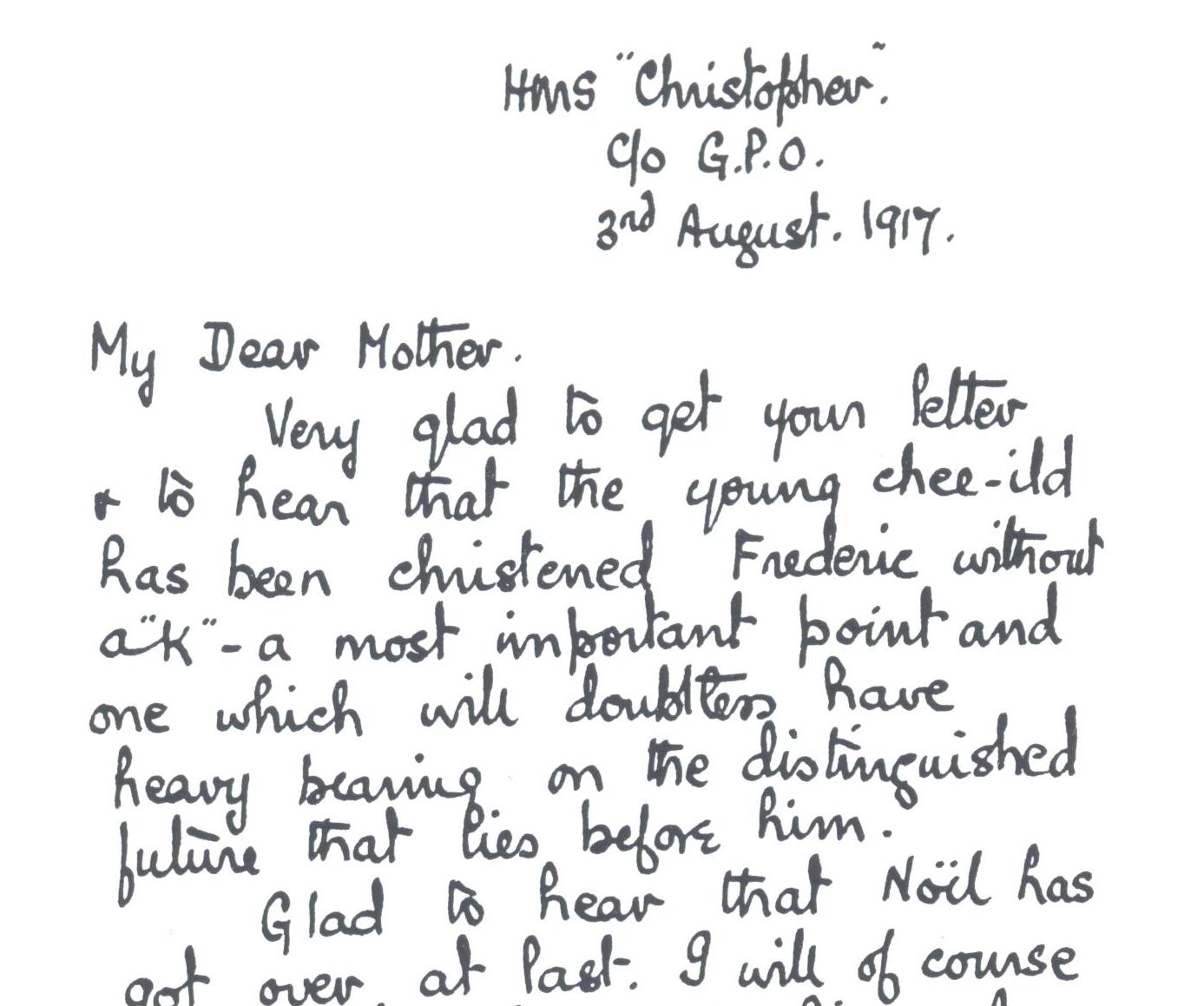
FTP navy service file showing the correction

Thirdly, Fritz makes clear how he wished his name to be spelled in letters home in 1917 when he was in command of the destroyer HMS Christopher.  Below are scans of the letters and transcription of the text referring to the spelling of Frederic.  The issue arose when his sister Helen Dewdney gave birth to her first, and only, son on May 2, 1917 and said she wanted Fritz to serve as Godfather and to name the boy with Fritz`s official first name of Frederic.  The boy was named Frederic Hamilton Bruce Dewdney, and he would serve as a lieutenant with the Royal Canadian Navy in the Second World War on Fairmile motor launches in anti-U-Boat patrols off the east coast of Canada.  After the war he worked as a lawyer with Cominco Ltd. in Trail, B.C., retiring in 1982.  He died in Trail Nov. 28, 2008 at age 91.  Ironically, he used the “Frederic” name even less than his uncle Fritz did.  From an early age, the boy was known by his nickname Peter.  As an adult, he had his name legally changed to Frederic Hamilton Peter Dewdney.

Transcription — June 2, 1917 letter from Fritz Peters to his mother Bertha:  Dear Mother, Many thanks for your letter of May 4th which I have just received. I am delighted to hear this news of Helen and of course I should be equally delighted to be his Godfather. Be careful to spell his name without the “k” — Frederic — saves ink — war economy. Anyhow it’s how I spell mine…

June 2, 1917 letter re Frederic spelling (he mistakenly lists the date as 1916, but it has to be 1917 because it refers to the boy`s birth in May 1917)

2. Transcription — August 3, 1917 letter from Lieut. Fritz Peters to his mother: My Dear Mother, Very glad to get your letter and to hear that the young chee-ild has been christened Frederic without a “k” — a most important point and one which will doubtless have heavy bearing on the distinguished future that lies before him.

August 3, 1917 letter from Fritz to his mother

Older Entries Newer Entries