Book launch event December 15th at Touchstones in Nelson, B.C.

2 Comments

Sam McBride, author of “The Bravest Canadian – Fritz Peters, VC: The Making of a Hero of Two World Wars” will launch the book in Nelson, British Columbia on Saturday, December 15th

He will be in the lobby of the Touchstones Nelson – Museum of Art and History at 502 Vernon Street in Nelson from 1 pm to 3 pm.

While Capt. Frederic Thornton “Fritz” Peters never lived in Nelson himself, his mother Bertha Gray Peters and his sister Helen Dewdney and her family resided in Nelson from 1929 to 1969.  Previously, they lived in the nearby West Kootenay communities of New Denver, Rossland and Trail as Helen’s husband Ted Dewdney was transferred around the region to manage branches of the Bank of Montreal.  

After Capt. Peters’ death in an air crash near Plymouth, England in November 1942, a delegation from President Roosevelt and General Eisenhower came to Nelson in February 1944 to officially present the U.S. Distinguished Service Cross medal he earned for action in the harbour of Oran, Algeria to his mother Bertha Gray Peters as next-of-kin. 

In 1946, a mountain on the west edge of Nelson was named Mount Peters in his honour.  Since then, Helen Dewdney’s children and descendants have donated a number of artifacts and photographs to the museum and archives in Nelson, mostly related to the Hon. Edgar Dewdney, builder of the Dewdney Trail, who was Ted Dewdney’s uncle and legal guardian after Ted’s parents died when he was 11. 


70 Years Ago Gen. Eisenhower Awarded U.S. DSC to Capt. Frederic Thornton Peters

Leave a comment

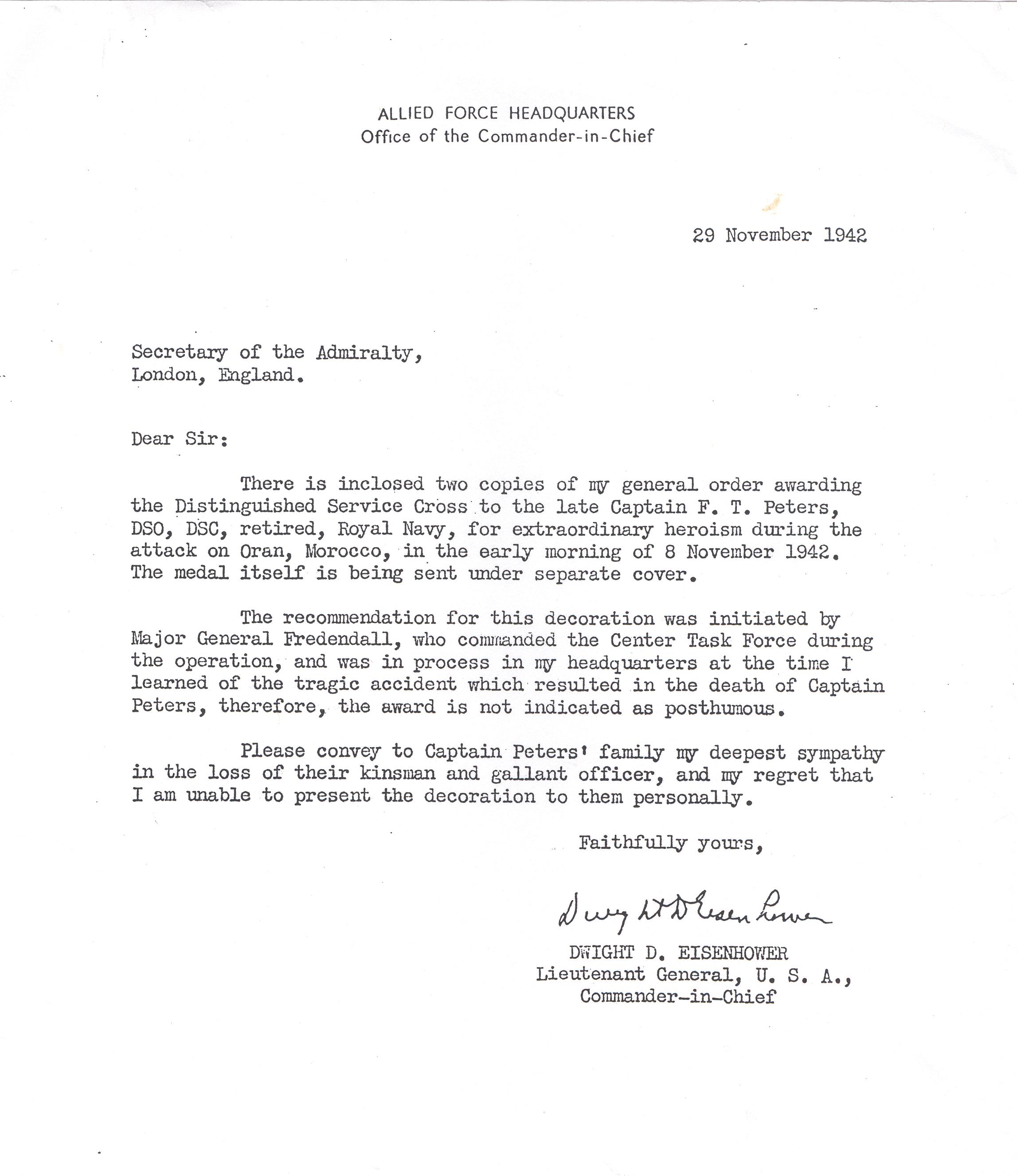
ABOVE: Nov. 29, 1942 letter from Eisenhower (Peters Family Papers).

In the letter above, dated Nov. 29, 1942, Lt. Gen. Dwight D. Eisenhower, overall commander of Operation Torch, the Allied invasion of North Africa, advises the British Admiralty that he is awarding the U.S. Distinguished Service Cross to Acting Captain Frederic Thornton “Fritz” Peters of the Royal Navy.

The letter was forwarded to Peters’ mother as next-of-kin as a memento of her son who tragically died when the flying boat transporting him back to England crashed in heavy fog in Plymouth Sound in the evening of Nov. 13, 1942. It was likely sent to Mrs. Peters in 1943 by either Adm. A.M. Peters (no relation to Fritz) or Adm. Sir Frederick Dalrymple-Hamilton, both of whom served terms as Secretary of the Admiralty and wrote letters to Mrs. Peters in response to her inquiries after Fritz’s death. While A.M. Peters was a casual acquaintance of Fritz, Dalrymple-Hamilton was a longstanding friend and naval colleague who was a fellow student with Fritz at Cordwalles Boys School in Maidenhead in the 1901-1904 period. The letter was retained by Mrs. Peters and her descendants, and is part of the Peters Family Papers on which the new book “The Bravest Canadian — Fritz Peters, VC: The Making of a Hero of Two World Wars” is based.

In the letter Eisenhower applauds Peters for “extraordinary heroism during the attack on Oran, Morocco in the early morning of 8 November 1942”. It is interesting that Eisenhower mistakenly says Oran is in Morocco, when it is actually the second largest city of Algeria. This may have just been a clerical oversight, or it may be a reflection of Eisenhower’s poor knowledge of North Africa geography.

It is also interesting that Eisenhower says Gen. Lloyd Fredendall, in command of the Centre Task Force to capture Oran in Operation Torch, had made the recommendation for Fritz’s American DSC medal. Fredendall strongly disliked his British allies and encouraged his staff to mock them with fake English accents. At the time this letter was written, Eisenhower was still a strong supporter of Fredendall, but in February 1943, after the humiliating defeat at Kasserine Pass, Fredendall was replaced as commander of II Corps by Gen. George S. Patton, and sent back to the States.

Oak Bay News reports on “The Bravest Canadian”

1 Comment

by Sam McBride

The October 20, 2012 issue of the Oak Bay News has a feature titled “Oak Bay Man a Forgotten Hero” about the new biography “The Bravest Canadian — Fritz Peters, VC: The Making of a Hero of Two World Wars”.

See the story at the following link:
http://www.oakbaynews.com/community/175002621.html

The community of Oak Bay, located immediately east of Victoria on the southeastern top of Vancouver Island in British Columbia, Canada, has a significant connection to the Fritz Peters story because he moved there from his native Prince Edward Island at age eight in 1898 with his family when his father Frederick Peters moved west to establish a law partnership in Victoria with fellow lawyer and politician Sir Charles Hibbert Tupper. Fritz lived in Oak Bay until joining the Royal Navy at age 15 in 1905, aside from time in England at the Bedford and Cordwalles boys’ schools.

Peters and Tupper built complementary, adjoining houses near York Place at Prospect Point in a new property recently developed by renowned architect Francis Rattenbury. J.R. Tiarks of the Rattenbury firm designed the Tupper and Peters house. The Tupper home took the name of “Annandale” and the Peters home was “Garrison House”. The family sold the house in about 1908 and moved to Esquimalt, and then three years later to Prince Rupert.

Seventieth Anniversary of Fritz Peters’ Victoria Cross Action of Nov. 8, 1942

Leave a comment

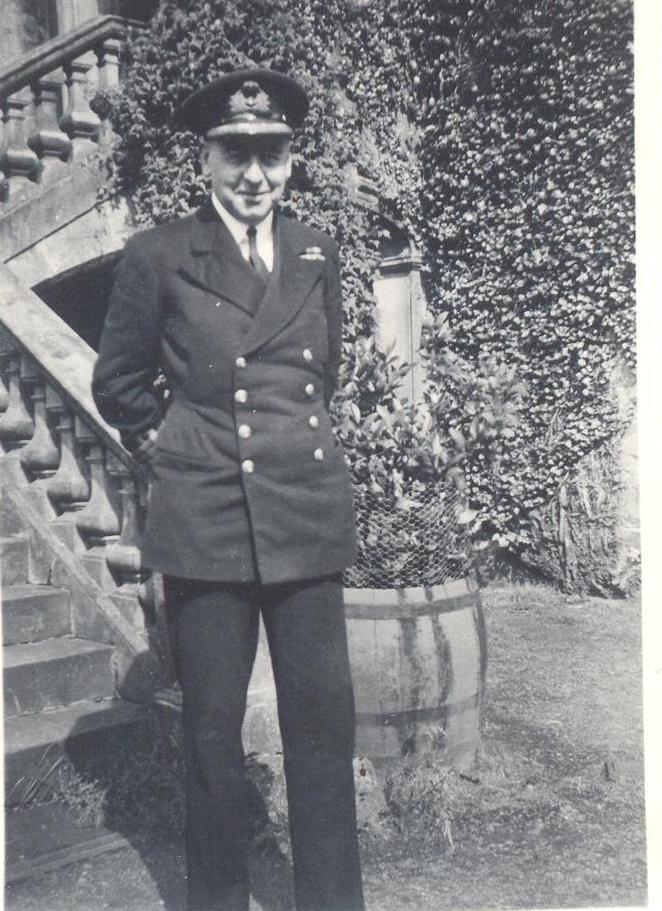
Capt. Frederic Thornton “Fritz” Peters, at Cleish Castle in Scotland, circa spring 1942. (McBride Collection)

November 8, 2012 will mark the 70th anniversary of the Allied invasion of North Africa, code-named Operation Torch, a turning point in the Second World War.

The date is also the 70th anniversary of the action in the harbour of Oran, Algeria which earned Canadian Capt. Frederic Thornton “Fritz” Peters, VC, DSO, DSC and bar, DSC (U.S.), RN the Victoria Cross and the U.S. Distinguished Service Cross – the highest awards for valour offered by Britain and the United States.

Born in Charlottetown, Prince Edward Island and raised in Victoria, British Columbia before joining the Royal Navy at age 15 in 1905, Peters is unique among Canadian war heroes in receiving multiple awards for valour in both World War One and World War Two.

The story of Fritz Peters is told in the new biography “The Bravest Canadian – Fritz Peters, VC: The Making of a Hero of Two World Wars”, by Trail, B.C. writer Sam McBride. The main sources used by the author are a recently-discovered collection of personal letters, photographs and other documents that reveal Peters’ personality, motivations and remarkable fearlessness and cool demeanor in battle.

Published by Granville Island Publishing of Vancouver, B.C., the book will be available in book stores, through amazon.com and in electronic formats in November 2012.

The invasion of Vichy French territory was the first large combined operation of British and American forces. The initial targets of the invasion were the two largest cities and ports in Algeria, Oran and Algiers, as well as Casablanca in Morocco.

The harbour attack began on Sunday, November 8, 1942 at 3 am — two hours after the first Allied troops landed on beaches on the west and east flanks of Oran — as the cutter HMS Walney at top speed smashed through the harbor boom, followed immediately by its sister ship HMS Hartland. Despite heavy fire from all directions and 90 per cent casualties among the crew, Peters was able to maneuver Walney close to its target landing site a mile and a half within the congested harbour.

Peters and other survivors were taken prisoner by the French defenders, but released two days later when the city surrendered to advancing American troops. Peters was carried through the streets of Oran as a hero, but tragically he died in the evening of Friday, November 13, 1942 when the flying boat transporting him back to England to report on the action to Prince Minister Winston Churchill crashed in heavy fog in Plymouth Sound.

The surrender of the last Nazi forces in North Africa in May 1943 in the French colony of Tunisia secured Allied shipping lanes in the Mediterranean and gave the Allies bases for subsequent invasions of Sicily, mainland Italy and France.

Fritz Peters’ Cadet Report in 1906

Leave a comment

by Sam McBride

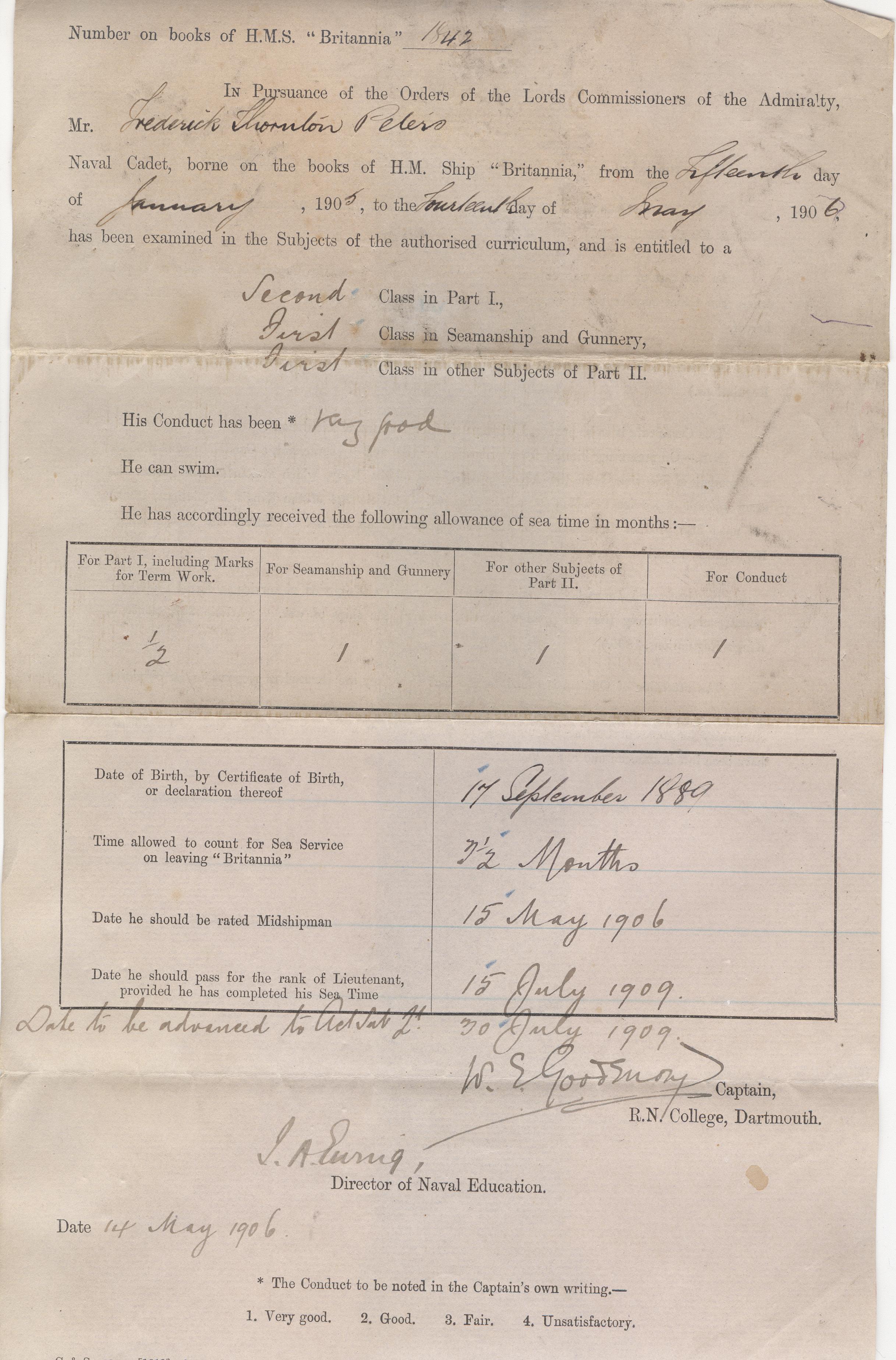
The Peters Family Papers contain a wide array of personal letters, photographs, family history notes, and original documents such as the following report on his performance as a Royal Navy cadet on the training ship HMS Britannia from when he started with the navy on Jan. 15, 1905 until May 14, 1906.

Memorabilia such as this is the basis for my new book “The Bravest Canadian — Fritz Peters, VC: the Making of a Hero of Two World Wars”, to be released by Granville Island Publishing in September 2012.

November 8, 2012 will be the 70th anniversary of the action against Vichy French forces in the harbour of Oran, Algeria which earned Peters the Victoria Cross and the U.S. Distinguished Service Cross.

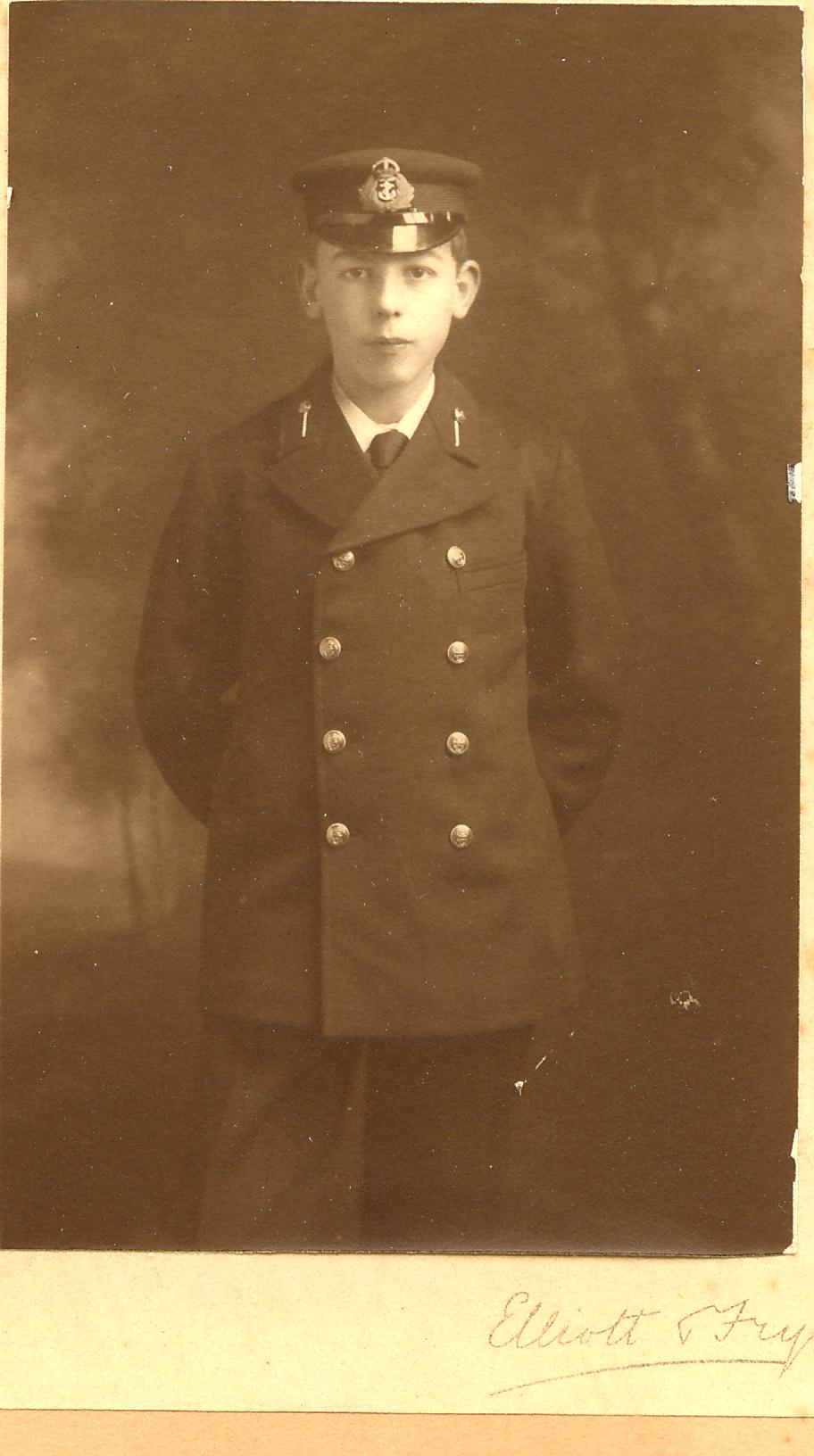
Frederic Thornton “Fritz” Peters in about 1906 (McBride Collection)

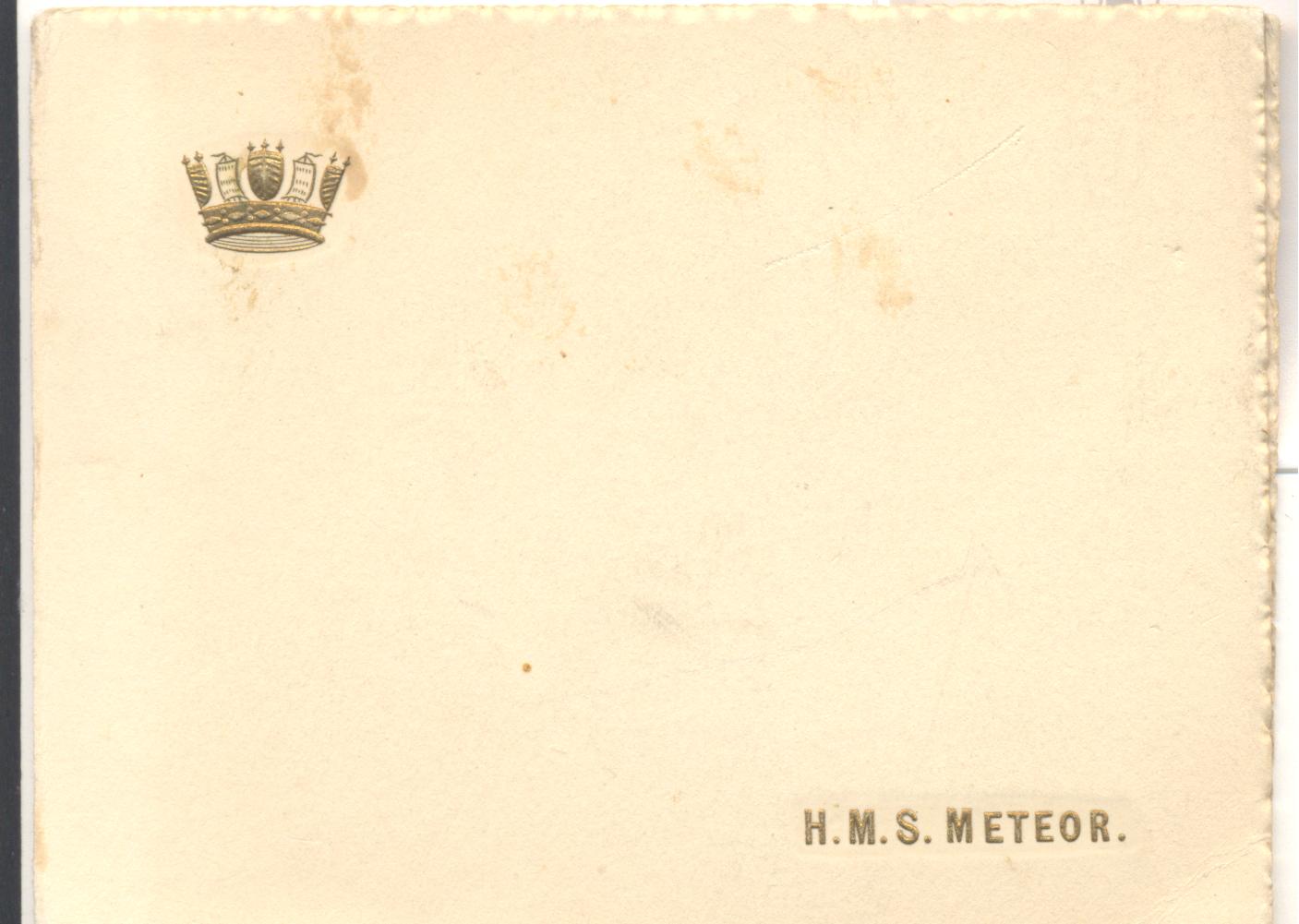
1914 Christmas card from Frederic Thornton Peters on HMS Meteor

Leave a comment

by Sam McBride

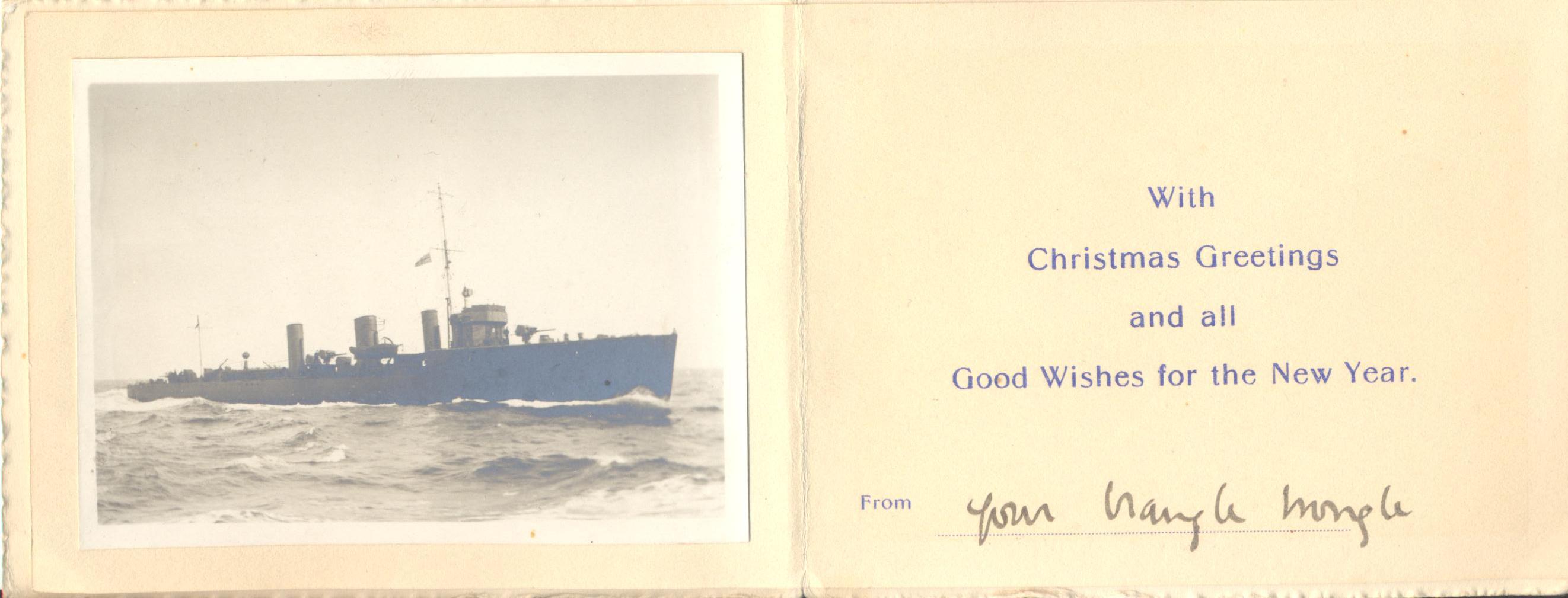
Among the memorabilia of Frederic Thornton “Fritz” Peters, VC, DSO, DSC and bar, DSC (U.S.), RN that exists today in the family collection is a Christmas card he sent home to his parents and siblings in Prince Rupert, British Columbia in December 1914.

Scans of the front and inside of the card are shown below.  The back of the card was blank.  The pre-printed message in the card is “With Christmas Greetings and all Good Wishes for the New Year.”  Then, in Fritz’s handwriting, is a personal message which I have not yet been able to figure out.  It looks like “Your hangle mongle”.  Members of the family often used nicknames and pet phrases in letters to each other, but this is not repeated in any other correspondence.

front of 1914 Christmas card

Fritz had served in the Royal Navy from 1905 until retiring in 1913, and then rejoined the navy at the outbreak of war in August 1914, serving as a lieutenant second-in-command of the destroyer HMS Meteor out of Devonport.  His service on Meteor drew front page news coverage on two occasions.  First, in October 1914 Meteor stopped the German hospital ship Ophelia after a sea battle off Texel Island.  After search and interrogation, Fritz and other Meteor officers concluded the ship was scouting for German submarines, and directed it to Yarmouth where it was converted for British use.

inside 1914 Christmas card

In January 1915 in the Battle of Dogger Bank in the North Sea, Meteor ‘s engine room was hit by an 8.2-inch shell from the German cruiser Blucher.   In the face of flames and bursting boilers, Fritz courageously rushed straight to the engine room, saved the lives of two ratings and prevented further damage to the ship from explosions.  He was Mentioned in Dispatches and then in March 1915 received the Distinguished Service Order (DSO) medal from King George the Fifth.  For a naval officer, the DSO was second only to the Victoria Cross as an award for valour.

There was talk among Fritz’s naval colleagues and friends that his actions at Dogger Bank could have qualified for a Victoria Cross.  It may have made a difference if he was in command of the warship rather than a “Number One” (second-in-command).  In November 1915 Fritz was placed in command of the HMS Greyhound.

In 1918 Fritz received his next major award for valour in battle, the Distinguished Service Cross, for anti-submarine heroics.  Returning for Royal Navy service in the Second World War, he won a bar to his Distinguished Service Cross in 1940, and then won the Victoria Cross and U.S. Distinguished Service Cross for gallantry in leading the attack through the boom of Oran harbour in the Allied invasion of North Africa of November 1942.

My book The Bravest Canadian about the extraordinary two-world-war naval career and mysterious life of Frederic Thornton Peters in his native Canada — as well as exploits in Britain, Africa and around the world — will be published later this spring.

Family of Frederic Thornton Peters — Part Seven: sister Violet Avis Peters

Leave a comment

from Nov. 14, 1905 Victoria Daily Colonist

by Sam McBride

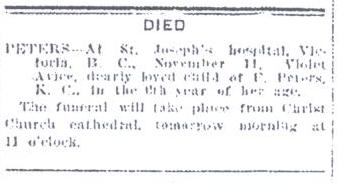
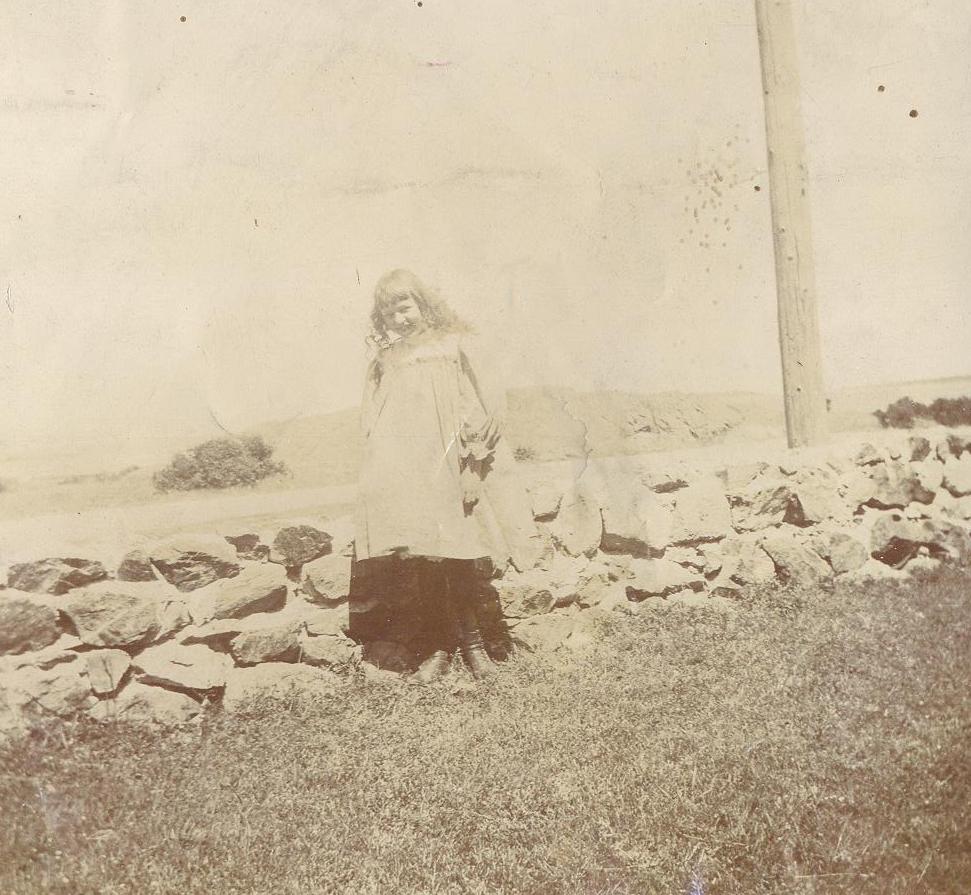
The death of Violet Avis Peters on Saturday, November 11, 1905 was the first of several tragedies to strike the family of Frederick Peters and Bertha Gray in British Columbia.

Violet

Many years later Helen said her little sister Violet “burned to death” in a fireplace accident at the family home in Oak Bay, on the eastern outskirts of Victoria.  Their house, a large seaside bungalow, had several fireplaces for heat.  Helen was 18 at the time of the tragedy, and Fritz was 16 and training as a cadet in Britain with the Royal Navy.   Of the other brothers, Jack was 14 and Gerald and Noel were 12.

We do not have details of what happened, but it appears a spark may have landed on her dress and set it on fire.  People often died from smoke inhalation in the panic of an accident such as this.  Fire was an ongoing hazard in that era.  Helen told her children how she used gasoline to wash clothes when she was a young woman.

The Victoria Daily Colonist said she was the “dearly loved child of F. Peters, KC” and she died at St. Joseph`s Hospital in Victoria.  The newspaper spelled her middle name “Avice”, but the death registration and cemetery record have it as “Avis”.

The funeral at 11 am on November 15, 1905 started at Christ Church Cathedral, the cathedral church of the diocese of British Columbia of the Anglican Church of Canada, at Rockland Avenue and Quadra Street and went from there to burial at nearby Ross Bay Cemetery.

Fourteen years later, in early August of 1919, her father Frederick Peters was buried in a plot next to Violet`s grave.   His tombstone included plates commemorating sons Gerald and Jack who died in the First World War.  A photograph taken soon after the father`s burial shows a small stone cross beside it with the words “Baby Violet”.   Today that small stone cross has disappeared, probably sunk into the soft, wet ground over time.

Violet Peters was listed as being one year of age as of March 31, 1901 in the Canadian census.   Strangely, there is no record for her birth in British Columbia, some time in 1899.  Records at the time were not as comprehensive as they are today.   For example, we know that her sister Helen`s husband Ted Dewdney was born Dec. 26, 1880 in Victoria, but there is no record of his birth in B.C. registrations.


Family of Frederic Thornton Peters — Part Three: his sister Helen Dewdney

Leave a comment

by Sam McBride

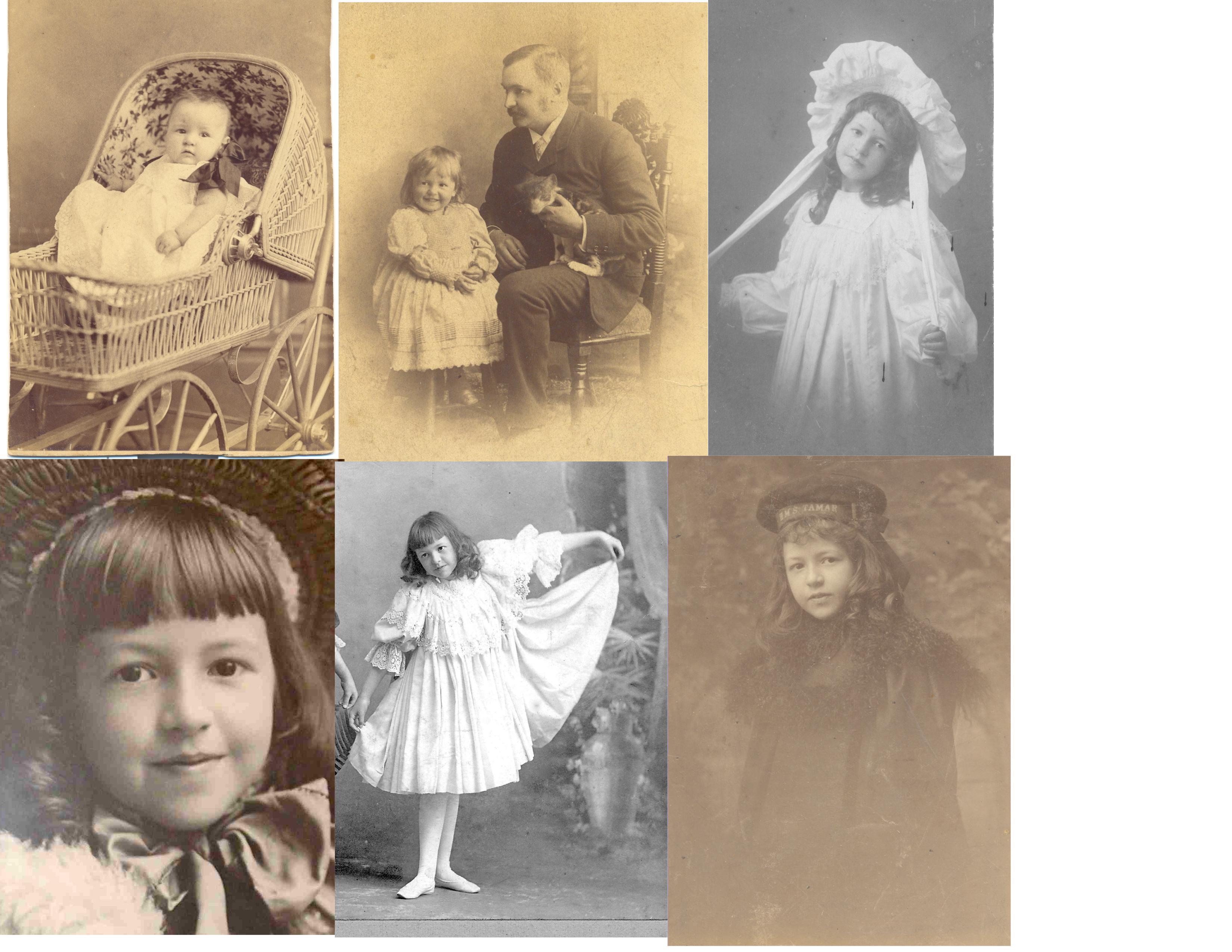
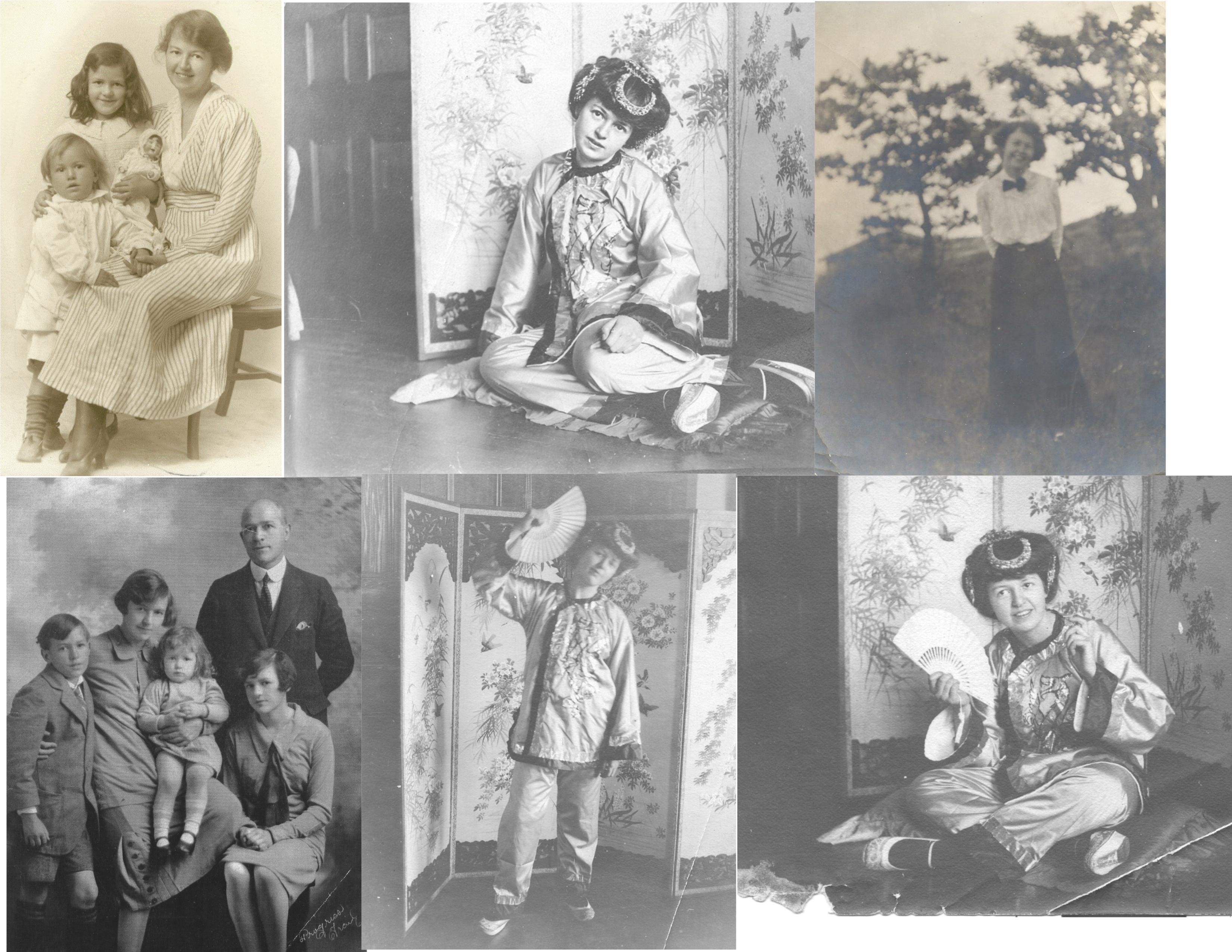
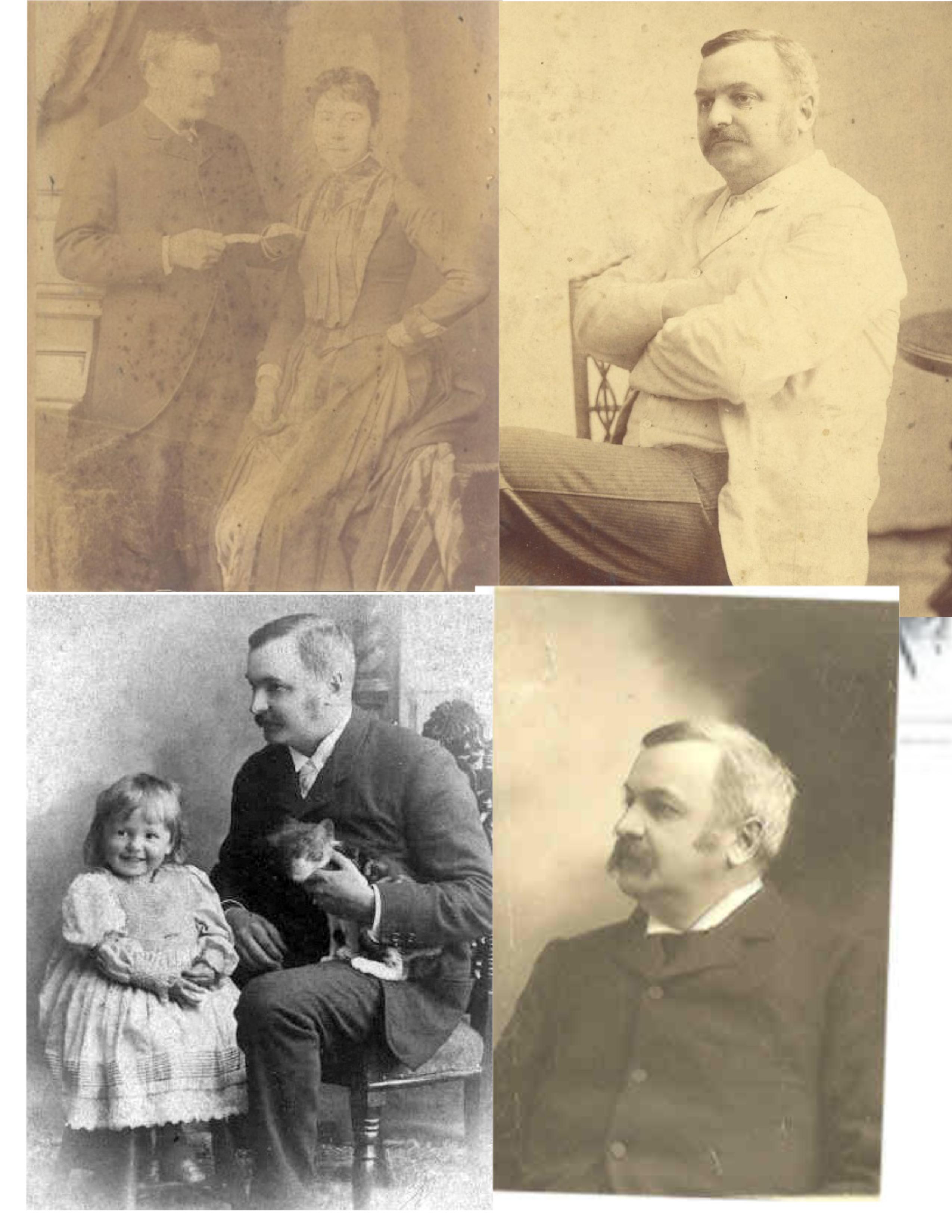
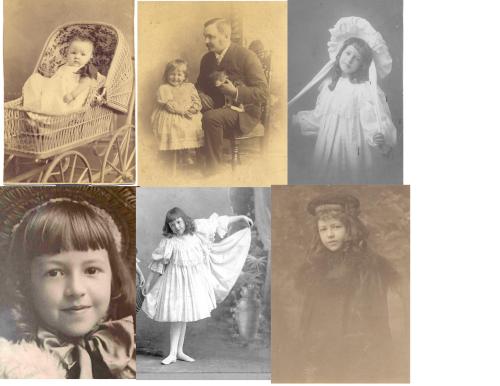
clockwise, from top left: baby Helen, 1887; with her father Fred and a cat, 1889; and four images of her as a young girl in Charlottetown (McBride Collection)

Mary Helen Peters was born in Charlottetown, Prince Edward Island on August 31, 1887.  She was always known as Helen by friends and in the family, and in later years was known as Gran to her three children and ten grandchildren and many of her younger friends.  The first of six children, she outlived all of them, including a younger sister who died in a fireplace accident, three brothers who died in the world wars, and another brother who had a mental disability.

At age eight in early 1898 she moved with her family across Canada by boat, trains and boat again to Victoria on Vancouver Island.  The sea was a constant in her youth, as she went from an Atlantic island to a Pacific island.
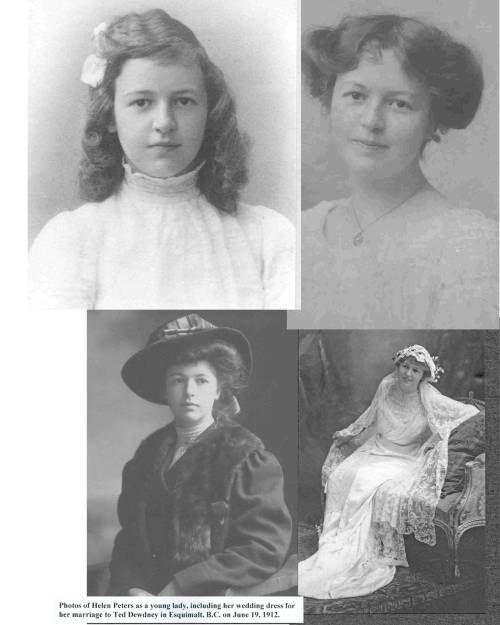
She went to schools in Charlottetown and Victoria, and then in 1900 went to Bedford in north London, England where she attended the Bedford School for Girls.  At the same time, her brothers Fritz and Jack attended the Bedford Grammar School.  It is likely they all stayed at the home of their mother Bertha`s stepmother, Sarah Caroline Cambridge Gray, who moved there after the death of her husband, John Hamilton Gray in 1887.  One of Helen`s memories from her time at Bedford was watching with her brothers on a London street in January 1901 as the funeral procession for Queen Victoria solemnly passed by.
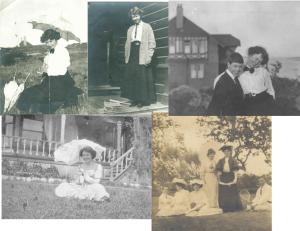
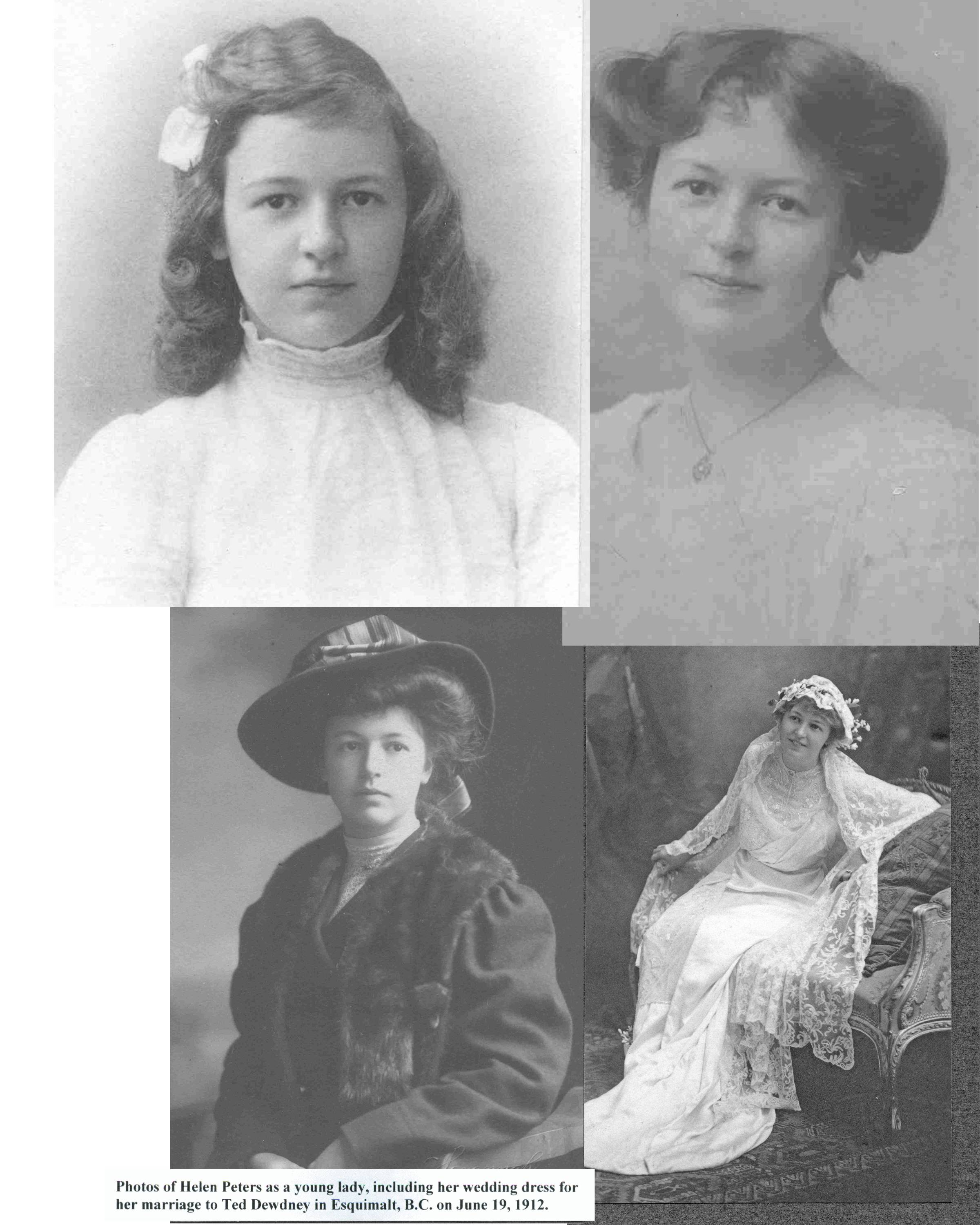
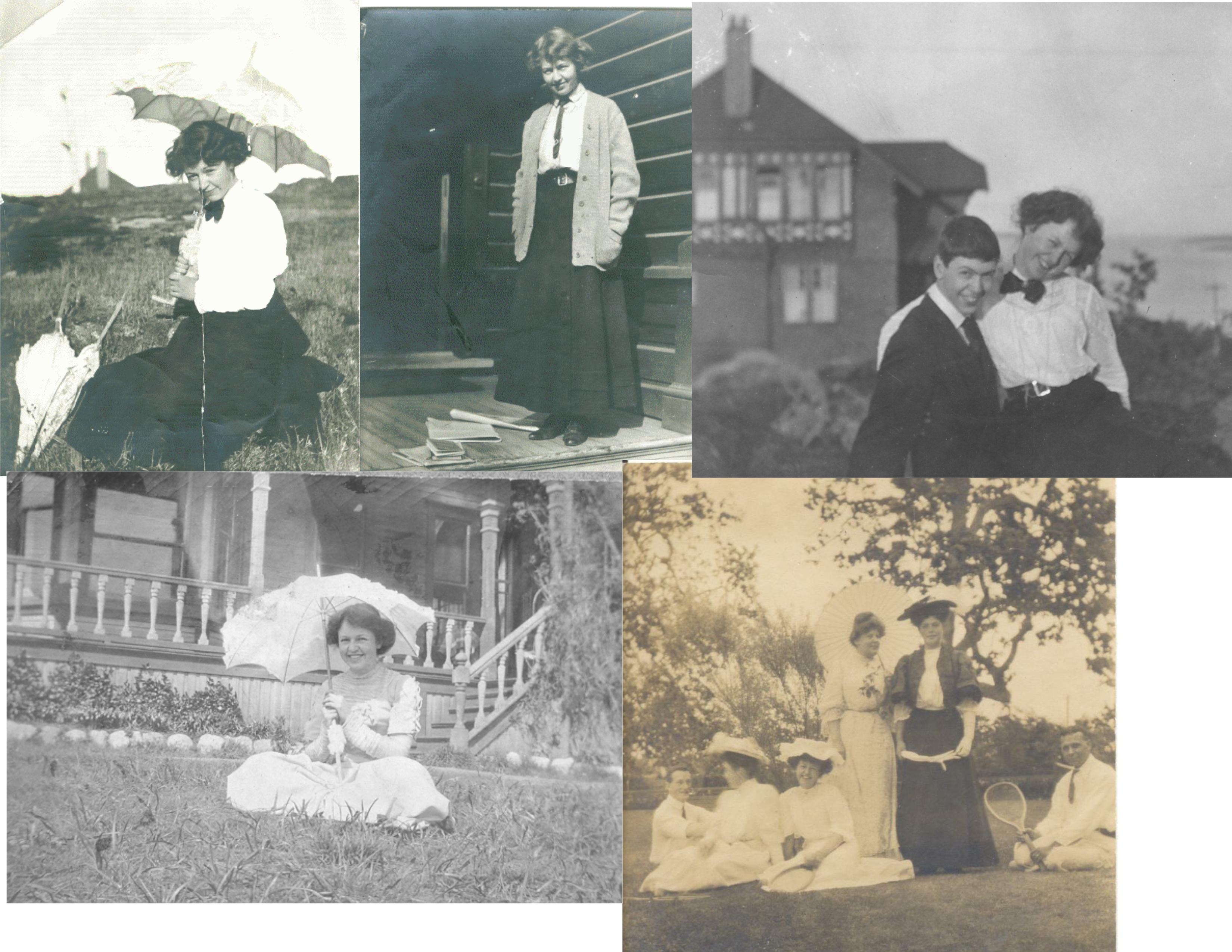
clockwise, from bottom left: three images of Helen as a young lady in Victoria; with her brother Gerald in the yard of their Oak Bay home; seen with tennis friends (McBride Collection)

Helen studied piano and music at the Royal Conservatory of Music in London, and became an accomplished pianist.

One of her father`s partners in business ventures in Victoria was the Hon. Edgar Dewdney, the former trail-builder, federal cabinet minister and B.C. lieutenant governor.  Dewdney was uncle and guardian of Edgar Edwin Lawrence “Ted” Dewdney, born December 26, 1880 in Victoria.  Ted`s mother Caroline Leigh died when Ted was four and his father Walter Dewdney died when Ted was 11.  Ted lived with his uncle Edgar and aunt Jane between 1892 and 1897 at Cary Castle in Victoria when it was the official residence of the Lieutenant Governor.
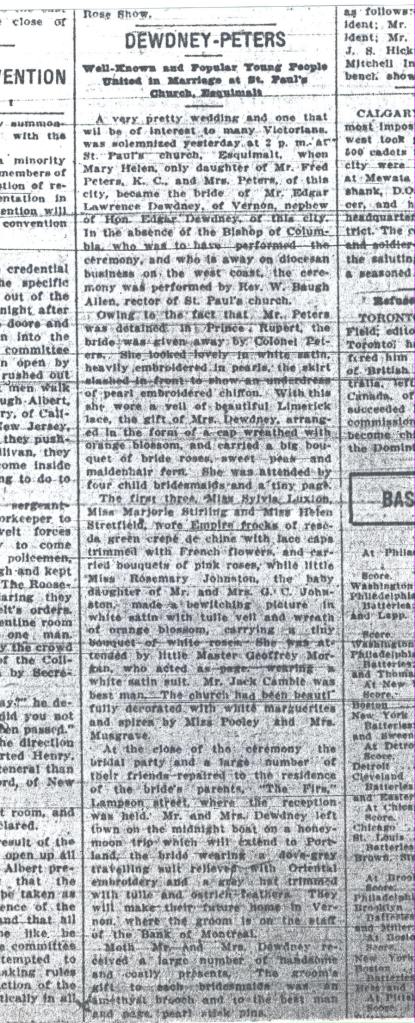
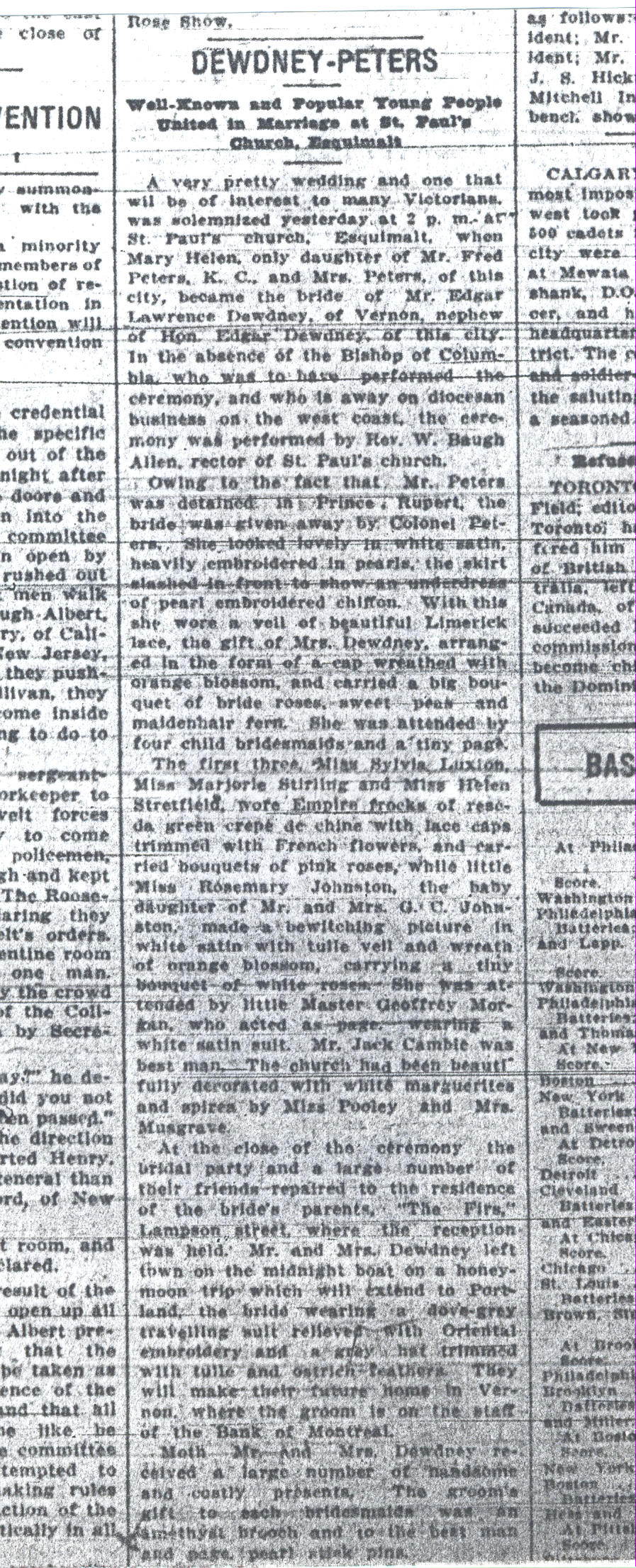
Victoria newspaper report of her wedding

A  keen student of history and literature, Ted wanted to go to university, but his uncle insisted he enter the banking world at an early age.  Ted began as a clerk for the Bank of Montreal in Victoria in December 1897, and was subsequently transferred to the bank branches in New Westminster, Greenwood, Rossland and Armstrong before returning to Victoria in 1908.

Ted was athletic and an outstanding tennis player, winning the West Kootenay Tennis Championship three times in the early 1900s while residing in Rossland.  Helen was also a keen tennis player and participant in tennis-related social events in Victoria.  It is likely that the pair got to know each other in tennis activities or through the Anglican Church.

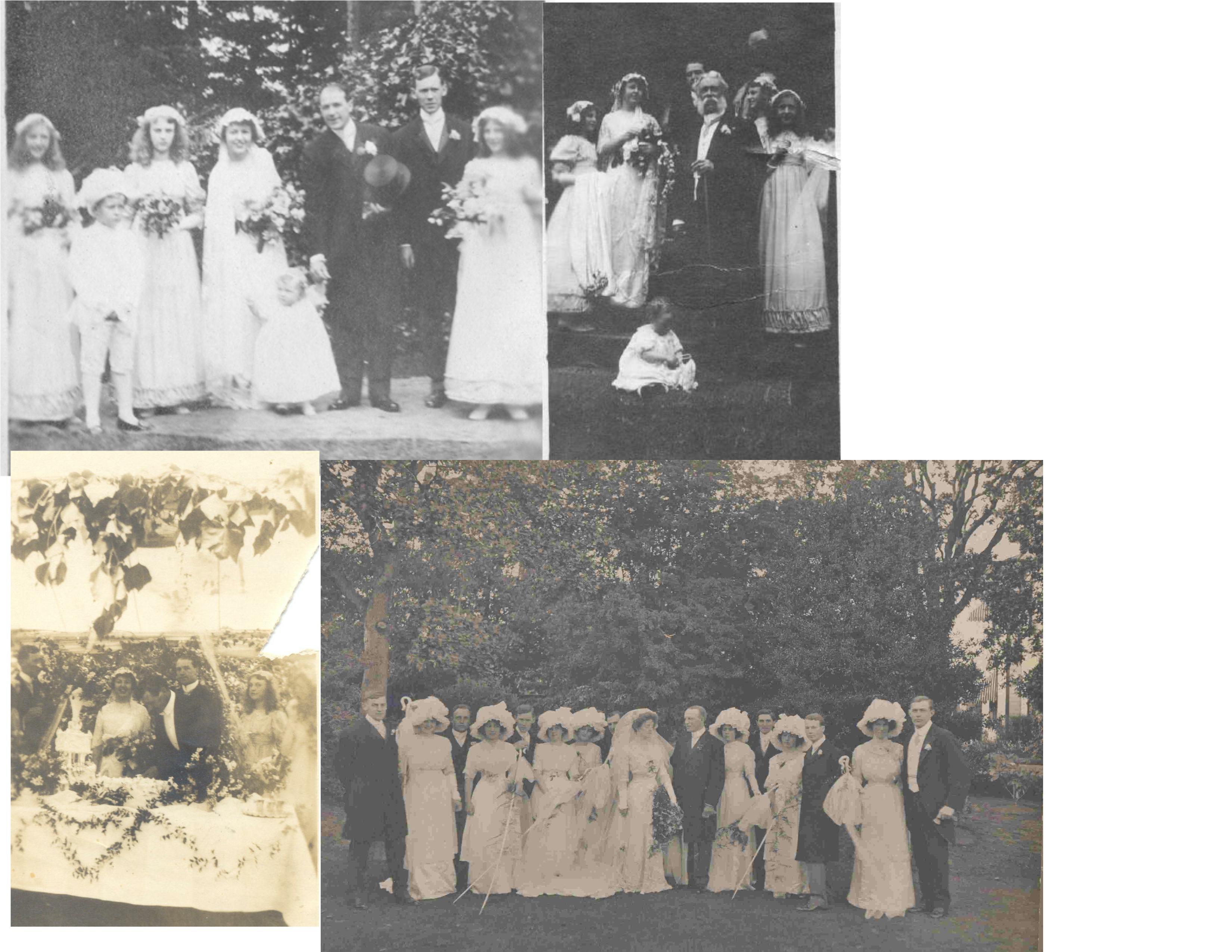
Ted and Helen married June 19, 1912 at St. Paul`s Anglican Church in Esquimalt, adjacent  to Victoria.  Her father Frederick Peters could not attend because he was tied up with his work in Prince Rupert.  He asked his cousin, Colonel James Peters, to fill in for him in “giving the bride away”.  Col. Peters had retired recently after an eventful 42-year career with the Canadian military, including many years in charge of West Coast defence.  When he arrived in Victoria in command of the first battery to defend Victoria and the Esquimalt Naval Base he was the first of the Peters clan to settle in B.C.  The wedding reception may have been something of a reunion for Col. Peters and another prominent guest, the Hon. Edgar Dewdney.  Twenty-five years earlier Dewdney was Lieutenant Governor of the Northwest Territories and Minister of Indian Affairs during the Riel Northwest Rebellion, in which Col. Peters (then a captain) was in charge of an artillery battery and was honoured with a Mention in Dispatches.  For further information on Col. Peters, see http://www.navalandmilitarymuseum.org/resource_pages/coastal_defence/james_peters.html.
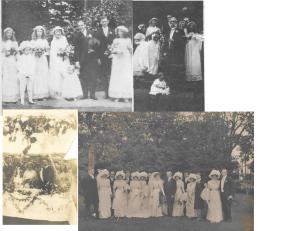
from bottom left: cutting the cake; the wedding party; Helen beside Ted`s uncle, Edgar Dewdney; Helen (fourth from right) as a bridesmaid for a friend`s wedding (McBride Collection)

Ted and Helen moved to Vernon in the Okanagan region of central B.C., where Ted worked as an accountant with the Bank of Montreal.   On Dec. 6, 1913, their first child, Evelyn Mary “Eve” Dewdney was born.

They were in Vernon at the outbreak of the First World War in August 1914.
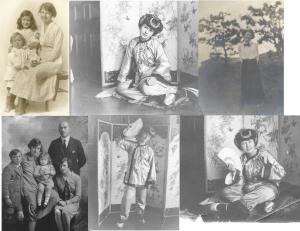
from bottom left: Helen and Ted with children Eve, Peter and Dee Dee, 1925; four images of Helen, including her costumes for local productions of Gilbert and Sullivan`s Mikado (McBride Collection)

Her brother Fritz had left the Royal Navy in 1913 after eight years of service.  With war declared, he caught a ride on a steamer going to Britain to rejoin the navy.  Her other brothers Jack, Gerald and Noel had all taken militia training in Victoria and later in Prince Rupert with the Earl Grey Rifles.  Each of them went to enlist in the army but only Jack was accepted.  Tall and thin, Gerald`s chest measurement was below army standards so he failed the physical examination.  Noel was rejected because of his mental disability, which was actually not as bad as it seemed in his appearance.  Gerald went to Montreal to try to enlist, and this time he was accepted.  Noel wasn`t accepted for service until May 1917 when he joined the Canadian Forestry Corps in Britain.  At 33, Ted Dewdney was past ideal age for enlistment, and he was supporting a wife and child, so he did enlist.  If the war had come while he was still a bachelor, he would have rushed to enlist, as he had been extremely active in the Rocky Mountain Rangers militia when he was working as a bank clerk in Rossland in the early 1900s.

In 1915 Ted the Bank of Montreal  transferred Ted to its branch in Greenwood, a small mining community near the U.S. border and on the west edge of the West Kootenay region.  This was his first appointment as branch manager.  A year later he was transferred to manage the New Denver branch in the famous Silvery Slocan district.  Housing for the manager and his family was provided in quarters above the bank, which today serves as the community`s museum.

The period from late May 1916 to late July 1916 was a time of anxiety and sorrow for the Dewdney family.  First they heard that Helen`s brother Jack was not a prisoner of war as previously reported, and was now assumed to have died in April 1915 in the Second Battle of Ypres.  A couple of weeks later they heard that Gerald was missing, and by early July it was confirmed that he had died in the Battle of Mount Sorrel.  Helen`s mother Bertha, who had been residing in England since the late spring of 1915 so as to be close to her boys, was devastated by the deaths of two sons, particularly Gerald, with whom she was particularly close.  She felt she could not return to the house in Prince Rupert with so many memories of Gerald, so she went to live with Helen`s family in New Denver.  This arrangement would continue for 30 years until Bertha`s death at age 84 in 1946.

Their first and only son, Frederic Hamilton Bruce Dewdney, was born May 2, 1917 in New Denver.  He was named after his uncle Fritz, and Fritz was his godfather.  At an early age the boy picked up the nickname “Peter”, and he was known by that name the rest of his life.  As an adult he had his name officially changed to “Frederic Hamilton Peter Dewdney”.  He went by the name “F.H. Peter Dewdney” when he was the Progressive Conservative candidate in three federal elections in the Diefenbaker era.  Each time he was defeated by the popular NDP incumbent MP, Bert Herridge.

The Dewdney family moved to Rossland in 1920 when Ted was transferred to manage the Rossland branch.  A second daughter, Rose Pamela Dewdney, was born in Rossland June 29, 1924.  She acquired the nickname “Dee Dee” and was known by that name as a teenager and throughout her adult life.

The family moved to Trail in 1927 in line with Ted`s appointment there, and then to Nelson in 1929, where Ted retired from the bank in 1940 after 42 years of service.

In each community Helen was active in organizing musical and theatrical productions using local talent.  She would direct, act and play piano; Ted would be stage manager and treasurer for the productions; and they would enlist the help of people throughout the community to participate on stage or behind the scenes.

Throughout her life Helen was an ardent bridge player.  She and her mother rated each community in the West Kootenay region by the quality of its bridge players.
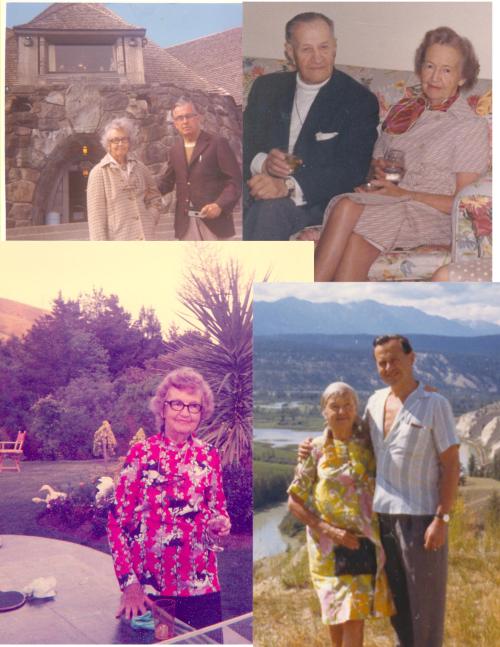
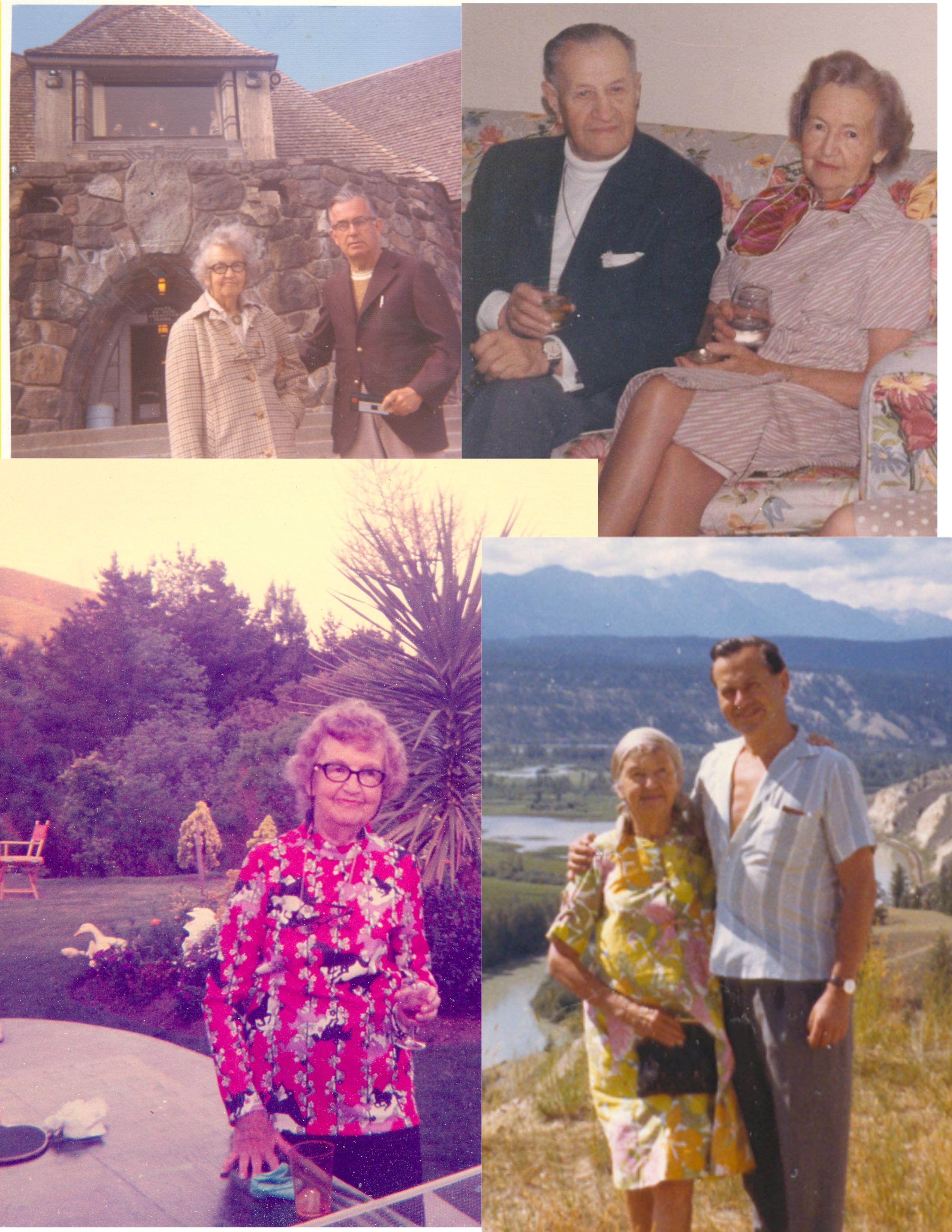
from top left: with Leigh McBride at Banff Springs Hotel; with Herbert Forbes-Roberts, father of Peter`s wife Maxine; with Peter; and in California (McBride Collection)

When Ted retired, the family had to leave the Bank House in Nelson, so he purchased a house at 820 Stanley Street in Nelson.  Eve had left home in 1933 when she married Sandon, B.C.-born mining engineer Jack Fingland and moved with him to Kimberley.  In 1935 Peter began studies at the University of Alberta, where he earned a bachelor’s degree and then a law degree in 1942.

from top left: Dee Dee, Ted and Helen; Ted and Helen; Helen with baby; Helen on visit to Mexico in 1950s; Helen and Eve in the Stanley Street home in Nelson. (McBride Collection)

After graduation he enlisted in the Royal Canadian Navy and trained at HMS Royal Roads on Vancouver Island.  In the war Lieut. Peter Dewdney served as an officer and commander of Fairmile motor launches in anti-U-Boat operations off Canada`s east coast.
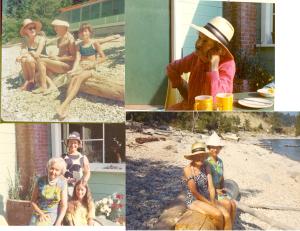
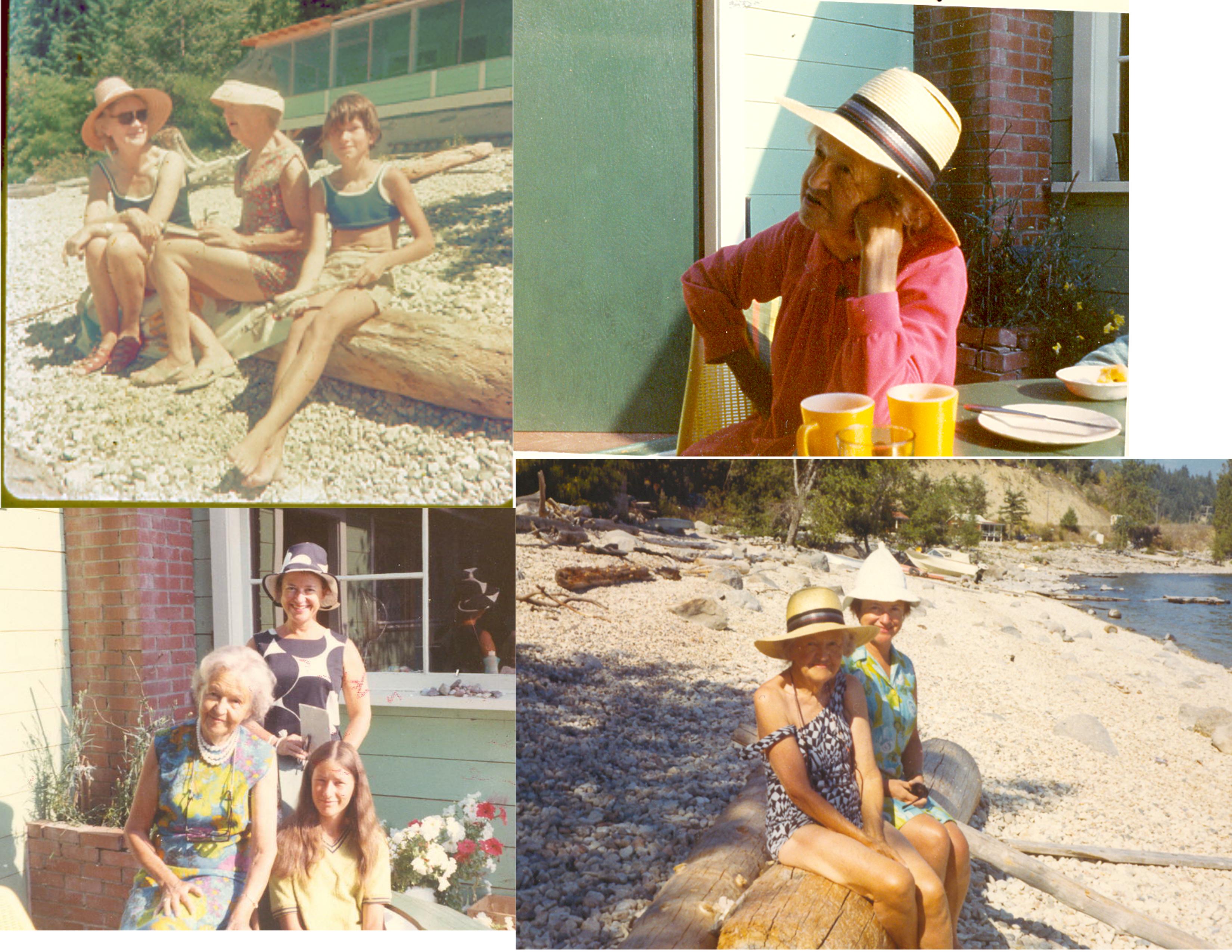
Helen with Dee Dee, granddaughter Eve and a visitor at the McBride cabin and beach at Queen`s Bay, near Balfour (McBride Collection)

Dee Dee earned a bachelor of arts degree at UBC and then a professional librarian certificate at the University of Toronto.   In 1944 Peter married Maxine Forbes-Roberts of St. John`s, Newfoundland, and in 1948 Dee Dee married Nelson lawyer Leigh McBride, who had served as a major in the Seaforth Highlander regiment of the Canadian Army in the Allied invasions of Sicily and Italy.

After Ted Dewdney`s death in 1952, Helen came to live with her daughter Dee Dee McBride`s family.  Helen moved with the McBrides to nearby Trail in 1969 when Leigh began working in the law department of Cominco Ltd.
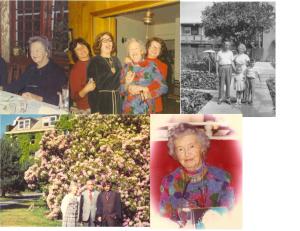
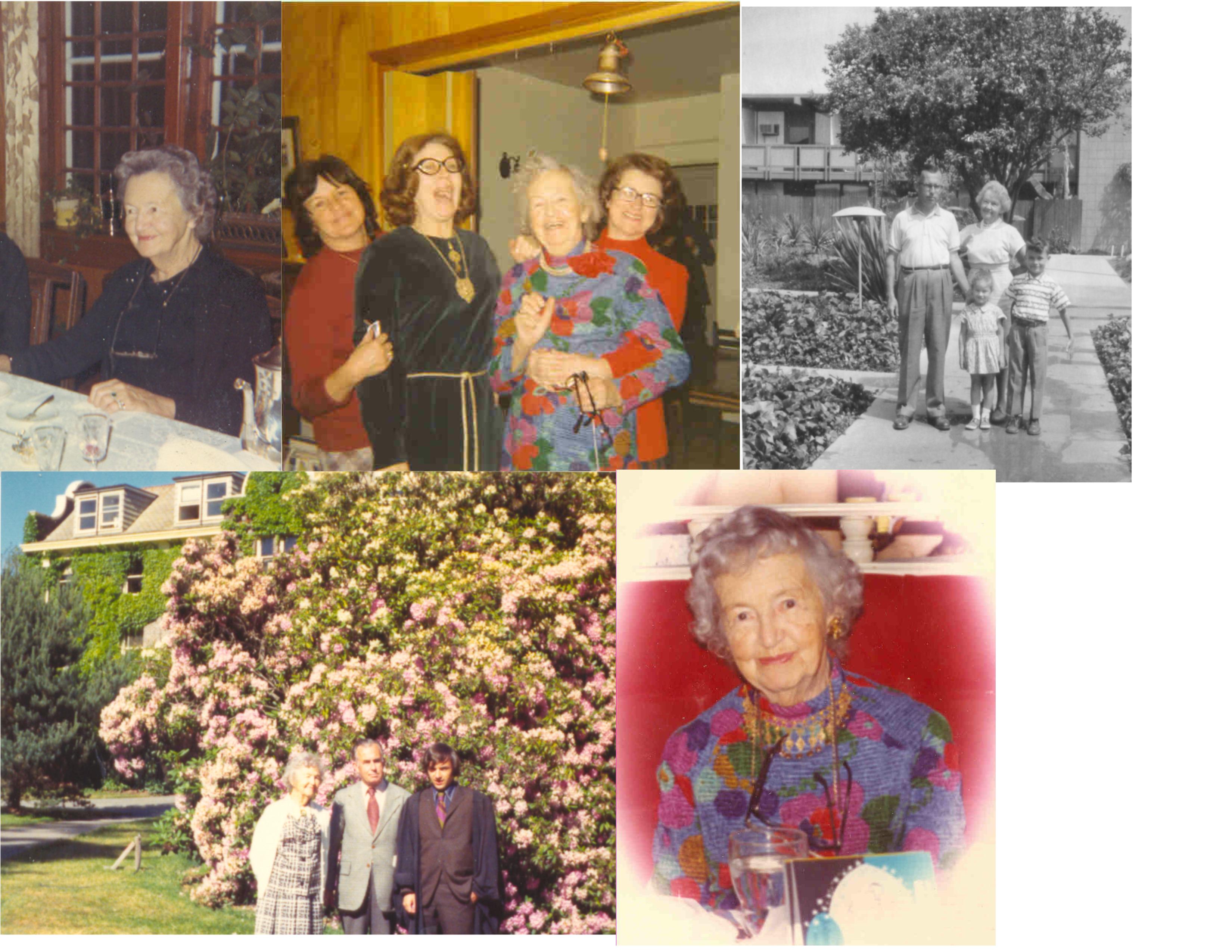
Helen with Leigh and Sam at University of Oregon graduation, 1973; Helen; Eve, Maxine, Helen and Dee Dee; Helen and Leigh with Sam and Eve; Helen in Las Vegas in early 1970s (McBride Collection)

Helen had several bouts with cancer in her last decade, and died in Trail November 27, 1976.
Family of Frederic Thornton Peters — Part One: his father, the Hon. Frederick Peters, Q.C.

5 Comments

by Sam McBride

Frederick Peters was born Charlottetown on April 8, 1851, the son of Judge James H. Peters of the Supreme Court of Prince Edward Island, and Mary Cunard, eldest daughter of Sir Samuel Cunard. He received his early education in Charlottetown schools and at Prince of Wales College before gaining a Bachelor of Arts degree from King’s College in Nova Scotia.


Following his graduation, Peters studied law in England and later returned to Charlottetown where he set up his first law practice. He was called to the bar at the Inner Temple, London in 1876, and to the bar of Prince Edward Island and Nova Scotia the same year.  In England he articled under Lord Alverstone, who later said Peters was the most brilliant student he ever had.  He established a law practice in Charlottetown with his brother Arthur Peters, who followed Fred`s schooling and legal career, almost step for step.

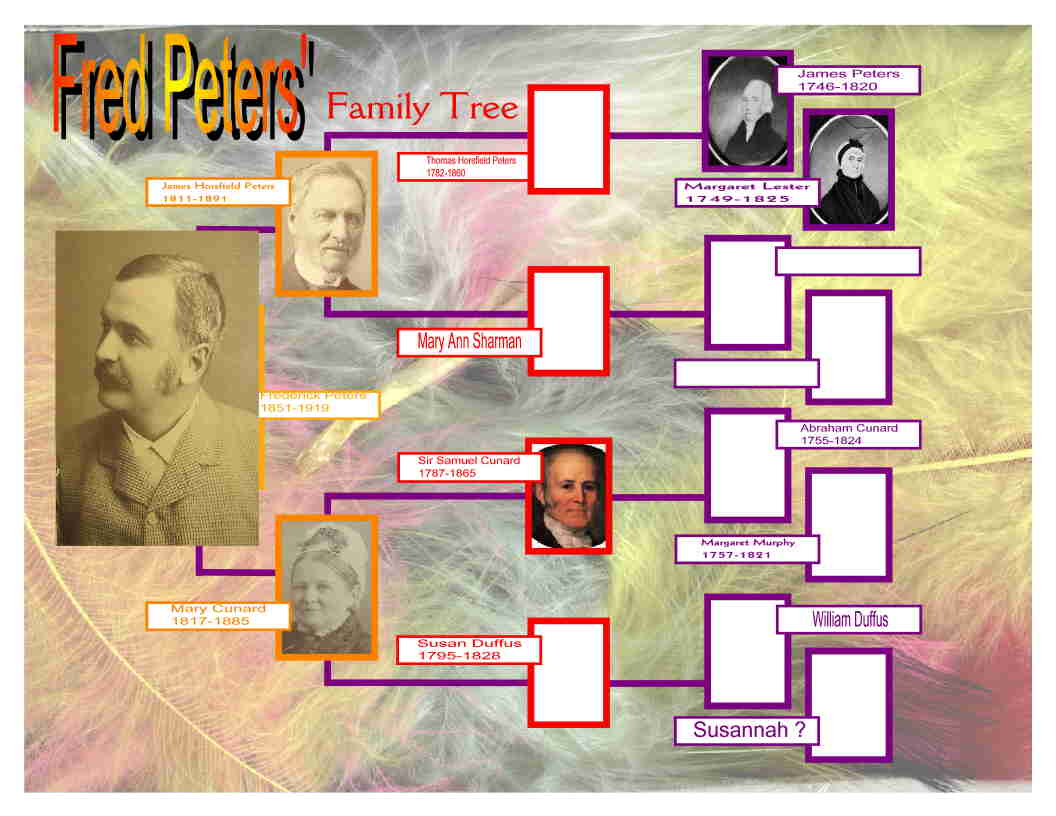
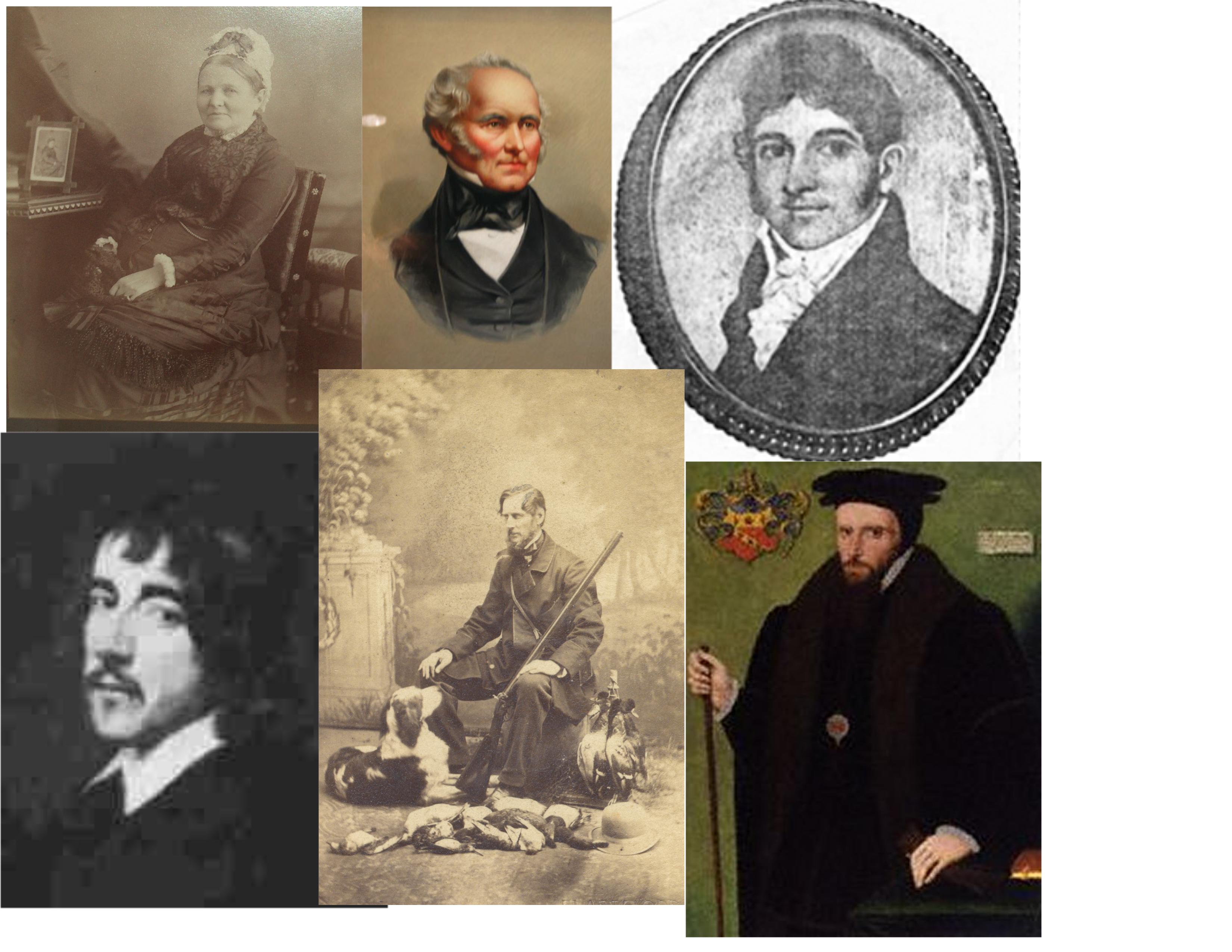
Famous ancestors, from top left: Mary Cunard, Sir Samuel Cunard, Loyalist James Peters, Tudor secretary of state William Petre, Judge James Horsfield Peters, the Rev. Hugh Peters, (McBride Collection)

Always a supporter of the Liberal Party, Peters was first elected to the House of Assembly in 1890. One year later, after a series of by-elections, the government of Neil McLeod found itself in a minority position and Peters was asked to take over the Premiership and form a government.  He became PEI`s sixth premier since Confederation, serving also as attorney general.  He was the first Liberal to lead the province.
Perhaps the most significant act during his term as Premier of Prince Edward Island was a bill changing the form of the Island Legislature. Previous to his administration, the Legislature consisted of two houses, a Legislative Council and a House of Assembly, much the same as the Senate and the House of Commons in the federal government of today. This system became unnecessary in Prince Edward Island and abolition of the Legislative Council was seriously looked at as a solution. However, such a bill did not have a chance of passing the Upper House so Premier Peters offered a compromise by abolishing both Houses and creating a Legislative Assembly in which members were referred to as Councillors and Assemblymen.

He served as premier and attorney general until resigning in October 1897 to move to British Columbia.  He retained his seat in the Prince Edward Island legislature until 1899 despite no longer residing in the province.  His brother Arthur became premier and attorney general in 1901, serving until his death in office in 1907.

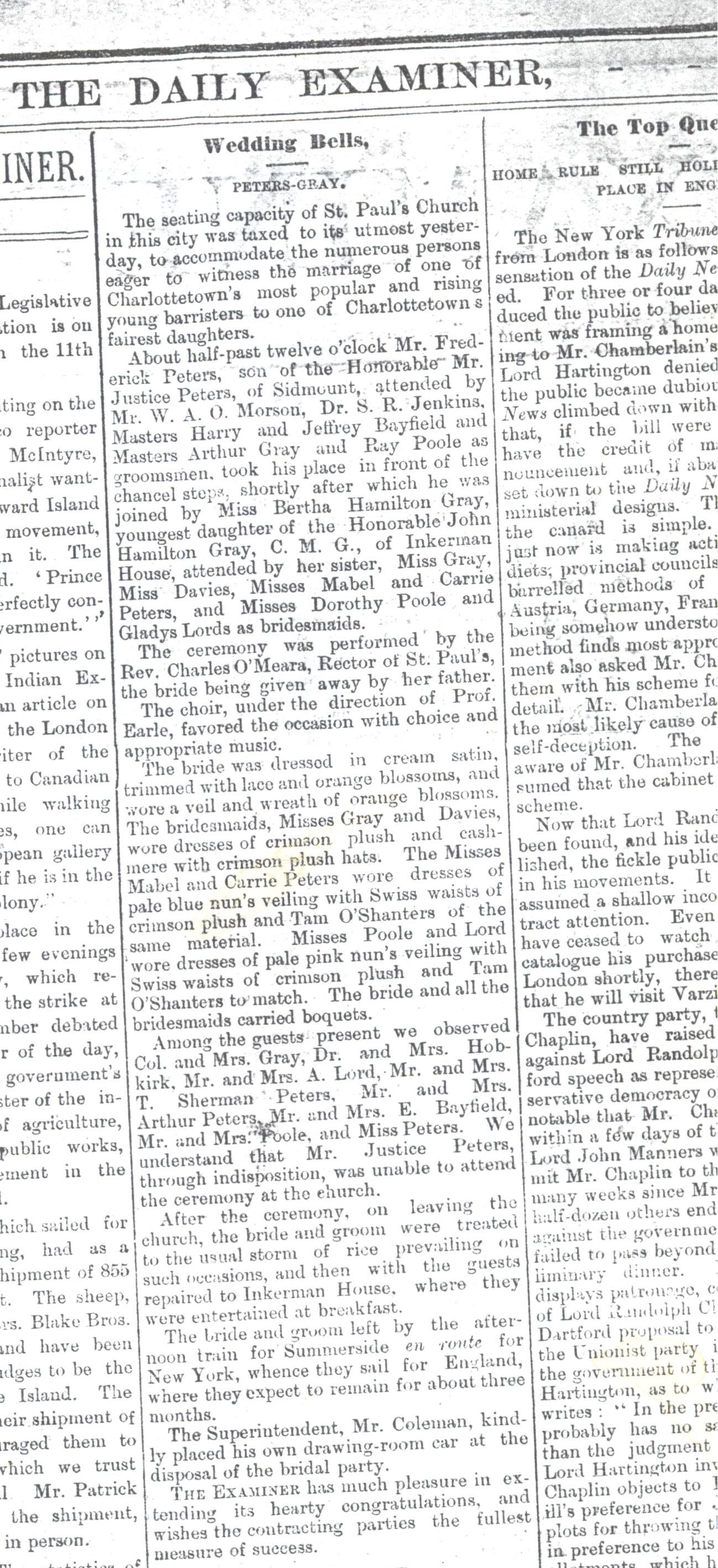
Charlottetown newspaper report of his 1886 marriage to Bertha Gray

Fred Peters was senior counsel for Great Britain against the United States of America in the Behring Sea Sealing Dispute.  Americans laid claim to all seal harvesting in the Bering Sea based on their purchase of Alaska from the Russians, but this was disputed by Britain, Canada and other countries. Peters` co-counsel was federal Conservative Marine and Fisheries Minister Charles Hibbert Tupper of Halifax. Tupper was a son of the Nova Scotia Premier and Father of Confederation Sir Charles Tupper who served briefly as Prime Minister of Canada in 1896. The August 1893 decision of an international arbitration panel solidly in favour of Britain’s position was a feather in the cap for Peters and Tupper, who was knighted.  Peters and Tupper also subsequently served as counsel in the Bering Sea Claims Commission.

In 1896 Frederick Peters attended the founding meeting of the Canadian Bar Association in Montreal and was elected as a vice president of the new organization.

While in Victoria, British Columbia for hearings in the Bering Sea sealing case, Peters and Tupper were impressed with the city`s scenery, mild weather and positive economic prospects, and vowed to move there some time in the future with their families.  Their plan to move across the continent and establish a law practice in Victoria was speeded up by excitement associated with the Klondike Gold Rush in the Yukon in the spring of 1897.  The paid wanted to get in on the prosperity of the gold rush in some way. They saw that the city of Victoria stood to gain as a supply point for people and goods going to and from the Klondike. Peters resigned as premier as of October 27, 1897.  He and Hibbert Tupper crossed Canada by train and arrived in Victoria on November 11, 1897.  Their law firm in the west coast capital was established as Tupper, Peters & Potts.

Clockwise, from top left: Fred and Bertha as a young couple, two photographs of Fred, and Fred shown in about 1889 with his daughter Helen and a cat. (McBride Collection)

Impressive homes were built on adjoining lots in 1898 for the Tupper and Peters families in the recently-developed community of Oak Bay, east of Victoria.

Peters invested heavily in mining ventures which faded away as the stampeders left the Yukon for new gold finds in Alaska. This was the start of money problems that would dog him and his family for the rest of his life. By 1902, Peters and Tupper had parted ways in their law firm.

The outcome of the Alaska Boundary Dispute in October 1903 was a huge disappointment for Canadians, especially for Peters, whose reputation suffered because of his involvement with the case as a researcher and his longtime association with Britain’s arbitrator Lord Alverstone, who stunned Canadians by casting the deciding vote for the Americans, who were still angry about losing the seal hunt arbitration a decade earlier.  U.S. President Theodore Roosevelt had threatened to send in the marines if the boundary dispute did not go his way, and Britain was not interested in battling the Americans so far away at a time when their focus was on the rising power of Germany close to home.

Peters found his law work bringing in much less income than he expected and needed, particularly as his wife Bertha wanted their children to attend private school in England.  In 1911 Peters took a job as Solicitor (lawyer) for the new city of Prince Rupert, which looked like it was about to boom as a result of the Grand Trunk Railway establishing a major port that would rival Vancouver in the extent of its business.   However, the boom never happened, and Peters found himself struggling each year to keep Prince Rupert from bankruptcy.  He took on the higher position of City Clerk in 1916.

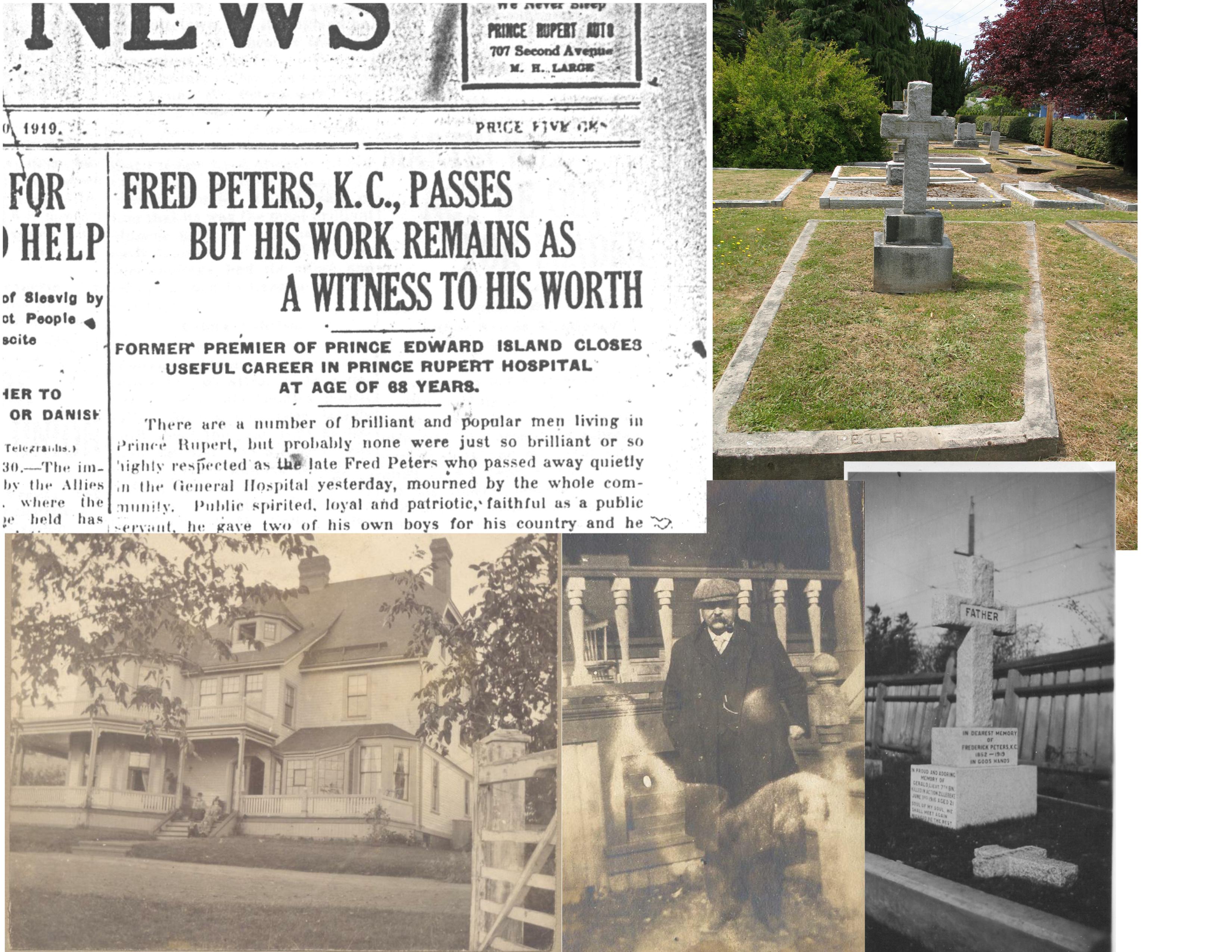
Clockwise, from centre bottom, Fred in about 1917 visiting his wife and daughter in New Denver; the Peters home in Oak Bay named Garrison House, c. 1900; Prince Rupert newspaper announces his death; his faded tombstone at Ross Bay Cemetery in Victoria in 2008; the tombstone when he was buried in 1919. (McBride Collection)

During the Great War Peters was regularly called upon to deliver speeches supporting the war effort to Prince Rupert community groups.  While he was proud of the honours won during the war by his eldest son Frederic Thornton “Fritz” Peters serving with the Royal Navy, the war hit his family hard, as son Private John Francklyn “Jack” Peters died in the Second Battle of Ypres in April 1915 and son Lieutenant Gerald Hamilton Peters died a year later in the Battle of Mount Sorrel.  His wife Bertha was in England when she learned of the death of her sons.  Instead of returning to Prince Rupert, where she would be haunted by the memories of her dead sons, she chose to live with her daughter Helen Dewdney in New Denver, B.C.  Fred Peters visited his wife at least once in New Denver, and the couple got together for a short holiday in the spring of 1919, but Fred was already in ill health by then.  He died July 29, 1919 alone in Prince Rupert.  According to his wishes, his funeral was in Victoria and he was buried at historic Ross Bay Cemetery in Victoria.

Souvenirs from the Victoria Cross centennial of 1956

Leave a comment

A schedule of special events in June 1956 marked one hundred years since the Victoria Cross was established by Queen Victoria in 1856 to honour the greatest acts of valour in the face of an enemy.

Living recipients throughout the Empire and Commonwealth were invited to attend the ceremonies.  In addition, next-of-kin of deceased VC recipients were invited.

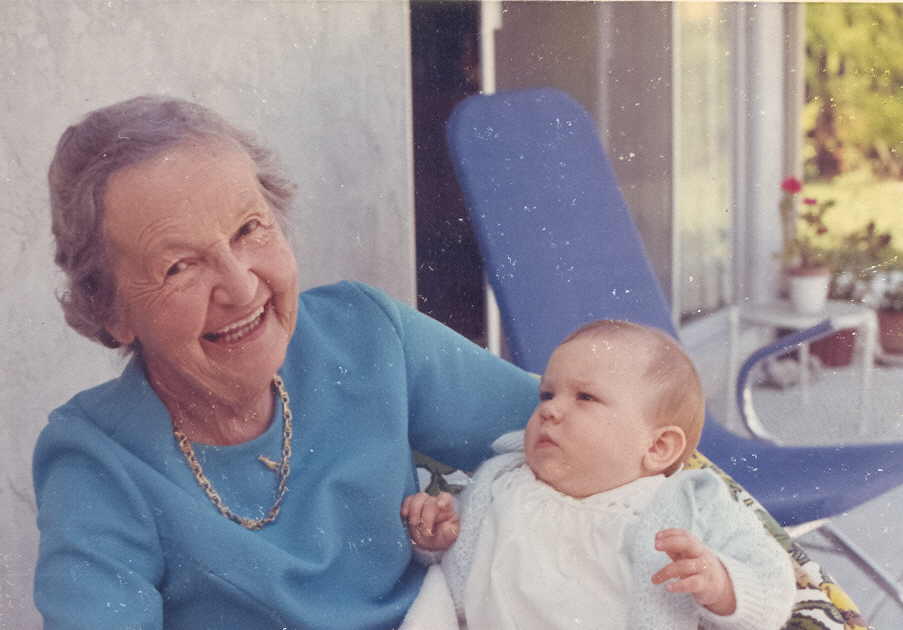
Helen Dewdney in 1968 with great-grandaughter Michele Fingland

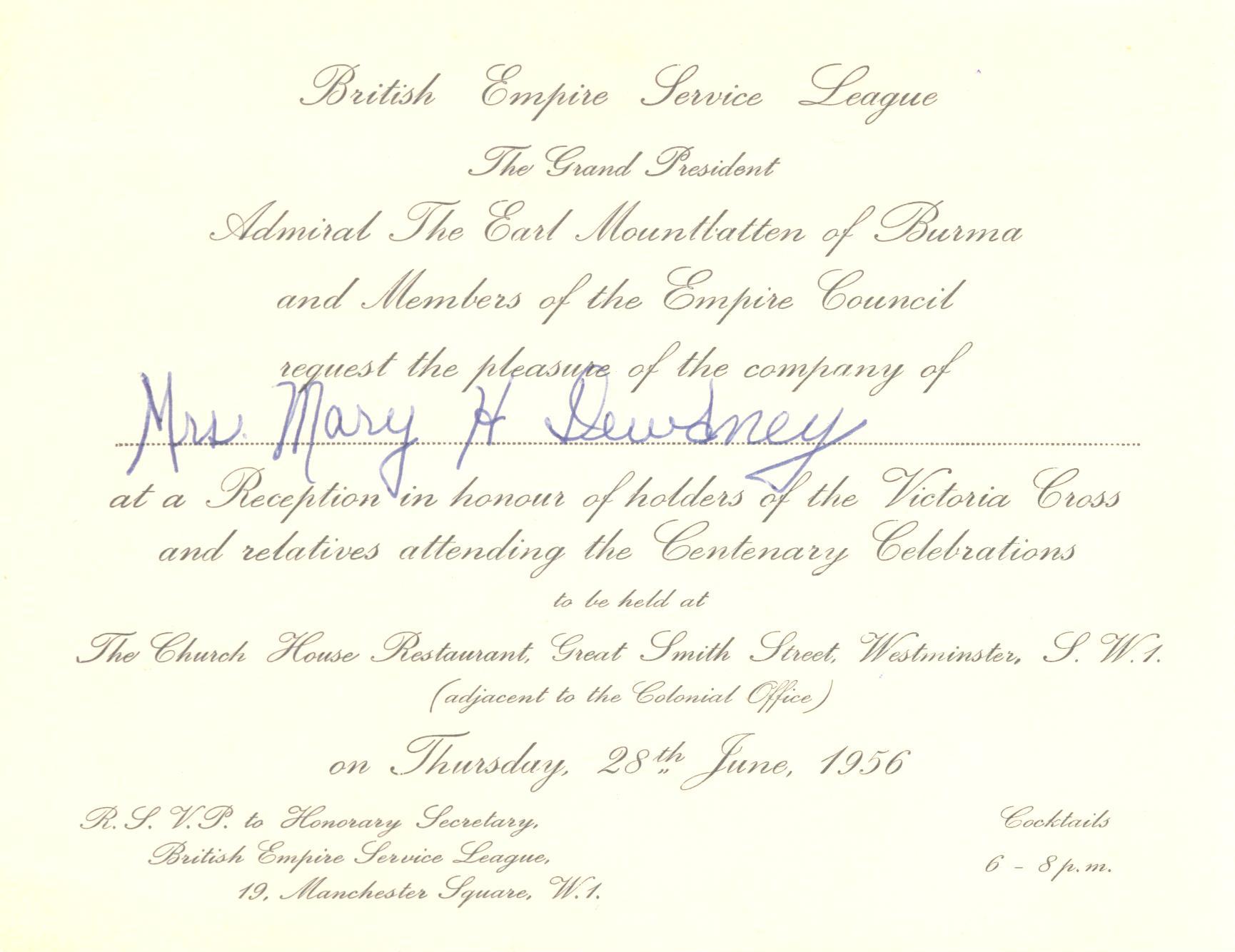
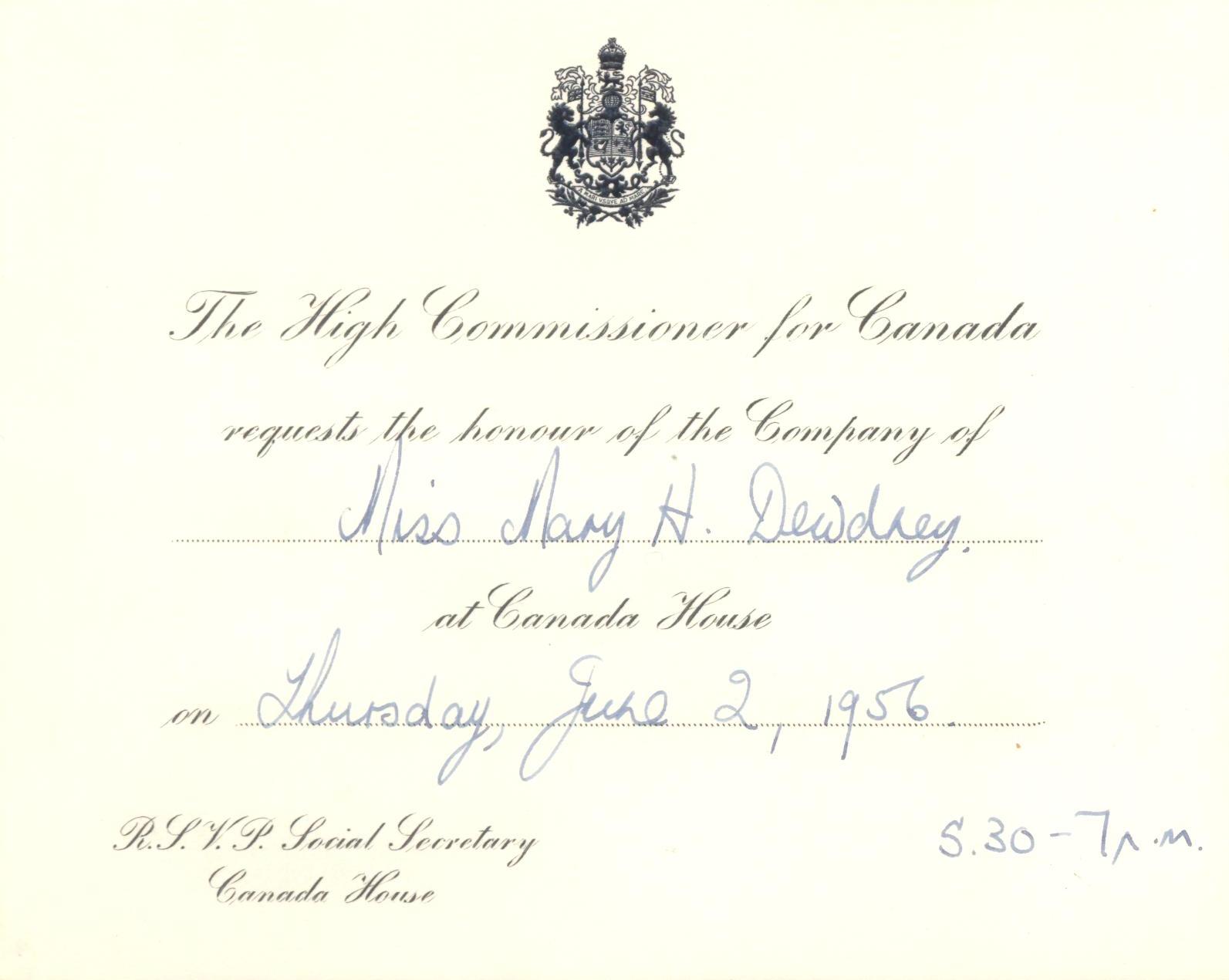
It was in the latter capacity that my grandmother, Mary Helen Peters Dewdney (known as “Helen” by her friends and “Gran” by her family) travelled from her home in Nelson, British Columbia to England to represent her late brother, Capt. Frederic Thornton “Fritz” Peters, VC, DSO,. DSC and bar, DSC (U.S.), RN at the centennial celebrations.  It was the first time she visited Britain since studying piano as a girl at the Royal Conservatory of Music in London.

As an Anglophile and a keen student of history, she enjoyed visiting historic venues such as Windsor Castle during the centennial program, but she disliked the marches and music that reminded her of losing not just Fritz in the Second World War, but also brothers Gerald and Jack in the First World War.  She also lost several close cousins and friends in the world wars­.

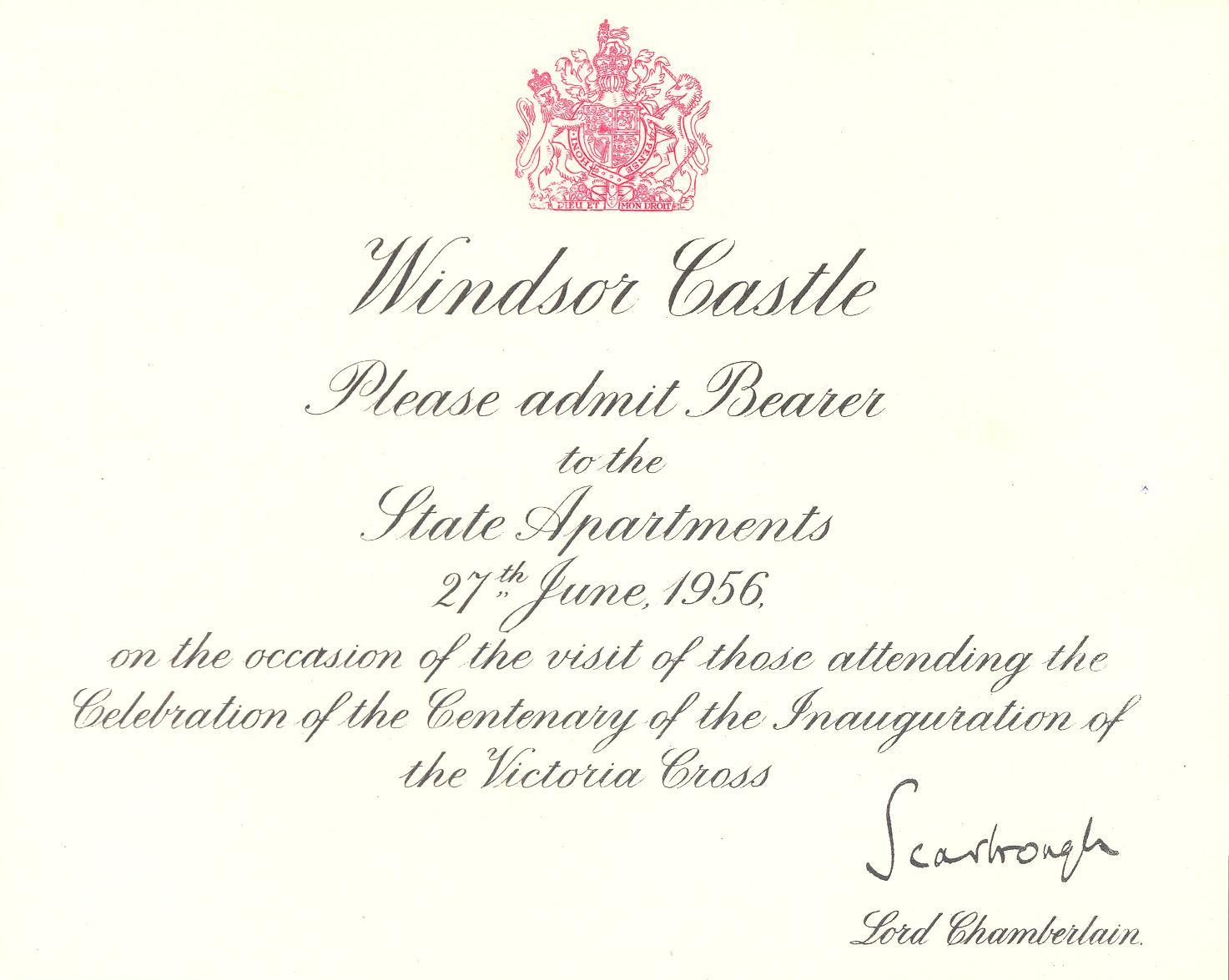
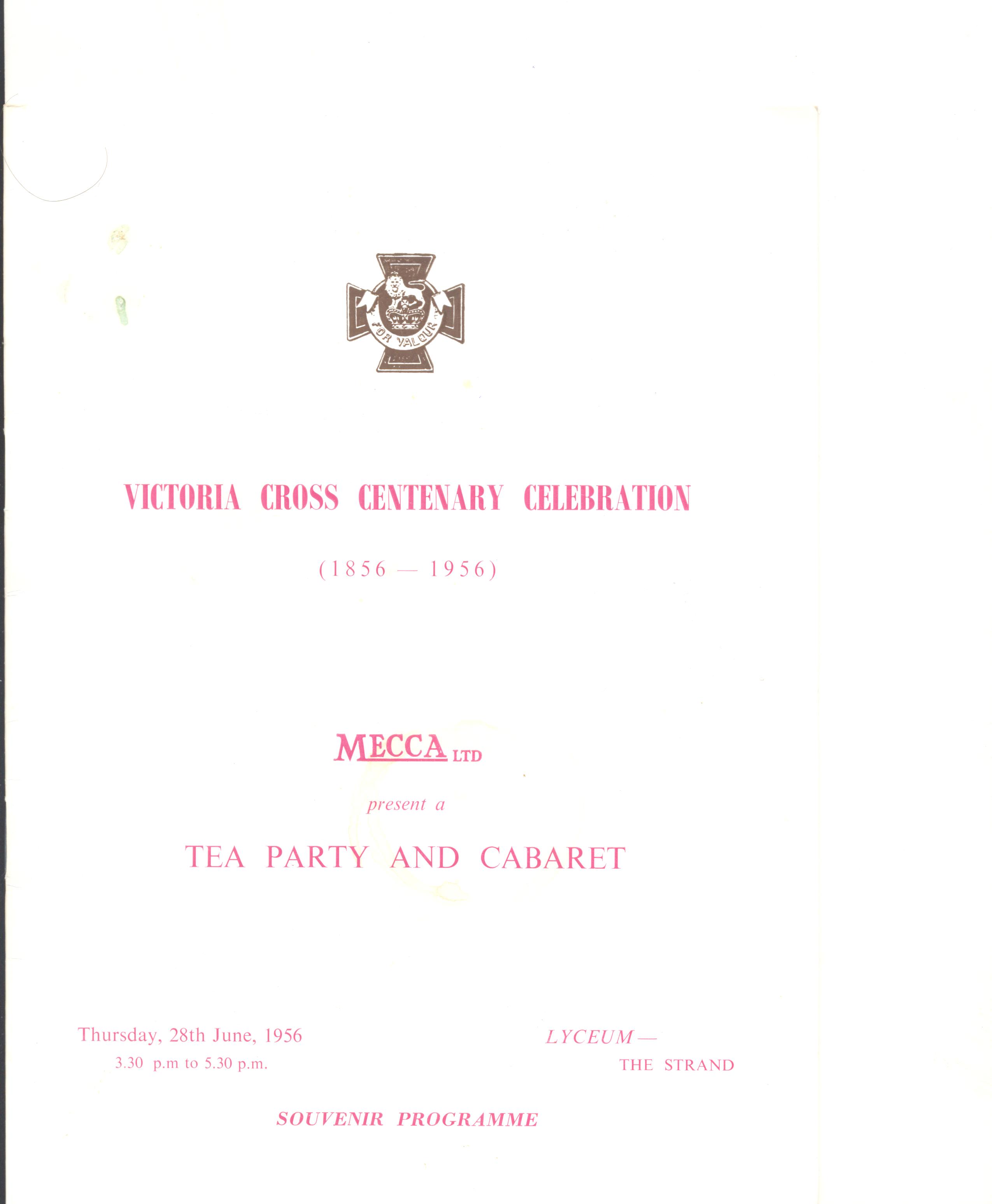
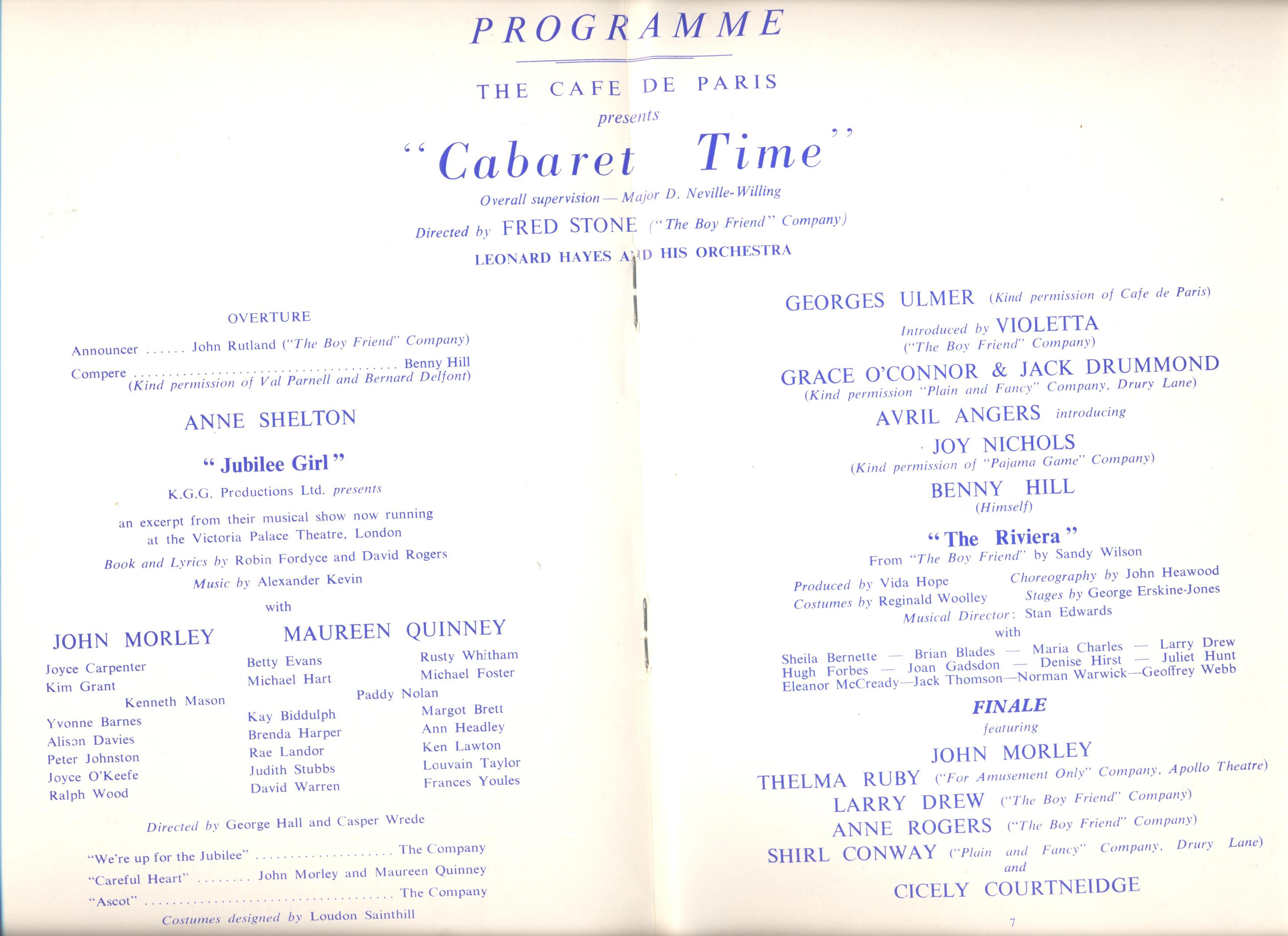
Images of some of the memorabilia Helen brought home from England are shown here.

Below are the cover and inside spread of a cabaret and tea for the VC centennial participants, including British entertainers such as Benny Hill.

Older Entries Newer Entries