New Information Emerges on the Air Crash That Killed Fritz Peters 70 Years Ago on Nov. 13, 1942.

10 Comments

By Sam McBride

Today,November 13th, 2012, is the 70th anniversary of the death of Captain Frederic Thornton “Fritz” Peters, VC, DSO, DSC and bar, DSC (U.S.), RN. 

The tragic irony was that he miraculously survived the action in the harbour of Oran, Algeria and hundreds of other close calls in a life of battle and adventure, only to die as a passenger when the flying boat transporting him back to England to report on the Oran mission to Winston Churchill encountered horrific weather and crashed in heavy fog in Plymouth Sound, just a short distance from its destination.

All five passengers were killed, but each of the 11 crew survived, though several were seriously injured.  Because of secrecy requirements at the time, the Royal Australian Air Force crew manning the flying boat never knew the names of the passengers who died, except that one passenger – the man pilot Wynton Thorpe found to be conscious in the water and valiantly tried to carry while swimming to safety – was “a Naval captain who won the Victoria Cross”.

The crash was well-known in the Australian air force community for many years, and Thorpe’s family donated his life jacket from the crash night to the Australian War Memorial after his death in 2008.  The wreckage of the Sunderland flying boat was discovered by a Plymouth diver in 1985, and two years later the propeller went on display at an air force museum in Perth, Australia.

In 2010 I noticed the life jacket come up in an Internet search, and I contacted the Australian War Memorial web site to advise them that the “Naval captain” mentioned in their records was indeed Capt. F.T. “Fritz” Peters.   But the information from my records only had the names of Fritz Peters and Brigadier Frank Vogel, who was a British officer serving on the staff of General Eisenhower. 

Recently, the following list of passengers killed on the flight surfaced in the “Submerged” web site that provides details of the discovery and recovery of wreckage of the flying boat crash.  I do not yet have details of the source of the list, but if it pans out it is an important addition to what we know about the flight and its tragic end.

The list of passengers is presented below, as per the original.  Note that Fritz Peters is listed as “R.N. Peters”, an error likely based on the “Royal Navy” initials after his name.

Royal Army Brigadier F.W. Vogel, killed

Royal Navy Captain G.W. Wadham, killed

Royal Navy Captain R.N. Peters, killed

Royal Navy Commander R.R. Devlin, killed

RAF Sgt R.E. Cordrey (Ait Gunner), killed

Radio coverage of 70th anniversary of Fritz Peters’ Victoria Cross action

Leave a comment

The link below shows one of the radio-based stories posted on-line as part of the media coverage of the book “The Bravest Canadian” and the 70th anniversary of the action in Oran Harbour Nov. 8, 1942 for which Frederic Thornton “Fritz” Peters earned the Victoria Cross and U.S. Distinguished Service Cross.

http://www.news1130.com/news/local/article/420790–new-book-shines-light-on-bc-veteran

http://www.news1130.com/news/local/article/420790–new-book-shines-light-on-bc-veteran

Feature on “The Bravest Canadian” in Nov. 11, 2012 Halifax Chronicle-Herald

Leave a comment

The link below goes to a Remembrance Day feature article by Ian Fairclough in the Sunday, Nov. 11, 2012 issue of the Halifax Chronicle-Herald, the largest daily newspaper in the Maritimes.

http://thechronicleherald.ca/books/168866-a-hero-s-story-more-than-a-military-man

Recent Interviews and Presentations of the Author of “The Bravest Canadian”

Leave a comment

Nov. 6:  interviewed by phone in Trail by Peter Anthony Holder at Stuph Files (www.thestuphfile.com) in Montreal.

Nov. 7: interviewed by phone in Osoyoos by Chris Walker, host of “Daybreak South”, of CBC Kelowna station

Nov. 9: (1) interviewed by phone  in Vancouver by Mike Lloyd at News 1130 at 9:30 am; (2) interviewed by Mark Forsythe for the CBC Almanac show, at the CBC Vancouver studio; (3) interviewed by phone at Tsawassen at 2:30 pm in Vancouver

Nov. 10:  Participated in Remembrance Day display and exhibition at the Royal B.C. Museum in Victoria, 10 am to 5 pm.  Gave half-hour presentation on Fritz Peters with photo show at 2 pm. 

 Nov. 11: (1)  Interviewed by phone in Victoria at 7:32 am by Jill Bennett of CKNW; (2)  :  Participated in Remembrance Day display and exhibition at the Royal B.C. Museum in Victoria, 10 am to 5 pm. 

Upcoming

Nov. 12:  Will be at studio of CFAX in Victoria beginning at 11 am for interview and call-in show (250 920-4619). 


Monday Magazine article on 70th anniversary of the Victoria Cross action of Canadian War Hero Capt. Frederic Thornton “Fritz” Peters

Leave a comment

by Sam McBride

Much thanks to Mary Ellen Green of Monday Magazine in Victoria, British Columbia, for her feature on “The Bravest Canadian — Fritz Peters, VC: The Making of a Hero of Two World Wars.”

One note for readers: The feature article describes the book as a “novel”, a term that has connotations of a fictional story, but it would be more accurate to call it non-fiction “biography”, as the book is based on real people, actual events, original documents and attributed sources.

http://www.mondaymag.com/entertainment/177781151.html

“The Bravest Canadian” Now on Twitter as @BravestCanadian

Leave a comment

The new book “The Bravest Canadian — Fritz Peters, VC: The Making of a Hero of Two World Wars” is now on Twitter as @BravestCanadian.

The author on Twitter is @SamMcBride3.

Oak Bay News reports on “The Bravest Canadian”

1 Comment

by Sam McBride

The October 20, 2012 issue of the Oak Bay News has a feature titled “Oak Bay Man a Forgotten Hero” about the new biography “The Bravest Canadian — Fritz Peters, VC: The Making of a Hero of Two World Wars”.

See the story at the following link:
http://www.oakbaynews.com/community/175002621.html

The community of Oak Bay, located immediately east of Victoria on the southeastern top of Vancouver Island in British Columbia, Canada, has a significant connection to the Fritz Peters story because he moved there from his native Prince Edward Island at age eight in 1898 with his family when his father Frederick Peters moved west to establish a law partnership in Victoria with fellow lawyer and politician Sir Charles Hibbert Tupper. Fritz lived in Oak Bay until joining the Royal Navy at age 15 in 1905, aside from time in England at the Bedford and Cordwalles boys’ schools.

Peters and Tupper built complementary, adjoining houses near York Place at Prospect Point in a new property recently developed by renowned architect Francis Rattenbury. J.R. Tiarks of the Rattenbury firm designed the Tupper and Peters house. The Tupper home took the name of “Annandale” and the Peters home was “Garrison House”. The family sold the house in about 1908 and moved to Esquimalt, and then three years later to Prince Rupert.

Podcast interview on thecommentary.ca

Leave a comment

On October 16, 2012, Sam McBride, author of “The Bravest Canadian — Fritz Peters, VC: The Making of a Hero of Two World Wars” was interviewed on the phone by Joseph Planta of thecommentary.ca.

The podcast can be heard at http://www.thecommentary.ca.

Letters Reveal Fritz Peters’ Way of Thinking and Love of Literature

Leave a comment

By Sam McBride

Capt. Frederic Thornton “Fritz” Peters was low-profile by nature and particularly secretive due to his involvement in naval intelligence with the Royal Navy and with the spy world of Britain’s Secret Intelligence Service.  It is doubtful that he ever kept a personal diary, but if he did it has never surfaced in the years since his death.

What we do have from Fritz Peters is 28 letters he sent to members of his family in Canada during both world wars, particularly the First World War.  Part of the collection of letters and memorabilia known as the Peters Family Papers, these letters are the basis for my biography titled “The Bravest Canadian – Fritz Peters, VC: The Making of a Hero of Two World Wars”.

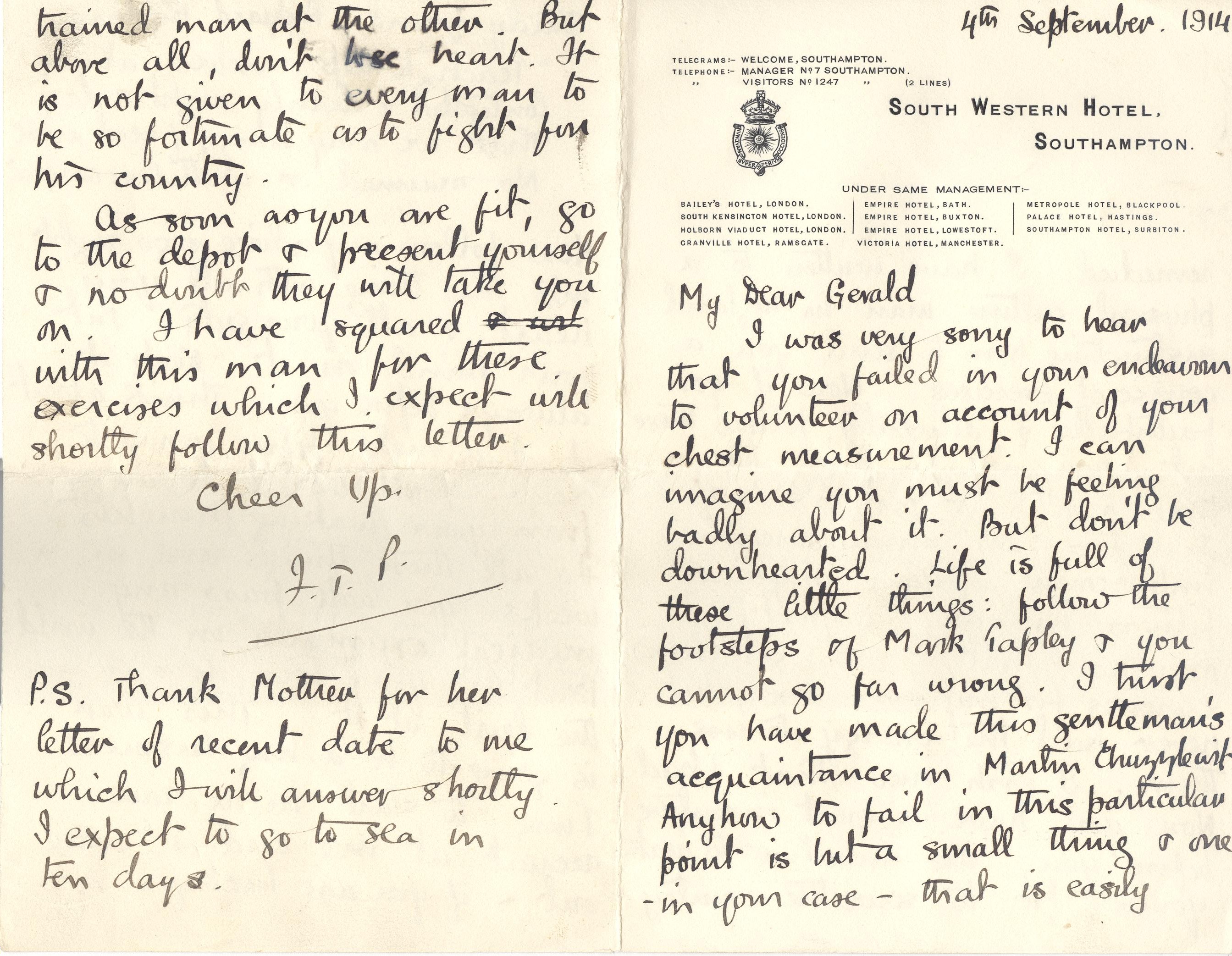
At age 19 – two months shy of 20 – and with some training in local militia, Fritz’s brother Gerald was considered a good prospect for military service, particularly in a family with a strong tradition of military service and loyalty to Canada and the British Empire.  However, as noted in the first of Fritz’s letters, featured below, the Peters family was devastated when Gerald was refused admittance to the army because he failed the physical exam performed on him by a Prince Rupert doctor.

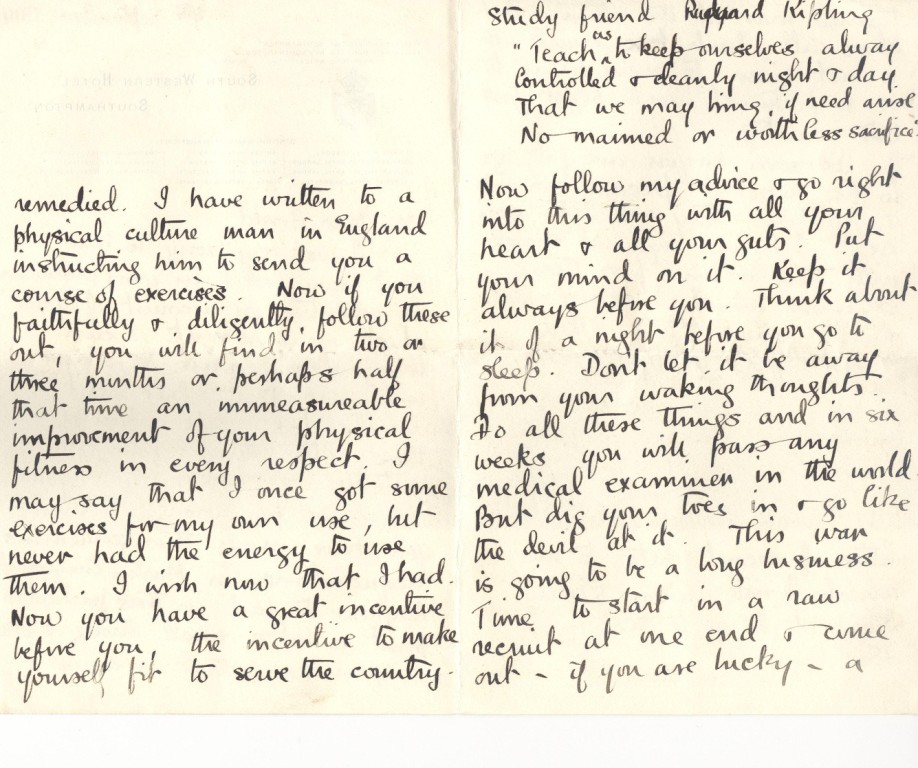
(ABOVE: first page of Sept. 1914 letter at right, and fourth page at left; BELOW: second and third pages of the letter)

Gerald was tall and thin, and his chest measurement did not meet the standards for passing the physical.  His brother Fritz, 25, had eight years of service in the Royal Navy before retiring in 1913, and then re-joined a year later at the outbreak of war.  Fritz’s advice to his brother in the letter reveals a lot about Fritz’s personality and ideals.  The Peters children were all avid readers, so it is not surprising that Fritz uses characters and lines from Charles Dickens and Rudyard Kipling to make his points in the letter.

Fortunately for the transcriber (me), Fritz’s handwriting is legible and he is a thoughtful and clear writer.

Fritz advises that he has ordered some exercises from a supplier in England that will help Gerald improve his strength so he can pass a future enlistment physical.  He advises Gerald to not be downhearted if the exercise regimen does not gain him entrance into the army, because “It is not given to every man to be so fortunate as to fight for his country.”

That comment reflected Fritz’s belief that military service in time of war is not just a duty, but a privilege and wonderful opportunity.

Subsequently, Gerald travelled across Canada to Montreal where he established temporary residence at his aunt Mim Abbott’s home, and was successful in enlisting with the 24th (Victoria Rifles) Battalion.   After service in the Ypres trenches in 1915 Gerald was accepted for officer training in early 1916, and became a lieutenant with the 7th (British Columbia) Battalion, the same unit his older brother Private John Francklyn “Jack” Peters was with when he went missing in the Second Battle of Ypres on April 24, 1915.  By late May 1916 Canadian military authorities had concluded that Jack died 13 months earlier in the Ypres Salient.  For the Peters family, this was only the beginning of their war tragedies.  On June 3, 1916 Lieut. Gerald Peters died while leading a charge in the Battle of Mount Sorrel, just a few miles from where his brother Jack died a year earlier.

Ironically, Fritz, who was by far the most enthusiastic warrior among the brothers, came out of the First World War intact, surviving numerous close calls in battle at sea.  Earning the prestigious Distinguished Service Order and Distinguished Service Cross medals, his record was such that he was allowed back in the Royal Navy for war service in the Second World War, despite being 50 years of age.

In 1940 Fritz Peters earned a bar to his Distinguished Service Cross.  His heroism in leading the attack on the harbour of Oran, Algeria in the Allied invasion of North Africa on November 8, 1942 was acknowledged with both the Victoria Cross and the U.S. Distinguished Service Cross, which was the highest honour the Americans could bestow on a non-American.

“It is not given to every man to be so fortunate as to fight for his country”.

–          Frederic Thornton “Fritz” Peters, September 1914

Biography of Canadian War Hero Fritz Peters ,VC

1 Comment

A new book tells the story of one of Canada’s most decorated – and least known — military heroes, Capt. Frederic Thornton “Fritz” Peters, VC, DSO, DSC and bar, DSC (U.S.), RN.

Previous attempts at biographies of Peters were stymied by a lack of information in official records, but The Bravest Canadian – Fritz Peters, VC: the Making of a Hero of Two World Wars by Sam McBride is based on a collection of recently-discovered personal letters that reveal his personality, motivations and chivalric ideals.   They also answer many questions about his mysterious life, including service with Britain’s Secret Intelligence Service, exploits in the Gold Coast colony of west Africa in the inter-war years, three stints of Royal Navy service over a 37-year period, and his tragic death in a flying boat crash returning to England after miraculously surviving heavy fire from all directions when he led a charge into the Vichy French-held Algerian port of Oran.

Published by Granville Island Publishing, The Bravest Canadian will be released in print and online in Canada and internationally in November 2012.

Book release coincides with 70th anniversary of Operation Torch

November 8, 2012 will mark the 70th anniversary of the Allied invasion of North Africa, code-named Operation Torch.  The invasion of Vichy French territory was the first large combined operation of British and American forces, and would prove to be a turning point in the war against Nazi Germany.   The initial targets of the invasion were Oran and Algiers in Algeria, and Casablanca in Morocco.

Fritz Peters’ courage in leading an attack by two converted Coast Guard cutters though barriers and inside Oran harbor at 3 a.m. on Nov. 8, 1942 in the face of point blank fire from French shore batteries and moored warships was honored with the highest awards for valor offered by Britain and the United States.

The surrender of the last Nazi forces in North Africa in May 1943 secured Allied shipping lanes in the Mediterranean and gave the Allies bases for subsequent invasions of Sicily, mainland Italy and France.

Born in Charlottetown, Prince Edward Island in 1889, Peters moved with his family in 1898 to Victoria, B.C., where he lived until joining the Royal Navy in 1905, aside from time in England at naval prep school.

He was determined to live up to his family’s tradition of military leadership and courage in battle, going back to United Empire Loyalist leaders in the Revolutionary War, a heroic general of the Crimean War, and his maternal grandfather Col. John Hamilton Gray, who was a career officer in the British Army before taking on a central role in the founding of Canada as a P.E.I. Father of Confederation and chairman of the Charlottetown Conference of 1864.   Peters’ father, P.E.I. Premier Frederick Peters, was a close grandson of shipping magnate Sir Samuel Cunard, one of the reasons why his son Fritz chose a career in the navy.
Image

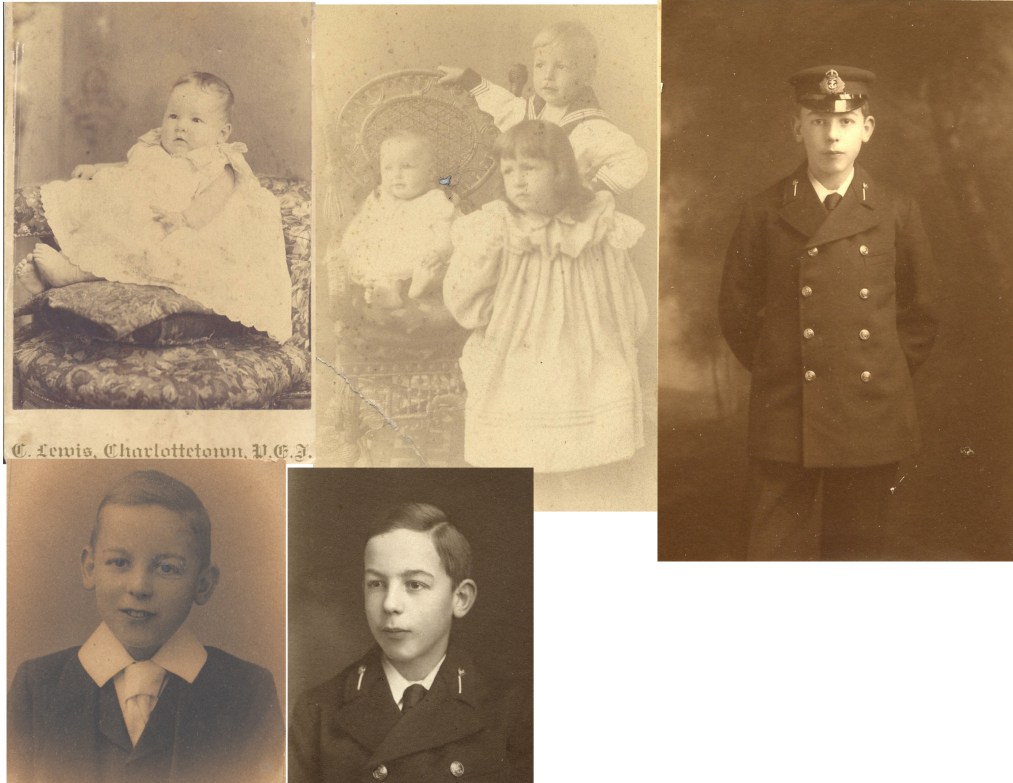
ABOVE: clockwise from top left, Fritz as a baby in 1889; Fritz at right with sister Helen and baby brother Jack in 1892; two photos of him as a young naval cadet in about 1906; and in Bedford, England in about 1900.  (McBride Collection)

At age 53 in 1942, Fritz Peters was the oldest Victoria Cross (VC) recipient in the Second World War.  Twenty-seven years earlier, in January 1915, he received the Distinguished Service Order (DSO) medal, second only to the VC as an award for valor in battle.  He was also Mentioned in Dispatches, earned a British Distinguished Service Cross (DSC) in 1918, and then a bar to his DSC in 1940.  His Oran gallantry was recognized with the Victoria Cross and the U.S. Distinguished Service Cross, the highest medal for valor awarded by the U.S. to non-Americans.

In the inter-war years he developed technology for miniature submarines, and was an early user of plastic explosives and time-delay fuses in his work with secret intelligence.  In 1940 he commanded a school for spies and industrial sabotage for expatriates who later returned to their native countries in Occupied Europe to fight the Germans from within.  His staff at the school included the Soviet spies Kim Philby and Guy Burgess, who liked and admired their commander despite their personal political differences.  Philby’s memoirs are a major source on Peters as a planner, colleague and leader.

Peters’ admirers also included Prime Minister Winston Churchill, Allied commander-in-chief U.S. General Dwight Eisenhower, and British naval commander Admiral Sir Andrew Cunningham.  However, several of Eisenhower’s American underlings were bitter opponents of Peters in the planning and carrying out of the Oran harbor attack, and blamed him for heavy casualties suffered by U.S. troops.

Tragically, Peters died before he had a chance to tell his side of the story.  Later, British authorities chose to downplay the Oran action to avoid antagonizing the French when they resumed as allies against the Nazis.  Some government documents were destroyed, and others were kept secret for 30 years.  As a result, the personal story of Fritz Peters – recipient of six medals for valor in two world wars – remained a mystery until the author’s discovery of the Peters Family Papers.

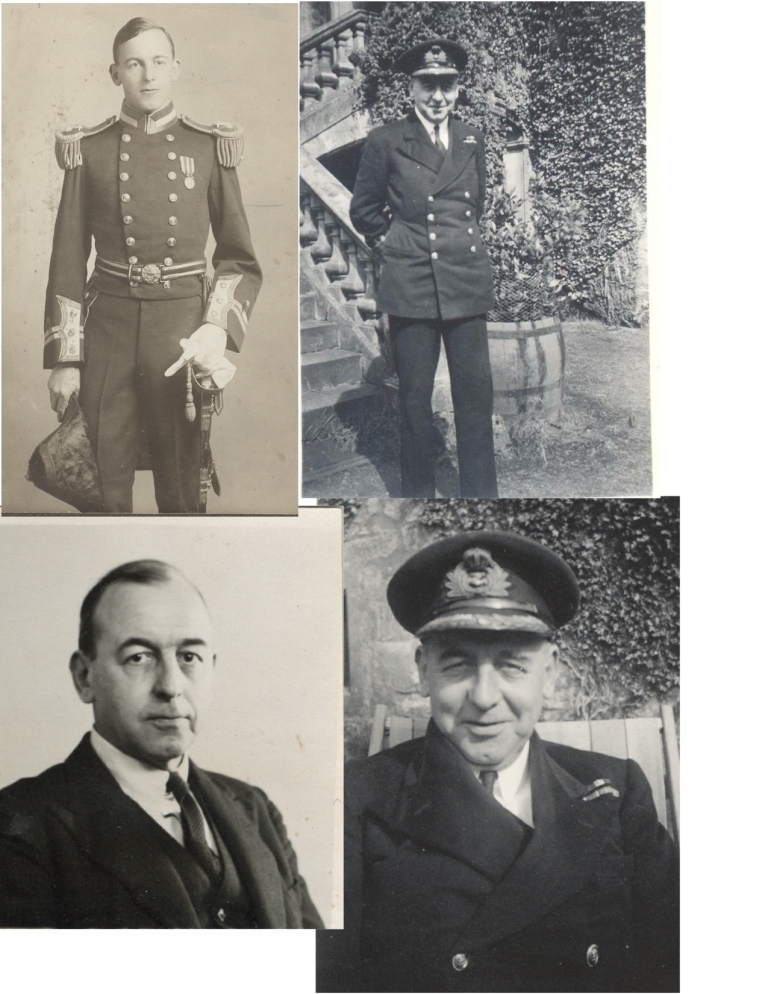
Clockwise from top left: Fritz as a lieutenant in about 1912; Fritz at Cleish Castle; photo of him soon before his final mission in 1942; and Fritz in about 1930. (McBride Collection)
Older Entries Newer Entries