Condolence Letters Received by Bertha Gray Peters in 1916

Leave a comment

by Sam McBride

 1916 was a terrible year for Fritz Peters’ mother Bertha. 

 It began well, as she was living in a rented cottage on the southeast coast of England where she regularly hosted her son Private Gerald Hamilton Peters on his leaves and when he was undergoing officer training.  Another son, Private John Francklyn “Jack” Peters, had been missing since the Second Battle of Ypres the previous April, but she had been told by relatives that he was safe at Celle Lager prison camp in Hanover, Germany.

However, in late May 1916 she was informed by Canadian authorities that the Red Cross reported that Jack was definitely not a prisoner of war in Hanover, so it was assumed that he died “on or after” April 24, 1915.  He was killed in the heroic stand that day by Canadian troops against a massive German attack that used poison gas at a time when Allied soldiers were not expecting poison gas and therefore had no gas masks.

Then just a couple of weeks later Bertha learned that her favorite child Gerald, now a lieutenant with the 7th (British Columbia) Battalion (the same unit Jack served with, but with almost complete turnover due to heavy casualties), was missing after a counterattack by Canadian troops on June 3, 1916 in the Battle of Mount Sorrel in the Ypres Salient.  By the first week of July she got confirmation that Gerald was dead.

The following five letters illustrate the pain and desperation of the era, as letter-writers share their own sad experiences from the war with Bertha.  It was during this period of grief that Bertha turned to spiritualism as a way to get in contact with her dead sons, particularly her soulmate Gerald. 

Susan Cummins to Bertha                                 c. August 1916

 My dear Bertha,

          I see in today’s Book of Honour the sad news that your uncertainty about dear Gerald is at an end.  I can only say how intensely I sympathize with you, in your dreadful bereavement.  Only God knows what a mother feels at such a time.

          …If this war goes on much longer even the old men will have to go, I fear.

          …I remain with heartfelt sympathy,

 Your loving cousin,

Susan E. Cummins

Mary Wilkins to Bertha                            August 4, 1916

 938 Fitzgerald St., Victoria, B.C.

 My dear Mrs. Peters,

          I feel I must write a few lines to assure you of my real sympathy with you and your husband in your sad loss.  How the years have gone.  I cannot realize that your dear boys had grown to manhood.  How many hearts and homes this cruel war has broken.  One wonders where God is and how long before the end.  Sadness seems so rife just now.

          …This lingering tuberculosis is an appalling thing, but I must not trouble you with my troubles.  I hope Fred is well, remember me to him.  How the old Windsor1 days come back when I think of Windsor and our college boys…

 Yours very truly,

Mary A. Wilkins

1 – the Windsor referred to is likely the Windsor Hotel in Victoria, British Columbia.

Canon Rix to Bertha                                          August 22, 1916

 Canon G.A. Rix, St. Andrew’s Rectory, Prince Rupert, B.C.

 Dear Mrs. Peters,

          For some time I have had it in mind to write to you, but for the reason of the uncertainty as to the fate of your son.  I hesitated until I might learn something more definite.  Recently word has come through in regard to Gerald and I must no longer refrain from sending you a letter conveying my most sincere sympathy.  I am quite well aware that no letter can possibly convey any real comfort to one so grievously stricken, but I nevertheless wish you to know that you have been very much on my mind and that never in my life has my earnest sympathy gone out so completely as it has to you.

          You have been called upon to sacrifice two as fine boys as the nation possessed; clean were they in body, mind and soul and so far as the ordinary eye could tell, both were destined to lives of great usefulness and certainty of great comfort to you. 

          They have been taken (I earnestly trust that yet Jack will return to you) but as you so well know, they have offered themselves on the altar of loyalty – and as the years pass your increasing pride will be that they have done so.

          …Your sons not only offered themselves but you said not “nay”.

          …It was my pleasure at a meeting held to arrange for a patriotic demonstration on the second anniversary of the war to move that Mr. Peters give the address.  This was carried out and although I had to be out of town and did not hear the address, yet I have been assured that it was the finest effort of that kind ever made in Prince Rupert1.  I am sure you will be pleased to hear this.

          Again I assure you of my own and Mrs. Rix’s most sincere sympathy and our earnest hopes that you are well and that ‘ere long we will see you back in Rupert again.

 I am, yours very sincerely

G.A. Rix

 1 – Her lawyer husband, former PEI premier Frederick Peters, who at the time of the letter was City Clerk in Prince Rupert, was an experienced public speaker who was often invited to speak in support of the war at community functions.

Women’s Club secretary to Bertha          Sept. 25, 1916

 Dear Mrs. Peters,

          I have often thought of you in your great sorrow and have wished to write, but it was such a sorrow that I felt I hardly dared to do so.  Then, at our last Women’s Auxiliary (W.A.) Mrs. Hiscolks who is now our President, asked me to write.

          Dear Mrs. Peters – what you have gone through since I last saw you at your daughter’s wedding1.  It was a short time before my mother’s death when you wrote me such a kind letter.  Now, how can I express to you how we all feel for you in the loss of your brave boys whom you gave up for their country so bravely and unselfishly.  This is such a terrible war and the poor fathers and mothers are called upon to give up so much.  One knows that the Man of Sorrows is with the dear ones at the Front – for are they not following his example of giving up their young lives for us, and He alone can comfort all the sorrowing hearts in the Homeland too…

          I wrote to you when I heard of your eldest son’s distinction in the first naval engagement2.  I do hope he is safe and well, and that your youngest boy3 is still with you.  May God keep them both safe and comfort you in this great trial.  With love and sympathy from all of your friends in the W.A.

 I remain, yours very sincerely

E.C. Morie, Sec of C.C.C.W.A.

 1 – Helen Peters married Ted Dewdney in June 1912 in Esquimalt, B.C.

2. – The Battle of Dogger Bank in the North Sea, where Fritz’s heroism was acknowledged with the Distinguished Service Order medal.

3. –  Gerald’s twin brother, Noel Quintan Peters, was still at the family home in Prince Rupert.  He was rejected for military service, likely because of a slight, but noticeable, mental disability.  He was finally accepted into the Canadian Forestry Corps in 1917.


Patricia Garlink to Bertha                        October 31, 1916

 46 Devonshire St., Portland Place

 Dear Mrs. Peters

          Do forgive me for not writing before, but I have had another shock since I saw you last.  My husband’s belongings have been returned to me through the Germans.  When I tell you that some of the things were thickly stained with blood you will understand what I have been going through again.

          I should like very much to have tea with you before you leave.  Will you drop me a line to say what day.

          The medium Mrs. Leonard still says that Frank is alive and is now almost well, and my mother-in-law still says she firmly believes he is alive. In spite of everything she feels it very strongly.  I am writing this on duty so will have to stop.

 Much love,

Patricia Garlink

Scandal of First Wife of Dr. Charles Peters and a Pirate in New York in Early 1700s

1 Comment

By Sam McBride

For many years in my family tree study, the only information I had on Dr. Charles Valentine Peters – the first of Fritz Peters’ ancestors of the Peters line to settle in North America – was from the book “A Peters Lineage: Five Generations of the Descendants of Dr. Charles Peters of Hempstead” by Martha Bocke Flint,

Published in 1896, the Flint book was well-read by Fritz and other members of his family as a comprehensive source of information on their cousins and ancestors.  Dr. Peters and his wife Mary Hewlett were great-great-great-great-grandparents of Fritz and his brothers and sisters.

The Flint book did not mention the extraordinary, documented story of Dr. Peters’ first wife, and what happened after the couple left England for the colony of New York.   Articles by John G. Hunt on the subject were in the quarterly publication The American Genealogist in 1967 and 1968.

In an article titled “Two Eighteen Century New Yorkers: Giles Shelley ‘Pirate’ and Dr. Charles Peters”, genealogical researcher Hunt notes that the surgeon Dr. Charles Peters was the son of William Valentine and Ann Peters of St. Clement Dane, London.  Records in England show that Charles married Mary Kake at St. Dunstan in the West, Middlesex  in about 1699 when he was 22 and she 18.  One child was born, a daughter.  Some time in the next three years  they emigrated to America.  Hunt notes that by September 1702 Mary Kake had left Charles and taken up with the highly successful (but already married) merchant/pirate Giles Shelley, who was a close friend of soon-to-be-hanged Captain William Kidd.  Like the infamous Captain Kidd, Giles Shelley was licensed by the King to take booty on the high seas from non-British ships.

Shelley included Mary Peters In his will dated September 22, 1702,  specifying that upon his death she would receive 50 pounds, and then 50 pounds per year for ten years “free from the control of her husband.”  The will stipulated that Mary – still legally married to Dr. Charles Peters – would be granted use of Shelley’s house and furnishings for the rest of her life.

The affair became well known in 1705 as a result of a court case launched by Shelley’s ignored wife Hillegond.  As the cuckolded husband, the situation of his wife living openly with another man must have been extremely embarrassing for Charles Peters in the conservative New York society.  And obtaining a divorce from an English court was virtually impossible from distant America at the time.

In 1710, Shelley adjusted his will to note that Mary Kake Peters had died.  There is no record of how or when she died.  With her dead, Charles was free to marry again.  There is also no record of the death of the daughter, but Hunt suggests she probably died at young age.

Sometime between 1710 and 1712, Charles Peters moved to Long Island and married Mary Hewlett, whose grandparents arrived in New York when it was known as New Amsterdam and controlled by the Dutch.  Apparently, Mary Hewlett and her relatives were unaware of Charles’ disastrous first marriage.  The couple had eight children and were accepted into the establishment of the community of Hempstead.  Charles died in 1733, and Mary Hewlett died 11 years later.

Their son Valentine Hewlett Peters (1716-1786) was a United Empire Loyalist in the American Revolution, as was his son James Peters (1746-1820).  After the rebels won, James (Fritz’s great-great-grandfather) was a leader in the Loyalist evacuation to New Brunswick.  As he was elderly, Valentine decided to stay in New York in the new country known as the United States.  The image below is of James Peters as a young Loyalist.

There is no mention of an earlier marriage of Dr.Charles Peters in the writings of James Peters, or in the writings of his descendants.  In that era of primitive communication, it appears Dr. Peters’ cover-up of his first wife and her scandalous affair with a pirate was successful – at least until original records were identified and interpreted in the 1960s.

It appears that Dr. Charles Peters was concerned that the details of his parents and ancestry could lead his in-laws and neighbours in Hempstead to discover the fiasco of his first marriage.  This led him to fabricate the connection to the famous Puritan Rev. Hugh Peters and his brothers William and Thomas who came to colonial America in the 1630s.  Hugh returned to England in 1642 and never returned to America, as he became a senior lieutenant of Oliver Cromwell in the English Civil War.  William was the only one of the three brothers to have sons, so over the years many in the Peters family tree assumed that William was the direct ancestor.  Flint found no records of any such connection, and chose to avoid the controversy of  Dr. Charles’ ancestry.  She began the family tree listings with his marriage to Mary Hewlett and her ancestry, but had no details on his parentage.

KEY SOURCES:

John G. Hunt, “Two Eighteenth Century New Yorkers: Giles Shelley ‘Pirate’ and Dr. Charles Peters”, The American Genealogist, Vol. 43, 1967:p.  163-7.

And John G. Hunt, “Addenda and Corrigenda”, The American Genealogist, Vol. 44, April 1968, p. 111

LINKS OF INTEREST:

http://longislandgenealogy.com/Peters.pdf

http://archiver.rootsweb.ancestry.com/th/read/Dutch-Colonies/1999-09/0936538958

http://www.uelac.org/Loyalist-Trails/2009/Loyalist-Trails-2009.php?issue=200949

http://www.iment.com/maida/familytree/antill/edwardantill1st.htm

Fritz Peters’ Cadet Report in 1906

Leave a comment

by Sam McBride

The Peters Family Papers contain a wide array of personal letters, photographs, family history notes, and original documents such as the following report on his performance as a Royal Navy cadet on the training ship HMS Britannia from when he started with the navy on Jan. 15, 1905 until May 14, 1906.

Memorabilia such as this is the basis for my new book “The Bravest Canadian — Fritz Peters, VC: the Making of a Hero of Two World Wars”, to be released by Granville Island Publishing in September 2012.

November 8, 2012 will be the 70th anniversary of the action against Vichy French forces in the harbour of Oran, Algeria which earned Peters the Victoria Cross and the U.S. Distinguished Service Cross.

Frederic Thornton “Fritz” Peters in about 1906 (McBride Collection)

Letters from Fritz Peters’ brother Private John Francklyn Peters, Part Two: March 11, 1915 – April 13, 1915

Leave a comment

by Sam McBride

Below are letters from Jack Peters in the six weeks before his death on April 24, 1915 at the Second Battle of Ypres. 


Jack to his brother Gerald           March 11, 1915

 France

 Dear Gerald,

          I was awfully glad to hear from you at last.  I was wondering where you had got to.  You’ve done the right thing alright in joining the Victoria Rifles1.  I suppose you are in England by now.  You’ll just get in on the war at the right time.  I don’t think you’ll be sent to Egypt.  That is just the usual rumour2.

          You want to visit Aunt Florence and Aunt Helen and the Hodsock bunch if you get leave.  They’ll treat you well.  Only take my tip and just spend a day at each place, because they are rather boring after that time. 

          I’ve been in the firing line quite a while now.  There hasn’t been much excitement.  You remember Boggs3 who used to command the High School cadets.  He was killed by a sniper a few weeks ago.  He was a lieutenant in E Company.  Pretty hard luck so early in the war.

          I’m writing this letter in the actual firing trench.  Shells whistle over me every minute and now and again a bullet hits the parapet above.  Sounds exciting but it isn’t.  Just a little monotonous.  We go out for a rest tonight to our billets, which are generally barns.  We get plenty of freedom and can go to the villages to buy what we can – which isn’t much because they only give us three francs a month.  I’ve got nearly $50 to my credit now which I cannot draw.  If I were you I’d have some pay assigned because it’s so easy to fritter it away inEngland.

          I suppose you know about Fritz winning the D.S.O.4 and being mentioned in dispatches.  Won’t Father and Mother be tickled to death!  I dare say he is quite satisfied, but I should think that it certainly should help his promotion a lot.

          Any time you have a magazine or paper you might shoot them along to me, and milk chocolate always comes in handy.  I’m going to send you money to buy things for me soon.  The minute I can raise it from the Paymaster.  If you want ₤5 I can easily spare it.  Just say the word.

Good bye, Old Man

Jack

 1 – Gerald initially joined the 24th Battalion (Victoria Rifles regiment) in Montreal and served as a private with them for four months in the Ypres trenches starting in September 1915.  He went back to England in February 1916 for officer training and began as a lieutenant with the 7th Battalion in May 1916, 13 months after Jack went missing while serving in the same battalion.

2 – Weather and ground conditions were so bad in Salisbury Plain that soldiers were suffering and missing out on training because training programs were often cancelled.  As a result, the Australian government took their soldiers away from England and had them trained in Egypt instead.  But Canadian soldiers stuck it out in England.  Unfortunately for the Australians, training in Egypt meant they were conveniently located for transport to the disastrous Dardanelles campaign.

3 – Lieut. Herbert Boggs, 22, of the 7th Battalion, son of Beaumont and Louise May Boggs of Victoria, B.C., died February 26, 1915 at the Battle of Neuve Chappelle in the Ypres Salient.  He was among the first Canadian officers to die in the war.  By coincidence, the Boggs family that the Peters boys knew in Victoria lived next door on Fort Street to Mr. and Mrs. Arthur W. Currie.  When Herbert died Currie was Brigadier General in command of the 2nd Brigade, which included the 7th battalion.  It was Currie’s responsibility to write personal letters of condolence to next of kin, who in this case were neighbours he knew well.  Beaumont Boggs and Arthur Currie had both been realtors in Victoria before the war.  Currie went on to lead Canadian forces in taking Vimy Ridge in April 1917 and command all Canadian forces in Europe.  According to Pierre Berton, Currie was “the only great general Canada ever produced”.  British Prime Minister David Lloyd George was reported to have said in 1918 that if Douglas Haig was to be replaced as head of the British Empire forces, he would nominate Currie.  There are no references to Currie in the Peters letters, but as acquaintances of Herbert Boggs the Peters boys or their parents may have also known the Curries.  This may have been one of the connections that the Peters family used to help get Gerald accepted for Officer Training in early 1916.

4 – On March 3, 1915 Fritz was awarded the Distinguished Service Order for his actions in the Battle of Dogger Bank in January 1915. The DSO at the time was the military decoration for the U.K. and Commonwealth countries, awarded for meritorious or distinguished service by officers in war time. The only higher decoration was the Victoria Cross.


Image

Jack as a boy in British Columbia, in about 1907

Jack Peters to his cousin Evelyn Poole          April 4, 1915

 Easter Sunday,

France

 Dear Evelyn1,

          Many thanks for your letter.  Letters are one of our few excitements.  At present we are in reserve behind the firing line after six weeks in the trenches.  Three days in them and three to rest.  Our stay there was very quiet.  The Germans opposite to us generally preferring to let us rest as long as we didn’t bother them.  During two days of the Neau Chappelle2 fighting we kept up a steady rifle fire and our artillery shelled their trenches.  The German snipers are very good shots and once in a while they would account for one of our men.  They have telescopic sights which is more than we have.

          This town is out of shell fire [range] so beyond aeroplane bombs dropping now and then you would hardly realize that a war is going on.  On a clear day there are aeroplanes to be seen being shelled  — hundreds of shells seem to explode all around them but I’ve never seen one brought down.  All our other billets have been within easy range of the enemy guns, shells used to fall in the streets but seldom hurt anyone.  A few houses would be smashed up.

          My correct address is Pte. J.F. Peters, 17417,

          1st Canadian Division, British Exped. Force

          2nd Infantry Brigade, 7th Battalion, No. 4 Company


I haven’t been able to find where Willie Abbott3 is although he must be nearby.  I hope Eric4 is alright again by now.  He has had hard luck in being stationed so long on the East Coast.  I got your Punch – any magazines always come in handy.  We are well-clothed, you needn’t bother about socks or anything like that.

Good bye for the present,

Jack

 1 – Evelyn Poole was a daughter of Bertha’s sister Florence Poole in Guildford, southeast of London, England.  Jack’s correspondence with her would have been much faster than letters to and from his family that had to go across the Atlantic by boat in wartime conditions.  She was the same age as Helen Peters and they appear to have been close as cousins.  It is possible that Helen’s daughter Eve was named after her.

2 – After leaving England for France in February 1915 the First Canadian Division had a quick introduction to trench warfare in performing a diversionary role in the Battle of Neuve-Chapelle in the Ypres Salient, which was the site of many battles during the war because it was the only part of Belgium held by the Allies.  Allied troops were at a disadvantage in the Salient because its triangular shape often allowed the Germans to aim their artillery and guns at the Allied trenches from three sides.  The enemy forces at the Battle of Neuve-Chapelle included Private Adolf Hitler who was a runner with the 6th Bavarian Reserve.  Runners took messages from station to station in the era before radio communication.  Telephones were used, but their lines were often broken by shelling.  Hitler was one of the very few men on either side who actually enjoyed trench life and the battles.  He only rose to corporal because of his inability to get along with people, but he did win the Iron Cross First Class for bravery.  If Jack had lived until the Second World War years, it is likely he would have joined thousands of other veterans who wished they had shot Hitler in the 1914-1918 war.

3 – Jack’s cousin Willie Abbott was a son of Bertha’s sister Mary/Mim Gray and William Abbott, son of Canada’s second Prime Minister Sir John Abbott.


Jack to cousin Evelyn                 April 13, 1915

 France

 Dear Evelyn,

          A few lines to thank you for your magazines which arrived today and are at present being eagerly read by everyone in the section.  In the Illustrated London News you sent me, strangely enough, there is a picture of Plugsteert1, where we were first under fire in February.  Plug-street is what we used to call it.

          Our rest is over now for we leave for the firing line tomorrow, and from all reports we may really be up against something this time.  Smith Dorrien reviewed us on Sunday, and General Alderson2 two days before.  It’s been quite like Salisbury Plain again, what with Company drill and bayonet exercises.  Every one of us are in good health after resting up, and I’m glad to move as it’s been rather monotonous at this billet as we are away out in the country.  The nearest village only having about 8 houses in it.  You can barely hear the guns from where we are.  We’ve also all been broke owing to our last stay in a town where we spent all our money.  Needless to say, the French people make as much out of the Canadians as they can.  We only draw to 30 francs so we should be rich when the war is over, at least the ones that are alive.

          I’ll have to stop now, as there is a select concert going on in the farm yard, which makes it impossible to do anything except listen to it. 

          Give my love to all.  I’ll drop you a card from the trenches.

Your affectionate cousin,

Jack Peters3

 1 – in the Ypres Salient in Belgium

2 – British General Sir Horace Smith-Dorrien (1858-1930, commander of the British 2nd Army, which included the Canadian 1st Division.  He was fired and sent home after losing ground in the 2nd Battle of Ypres in which Jack died. British General Sir Edwin Alderson (1859-1927), served under Smith-Dorrien in charge of Canadian troops.  He lost his command as a result of losing ground in the 2nd Battle of Ypres, as well as other setbacks and disobeying orders in previous battles. 

3 – This was the last letter from Jack.  He died on Saturday, April 24, 1915 in the 2nd Battle of Ypres when Canadian troops were making a courageous stand against a German attack that used poison gas for the first time on the Western Front.  The use of poison gas in artillery shells was forbidden by the Hague Conventions which both sides had agreed to in 1899 and 1906, but the German commander at Ypres thought he could get away with spreading the gas directly from canisters and piping from their own trenches, depending on the wind to take it to the enemy.  The completely surprised French colonial troops on the Canadians’ left panicked and ran away from their positions upon experiencing the greenish-yellow cloud of chlorine gas late in the afternoon of April 22nd, which left the inexperienced Canadians to fill a four-mile gap in the Allied line protecting the headquarters at Ypres and the coastal ports.  Reinforcements promised by the French never arrived.  The Germans did not expect the gas to have such a dramatic impact – wind conditions and temperature were ideal for distribution of the heavier-than-air gas, unlike a previous attempt to use poison gas on the Russian front — and were not prepared with reserves to immediately take advantage of the break in the line.  They were ready by the early morning of Saturday, April 24th, launching a full-scale offensive with gas directly against the Canadians.  Jack in the 7th battalion would have been right in the middle of it.  The Canadians found they could function somewhat under the gas by holding urine-soaked handkerchiefs against their faces and partially neutralizing the chlorine.  Records show that relatively few soldiers died from just the poison gas; they would be hit by bullets and shells when drawn away from their trenches by the gas and unable to defend themselves. Flame-throwers were also introduced for the first time in the offensive, making a horrific situation even worse for the defenders.  If the Canadians had not held the new battle line, the enemy could have easily encircled 50,000 Allied troops and marched to the North Sea to capture ports (as happened at Dunkirk in May 1940 in the Second World War), which would have been a devastating blow to the Allies.  British General Sir John French gave the Canadians credit for extraordinary bravery and said they “saved the situation”.  The Germans also began respecting Canadians as adversaries after this battle.  While we don’t know exactly what happened to Jack in the battle (witnesses died too), it is noteworthy that he was a part of what was probably the most dramatic and important defensive stand in Canadian history. There were hundreds of Canadian prisoners taken in the shifting front that day, and for a period the military authorities thought Jack might be among prisoners in Belgium or Germany, but on May 29, 1916 he was officially presumed to have died “on or after April 24, 1915”.  Of 900 men and 24 officers in Jack’s battalion, 580 men and 18 officers were casualties in the 100 hours of frantic action that followed the first gas attack.  Four Victoria Crosses were awarded to Canadians in the battle, including Lieutenant Edward Bellew of Jack’s 7th battalion.  John McCrae, a surgeon in charge of a field hospital, wrote his famous poem “In Flanders Fields” on May 3, 1915, inspired by the death of a close friend in the same battle in which Jack died.


Cumulative Index of the Blog — as of June 6, 2012

Leave a comment

Here is a list of postings on thebravestcanadian.wordpress.com blog since it started in December 2011.  These postings can be accessed through the Archives list on the right side of the screen.


December 2011

Biography of Fritz Peters, VC to be published in 2012 – Dec. 8, 2011

Ancestry of Frederic Thornton Peters, VC – Dec. 12, 2011

Fritz Peters’ first medal was for rescue actions following Messina earthquake – Dec. 15, 2011

Hilarious BBC broadcast of 1937 fleet review by inebriated Lt.-Cmdr Woodrooffe – Dec. 16, 2011

Naming of Mount Peters near Nelson, B.C. after Canadian war hero Fritz Peters, VC – Dec. 19, 2011

Proper spelling is “Frederic Thornton Peters”, NOT “Frederick” – Dec. 21, 2011

Souvenirs from the Victoria Cross Centenary of 1956 – Dec. 22, 2011

Family of Frederic Thornton Peters – Part One: his father, the Hon. Frederick Peters, QC  – Dec. 25, 2011

Family of Frederic Thornton Peters – Part Two: his mother, Roberta “Bertha” Hamilton Susan Gray, Daughter of Confederation – Dec. 25, 2011

Family of Frederic Thornton Peters – Part Three: his sister, Helen Dewdney – Dec. 26, 2011


January 2012

Family of Frederic Thornton Peters – Part Four: his brother, John Francklyn “Jack” Peters – Jan. 2, 2012

Family of Frederic Thornton Peters – Part Five: his brother, Gerald Hamilton Peters – Jan. 5, 2012

Family of Frederic Thornton Peters – Part Six: his brother, Noel Quintan Peters – Jan. 6, 2012

Family of Frederic Thornton Peters – Part Seven: his sister, Violet Avis Peters – Jan. 8, 2012


February 2012

Family of Frederic Thornton Peters – Part Eight: his four grandparents – Feb. 7, 2012

Family of Frederic Thornton Peters – Part Nine: his cousins – Feb. 21, 2012


March 2012

Peters Family Papers: family history documents – March 10, 2012

New book “The Bravest Canadian” tells the story of Capt. Frederic Thornton “Fritz” Peters, VC – March 17, 2012

Letters from Private J.F. “Jack” Peters, Part One: Dec. 1914 – February 1915 – March 24, 2012

1914 Christmas card from Lieut. Frederic Thornton Peters on HMS Meteor – March 28, 2012


April 2012

Letters from Lt. Gerald Hamilton Peters, Part One: 1915 – April 2012

Letters from Lt. Gerald Hamilton Peters, Part Two: 1916 – April 2012

Implications of the sinking of Titanic in the Fritz Peters story – April 18, 2012

Itinerary for Helen Peters Dewdney and other Canadians at the VC Centenary in England in 1956 – Apr. 20, 2012


May 2012

Family of Frederic Thornton Peters – Part Ten: his brother-in-law Ted Dewdney – May 6, 2012


Family of Frederic Thornton Peters — Part Ten: his brother-in-law Ted Dewdney

Leave a comment

by Sam McBride

In his letters home, Frederic Thornton “Fritz” Peters often had kind words for his brother-in-law, Edgar Edwin “Ted” Dewdney (1880-1952), who married his sister Mary Helen (known by friends and family as “Helen”) Peters in June 1912.

Ted Dewdney (left) and a Bank of Montreal colleague in about 1900.

Fritz may have met Ted soon after the Peters family arrived in Victoria in 1898, as Fritz’s father Frederick Peters and Ted’s uncle and guardian, the Hon. Edgar Dewdney, were friends and business associates.  Ted was nine years older than Fritz, and would soon begin a lifelong career with the Bank of Montreal.  It is likely that Fritz encountered Ted most often in the period after Fritz returned to B.C. following retirement from the Royal Navy in June 1913, until Fritz re-enlisted at the outbreak of war in August 1914.

In a 1917 letter, Fritz said he was glad that Helen married a Canadian rather than an Englishman “because I am a tremendous believer in country.”

It must have been very difficult for Ted to go through the First World War on the homefront rather than serving in the army.  At 33, he was past the ideal age for a soldier, but it is extremely likely that he would have signed up if he was a bachelor, as he was fit, athletic and had substantial militia training.  But for him to serve, his wife would have to give her approval in writing, which she was unlikely to do, as she and her one-year-old daughter Eve Dewdney were Ted’s dependents.  Helen was never keen on the war as a young woman, and she likely felt her family was doing more than its fair share for the war with four brothers in service – Fritz in the Royal Navy, Jack and Gerald in army battalions of the Canadian Expeditionary Force, and later Noel in the Canadian Forestry Corps.

Helen would not support Ted enlisting

Helen was devastated after Jack died in the Second Battle of Ypres in April 1915 then Gerald died in the Battle of Mount Sorrel in June 1916.  News of the deaths of the two brothers came within a few weeks of each other, because Jack was incorrectly believed to be a prisoner of war until May 1915.  While Helen was discreet in not expressing controversial opinions in public, she was decidedly anti-war for the rest of her life.  Like many next-of-kin who lost loved ones in the First World War, she harboured resentment against generals, and felt they could not be trusted.  Referring to the previous president, Dwight D. Eisenhower, in the 1960s she said to me “the Americans should never have allowed a general to be president.”

Ted’s father served in the British cavalry

As a boy, Ted was keen on army service because his father Walter Dewdney served for 12 years in the 17th Lancers cavalry regiment of the British Army.  The birth records are not conclusive, but it appears that Walter was born in 1836 in Devonshire, and joined the army in 1854 at age 18.  He may have fudged his birth year in his enlistment, to make himself old enough for service.  He had a rollercoaster-like experience in the British military, rising quickly from private to troop sergeant-major, and then was busted back to private by the time he retired from army service in 1866.

Ted’s father Walter Dewdney and his stepmother Clara, in about 1890

Walter joined the Lancers in the spring of 1854, and came close to being in the famous Charge of the Light Brigade in Balaclava in the Crimean War, on October 25, 1954.  The Light Brigade consisted of the 17th Lancers, as well as the 4th and 13th Light Dragoons and the 8th and 11th Hussars.  Of the 147 men of the 17th in the charge, just 38 were at the roll call the following morning. The charge was celebrated as a demonstration of British courage in the poem of the same name by Lord Alfred Tennyson, though the folly of the near-suicidal charge was noted in the poem in the line “someone had blunder’d”.  The Lancers suffered 45 per cent casualties in the charge, which resulted in a position in the unit being available for Private Walter Dewdney.  It is likely that Walter heard many first-hand accounts from comrades-in-arms who survived the charge and continued with the Lancers.

As a boy, Ted learned from his father Walter how to ride a horse like a cavalryman.  It is likely he also heard stories from his father’s army service, which included the Indian Mutiny, in which Walter won the India Mutiny Medal, as well as the Crimean War.  Walter came to British Columbia in 1866 after retiring from army service with an honourable discharge.

The family connection with the Charge of the Light Brigade is interesting because of similarities between it and the attack on Oran Harbour on November 8, 1942 under the command of Captain Fritz Peters.  A war correspondent noted that a number of men on HMS Walney recited lines from the poem after they learned of the extreme danger of their mission after leaving the rendezvous point of Gibraltar towards Algeria.  There were several similarities between the 1854 charge and the 1942 charge through the Oran Harbour boom.  Both charges had a force of approximately 600 – referred to in the poem as the “noble 600”.  Oran harbour was about a mile and a half in length – about “half a league” in the old form of measurement stated in the first line of Tennyson’s verse.  Both charges came about as a result of miscommunication among commanders, and both suffered massive casualties while failing to achieve their objective.

Walter came to sad end

As was common with soldiers of that era, Walter suffered from illness during much of his service.  Among other ailments, he had malaria and sunstroke.  There is no record of him being wounded in action.  He participated in a particularly long and rigorous battle march in the India Mutiny campaign.  After retiring from the army in 1866 Walter came to Canada, encouraged by his brother Edgar who had arrived in British Columbia in 1859 and made a name for himself as a civil engineer, trail-builder and politician.

Walter had some success as a prospector in the Cariboo region, and had mining-related appointments in Victoria, Yale and Vernon.  His friends from growing up in England and army service included the novelist Robert Louis Stevenson, who visited Walter and his family in Victoria.

Acquaintances said Walter never completely recovered from the malaria he army service abroad.  He also suffered excruciating pain from injuries suffered in the Cariboo when pranksters put tacks under his horse’s saddle.  When Walter jumped on his horse with the confidence of a cavalry veteran, the pain from the tacks caused the horse to throw him off, resulting in head and body injuries that could not be treated by the medicine of the era.

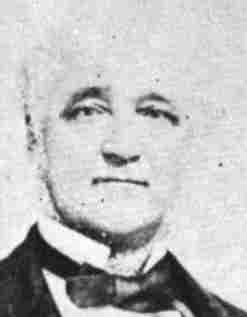
Ted’s maternal grandfather, William Leigh, who served as Victoria’s City Clerk for 20 years before his death in 1884.

His first wife (Ted’s mother) was Caroline Leigh, daughter of William Leigh, city clerk for Victoria.  Carrie died in childbirth in 1885 when Ted was four years of age.  A couple of years later Walter married Clara Chipp as his second wife.  Ongoing physical pain, along with some bad financial news from England, led Walter to commit suicide on January 28, 1892.  He shot himself in the head while sitting at the desk in his office in the family home where he did his work as gold commissioner.  The Victoria Colonist newspaper reported that the first person on the scene after the shooting was his son Ted, age 11 at the time.  It must have been traumatic for Ted, because for the rest of his life, he never talked of the shooting, except to his wife Helen.  The only information his children had of the suicide came from their mother.

After their father’s death, Ted and his brother Walter Robert Dewdney and sister Rose Dewdney went to live with friends of the family, including the sister of Rev. Henry Irwin, a popular figure in B.C. history known in the frontier communities as “Father Pat”.  After a few months of temporary stays in the North Okanagan area, the children went to Victoria to live on a permanent basis with their uncle Edgar Dewdney and his wife Jane.  As they arrived, Edgar was beginning a five-year term as Lieutenant-Governor of B.C. and living at the vice-regal estate known as Cary Castle.   In 1893 Edgar became Ted’s legal guardian.   Because both uncle and nephew had Edgar as their first name, within the family the uncle was known as “Ned” and the nephew as “Ted”.  Jane also had a nickname, as she was known as “Jeannie”.

As a boy, Ted was a keen student of history and literature and wanted to study at McGill University in Montreal, but his uncle Edgar, who was his legal guardian, insisted that Ted go to work in business at an early age.  Ted was a couple of months shy of 17 when he began with the Bank of Montreal as a teller in Victoria.  He was transferred to bank branches in New Westminster and Greenwood, and then in 1900 began as a clerk with the Bank of Montreal in West Kootenay gold-mining town of Rossland, B.C.  Later that year, his stepmother Clara, who had married William Cameron after Walter’s death, contracted cancer.  Experiencing extreme pain from the cancer, Clara killed herself by drinking carbolic acid, a common way of committing suicide by women of her era.

Ted Dewdney (right) in 1891 with his sister Rose and brother Walter.

Soon after arriving in Rossland, Ted joined the local branch of the Rocky Mountain Rangers (RMR) militia.  In the next seven years Ted would make many friends in Rossland and rise from private to lieutenant in the RMR.  When the bank transferred him to the Okanagan community of Armstrong in 1907, his friends in Rossland – particularly comrades in the RMR – honoured him with a high-profile farewell party at the Rossland Club, which was the young city’s white-collar social and business club of the time.

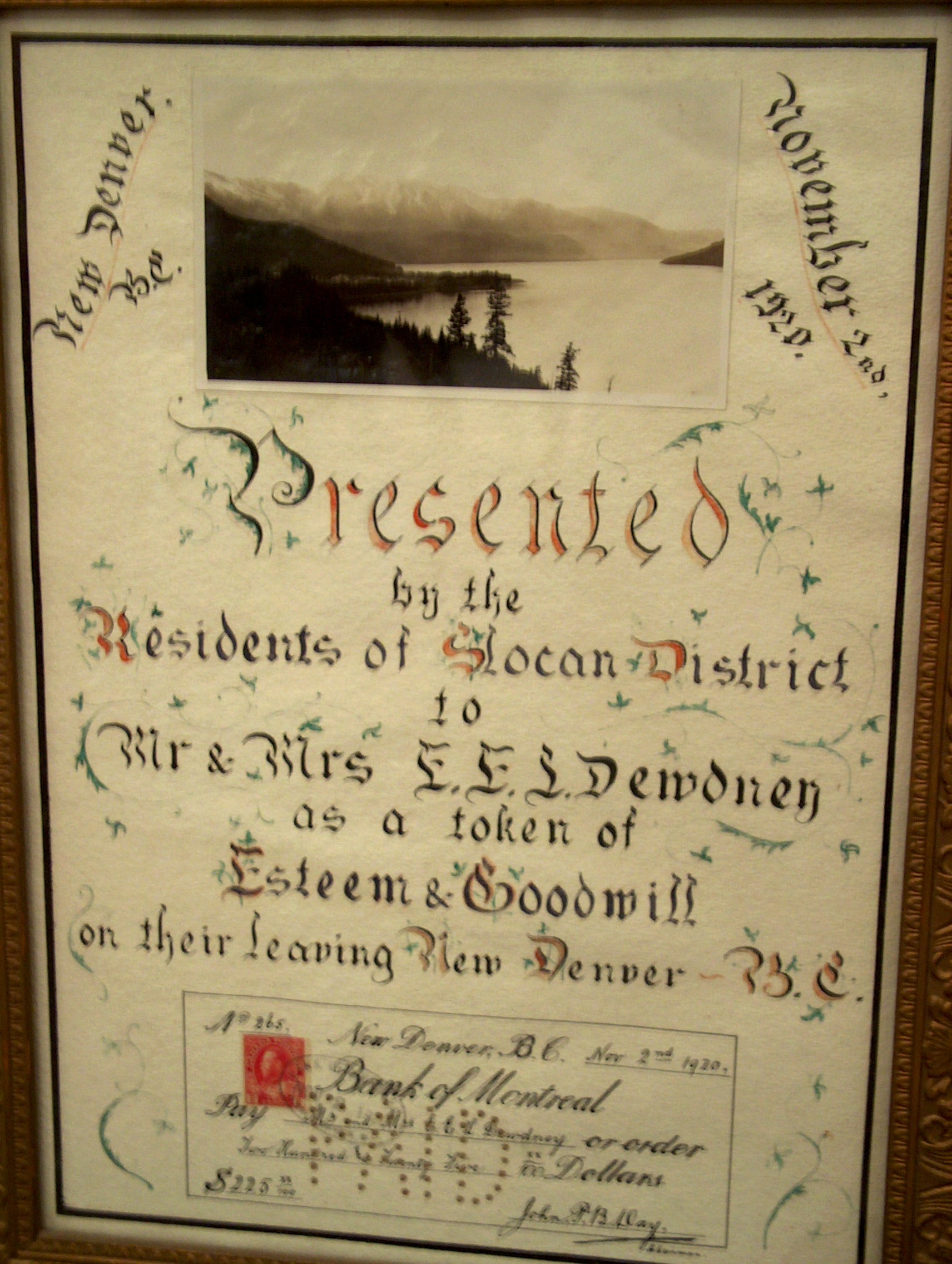
The Bank of Montreal transferred Ted to Victoria, where he courted Helen Peters, and then back to Rossland.  Ted and Helen married at the St. Paul’s Anglican Church in Esquimalt in June 1912, and went to live in Vernon, where Ted was beginning a new assignment as accountant of the local bank branch.  Their first child, daughter Eve Dewdney, was born in December 1913, and then in the spring of 1915 Ted moved to Greenwood to begin his first appointment as branch manager.  A year later, the Dewdney family moved to the silver-mining community New Denver, where they lived in quarters above the bank office managed by Ted, which today serves as New Denver’s Silvery Slocan Museum.

While at New Denver, Helen learned of the deaths of her brothers Jack Peters and Gerald Peters in the war.  Her despairing mother, Bertha Gray Peters, came to live with her daughter’s Dewdney family after returning from England, where she was staying during the war years to be close to her sons in battle.  In May 1917, Ted and Helen’s son Frederic Hamilton Bruce Dewdney was born.  As a toddler, he picked up the nickname of “Peter”, and was known as “Peter Dewdney” the rest of his life.

Plaque and cheque Ted and Helen received from friends in New Denver as a farewell gift in 1920.

In 1920 the family moved to Rossland in line with Ted’s transfer to manage the Rossland branch.  Daughter Rose Pamela Dewdney – who went by the nickname “Dee Dee” from an early age – was born in 1924.  Ted transferred to manage the nearby Trail branch in 1927, and then was moved to Nelson in 1929, retiring there in 1940 after 42 years with the Bank of Montreal.  Helen’s mother Bertha stayed with the family through every move, and helped with meals and looking after the children.  She was in good health until suffering a serious fall down the stairs of the Nelson house in about 1935.  The fall left her disabled and bedridden for the rest of her life.  Upon Ted’s retirement, the family moved from the Nelson Bank House known as “Hochelaga” to a heritage house he purchased on Stanley Street.

As a young man, Ted was athletic and a champion tennis player, winning the West Kootenay Tennis Singles event three years in a row.  He was also a keen fisherman, rower and stage manager for his wife’s musical and theatrical productions.  He was also extremely active in community groups and charities, including the Anglican Church, the Red Cross, the Kootenay Lake Hospital board, and the Welcome Home Committee that assisted veterans returning from service abroad.

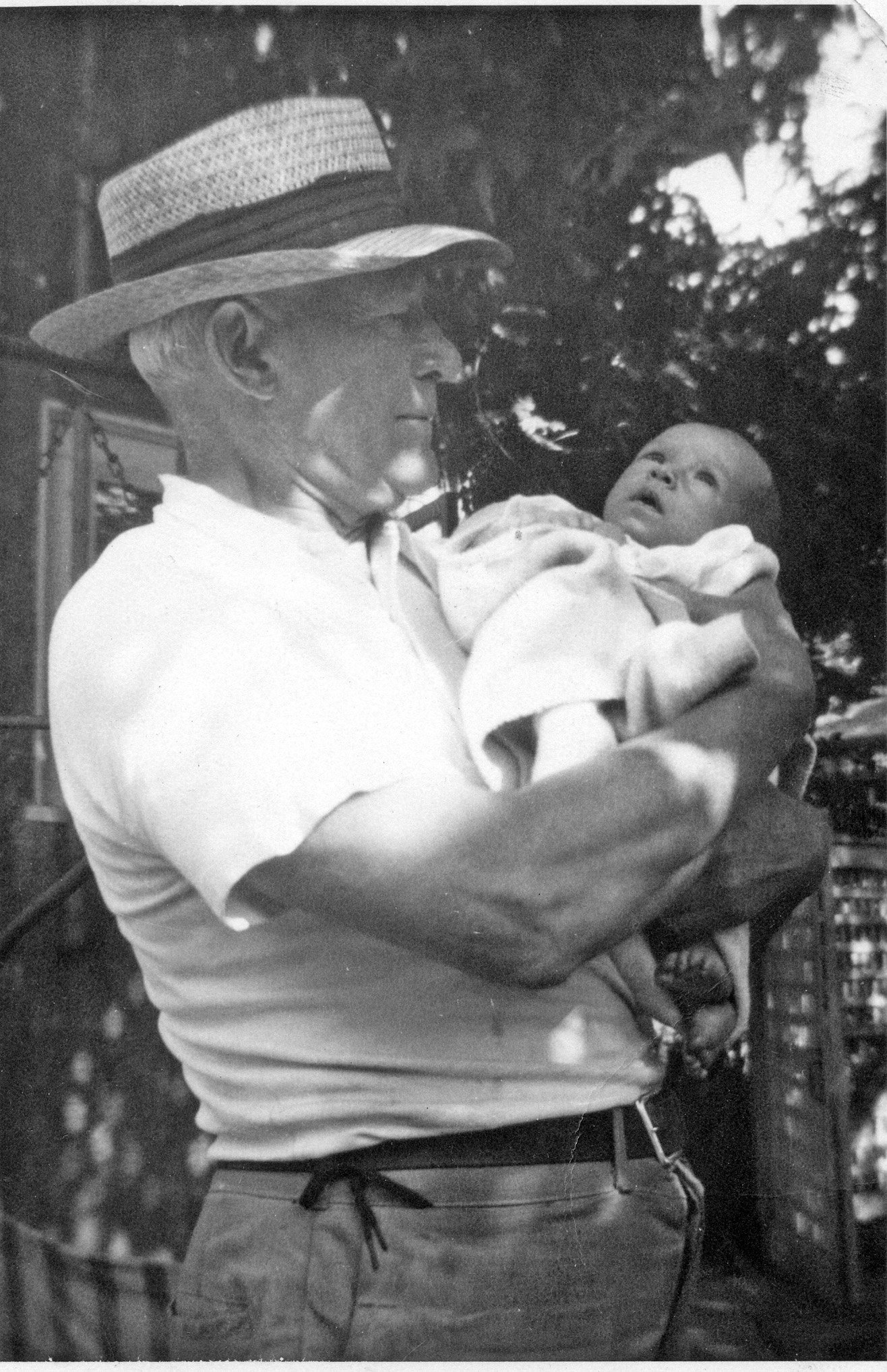
Ted Dewdney with his grandson Sam McBride, October 1951.

Ted died at age 71 in 1952 from a heart condition which today might be remedied by bypass surgery.  His widow Helen inherited his Dewdney memorabilia and went to live with her daughter Dee Dee McBride’s family.  In 1968 the Dewdney Papers that Edgar left to his nephew Teddy in his will were donated by the family to the Glenbow Archives in Calgary.  As they include extensive correspondence between Edgar Dewdney and Prime Minister John A. Macdonald around the time of the Northwest Rebellion of 1885, the Dewdney Papers are often accessed by researchers and writers of Canadian history.

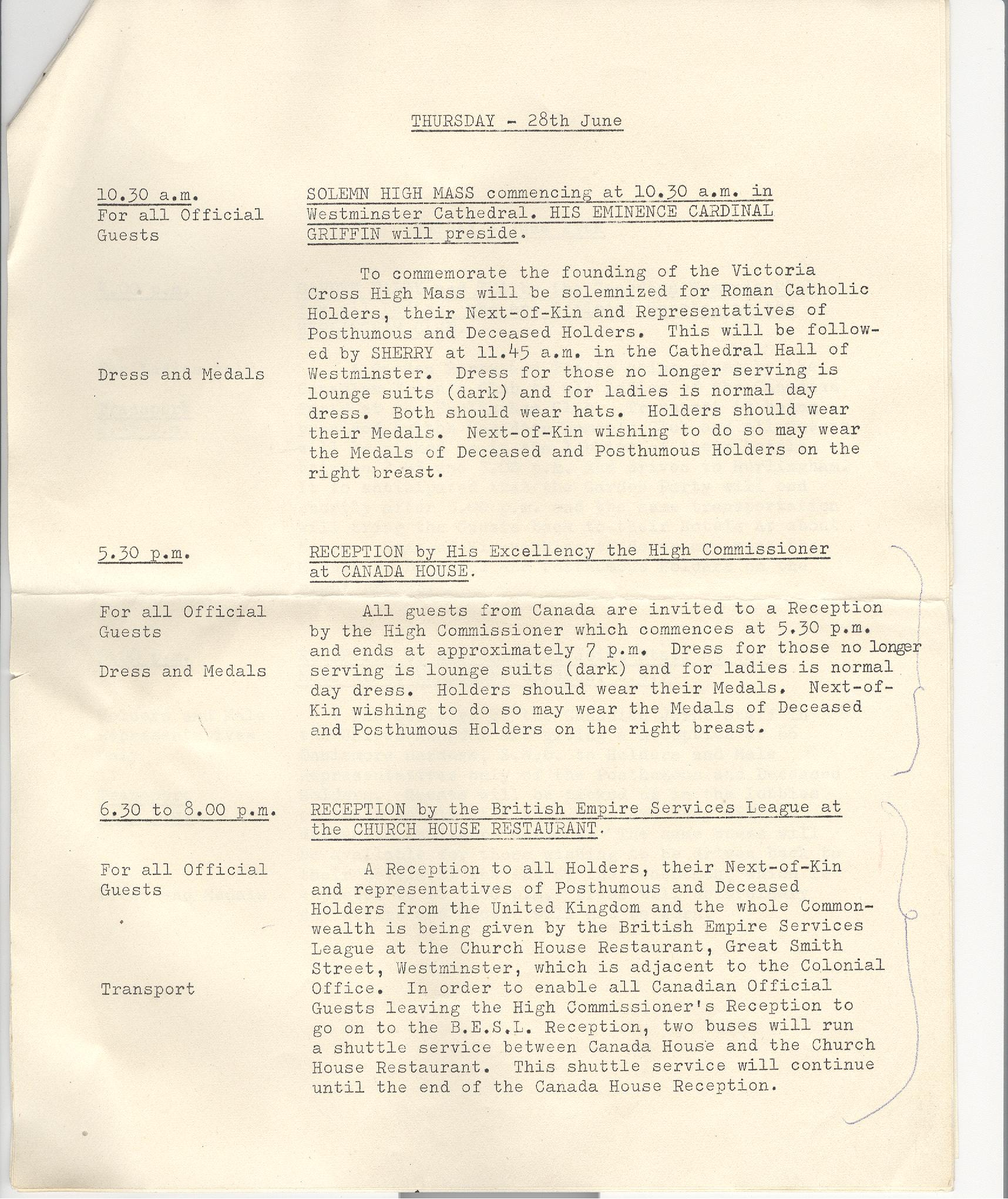
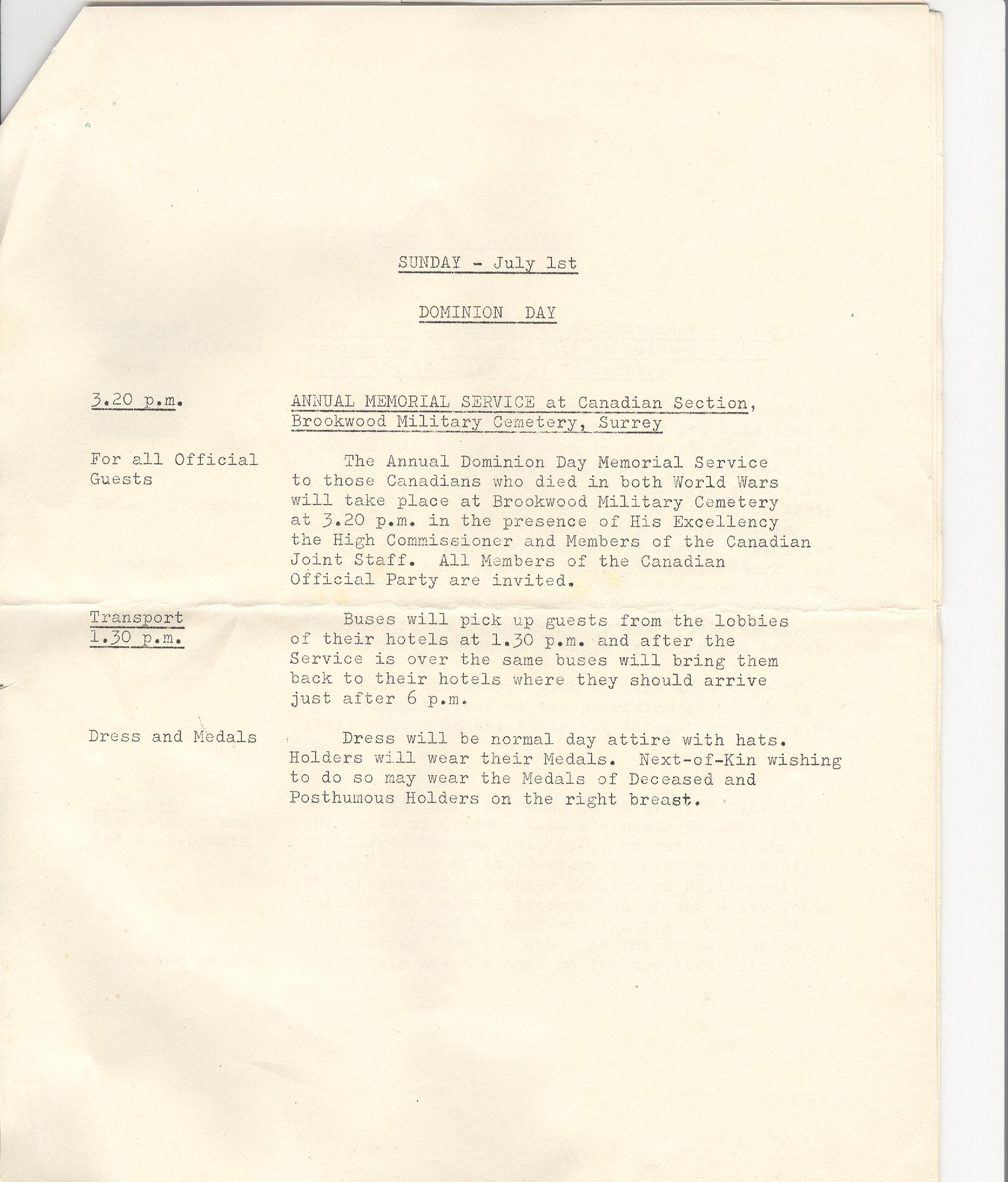
Itinerary for Helen Peters Dewdney and other Canadians at the Victoria Cross Centenary in England in 1956

5 Comments

itinerary page 4

itinerary page 6

itinerary page 5

by Sam McBride

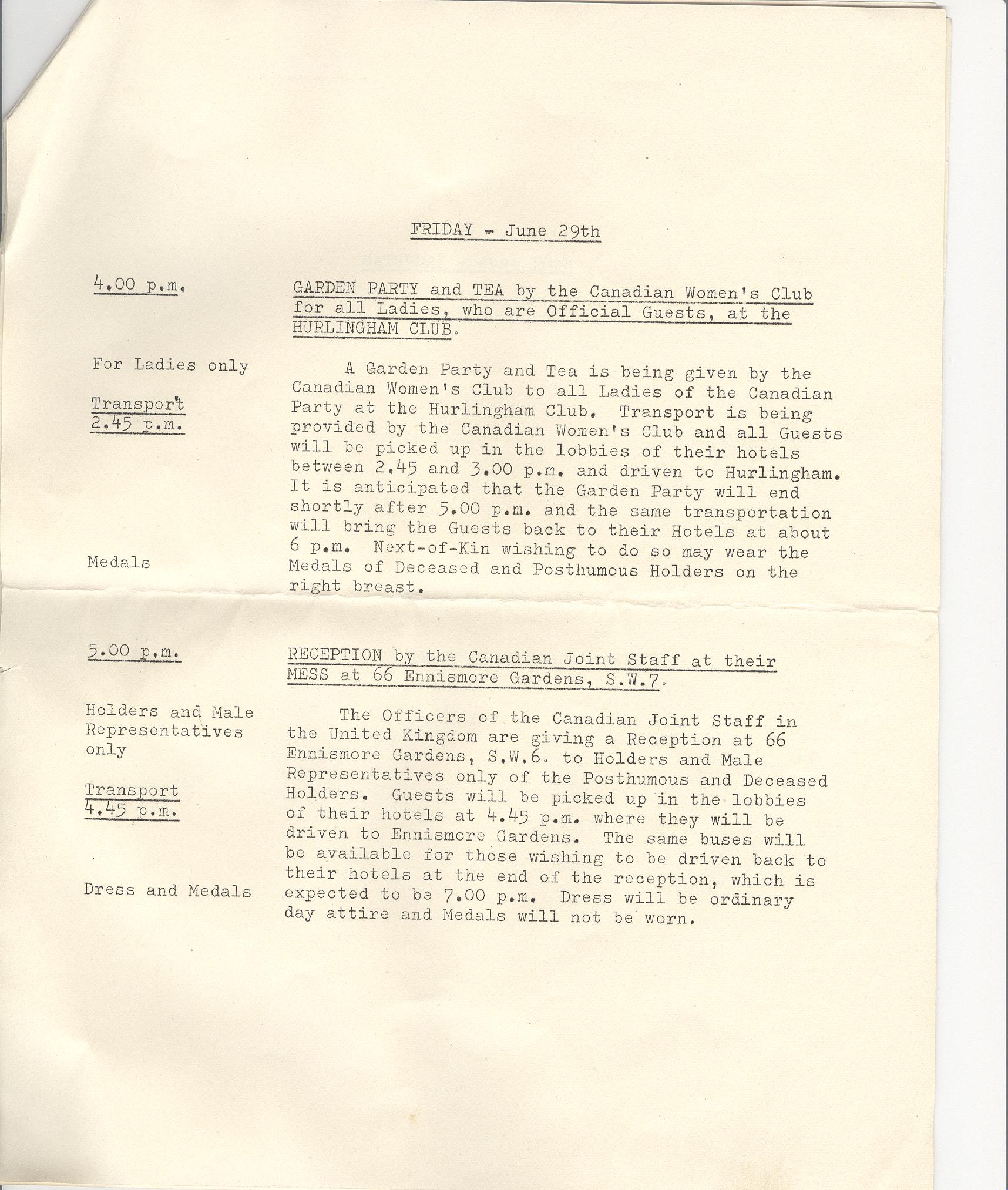
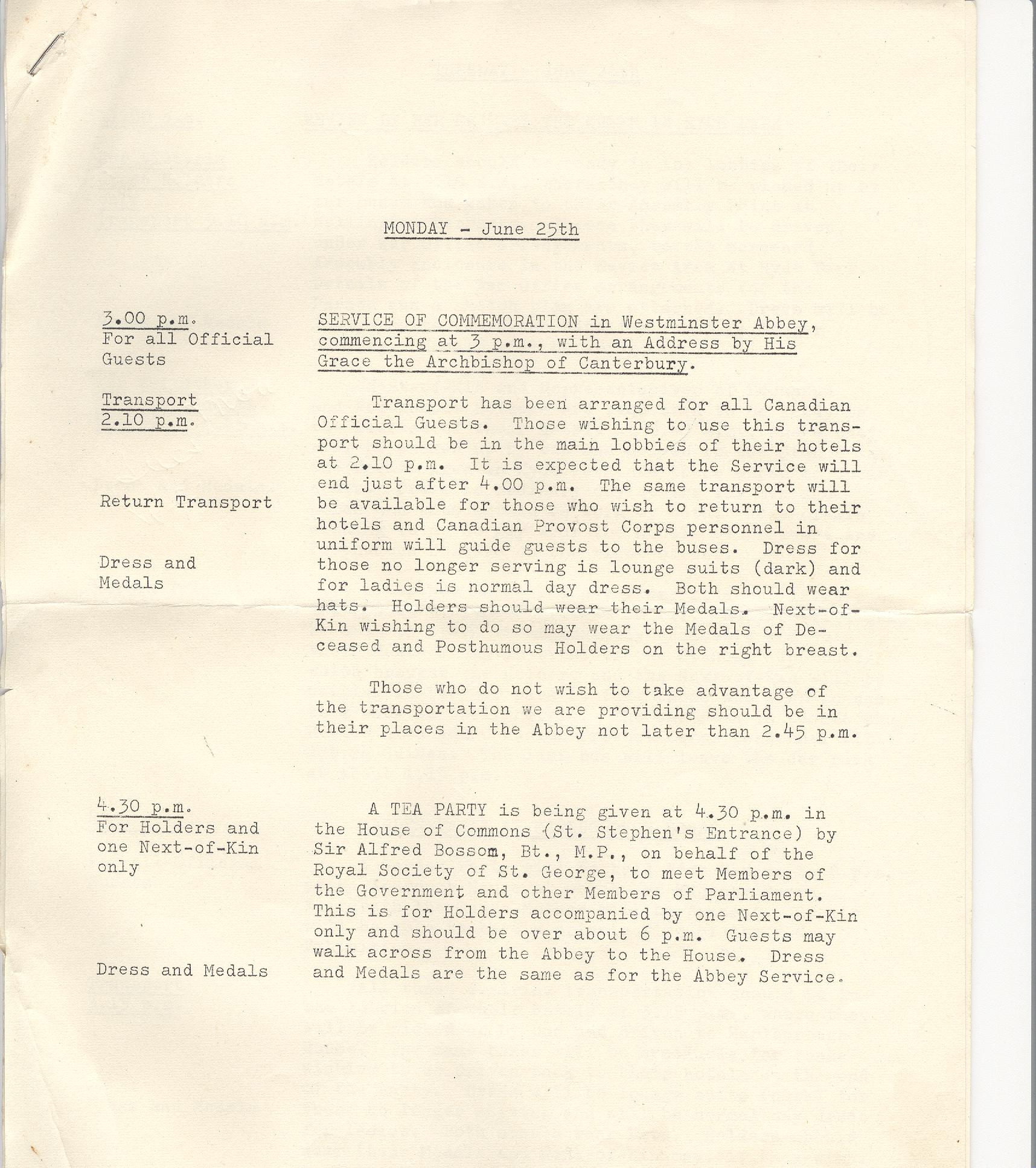
My posting in this blog dated Dec. 22, 2011 features scans of tickets, invitations, theatre programs and other memorabilia my grandmother Helen kept as souvenirs from the Victoria Cross Centenary events in June 1956 marking the 100th anniversary of the creation of the Victoria Cross as the ultimate award for valour in the British Empire.

Helen was invited to England for the centenary as next-of-kin to her brother, Capt. Frederic Thornton Peters, VC, DSO, DSC and bar, DSC (U.S.), RN, who received the Victoria Cross and the U.S. Distinguished Service Cross for heroism in the attack on the harbour of Oran, Algeria on Nov. 8, 1942 in the Allied invasion of North Africa.  He miraculously survived the Oran action, but died five days later when the flying boat transporting him back to England to report to Prime Minister Churchill on the Oran action crashed in Plymouth Sound.

Going through family papers recently I discovered the seven-page itinerary that Helen and other Canadian participants received for the centenary events.

Implications of the sinking of “Titanic” in the Fritz Peters story

April 14, 2012

2 Comments

by Sam McBride

When the supposedly unsinkable RMS Titanic sank off the coast of Newfoundland during the evening of April 15, 1912 after hitting an iceberg, Frederic Thornton “Fritz” Peters was a 22-year-old newly-commissioned lieutenant at the Royal Navy’s China Station in the British colony of Weihaiwei on the northeast China coast.

While none of Fritz’s close relatives died in the Titanic disaster and he never mentioned the sinking in his letters home between 1914 and 1942, the disaster had a significant impact on his family.  His father, former Prince Edward Island premier Frederick Peters, abandoned his law practice in Victoria in 1911 to move north to the new community of Prince Rupert to take up the position of city solicitor.  He made the move at age 59 confident that he was getting in on the ground floor of boom town.  He had lost money in mining-related investments, and was hoping to get back on track financially in a thriving frontier economy.

Led by CEO Charles Melville Hays, the Grand Trunk Railway was going full speed in its program to develop Prince Rupert as a Pacific port to match thriving Vancouver.  Another booster of the Grand Trunk Railway and Prince Rupert was Frederick Peters’ longtime political ally, Prime Minister Sir Wilfrid Laurier, who visited Prince Rupert in 1910 and expressed his government’s support for port development.

The death of Hays in the Titanic disaster was a major blow to Prince Rupert, as he championed the port development project and had not shared his detailed plans for it with anyone else before his death.  Frederick Peters would spend the last seven years of his life working to keep the fledgling Prince Rupert community from bankruptcy.   When Fritz retired from the Royal Navy in 1913 he said the main reason was to “add to my family’s coffers”.

His father Frederick Peters’ finances were reduced to the point that his wife Bertha needed to collect contributions from her sons’ military pay so she could travel to England during the war years to be close to her sons fighting in the First World War.

The Peters family would also have taken a great interest in the Titanic story because of their heritage as descendants of steamship magnate Sir Samuel Cunard.  Fritz’s father Frederick Peters knew his grandfather Samuel Cunard well from Cunard’s many visits to Charlottetown before his death in 1865 when Frederick was 13.

Titanic was built and operated by the White Star Line, which was the chief rival of the Cunard company in trans-Atlantic travel.   Titanic and its sister ships Olympic and Britannic were built in response to the Cunarders RMS Mauretania, which began service in 1906, and RMS Lusitania, launched in 1907.

A key reason for the success of the Cunard company since its inception in 1840 was its commitment to safety as top priority.  The sinking of Titanic was one more instance of loss of life by Cunard competitors obsessed with speed or otherwise careless about safety.  In the 19th century the U.S. Congress provided grants towards establishing the Collins company as a dominant force in trans-Atlantic travel, but it was devastated by many well-publicized wrecks and fatalities at sea.

The exception to the Cunard record of safety was during wartime, when many Cunard vessels were seconded for British use in the war.  Half of the Cunard fleet was sunk by German u-boats in the First World War, including Lusitania and RMS Carpathia, which rescued the Titanic survivors in 1912.

Fritz’s Cunard cousins ceased being involved in the management of the company in the 1920s.

One of the jobs Fritz had after his first retirement from the Royal Navy in 1913 was as third engineer with Canadian Pacific Railway ships in the interior of British Columbia.  He left that position when he rejoined the Royal Navy in August 1914 at the outbreak of the First World War.  There is no record of him returning to civilian service at sea after retiring a second time from the Royal Navy in 1920.

In 1934 White Star merged with Cunard in a new company called Cunard White Star Limited.  By 1949 Cunard had acquired all of White Star’s assets, and reverted to using the single name “Cunard”.  Today, Cunard is a subsidiary of Carnival Corporation and PLC.

Sources: Peters Family Papers, “Steam Lion: a Biography of Samuel Cunard” by John G. Langley, unpublished memoirs of Commander David Joel, RN.

Letters from Lieutenant Gerald Hamilton Peters, Part Two: 1916

April 9, 2012

Leave a comment

by Sam McBride

Here are the full transcripts of letters from Gerald Hamilton Peters to his relatives in 1916, along with articles in Prince Rupert, B.C. newspapers about him in that period.

The year began well for him, as he was accepted into officer training in England after serving in the Ypres trenches in 1915 as a private.  His mother Bertha Gray Peters — with whom he had an extremely close relationship as her favorite child — rented cottages in southeastern England so she could get together with him on his leaves.in

Gerald died in action on June 3, 1916 in the Allied offensive to re-take Mount Sorrel in the Ypres Salient, which the Germans had won on June 2.  Fourteen months earlier, on April 24, 1915, Gerald’s brother Private John Francklyn “Jack” Peters died in the Second Battle of Ypres.  Gerald, Fritz and other relatives were convinced, based on poor communication and wishful thinking, that Jack was alive as a prisoner of war.  It was not until late May, 1916, that Canadian Army authorities learned for sure that Jack was not a P.O.W., and therefor was assumed to have died on April 24, 1915.  It is not clear from the following letters that Gerald received the final news on brother Jack.  His mother and other relations would have heard that Gerald died within a couple of weeks of hearing that Jack died earlier.

Like Jack, Gerald was originally listed as missing.  It was not until the third week of July, 1916 that his death was announced.

This posting is the second half of the transcribed letters of Gerald Hamilton Peters in this blog.  The previous post includes all letters from Gerald up until February 1916.

Gerald to his sister Helen                                  February 13, 1916

Queen’s Hotel, Folkestone

My Dearest Ode Hagen,

No doubt Mother has told you already about my amazing luck.  The right amount of pull has succeeded in getting me a commission1 and I am back in dear old England and out of that Blasted Bloody Belgium2.  You can’t imagine how glorious it is to be back.  It was simply miserable over there, no glamour or glory of war, just unending work and nothing to do if you did get any spare time.  It isn’t hard to look back on, but at the time there was little fun in lying in ditches while their horrible machine guns swept over you, pattering everywhere.  I can’t realize my wonderful luck — three months training in Shorncliffe and such far better pay.  I have got a week’s leave now, and if I want more I can wire for an extension.  I think the O.T. {Officer Training} course begins on the 25th and until then I believe my time is practically my own.  Mother came down yesterday, and joined me here.  We were to have gone to London this morning, but she has a headache so I expect we will go up tomorrow.  I am very glad for her sake also about my commish.  I do hope she will be able to take a little cottage near here while I am training, it would be so lovely for both of us.  I know she rather felt staying so long at Spreyton3.  It is beastly to feel you are an expense, you know what it is.  My pay will be pretty good — $60 a month and $18 allowance while in England.  So I will be able to let Mother have quite a bit.

Feb 15/16

We are in London now, staying at a boarding house on Russell   Square.  Hotels are terribly expensive now, things are almost double.  It is great to be here again, you can’t think how lovely it is to be able to sleep all night instead of doing guards and snatching a few odd minutes rest.  I will miss all the drudgery that will go on from now until everything is ready for the Big Drive4.  I expect we will all be back for it, they say everyone will be hurried over in time, even the slightly wounded and the sick.  It is hard to realize the colossal scale it will be on.  Let us hope it will finish it all.  I always thought the war would be ended by fighting, and not by starving Germany out, or lack of money.  Things were just getting active again before I left.  I had a periscope shot to pieces in my hand a few days back.  It gave me a horrible shock and nearly knocked me down.  The same instant a fellow near me had his brains blown out by the same machine gun.  I left Belgium without any sorrow.  It is rather flat to have been there five months and never seen any fighting, but perhaps it is as well.  I expect real fighting is about as bughouse as trench warfare.

I rather dread going back as an officer.  It is a real responsibility – even a junior officer – as he has control of a platoon, about 50 men, and perhaps a big extent of trench.  Fancy having to take out wiring parties to within 40 yards of the Germans and work for three hours in the open.  It’s bad enough to be on these parties, let alone commanding them.  However, it will be better in most ways, and I will have a glorious time in England first.  If you ever hear a man say he wants to get back to the firing line again, you can tell him he is a darned liar.

I must go to Millbank now and wrestle with various officials for my pay.

Your loving Zarig.

P.S. Address your letter c/o Mother and please remember I am still a private.

 1 – His service file shows that he was accepted into Officer Training onFeb. 12, 1916.

2 – It is interesting to see how Gerald is much more candid describing the trench conditions with his sister Helen than he was with his mother Bertha.   He apparently doesn’t want to worry her about the dangers and unpleasantness of the trenches, and at the same time he wants to live up to her expectations of bravery.

3 – Spreyton was the address of the Poole relations in Guildford, Surrey.

4 – The big push would be the Battle of the Somme that began on July 1, 1916, a month after Gerald died at the Ypres Salient.  The Somme resulted in more than 600,000 casualties for the Allies and about 500,000 German casualties, ending in a virtual stalemate.  The result was a huge disappointment for the Allies, who were counting on a breakthrough with all of their resources focused on one campaign.  It was in line with the general trend in the war, where defenders had the advantage in battles because of the technology of the time.


Prince Rupert Daily Empire1 news clipping             May 6, 1916

Headline: Gerald Peters is in Officers Training School in England Studying Enemy’s Methods

          In a letter from Mrs. Peters, the city solicitor has heard that his son Gerald is in the Officers’ Training School at present, and that he is specializing in the study of enemy methods as discovered from all enemy papers discovered on prisoners, in trenches, and in captured positions.  These documents, etc. are all carefully studied and used for what they may be worth.  They frequently throw light on enemy plans and explain situations.

1 – The largest local newspaper in Prince Rupert at the time, The Empire, was founded in 1907 by John Houston, who is well-remembered in Nelson, B.C. as that city’s first mayor.  He sold the newspaper in 1909 to Seville Newton.  The Empire merged in 1947 with the Prince Rupert News, which continues to be the primary newspaper of the city today.

Gerald to Bertha                                                                     May 22, 1916

Officers Club, Boulonge-Sur-Mer (stamp impressed)

My Dearest Zarig,

I have got this far in safety.  We left at 3 o’clock and had a calm crossing.  I see that French time is an hour behind, so I gain an hour now.  I am to go by rail tonight, for which I am very thankful.  It will mean arriving in the early morning, the best time.  I am waiting at some club for officers, quite nice, and I will get dinner here.  I do hope you got home all right after I left.  Write when you decide on anything.  I look forward to your letters.  And I know you won’t be too low, you are so Spartan.  Only three months, at any rate.  I am glad the wrench is over.  I know it is far worse for you.

I met that English fellow on the boat.  There is no sign of the others, but several other boats left at about the same time, and I expect I missed them in the crush.

Nothing much to say.  How rotten it is to be writing to you again, but we can’t kick.  Good bye and good luck.

Your loving Zarig.

Gerald to Bertha                                           May 24, 1916

Belgium

My dearest Zarig,

I arrived at our camp yesterday afternoon, the Battalion being out of the trenches for a few days.  The first man I ran up against was Harris.  He joined the 7th after he got his commission.  I was delighted to meet him, and he seemed awfully glad I was joining them.  He is a very decent fellow I think.  He went back last night on leave so I nearly missed him.  I can’t tell you how splendid this battalion is.  The spirit of all the officers and men is wonderful.  The C.O.{Commanding Officer} seems to be thought the world of by everyone.  He is right there every time, keeps the battalion on the go.  He didn’t know I was coming, evidently, and he didn’t seem very enthusiastic when I arrived.  It is going to be a job to keep pace with some of our officers.  I met Wildy Holmes1, Wharton and Mr. Barton.  It is very nice meeting fellows you know so well, it is much less lonely.  Harris seemed really delighted I had come, and introduced me to the others as one of his “oldest chums”.  Rather decent of him.  He talked a lot of poor old Jack.  He said he had never met a man so cheerful and optimistic always.  He often saw him at Salisbury, and Jack was one of the ones who never kicked then.  You can’t think how glad I am to have him.  I know he will help me a lot when he comes back next week.

It will reassure you to hear that we are going in to a pretty civilized part of the line.  The method in the battalion is to give the Germans complete hell the first time in a trench, and then secure the upper hand at once.  The men seem to be beyond compare.

I have been given No. 11 Platoon, No. 3 Company.  Address No. 3 Coy., don’t give Platoon.  Clifford is in a different place now, and I didn’t go near his town, so couldn’t see him.

Please send me a new battery for my “Orilux” lamp2.  I know you can get them at an electrician in Folkestone on Sandgate Rd., about three  blocks from Town Hall.  Must stop now, but will write again soon.

Goodbye,

Your loving Zarig

P.S.: Please send a cheques book, and send a couple of cheques at once.

1 – Captain William Dumbleton Holmes from Victoria, B.C. died June 13, 1916, 10 days after Gerald.  He earned the Distinguished Service Order and Military Cross.

2 – A flashlight used by Canadian officers.

Gerald to Bertha                                  May 26-28, 1916

Belgium

My Dearest Zarig

I received your two letters of Monday and Tuesday yesterday evening.  I meant to write before but as you can see by the altered dates, I was unsuccessful.  We are in the trenches now, having a very easy time.  This is the truth.  The weather is glorious, sky larks and cuckoos singing away, and frogs croaking.  The trenches are just at their best now.  I have just this moment run across Ernest Mathews, who is near us.  He tells me Rawdy is in the Artillery around here, and I will try and see him soon.  Do you remember Judge1 of Prince Rupert?  He is in my platoon, I didn’t remember him at first.  I will try to look up those fellows you mention when we go in billets again.  As for finding more about Jack, I can see that is pretty hopeless.  None, or very few of the men here now were out so long ago, and I don’t expect to hear anything new.

I don’t much hope to hear from the person you say you are writing to in Belgium.  However, there is no harm in trying.  But it seems inconsistent if the Germans let us hear after so long.  I am sure it will not be until peace comes.

I am awfully glad you are going to London, and will be near Mrs. Bell.  I am sure you will like it better than Hythe.  It is very good of you sending a watch, I would prefer with a black face.  I was going to send for one, as it is an absolute necessity.  I don’t think I will bother about the binoculars just yet, I can manage easily without them.  I got a very nice letter from Wailts, thanking me for the draft and wishing me success and good luck.  Really they have been pretty decent.

          I was on the second boat on Monday.  Barton and Ellis turned up the next day.  Barton2 is in the same company as I am.  I am glad they have come.  I know quite a few of them now.  The leave seems to come around with delightful regularity. {FURTHER PAGES MISSING}

1 – Charles Judge of the 7th Battalion diedJune 3, 1916, the same day as Gerald.

2 – Edward Stephen Barton with the 7th Battalion died November 10, 1917

Gerald to Bertha                                                   May 31, 1916

Addressed to Mrs. F. Peters,

71 Queensborough Terrace,

Porchester Gate, London

My Dearest Zarig

I have just received yours of May 28th; you should have had my first letter written on May 24th by then, but I suppose they crossed.  We are at present staying at a farm.  Luckily, however, it is not like the one in the picture.  We are behind the lines in reserve, and by the time you get this we will probably be still farther back and I don’t think we will be in the trenches again for a month.  This is really official so you needn’t worry for several weeks, anyhow.  We had an easy time in this time.  I gave you a sample of our menu in my last, so you can see we don’t suffer any as poor old Broderick would say.  We are in a very gorgeous sort of farm at present.  I thought at first it was a chateau, but I was disappointed to find it wasn’t.  It has always been an ambition of mine to stay at a chateau.  I have a little room to myself, furnished with an enormous gold framed mirror, a marble-topped table, and a very small cot which makes a very comfortable bed, if approached with all due caution.  The weather is glorious, and you can lie in the long, warm grass and listen to thousands of skylarks, cuckoos and shells singing and bursting.  Things are a good deal more luxurious for me now than before.  My batman1 brings in water for washing in the morning, and in many small things it is better.  It is so lovely getting your letters.  Your hand wasn’t very shaky.  I know you want it to be shaky, but I’m afraid it isn’t.  Poor Beetle, how I hope you can get a little flat.  As soon as we are back, in a few days, I will get the Paymaster to assign ₤8 instead of ₤4.  I don’t think I can make it more just yet, but I hope to be able soon to save a little reserve for use in emergencies.

I have been very lucky, joining this unit, as it has been so long here that it is going to have a very easy time of it for a while.  I really can’t help being glad we are having such a long spell out, and apparently it is to be always as long, so you see we will only be in the trenches a quarter as long as we were last winter.

Your loving

Gerald2

P.S.  It was very thoughtful of you to send your address three times.  If you will send it again for half a dozen times I may get it all right.

 1 – personal assistant for an officer who helped with uniforms and other such duties

2 – This was the last communication from Gerald before he died in the Canadian attack on Mount Sorrel in the Ypres Salient on June 3, 1916.  The Germans had taken the high position in a surprise attack involving huge explosions in mines tunneled under Allied troops the day before, and new commander Gen. Sir Julian Byng – who would later lead Canadian troops to glory in the victory in April 1917 at Vimy Ridge and serve as Governor General of Canada — wanted to counterattack as soon as possible before the Germans could establish defences to the position.

Prince Rupert Daily Empire clipping                  June 8, 1916

Headline: Lt. Peters Missing

          Adding to his burden of anxiety for his boys in the service of King and Country by land and sea today, City Solicitor Peters is in receipt of a telegram fromOttawa informing him that his son Lieut. Gerald H. Peters, is amongst the missing in the recent heavy fighting in France.

Prince Rupert Daily Empire clipping          June 9, 1916

Headline: Lieut. Gerald Peters of This City is Among Missing

Fred Peters, K.C., City Solicitor, has received from militia headquarters the information that his son Gerald is among those missing following the fighting which has recently taken place.

          He was a member of the Union Bank staff here, but like the rest of the family of Mr. Peters could not resist the call to arms and left for the front.  Recently he received a commission as lieutenant and was so serving.  There are reported to have been a number of Canadians captured, and there is a possibility that he is among them.


Letters from Lieutenant Gerald Hamilton Peters, Part One: 1915

April 8, 2012

1 Comment

by Sam McBride

The following letters were written to relatives in 1915 by Gerald Hamilton Peters (1894-1916), brother of Frederic Thornton “Fritz” Peters.

The letters were kept among the Peters Family Papers by his mother Bertha Gray Peters (1862-1946), then after her death by his sister Helen Peters Dewdney (1887-1976), and most recently by his niece Rose Pamela “Dee Dee” Dewdney McBride (1924-2012).  I transcribed the letters in 2008, providing notes where relevant but without corrections to grammar, so as to retain authenticity.

Gerald to his mother Bertha (undated and ripped)                            early 1915

…It is beginning to get rather exciting.  I wonder how long we will be kept in England training.  I do hope I can get in touch with Jack.  How thankful I am that you are going1.  It would be lonely work going so far away, if I didn’t know you would be so close…

1 – Bertha was planning to go to England in early 1915 to be near her sons.

Gerald to Bertha (undated and ripped)                           early 1915

…You will probably find it easier to get money from Father before leaving than when you are safe in far off England…

…How proud you must be about Fritz.  I got your letter and Aunt Florence’s1 on the same day telling me of it.  You must almost want to go back to Prince Rupert to be able to tell everyone…

…Beyond an occasional dime I have not had to lend any money.

Your loving,

Zarig2

Beetle  Gorgeous toad3

1 – Bertha’s sister Florence Poole, who lived inGuildford,England, southeast ofLondon

2 – a pet name Gerald used in referring to himself and his mother

3 – other pet words used in writing to his mother

Gerald to Bertha (undated and ripped)                          early 1915

{PREVIOUS PAGES MISSING}

…it would have been fifty times better if you had been there.  But we won’t be over till nearly the end of May and we are sure to get at least six months more of training, so you are sure to be over long before we cross toFrance.

We had another field day today, hard work but I didn’t feel it nearly as much as last week.  It is wonderful the way one gets used to it.  I am so glad we are getting down to real work.  This is more what I joined for – a few weeks of it will make me a different being.  Tomorrow we set out at 8 o’clock for all day, to be inspected again by the Duke of Connaught1.  We are to have blank ammunition I believe.  Rather exciting, almost like the real thing.

Maisie is about the same, sometimes quite all right and sometimes very hysterical and uncontrolled.

I haven’t forgotten Mrs. Philpott, and will do my utmost to see her, unless I am on duty that night.

Good bye for a few days my night-blooming-serious.  Don’t imagine you won’t be able to make England.  We will beat the old hoodoo yet, surely fate won’t be so mean next time.

Your loving,

Beetle

 1 – The Duke of Connaught was Prince Arthur, third son of Queen Victoria.  As Canada’s Governor-General from 1911 to 1916, he actively supported improvements in military training.  He lent his name and support to the raising of the 7th Battalion (British Columbia Regiment), also known as the Duke of Connaught’s Own Regiment.  His daughter, Princess Patricia, also helped establish a regiment, the Princess Patricia Canadian Light Infantry, which had experienced troops at the start of the war and would go on to many honours in both world wars and beyond.
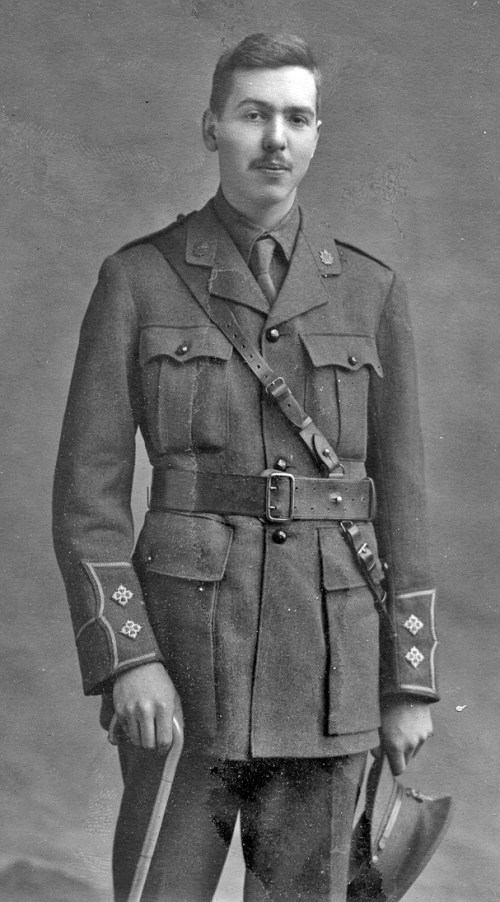
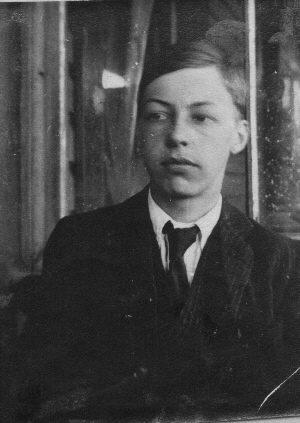
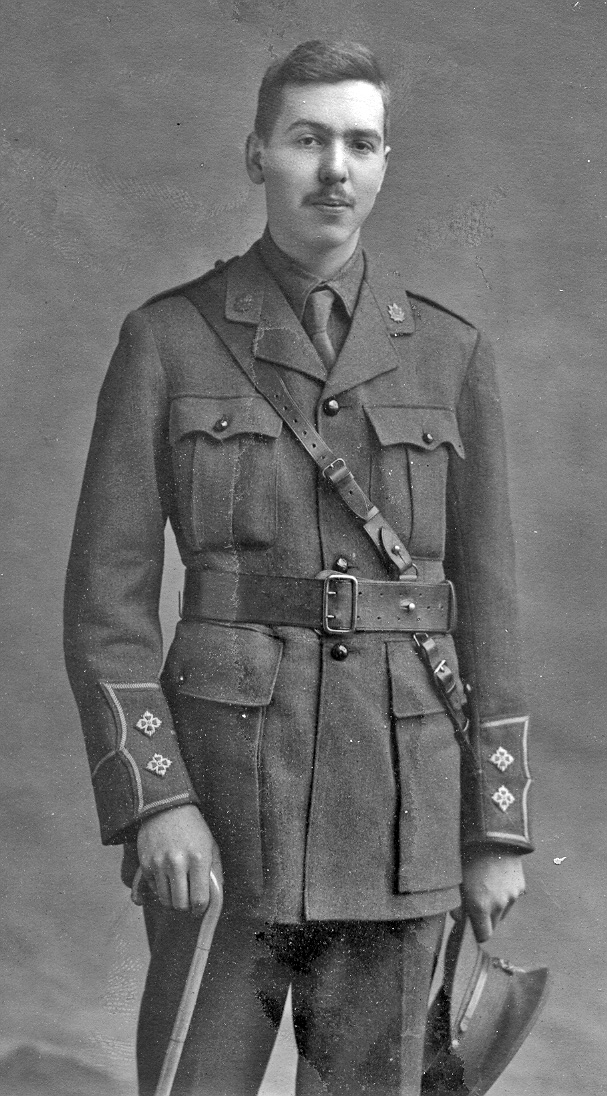
Lieutenant Gerald Hamilton Peters, spring 1916

Gerald to Bertha (undated and ripped)                           early 1915

How much {money} do you think you will need {to get to England}.  I don’t think you should cut it too fine.  You must have a safe surplus.  Do you intend keeping enough for your return fare?  After all, Jack and I should be able to help…  Noel is settled, but for that I don’t believe you could ever have got away, as it is, the prospect looks bright.

I wish you would give me Clifford’s number etc, and also Aunt Helen’s address, although I don’t suppose I will ever need it…

          Nothing more to say now.  Do write soon.  You can’t say I don’t write often.  Please don’t think of me as only “fairly happy”.  I am perfectly happy, I like the life and I get on very well with the other fellows.  They seem to like me, and regard me as a sort of millionaire…


Gerald to Bertha                                                     April 5, 1915

My Dearest Zarig,

It is Easter Monday and by rights I should still be in bed, it being only 11:30.  But in barracks there isn’t any lying in bed…

I sent the books and the photos yesterday.   I gave one to Aunt Mim, and of course you will give Helen what she wants.  I don’t like them much.  I went to the Abbotts1 all yesterday.  Maisie is up but still not better…

No more news of leaving yet.  I am afraid it will beVictoriaover again.  Our Colonel they say is making such a lot of money he doesn’t want us to go yet…

I should be able to learn to swim.  I can do about ten yards, but it is so tiring.  But at least I have made a start; the rest will come with practice.

          I am getting into the work now, and am feeling more at home in the life…{FURTHER PAGES MISSING]

1 – At their home inMontreal


Gerald to Bertha (undated and ripped)                     April 1915

…I have spent the morning writing some letters and at the YMCA.  I wrote to Fritz and to Edgar1 about the rifle.  I asked him to send the money to Helen if he has bought it and if not to return it to Father…

I wonder how you spent Easter this year.  Last year I think we went out in Clifford’s launch.  I think some day we will all manage to get together again somehow or other…

We are very well off here and so long as we don’t go to Valcartier2 I won’t mind…

          …Sometimes I would give anything just for half an hour’s talk with you.  I don’t think I could ever really enjoy anything away from my Beetle3

1 – He is likely referring to his sister Helen’s husband Edgar Edwin Lawrence “Ted” Dewdney.  The Dewdney name was prominent inBritish Columbiafrom Ted’s uncle Edgar Dewdney, a civil engineer fromDevonwho built the Dewdney Trail across the mountain ranges of southern B.C. and served as a senior cabinet minister under Sir John A. MacDonald.  Ted’s mother Caroline Leigh died when he was four, and his father Walter Dewdney died when he was 11, after which he lived with his uncle Edgar and aunt Jane Dewdney at Carey Castle inVictoriawhen Edgar was serving as Lieutenant Governor of B.C. in the 1890’s.  Ted met Helen Peters when he was inVictoriaon one of his many assignments with the Bank of Montreal, and they married in June 1912 inEsquimalt.

2 – Large Canadian training facility in Quebec that was built from scratch under orders from Sam Hughes, who didn’t like the existing training facilities at Petawawa, Ontario.  The trainees stayed in tents because there had not been enough time to build barracks for them.

3 – A pet name he had for his mother

Gerald to Bertha                                          April 1915

(written fromQuebec)

My Dearest Zarig,

I have just read yours of Apr 9th and I am so glad you have decided to go {to England}.  I have just returned from a field day yesterday.  We left barracks at 9 am with lunch in haversacks and were out until 5:30 pm and today we repeated this.  Very hard work indeed, about seven miles each way and then skirmishing at the double etc. the rest of the time.  I was just about finished when we staggered home to barracks.  I got some supper here, and read your letter and the two together bucked me right up.  These two days are the first field days I have had and I suppose are an example of what it will be in England.  But I feel very well, only very tired, and I think I kept up as well as mostly quite a few fainted, or fell out, as the weather was pretty hot and the mud fierce.  But soon I will be telling you everything, I hope, so I needn’t describe it all.

We may still be here when you come through, but there are the usual rumours afloat of leaving on Sunday.  I don’t really know at all when we will go.  We may wait for the Grampion to sail up the river and leave from here direct.  The river is about open now owing to the very mild winter.  And again most of all, we may go to Valcartier1.  It is impossible to say, but the 24th are said to be as good as any of the rest of the 2nd and I don’t see why they should be left behind.

I will certainly look around at Shorncliffe2 for a cottage or rooms – you couldn’t give me a pleasanter task.  But don’t expect too much, as I think we will be pretty well confined to barracks for a while, and also later on when we camp we will probably be some way out of town.  But there are always weekends etc. and I think we will not fail to make the most of every hour now.  I am glad you heard from old man Jack.  I have written to him often but have never heard from him.  I suppose we can’t expect too much from the mail service.  I got your last letter with Noel’s enclosed and the cuttings and other papers.  Certainly Noel doesn’t lack nerve.  I am sorry for the people we knew in Victoria.  But it is better than if he didn’t like it in which case he wouldn’t stay.  He could get his discharge easily enough, and his fellows would tell him so.  So it is very lucky he likes it.  I don’t think you need worry about Father, I think he is pretty secure.  At any rate, I am sure you will never be sorry you made the supreme effort and went.  I always knew you would go somehow or other.  I hope in a way we go first, unless we go to Valcartier, in which case I hope you come through Montreal first.  Valcartier will not be ready until May 15th about.  I think there will be awful trouble if the men are sent there, but on the other hand, everyone is so anxious to leave here, that they don’t care much where they go, so long as they escape the friends who daily ask “When are you leaving?”

Will stop, as I am dogging beat, so still I have to lift each leg with great care and slowness.

– Zarig   Beetle

P.S.  Don’t be angry because I don’t put more Beetles in, every time I write it I think it a thousand times and soon I hope will be saying it.  Be sure and let me know in good time when you will arrive here if you finally decide on it, as I have to give some notice to get leave to meet you.

P.P.S. I haven’t forgotten the $15 but am afraid I can’t send it till a little later in the month.

 1 – The Valcartier base inQuebecwas the central training and marshalling facility for the Canadian Expeditionary Force.  It was built from scratch by the federal government as ordered by Defense Minister Hughes, contrary to Canada’s existing mobilization plan.  Conditions for the troops were bad, but that was accepted as part of the training.

2 –A number of Canadian barracks and other military facilities were centred at  Shorncliffe, in Kent southeast of London.

Gerald to Bertha                                                   April 17, 1915

Khaki Club1

My Dearest Beetle

I got your wire yesterday morning, and I can’t tell you how badly I feel about it.  To think you should have been so nearly off, and then to be stopped at the last moment.  You must be heartbroken, my poor bedbug.  Hard, cruel, damnable luck.   I am glad poor Noel is better2 but I suppose it will be a long time before he is about again.  Will he be able to return to his regiment, or don’t you think he is fit for it?  It seems so hard after struggling against all the other difficulties, to be bowled over by the unforeseen.

Now, my own Zarig, I know you are so brave you will hold up as well as you can, even under this crushing blow.  But remember, even now, you may be able to make it a little later on.  Surely before August Noel will be all right, and although I suppose the expenses of his illness and your expenses will be pretty heavy, still you may have enough.  August seems a long, long time off but it will come at last and surely you can make it then.  I will do my utmost to send you what I can, but I am afraid it won’t be too much.  I am simply determined that you go toEngland by hook or crook.

I got you first letter in which you said you were almost certain to go on Thursday evening, and was so glad then on Friday morning.   I got your wire which simply made me curse everything.  We had a hard day all that day, but I couldn’t think of anything, but my poor beetle so terribly disappointed.  This morning I got your letter telling me what train you would be on, about getting a day’s leave etc. and that was the hardest of all.  If it is bad for me, it must be a thousand times harder for you.

Strange that poor Noel should be the first to suffer out of our family in this cause.  I do hope he soon gets better.   Thank Heavens none of us drink or smoke.  Here is where that will count.

I will try and see Mrs. Philpott, but really I don’t think I will succeed, they won’t allow you on the platform and the Windsor Street Station is so huge that it is almost impossible to find anyone in it.  But I will write two notes to her, one addressed care of the Misanabie and the other for the train.  If I can’t get her I will post one for the steamer and get a messenger boy to give the other to a porter.

We have been working very hard lately.  Last week we had three field days in succession ending Friday.  About seven miles march, and then skirmishing all day and the march home.  I was so stiff by Friday that it was simply agony to drag each leg along, but I am glad I was able to hold out.  It is very healthy work, all in the open, and I feel very fit after it.  I am glad we are settling down to hard work at last.

I do hope, my Zarig, that you won’t give up hope altogether.  Remember how many difficulties have been smoothed away settled, and Helen3 is far better off than when you first thought of going toEngland.  It will mean a long delay, I know, but sooner or later you will make it.  Of course I know how sickening it is, when it would have been so nice crossing with Mrs. Philpott, and going right away.

Please be sure and let me know what your plans are, how long must you stay in hospital, and if Noel can go back to camp again when he is better.

How I wish I could be with you to try and comfort you a little after this awful blow.  I always think disappointment is the hardest of all things to bear, and you have anxiety about poor Noel into the bargain.  To think that in a week you would have been with me again.  How I wish it could have been me that was the loser instead of it’s always being you that has the rough time of it.

Your loving Zarig

Beetle Beetle Bedbug glorious toad

1 – Khaki, from Persian for “dust-covered”, was a common fabric and camouflage colour for military uniforms.  To be “in Khaki” in World War One was to be in military service.  Later in the war years, gangs of women would accost young men in civilian clothes, say “why aren’t you in Khaki?” and plant a white feather symbolizing cowardice on the man’s coat or shirt.  Khaki Leagues were formed across Canada to support soldiers and veterans.  Gerald was apparently writing this letter in the recreation room that the Khaki League in Montreal provided for soldiers starting in December 1914.

2 – The problem with Noel isn’t specified.  It sounds as if he had something like a nervous breakdown.  It caused Bertha to cancel the arrangements for her trip toEnglandat the last minute, which was extremely disappointing for her and for Gerald.

3 – his sister Helen

Gerald to Bertha (ripped and fit together)              April 20, 1915

Khaki Club

My Dearest Zarig,

I am longing to hear from you again, and to find out how things stand exactly.  It will be too awful if you have given up all hope of ever going to England.  You must still make it your aim to get there sooner or later.  Sometimes I think I wouldn’t have left Prince Rupert at all had I known what was to be, not that I am sorry for myself, but really I think you are having too big a share of hard luck.  I miss you dreadfully now that the prospect of seeing you soon has gone, it makes it so much worse.  The awful distance makes me feel I was buried under the ground, it gives me just that feeling of suffocation.

Do make every possible effort to cross later on, when Noel is a bit better and you have had time to recover financially.

We have no further news of leaving yet.  I think it must be Valcartier next month.  I don’t much mind now, as you wouldn’t be in England.  Still, I hope we are sent across.

I was on quarter guard again yesterday and feel rather tired, so I won’t continue now.  Try and not be low, my cream of wheat, surely it will only be a matter of a few months before you can make it.  Goodbye, my crawling snake.

Your loving

Beetle

P.S. I wrote to Jack and told him about Noel, and also gave him your address

Gerald to Bertha                                                            April 27, 1915

Khaki Club

My dearest Zarig,

I was delighted to get your letter of Apr 19th.  I think it is splendid of you to be able to get away as soon as you intend.  I greatly feared you couldn’t make it until the fall.  You are very wise to take the chance, especially since this last dreadful battle.   I suppose you are on tenterhooks about Jack, but you would be wired from Ottawa right away if anything happened.  But you see what it would be like to be in such awful suspense all summer.

I strongly approve of you going.  I will send you $20 on May 1st.  I do hope Jack is able to send the $50.  I haven’t much time to write this, as I must hurry down to meet the St. John train.  Your wire, which I enclose, said Apr 27th but  I am sure it should have been the 22nd.  Unfortunately, I didn’t think there would be a mistake until too late, and will meet the train on the chance the Missanabe sailed Apr 23rd.  I doubt if we will be here by May 20th, but we may be delayed in which case you may be sure I will get two days leave and spend it all with you.  I hope I will still be here and there is a good chance of it.  How glorious it would be, only three weeks, I can’t realize it.  I think it is a splendid plan sending Noel to Helen.  He will like it and it is better for father.  Be sure to tell father how he wanted to go and also say that he wouldn’t hear of staying with her unless father paid $25 board.  Otherwise he will be slack in paying it.

Will write again tomorrow as I must fly to train although I know it is useless.

Your loving Beetle

Gerald to Bertha                                          May 4, 1915

My Dearest Zarig,

I am afraid I can’t send you the $20 as I promised in this letter, but I will leave it in a letter here for you to get on your way.  There are a lot of small expenses incidental to our going away that I hadn’t counted on.  But I hope you won’t need it until you arrive here.  I don’t think there is any doubt that we are leaving this Saturday or Sunday, May 8th.1 The Thespis and the Metagama are in port now, and I hear we are also to have the Misanabie in which case your passage will probably be cancelled.  I suppose that wouldn’t much matter as of course you would be given another booking.  It is rather hard luck your coming just after we pull out, but I think no other earthly power would have moved the 24th but our old friend the hoodoo.  I would sooner leave now though than be kept here all summer.  I will send you our new address as soon as we are told it, if possible in my wire.  You know the correct order to put it in so I can just put the brigade number as our regimental number will be the same.

This will be the last letter I will send to Rupert as this should arrive on May 11th.  I do hope Helen was able to send you the $20 etc but I fear she will have paid Waitts with it.

We will not see each other for over a month, I fear, but still it won’t be so bad as there will be so much for both of us to do.  I will send a wire to you c/o Aunt Florence2.  I expect they won’t give any leave for a few weeks.

{FURTHER PAGES MISSING}

1 – Gerald’s army file shows that he arrived inEnglandon the Cunard ship S.S. Cameronia on May 20, 1915, which was 12 days after the R.M.S. Lusitania was torpedoed and sank off the coast of Ireland.  Interestingly, Cunard authorities and the British government insisted until January 1917 that the Cameronia obeyed rules of neutrality and was not used for troop transports.  On April 15, 1917 a German submarine torpedoed and sank the Cameronia en route from Marseilles to Egypt, with a loss of 210 lives.

2 – Bertha’s sister Florence Poole in Guildford, Surrey, England.

Gerald to his mother Bertha                                         May 9, 1915

My Dearest Beetle,

I received your night wire on Friday and also your letter of Apr 28th.  I sent you a wire last night.  We are embarking tomorrow at 9 pm and probably sail at midnight.  I don’t know what boat we are to be on but think it is the Corsican or Corinthian.  I am not sorry to be off at last, although I wish you could have come here first.  Still you would have missed me even if you had sailed on the 20th.  I wasn’t surprised to hear that the Massanabi was taken, but I don’t know where she is at present, or who is to cross on her.  I do hope you won’t be delayed this time,  surely the third time should succeed.  It is rumoured that we are only to be kept in England about one month and then sent over to France.  There is a good range at Shorncliffe1; a few weeks on it should make our men good enough shots.  I hope this is true, as the training is pretty monotonous and we may as well get there as soon as possible.  As far as getting killed is concerned, you are as likely to be shot in one day as in several months of it.

We heard on Thursday that we were going this week but no one believed it.  On Friday all our rifles were packed and everyone realized that we really were off.  Forty-eight hours leave was given us from Friday evening to Sunday night.  I slept at Aunt Mim’s2 between sheets for the first time in three months and it certainly felt luxurious.  This morning I slept until 11 am and then Aunt Mim brought me my breakfast in bed.  I took Maisie to the Orpheum last night to see “Seven Keys to Baldpate”3, very American but not bad.  Maisie is nearly all right again now.

          It felt strange last night to be in a real bed again.  I tried hard to imagine I was back in my little room at home, then I remembered how I scratched on the wall and you answered.  If ever this war is over we won’t be parted again, my Beetle.  I don’t know whether to be glad or sorry we are off.  I feel so excited about it – so many things may happen.  I am going to try at once when we are over to exchange into Jack’s company.  There are a few nice fellows in our platoon.  I like one fellow named Bertram from Jersey, he seems to be a gentleman and quiet.  I quite like another fellow, Payne, but he is about the same class as Sarre.  He saw Fritz some years ago at Chatham.  Of course, I suppose he never knew him as he is only a mechanic of some sort, but very decent.

I am enclosing $10 in this.  I can’t say how sorry I am to have to break my promise and only send $10 instead of $20, but there had been so many small items that I had forgotten.  I will try to send you some more when we are paid again, but I am very much afraid that when we reach England we are only given thirty cents a day, and have the rest held back until the end of the war.  I suppose it would be a huge problem if they let loose all the soldiers after peace was declared if they were all penniless.  But we have not been told anything for sure yet.  I hope this tenner gets to you all right.  I know it is risky sending it like this, but can’t get a MO today and don’t want to ask Abbotts to get one.  Aunt Mim might think it odd.

That wretched barrel wouldn’t work as the lid wouldn’t fit.  We got a box instead but couldn’t get it quite big enough, so I am leaving the blanket here.  I notice Aunt Mim seems very short of them and I suppose Helen will have plenty now if the house is partly furnished.  By the time we got the box all packed it was too late to send it off, and Aunt Mim wouldn’t let me go to the station with it as the freight sheds are right at the other end of town, and it would have taken all the afternoon, my last one, to get it off.  She has promised to get it off herself.  I will leave enough to cover the freight, and she can give you anything over if there is any.  I know I would never have the power to get it off…(PAGE MISSING)

…The only redeeming feature is that so many Americans were drowned4.  Of course the States won’t do anything.  You ought to get a big reduction since this.  A fellow I know whose wife has just crossed by a Canadian line got about $15 knocked off, as he threatened to travel USA otherwise.  The Stars and Stripes are a certain amount of protection.  I don’t think you mind the risk of being torpedoed, although there certainly is a very big risk now.

I may as well end now.  How much I long to see you can’t be told in writing.  When you arrive here, go to the old high school on Metcalfe and you will see where I have been the last three months.  It is hard to realize that it has been a quarter of a year.  I have had a pretty good time, far better than I had expected.

I am glad you had a fairly decent day for your last in Victoria.  You are right about the Empress5, it is the only hotel that I have ever liked at all.  I well remember Love in Idleness.

I suppose Jack must have come through safely or you would have heard by now.  I will try to write you from Quebec, but I don’t think they will allow it, so this is probably my last from Canada.  If we cross quickly I will write you care of Aunt Mim.  I don’t think it will get here in time.  Goodbye my crawling toad.  Zarig. Beetle.

1 – in Kent, southeast of London

2 – Mim/Mary Abbott, who lived onGrosvenor Road,Westmount in Montrealwas Bertha’s sister.  Maisie Abbott was her daughter and Gerald’s cousin

3 – A play written and produced by renowned American writer/composer/performer George M. Cohan, best known for writing patriotic songs like “Over There” and “Grand Old Flag.”

4 – He resumed writing the letter after hearing of the sinking of the Cunard liner Lusitania by a German torpedo.

5 – The Canadian Pacific Railway’s Empress Hotel in Victoria B.C.

—————————————————————————–

Gerald to his mother Bertha                                  May 18, 1915

HMS Cameronia

My Dearest Zarig,

I am writing this on the chance of its reaching you before you sail.  We are now within the danger zone and our machine guns are mounted.  Tomorrow no man will be allowed on deck, and we will wear our life preservers all day.  We have had boat drill every day and everyone knows where it go.  But if you are torpedoed of course they would smash up all boats launched full of soldiers.  We have no escort, but may be met tomorrow.  No one has any idea where we are to land but all seem sure we are bound for Shorncliff.  I won’t be sorry when we land although the trip has been good enough fun.  The first four days we were in clover, but then we were moved to the hold, where all B Companies had been, and they were given our staterooms.  It certainly is pretty rough.  We are herded together in bunks about 2 feet by 6 and 3 feet high open all around, and at the bottom almost of the ship, and we eat on tables built in an open space in the middle.  There is what Clifford would call a “miasma”.  Some say cattle were kept there, but the general opinion is that it is hardly good enough for them.  But everyone treats it as a joke, and it is only for a few days.  My heart sank I confess when we were marched down below the decks and into this weird place, but it hasn’t been so bad really.  I sleep well enough, although I have my doubts as to what company is in the mattress.  So far I have seen nothing but some men have strongly expressed the feeling that it is “bugs”.

I needn’t give you any account of the trip as we will so soon meet.  I will post this as we arrive, probably Thursday, May 20th.  In less than a month we should be careering around London together.

May 21 – Arrived here 1 am this morning, address Private G.H. Peters 65781, 12th platoon, C Coy, 24th Battn Victoria Rifles, 2nd Can Exped Force, Sandling Huitments, Kent.

We are near Shorncliff and in huts very clean and comfortable.

Your loving Zarig. Beetle, glorious bug.

———————————————————————————

Gerald to his sister Helen                             July 17, 1915

Sandling Hutments1

My Dearest Ode Hagen,

I should have written before, but I waited to hear more news of Jack2.   I suppose you know he was reported missing since April 25th.  Aunt Florence told me this in her first letter.  Yesterday she wrote saying that Aunt Helen has found out through some friends of hers in Switzerland that Jack is a prisoner in Hanover3.  It is a great relief to hear he is still alive.  I was afraid he had been killed in the fighting around Ypres Apr 24-27.  About 350 officers and men of the 7th were captured with him.  It is hard luck, but it might have been so much worse.  I am sorry to hear that Mother heard he was missing before he was located.  I am afraid she must be terribly upset and anxious.  She is due in England any time now, evidently she traveled via Havre on the Sicilian which takes 12 to 14 days.  I expect a wire from her either today or tomorrow.  She is coming straight down to Hythe4, as there is no prospect of my getting any leave for some time yet.  We are allowed six days, but only a few at a time, and none until our course of musketry on the range here is over.  I have written to her care of the Union Bank5 telling her Jack has been traced.  I suppose he has written to her inPrince Rupert and so I cabled Father to open all letters from Germany and cable his address to Aunt Florence.  At least we will be able to send him weekly parcels of food etc and also some money, as most of the camps for prisoners have canteens where they can buy stuff if they have any cash.  Poor old Jack, what a blow to all his hopes, but he is the sort to make the best of it and he is  pretty sure to pull through all right.  At any rate he is far safer than he would be in the trenches.

I got a cheery letter from Fritz yesterday.  He hadn’t heard Jack was a prisoner for certain and said that after all, one of us three at least was bound to be killed.  He doesn’t expect to get any leave before August so I won’t be able to see him until then.  I am longing for Mother to come, she intends taking a little cottage or flat in Hythe for a while.  I could spend a few hours every evening with her and you could imagine how jolly it would be for me.  I am more than contented with our camp life at present.  The work is harder than inMontrealbut more interesting and the weather has been glorious so far, not like English weather is as a rule.  We get up at 5:30, drill from 6:30 to 7:30 generally physical training, running etc.; breakfast at 7:45, drill 8:45 to 12:45, bayonet exercises, musketry, trench digging, or route marches; dinner 12:45, afternoon parade 1:45 to 5 pm, then tea.  You can leave camp from 5:30 to 9:30 pm every night unless there is a night parade from 9 to 11 pm.  We have these two or three times a week.  We do nearly all our drill and marching with full kit, so you see we are kept pretty well at it.

In comparison to the First Contingent we are simply in clover.  We live in long wooden huts 30 men in each, with a bed made of three boards raised a little off the floor, a mattress filled with straw and three double blankets.  The huts are very clean and bright and airy.  We eat at tables down the centre of the room, good food and lots of it.  So far I haven’t had a single hardship, and scarcely even a discomfort.  Next week we go down to the ranges every day for target practice.  I rather dread this, as I know I will make a fool of myself.  These new “Mark 7” bullets the Ross fires6 kick like the dickens, and I doubt I will hit a target.  However, there are lots of others who can’t shoot as well.  They haven’t time to teach everyone now to shoot well, and it isn’t really essential to be a crack shot.  We were reviewed by General Steele7 the other day, and O.C. of the second division and he praised the 24th quite a lot.  I don’t think we will be kept inEngland long.  There is a rumour that Kitchener and the King are to review us in a fortnight or so.

I had a rather exciting time last Saturday afternoon in Folkstone.  Last week was “duty week” for the 24th Battalion, which means that all the pickets and guards etc. for the neighboring towns are taken from the 24th.  Each battalion takes a week in turn.  I was one of the 30 men for picket in Folkstone on Saturday from12 to6 pm.  There were four pickets, 8 men and an NCO to each.  We did nothing all the afternoon, no drunks to arrest, and at6 pm we lined up to await our relief.  We waited two hours and then got a phone from camp couldn’t get down to Folkestone, on account of the motor lorry breaking down, and ordering us to “carry on” until 10 pm.  We had had nothing to eat sincenoon, and were feeling pretty desperate, especially as half the picket were nearly drunk from numerous beers taken while on duty.  So our sergeant marched us off to get some supper at his own expense.  On his way to a restaurant we met a military police who told us to double up as there was a big fight on.  We flatly refused at first but on getting nearer we saw it was getting serious and so we had to hurry into it, to try and rescue a policeman who was being mobbed by enthusiastic Canadians.  Then began a riot that lasted untilmidnight.   Several were injured and one killed.  A squadron of cavalry turned up when it was all over, too late of course.  We had a hell of a time, I don’t know what we were meant to do, but everyone was bent on “smashing” the picket.  We were pretty well all in when we got home at1 am, and had to go to bed without anything to eat, and in the dark.

…I have just received your letter of May 20th.  By now you will know old man Jack is still alive, as Mother will cable you.  The suspense must be pretty hard for you, so far away it seems worse I know.  I also have just got a wire from Zarig.  She has just arrived in London.  I am dying to see her.  I wired to her to come down here at once.  I couldn’t wait for her to go to Guildford first.  She asked after Jack and by now she must have got my answer telling her he is a prisoner.  I am thankful she is out of the suspense at last.  I expect her tomorrow night, and will meet her train at Hythe by hook or crook, though of course I am on duty tomorrow… however I must manage it somehow.  I want her to stay at the hotel here for a day or so while she gets a cottage or flat.  I couldn’t get one as I am not good at that sort of thing, and I don’t get much time for looking around. England is such a weird place too, that one never quite knows what sort of house it is all right to live in.  As a rule, if you see a very nice little cottage it turns out to be an almshouse.  It is awfully good for her to want to stay in Hythe as it will be pretty dull for her all day long.

I don’t see how I can wait until she arrives.  I thought she would have been here by June 10th on the Metagama8 but evidently that sailing was cancelled as she came by the Sicilian via Havre and thus was a week longer.  This last week has seemed a year long.  I grudge every day, as I don’t think we will be in England very long.  It is rather exciting to be getting nearer and nearer every day.  The stories told by wounded men aren’t extra inviting, but it must be all fate I suppose.  There is very little “fair play” in this war – all the new bayonet exercises are made to take in every possible trick that before would be considered very unsporting.  Also, the standing orders seem to be to kill all the wounded.  I expectEngland will soon use gas.  I am afraid it will be necessary, but it is a hellish thing.  It is awful to see the poisoned men, black in the face and unable to breathe.

But now of course the men are provided with respirators etc.  I only hope if I am wounded it will be in some civilized part and not in the stomach etc. where you can’t ever tell people about it.

I had such a dreadful disappointment a few days after our arrival.  I got a letter in Jack’s writing, and I thought he was safe, as he said he was unhurt and well.  But then I saw the date was March 11th.  He had addressed it to the Army P.O. London as he thought I would be over by then, and they had held it until the 24th arrived.

I have just received another wire from Zarig.  She arrives here on Saturday afternoon.  How I am longing for it to come.  If only you were there too, what a time we would have.  How I sometimes look forward to the end of this doggasted war, when we will be together again, if we are lucky enough to all pull through.  I think it may end in six months, certainly not before, probably long after that.  At last,Englandis beginning to see what she is up against.  The damn fools who insisted on being “optimistic and cheery” are realizing it is largely their fault that we are making such slow progress.  That miserable attack onKitchenerby the Daily Mail was ungrateful and mean, but it is true we are short on shells.  I don’t see how they can say there are many slackers here.  I never see anyone in plain clothes around.

Don’t be too low about old Jack, he will be all right.  He is the sort to get through an affair like this, and he is with many of his comrades.  It will not be nearly so bad for him when we get in touch with him, which no doubt we soon can do.  Also, Hanover is the best place for prisoners, as it is the Prussians and Bavarians that are most bitter against us…

[further pages missing]

 1 – Canadian barracks in Kent

2 – Jack was listed as “missing” in the 2nd Battle of Ypres.  His battalion was among the hardest hit in the battle.  We don’t know how Jack died, but his body was never recovered, and most deaths in the battle were from the huge number of artillery shells launched by both sides on April 24, 1915.

3 – A combination of poor communication, wishful thinking and rumours led the family to believe that Jack was alive as a prisoner of war.  His service file shows that on July 3, 1915 J.F. Peters who was previously reported missing, was now “unofficially reported a Prisoner of War at Celle Lager, Hanover”.  However, onAugust 8, 1915Jack was noted as “still missing” and then onMay 29, 1916the note in his file states “The soldier interred at Celle LagerHanoveris proved to be not identical with above, who is still missing.  Now, for official purposes, presumed to have died on or since 24-4-15”.   After getting their hopes up, the news must have been devastating to the family, who within a matter of weeks would learn that Gerald was also dead.  The family – especially Bertha — still held out hope for Jack, but that faded over time, especially after the armistice.

4 – Hythe is a small market town on the coast in Kent four miles from Folkestone, where today the Channel Tunnel goes into the sea.

5 – Gerald formerly worked at the Union Bank in Prince Rupert, and was apparently using his contacts with the bank to have mail set aside for his mother who was travelling to England.

6 – After the Ross Rifle jammed terribly at Ypres, Canadian authorities opted to try to fix it rather than replace it.  Here they have designed a different type of ammunition for the rifle, but soldiers found that it still jammed.  Despite ample evidence that the rifle just would not work in battle conditions, Hughes and his allies insisted that the Ross continue to be used rather than the British alternative.

7 – Major-General Sam Steele was one of the great characters of the history of Western Canada, perhaps best-known for leading the North West Mounted Police in keeping law and order during the Klondike Gold Rush of 1898.  But he also came from a military background and served in virtually every battle from the Fenians Attack of 1866 until the First World War.  He applied for active service in 1914 but was initially denied on account of his age (65).  However, he received strong support from Minister Hughes, who wanted Steele to command all of the Canadian troops in Europe, which created complications because two British generals already had that responsibility.  This was one of many bitter conflicts between Hughes and the British.  Steele was knighted in January 1918, retired six months later, and died in 1919.

8 – The Metagama was a Canadian Pacific Railways passenger ship.  As it was just two months since the sinking of the Lusitania, relatives must have been relieved to hear that Bertha landed safely inEngland.


Gerald to sister Helen                                           November 28, 1915

Belgium

My Dearest Ode Hagen,

I should have written before, but I hate writing unless I use a green envelope and we only get one a week and I use that for Mother.  This should reach you about Christmas.  I am enclosing a handkerchief made by the Belgian peasants.  They make lace with scores of pins.  I hope you like it, but I don’t know anything about lace. However, it has the merit of being made within the sound of the guns.

It is pretty quiet on our front just now.  We never do any fighting at all.  In fact, I have only had one occasion on which I have really been under anything like a hot fire.  That was one night during our first spell in the trenches when I was in a working party, digging a new trench in front of our lines, only about fifty yards from the enemy.  It was a dark rainy night when we started digging, and for half an hour or so we were not seen, as we crouched down when the flares were up.  But then the clouds cleared away and the moon came out.  Then they saw us and started firing.  We kept on for a while digging but then a few men were hit and we were ordered to lie down and try and keep under cover.  The trench wasn’t deep enough to protect us properly, and a few more were hit.  One man a few yards from me was shot in the stomach.  You know what that means and it was very sickening hearing him.  I certainly felt pretty queer, and not at all heroic.  Their beastly explosive bullets kept hitting all around me knocking the mud into my face.  Imagine me crouching there, knowing only too well that I wasn’t properly covered.  However we got back safely, and the trench was finished by degrees.

We also had what Headquarters call an “exhibition”.  Our artillery bombarded the German trenches hard for an hour and a half, and then we threw smoke bombs to hide our trenches and kept up rapid fire for some time.  I got away about 120 rounds, and then my rifle was too hot to hold.  The Germans sent bullets whistling around but they soon lost sight of us through the smoke.  The whole affair was only to cover one of our attacks farther down the line.  It was pretty exciting when the German artillery started replying.  Of course all our men were in the slits, which are practically shell proof, but I happened to be sentry at the time, so had to remain in the trench alone.  The shells make a tremendous screaming, but they didn’t do much harm to our trenches.

There is some talk of our getting a week’s leave soon.  I am longing for it – how lovely to get back toEnglandand to see Mother again.

          Cousin Agnes has been {FURTHER PAGES MISSING}

—————————————————————————————–

Gerald to his father Frederick                                               November 30, 1915

Dear Father,

I have now been in and out of the trenches several times.  Things are very slack, and I have seen very little excitement.  However, we shall no doubt get plenty of it later on.  The life seems to be doing me good, at least everyone tells me I am getting fat on it.  Of course, everything is made easy for the second contingent, we have no hardships to endure as did the first.  So far I have witnessed one fairly good artillery bombardment, which we began and the Germans answered, and occasionally we have been under fire while on working parties etc.  But as a rule there is little danger or excitement.

I went down to the place where Jack’s company is billeted about a week ago.  It is some distance from here.  Unfortunately most of the men were away.  I saw one fellow who had known Jack at Salisbury.  But he wasn’t near him at Langemarke.  However, he promised to make enquiries and I left my address with him.  At least so far we have not heard of anyone who actually saw him killed.  I think there is a strong possibility of his being wounded and a prisoner in Belgium.

Well, it isn’t much use my wishing you the usual Christmas wishes this year.  We can only hope that next year we will be a less scattered family again.  I would like to see old Prince Rupert again.  The muskeg would be a welcome change from the appalling mud here.  Please give my respects to Mr. Broderick and my best wishes to the other fellows there.

You certainly were a prophet when you said that the war was far from finished.

Your affec son

Gerald


Gerald to sister Helen                                           December 7-8, 1915

{PREVIOUS PAGE MISSING}

…I couldn’t post this before, as I have been unable to get the handkerchief, but I will send it on later.  We have been away from the village we are generally billeted in for a long time, and I expect to go back there in about a fortnight.  Christmas we will spend in the trenches1.  I received your letter and the newspaper clippings.  It is so jolly hearing from you.  I wish I could write oftener, but it is such a terrible business under these circumstances.  We are now in a barn, half full to the roof with straw, so it is like being on a haystack.  The place shakes like jelly.  It is warm and comfortable enough but not made to write letters in.  I don’t think you should give up hope of Jack.  I think it is quite possible that he is in Belgium.  But I fear he must be very badly wounded and he must be having an awful time.   I am glad you are learning rags2.  I know what you feel about good music.  This war will about dish my hands of learning – a year more of this work and my hands will be horny and hard…{PAGE RIPPED AND TEXT MISSING}

…Wait until you have waded for a mile through thick, sticky mud, knee deep literally.  Your fat seems torn off you, and you are all in.

I would love to see the Baby3 again.  The sixth was its second birthday, wasn’t it?  She (beg pardon for the “it”) must be very cute now.

…I do so look forward to seeing you again.  It is a year and a half now since I left Vernon4.  Isn’t it bughouse the way all of us are scattered about.  We were such a happy family once.  Let us hope the future will be kind.

Well, goodbye now, my dearest Ode Hagen, and a decent Christmas and better New Year.

Your loving Zarig

P.S.: I will send the hanky as soon as possible.

 1 – Gerald’s service file shows that he embarked forFrancefrom Folkestone onSeptember 15, 1915.  In a subsequent letter in January 1916 he talks of being at the front for four months, so he must have gone to the front inBelgiumsoon after arriving inFrance.

2 – “rags” as in piano music of the time

3 – He would have met baby Eve Dewdney, who was born December 6, 1913, when he visited the Dewdneys in Vernon before they moved to Greenwood.  Eve married Jack Fingland in 1933 and died in December 2002.

4 – Ted and his family were in Vernon where he was an accountant with the Bank of Montreal before moving to Greenwood as a branch manager for the first time in 1915 and then to New Denver in 1916.
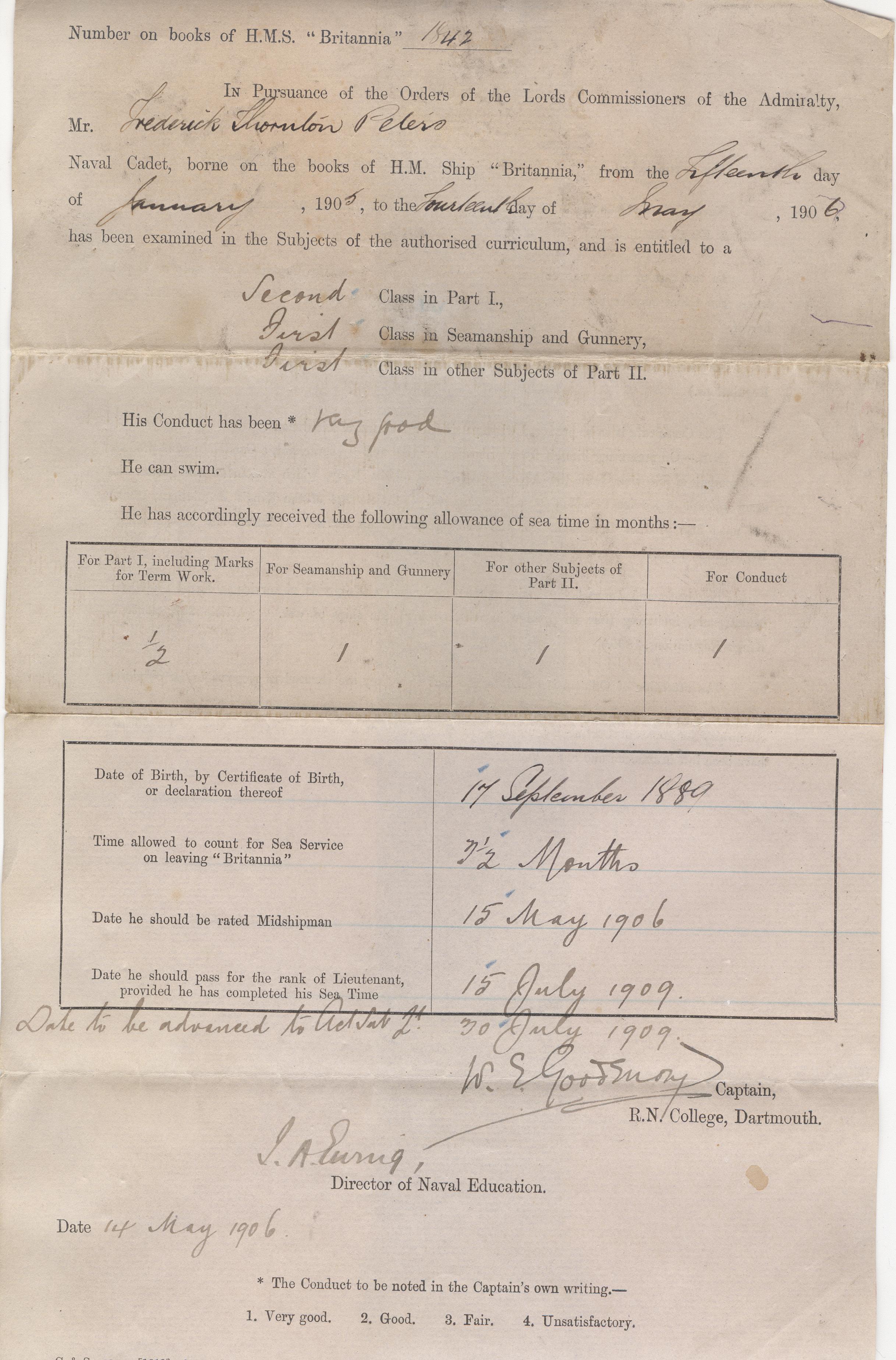
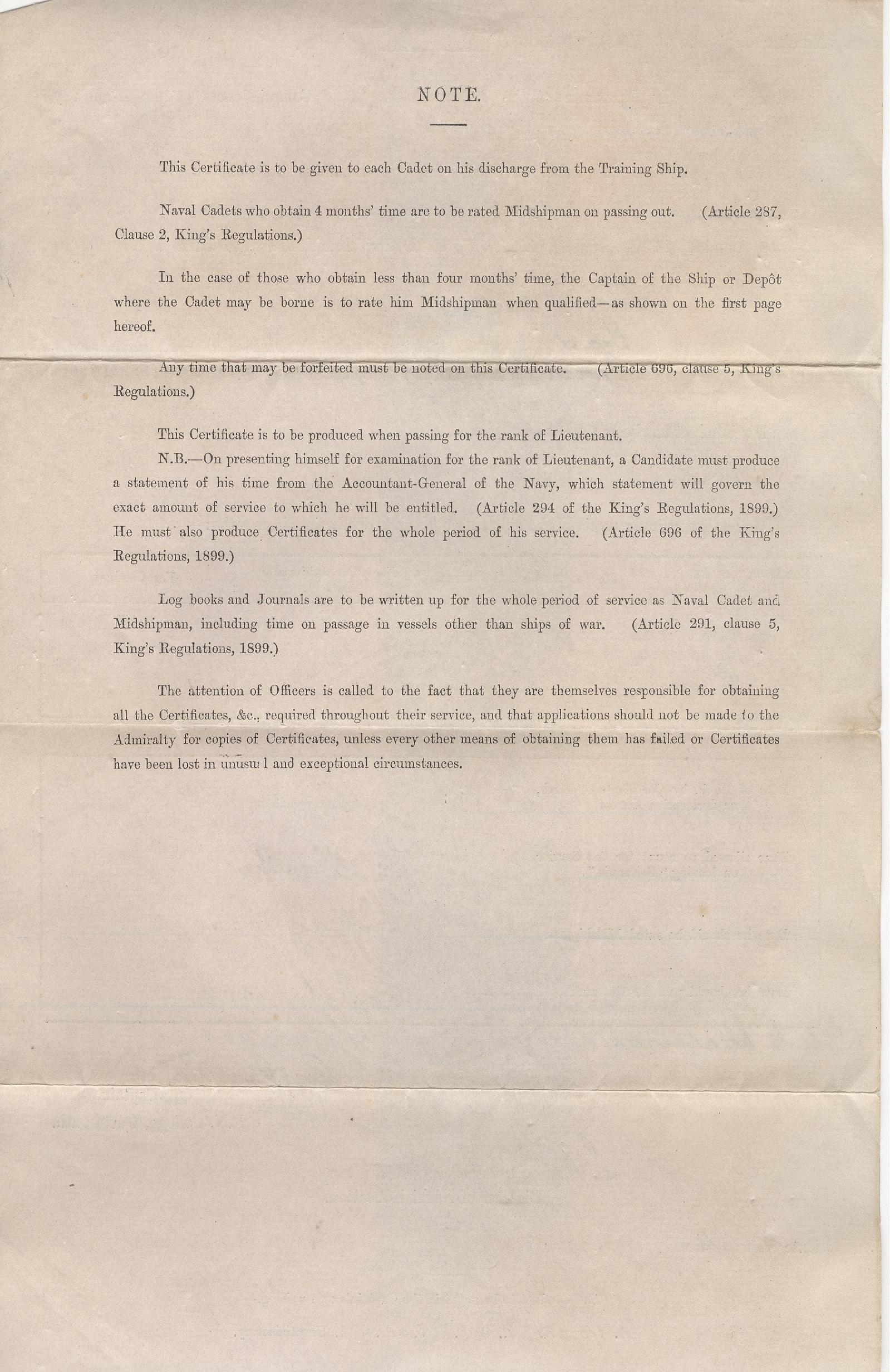
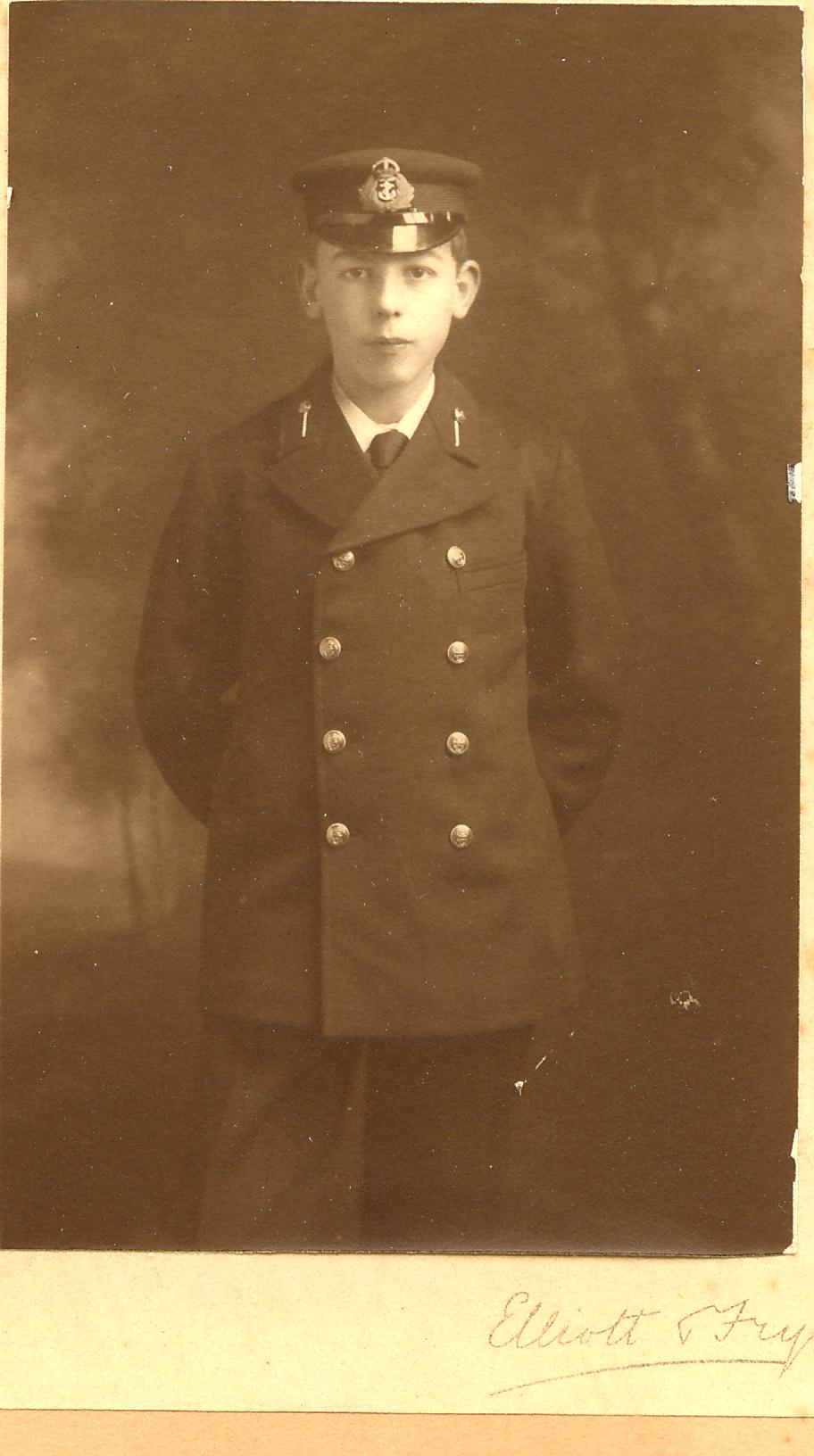
Older Entries Newer Entries