by Sam McBride
Many residents of Nelson, British Columbia see Mount Peters every day but have no idea of its name or the Canadian war hero it is named after. Located between Mount Nelson and Taghum, the mountain of modest height is identified on backwoods and topographical maps but not on road maps or tourist literature. The car pullout near the intersection of Highway 3a, Granite Road and Government Street has a sign about Historic Baker Street, but no mention of Mount Peters across the river.

Fritz Peters, circa 1935 (McBride Collection)
It is named after Captain Frederic Thornton “Fritz“ Peters, VC, DSO, DSC and bar, U.S. DSC, RN. The initials after his name reflect his status among the most decorated Canadians ever, including the highest honor of all, the Victoria Cross, which he received for leading an extremely hazardous attack on the harbor of Oran, Algeria in the Allied invasion of French North Africa on November 8, 1942. For the same action, he won the U.S. Distinguished Service Cross (DSC), the highest honor bestowed on a non-American by the United States. He miraculously survived the Oran action in the face of point blank fire from Vichy French shore batteries and warships in the harbor, but died five days later in a plane crash near Plymouth, England on his way back to England to report on the mission and receive medical treatment for injuries to an eye and shoulder he suffered at Oran.
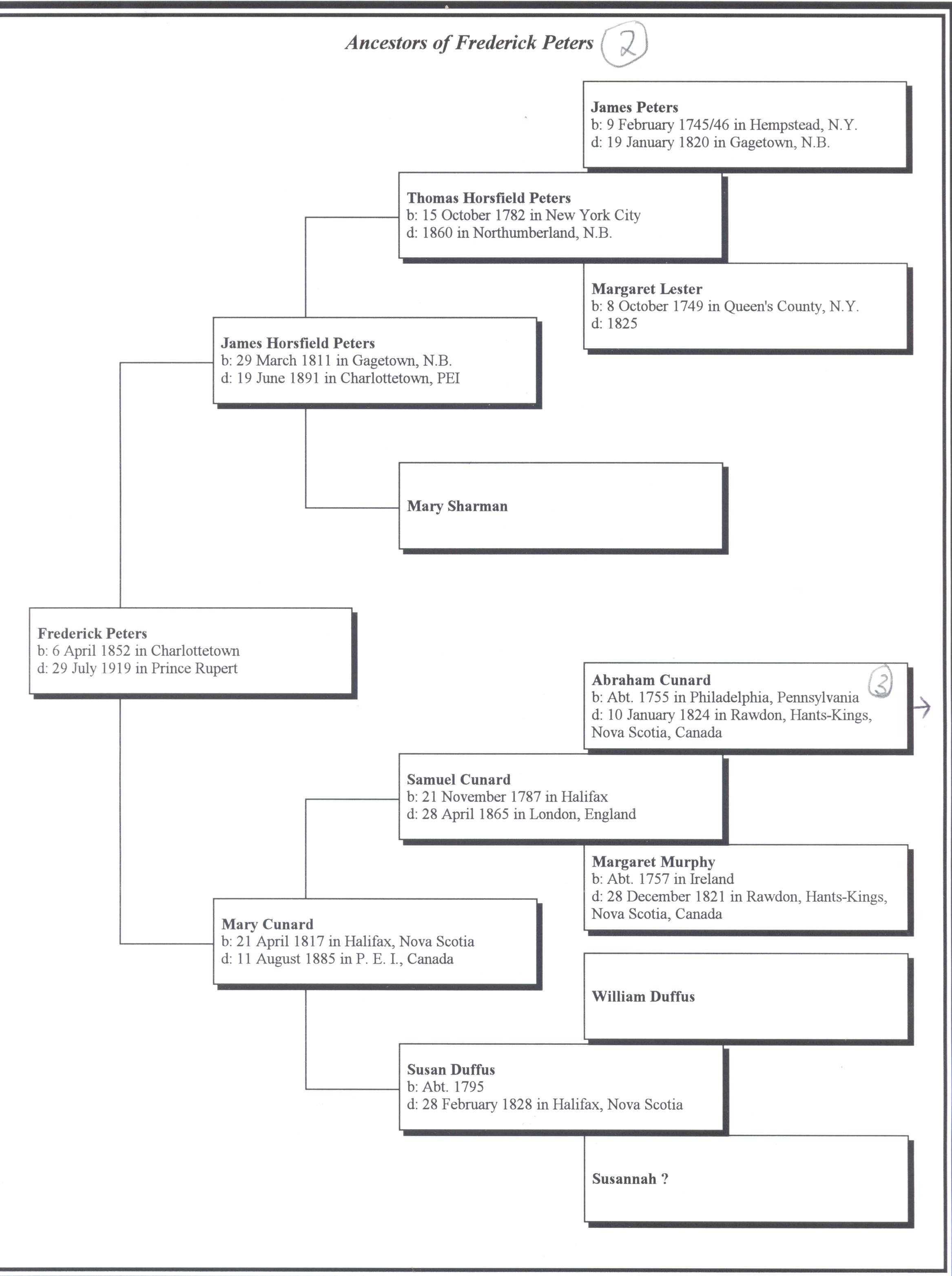
Born in Charlottetown, Prince Edward Island in 1889, Peters moved with his family to Victoria, B.C. in 1897 and lived there until joining the Royal Navy in 1905 – five years before the formation of the Royal Canadian Navy. He served with the Royal Navy, primarily on destroyers and gunboats, until resigning as a lieutenant in 1913; then rejoined when war came in August 1914, serving on destroyers, initially as a first lieutenant and later in command, until retiring in 1920; and rejoining again at the outbreak of the Second World War in 1939, when he alternated between anti-sub naval operations and work with Britain`s Secret Intelligence Service, including command of a spy school for expatriates from Occupied Europe who returned to their home countries to combat the Nazis with sabotage. He is believed to be the only Canadian to receive multiple awards for valor in both world wars, and the only person in the history of the Victoria Cross to receive it for action against France.
In the First World War Peters was mentioned in dispatches and received the Distinguished Service Order (DSO) medal for courageous action as a lieutenant on the destroyer HMS Meteor that saved lives after a shell from a German cruiser hit the engine room in the Battle of Dogger Bank in January 1915. He received the British Distinguished Service Cross (DSC) in 1918 for “showing exceptional initiative, ability and zeal in submarine hunting operations and complete disregard of danger, exceptional coolness and ingenuity in his attacks on enemy submarines.” He won a bar to his DSC in 1940 for leading a flotilla of anti-sub trawlers that sank two enemy submarines.
The only time Fritz Peters was in Nelson was passing through while working as an engineer with the CPR in 1913-14, but his mother Bertha Peters lived in Nelson from 1929 until her death in 1946, and his sister Helen Dewdney was in Nelson from 1929 until 1969. Bertha lived with her daughter Helen`s family in New Denver after the death of her husband Fred Peters in 1919, subsequently moving with them to Rossland, Trail and then Nelson as Ted Dewdney was transferred by his employer, the Bank of Montreal.

Nelson newspaper report of U.S. DSC presentation to Mrs. Peters in Feb. 1944.
On February 2, 1944 a delegation of American officers representing President Roosevelt and General Eisenhower came to Nelson with soldier musicians in a brass band to formally present the U.S. DSC medal to Mrs. Peters as next-of-kin of her late son. With Nelson Mayor Stibbs and representatives of civic organizations in attendance, the ceremony was held in the Dewdney house at Stanley and Mill streets. In stark contrast to the extravagance of the American presentation, the Victoria Cross – which Bertha Peters, as a granddaughter of a United Empire Loyalist and ardent Anglophile, valued far more than the American medal – arrived in the regular mail with no ceremony or even a cover letter. At the time, the casual delivery of the VC was thought to be an administrative mistake during busy wartime conditions, but British military files that became public in the 1970s show it was intentional, as France had resumed as an ally against the Nazis and the British wanted to avoid antagonizing the French with reminders of their vigorous action against the Allies in Oran harbor. British Admiral Andrew Cunningham, who directed naval operations under Allied Commander Gen. Eisenhower, issued an order in December 1942 that “silence is the best policy“ regarding the Oran VC. The awarding of a VC was normally cause for celebration, so the news media of the time were surprised that only a terse statement of commendation for the medal was released. Publicity of the medal in Canada was mainly generated by Peters` friends and relations in letters and interviews.
The idea of naming the mountain first arose at a meeting of the Nelson Board of Trade in December 1945, a month after it was announced that the late Lieutenant Robert Hampton “Hammy” Gray, VC, DSC, RCNVR had posthumously been awarded the Victoria Cross for sinking a Japanese destroyer. According to Nelson Daily News reports, Frank Putnam, the provincial minister of agriculture, mentioned to a board member that a new topographical map of the Nelson area was coming out soon, so it was an opportune time to propose the naming of geographical features in the Nelson area in honor of local war heroes. A committee consisting of H.M. Whimster and H.W. McMillan was set up to make inquiries and present recommendations to the board. Their discussions with the government naming authorities found there would be difficulty in changing the name of mountains already named after someone else, and the standard at the time was to have just one name for a mountain, so “Hampton Gray Mountain“ would be unacceptable.
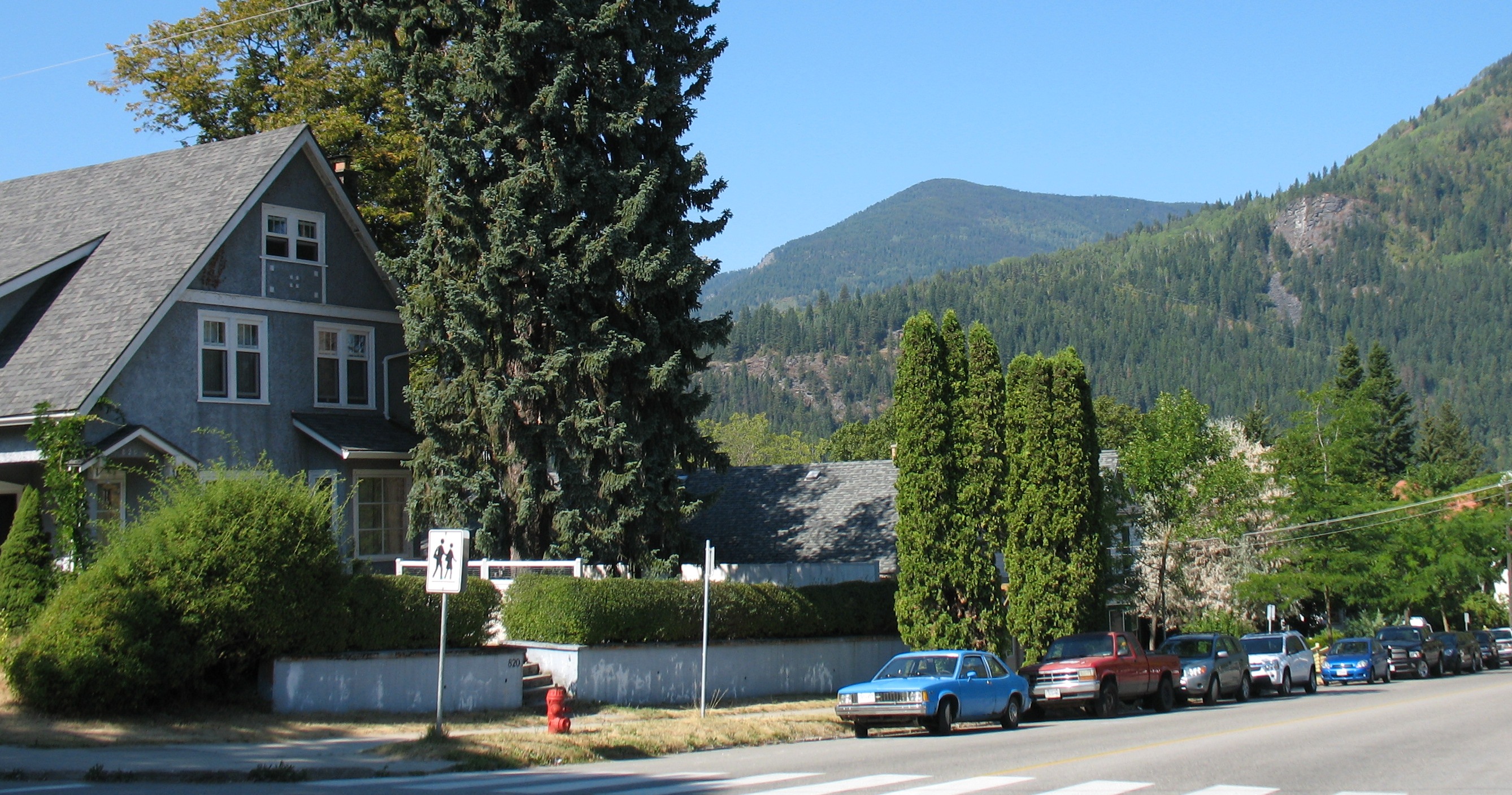
view of Mount Peters from Stanley and Mill Streets in Nelson. At left is the Dewdney home, site of the U.S. DSC medal presentation, as it looks today. (Sam McBride photo)
Following the committee`s recommendation, the board proposed that a peak in the south end of Kokanee Glacier Provincial Park that can be seen on a clear day from Rosemont be named Grays Peak (honoring Hammy`s brother RCAF Flight Sergeant J.B. `Jack` Gray, who was the first Nelson boy to die in World War Two, as well as Hammy, who was the last), and the mountain west of Grohman Creek based on the Kootenay River be called Mount Peters. The names were approved by the provincial government in March 1946, but there has been little follow-up since then to advise residents and visitors of the mountain names, especially Mount Peters.
Whimster`s daughter Lois Arnesen remembers the naming of Grays Peak but not Mount Peters, as she knew the Grays but had never known Peters. She is not surprised her father, who was a printer by trade, would recommend that mountains be named in honor of the heroes, as he was a keen mountaineer and member of the Alpine Club.
For Nelson`s Victoria Cross winner from World War One, Lieutenant Rowland Bourke, VC, DSO, RNVR, there is a Bourke Rock on the B.C. coast near Bella Bella named in August 1944, and Bourke Mountain (later changed to Mount Bourke) north of Tofino, named in July 1946.
There are interesting connections between the three Victoria Cross winners with links to Nelson. Some war correspondents called the Oran harbor action “another Zeebrugge“, referring to the famous British attack in 1918 on the heavily-defended port of Zeebrugge-Ostend, Belgium to trap German submarines by blocking the entrance with scuttled warships. Bourke`s was one of eight VC`s awarded for the Zeebrugge attack, which was similar to the Oran operation in audacity but with a very different objective, as the Oran attack attempted to keep the harbor in good condition for delivery of supplies needed for the Allied invasion. Peters was able to break through the boom protecting the harbour and reach the target landing site, but the defenders sank the two attacking ships with intensive fire and sabotaged the harbor facilities. Born in 1885, Bourke was close in age to Peters and held a similar rank in the Royal Navy, with Bourke rising later to Lieutenant-Commander and Peters to that same rank and then Acting Captain. While there is no record of Bourke, Peters or Gray encountering each other, Mrs. Peters knew Hammy Gray well because he was best friend and fishing buddy of her grandson Peter Dewdney and a regular visitor to the Dewdney house before the pair went to war as officers with the Royal Canadian Navy. Bertha Peters` maiden name was Gray, but the two families were not related.

view of Mount Peters from the parking lot across the Kootenay River. (Sam McBride photo)
Further information and photographs and other memorabilia of Peters and Gray can be seen in the Virtual Memorial of the Veterans Affair Canada web site. Bourke isn`t in the Virtual Memorial because he had the good fortune of surviving war service, passing away in retirement in Victoria in 1958 at age 73. Information on mountains and landmarks named after Kootenay war heroes is on the 54th battalion web site.
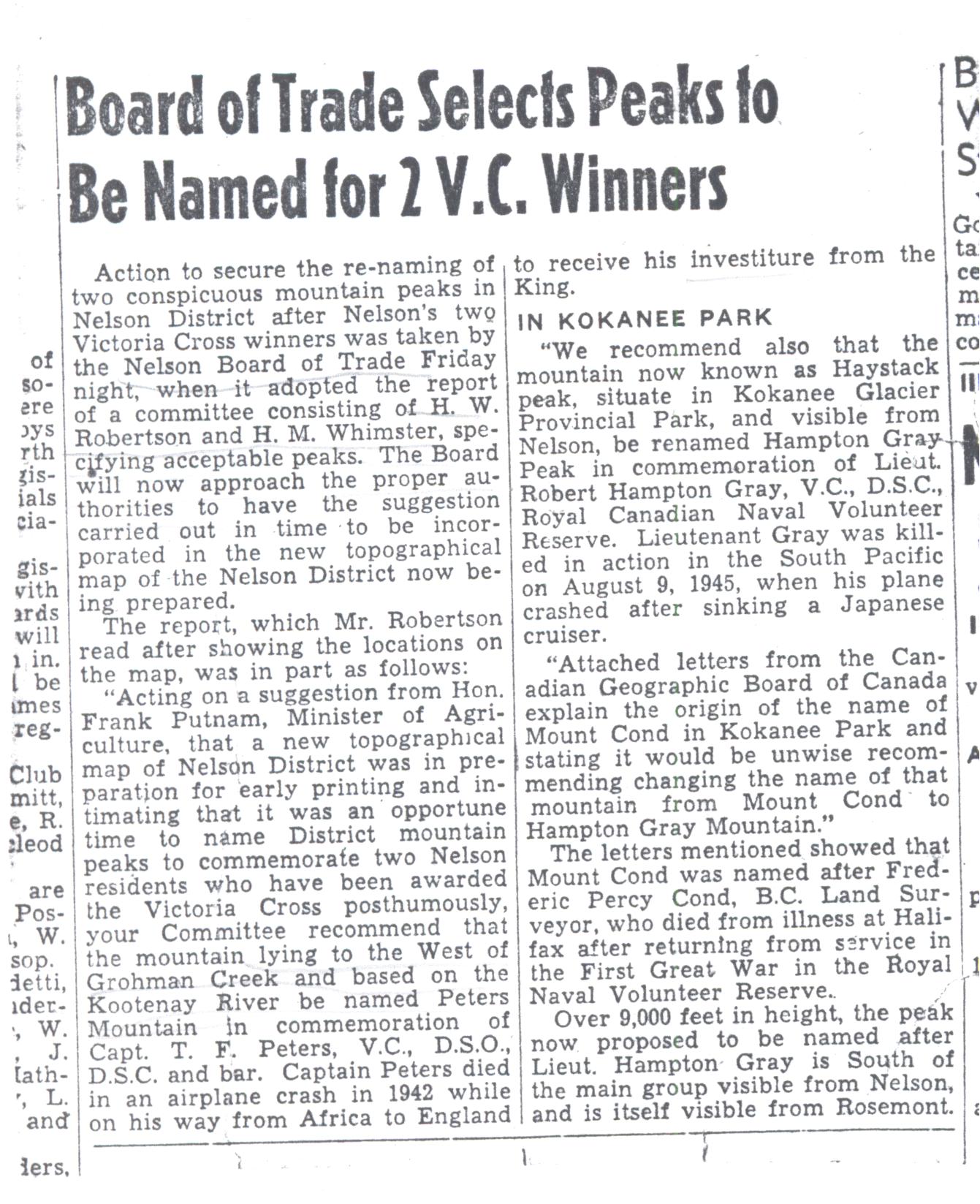
Nelson Daily News article Nov. 1945


 thebravestcanadian