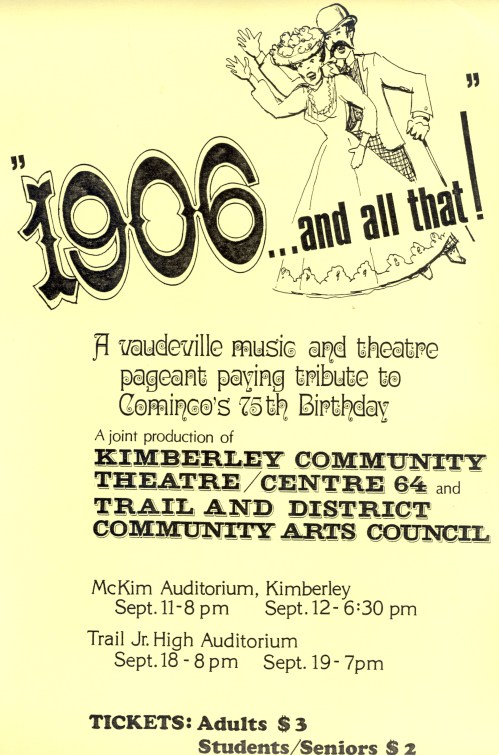
In 1981 Trail and Kimberley, B.C. theatre clubs celebrated Cominco Ltd.’s 75th anniversary with rollicking joint stage show “1906 — and All That”

Leave a comment

by Sam McBride

1981 was a happier time in Trail and Kimberley and surrounding regions. Cominco Ltd. was at the peak of a billion-dollar modernization and expansion program at its mining, smelting and fertilizer operations, with about 5,000 workers at Trail and another 3,000 at Kimberley. Today, it would be about a thousand at the highly-automated Trail plant and just a handful at Kimberley, since the Sullivan Mine finally ran out of ore and closed in 2000 after almost 100 years of production.

When Cominco — originally known as the Consolidated Mining and Smelting Company Limited (often abbreviated to C&S) and today part of Teck Resources Limited — celebrated its 75th anniversary in 1981, the folks from the Trail and District Community Arts Council and its equivalent in Kimberley saw the occasion as a chance to thank Cominco for its support of the visual and performing arts in Kootenay communities over the years.

poster for 75 show

poster for the 1981 stage show, designed by George Bourchier of Rossland, B.C., who was a long-time Cominco employee and veteran of many Rossland Light Opera Players productions

The B.C. Group Vice-President at the time, A.V. “Marc” Marcolin, had long been an ardent supporter of new facilities and financing for the arts in the Kootenay communities where Cominco employees resided. With that in mind, theatre groups got together to put on a special show “1906 and All That” commemorating the founding of Cominco in that year. What was really special about the project was the cooperation between theatre groups in both communities in putting together a heritage show in appreciation of Cominco’s support over the years that was performed jointly in both Trail and Kimberley, where most of the company’s B.C. Group employees resided.

ocy17190009

 program cover

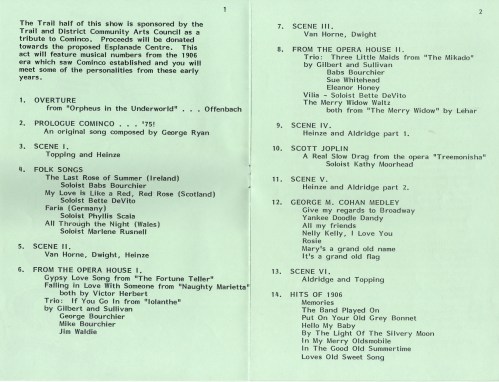
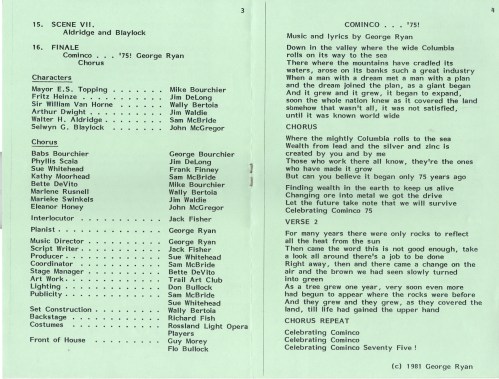
Here are some mementos from the show, including posters, program material, photographs and news clippings from shows in both Trail and Kimberley. I remember Marc was particularly pleased to hear the “Cominco 75!” song composed and directed for the occasion by George Ryan, who was well-known for his musical direction of many shows of Rossland Light Opera Players and Trail Theatre Unlimited.

ocy17190025

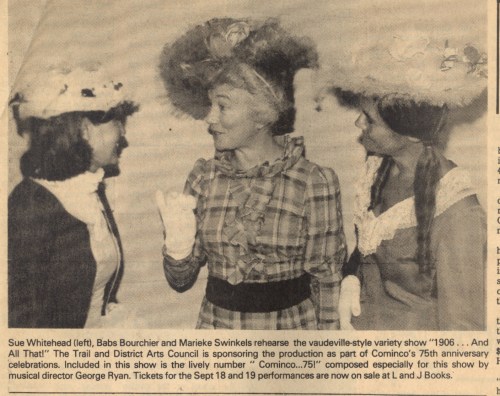
Trail Daily Times photo and caption from an early September 1981 rehearsal

After retiring in 1982, Marc Marcolin went on to serve as mayor of Trail and continued to be a vigorous booster of the community. In the mid-1970s, Marc had a key role in convincing the Cominco board of directors to remain in the Kootenays and upgrade its facilities there, rather than leaving B.C. and building a brand new mining and smelting operation in Latin America, which was an economically attractive option favoured by several corporate leaders at the time.

ocy17190010

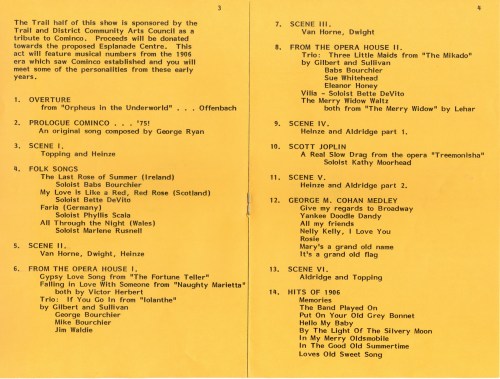
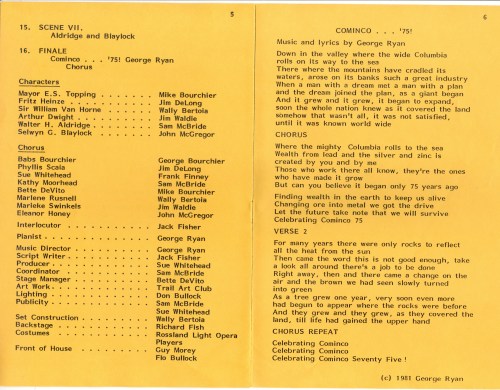
program pages for the Trail show


ocy17190011

ocy17190012

sept 2 190015

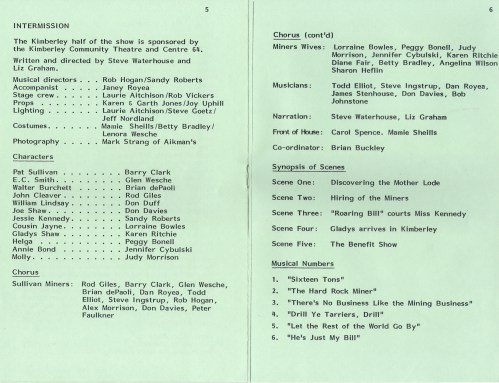
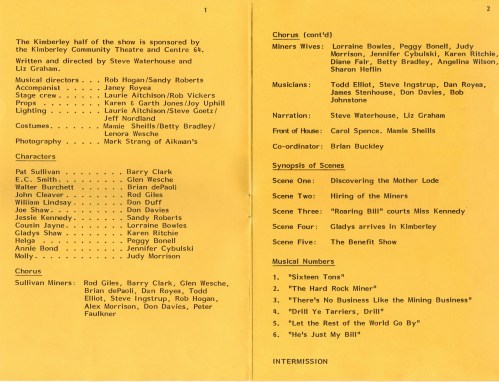
program pages for the Kimberley show

sept 2 190016

sept 2 190017


june 9 180026

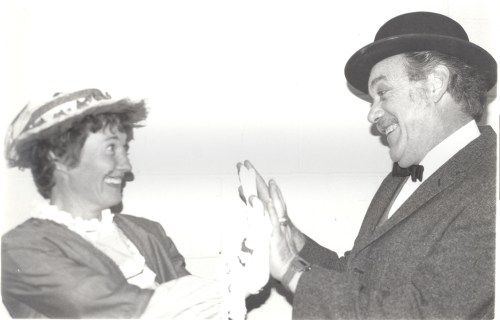
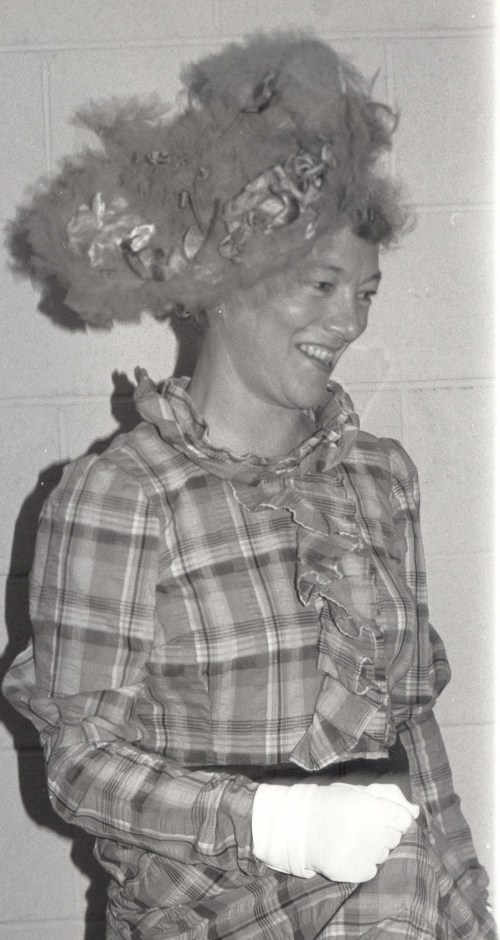
Eleanor Honey and Wally Bertoia of Rossland Light Opera in a skit

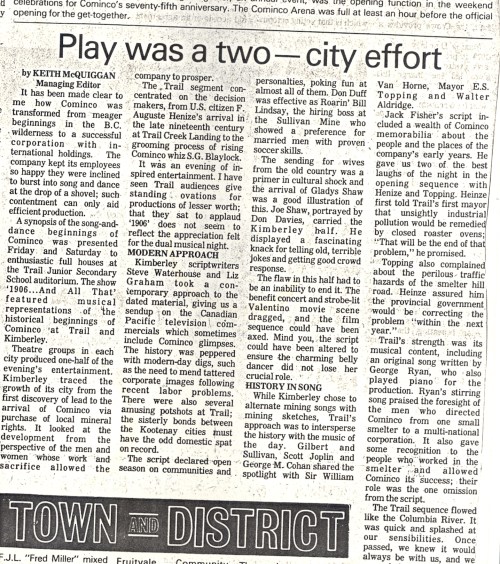
cominco 75 show review

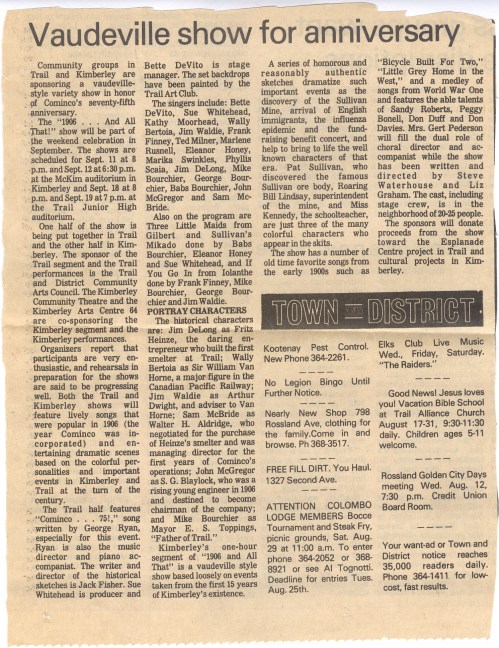
Trail Times preview of the show, early September 1981

june 9 180025 (2)

Barbara “Babs” Bourchier, long-time organizer and participant in RLOP productions and an active member of the Trail and District Community Arts Council

ocy17190021

Trail Times review of the show, Sept. 19, 1981

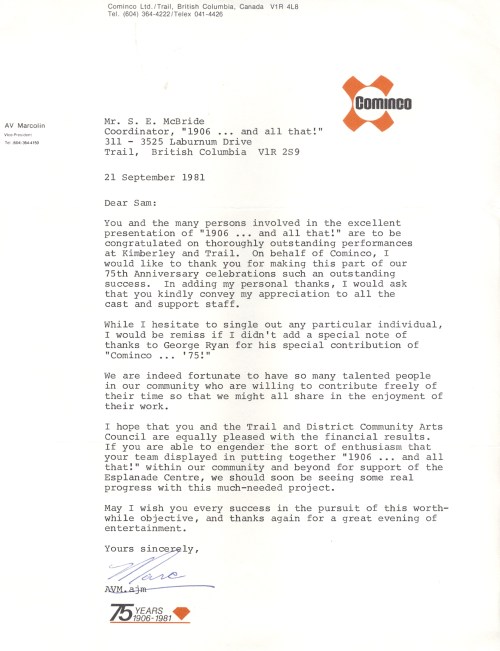
sam congrats from marc

one of the letters of thanks to organizers from Marc Marcolin


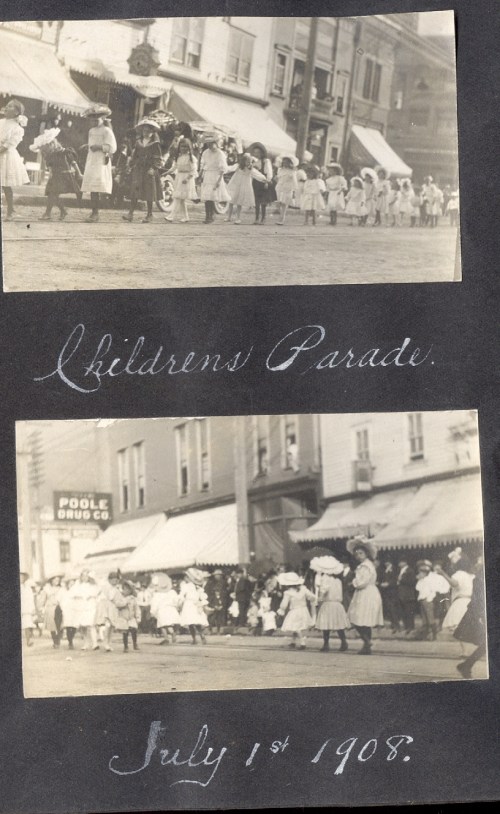
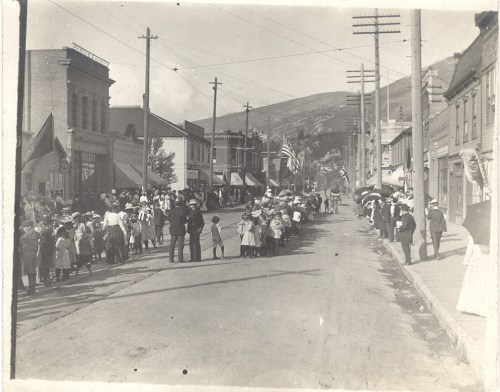
Annual Children`s Parade was a popular part of July 1st Celebrations in Nelson, B.C. in early 1900s

Leave a comment

By Sam McBride

My paternal grandmother Winnifred Mae Foote (1889-1960) enjoyed photography as a hobby in her hometown of Nelson, British Columbia from the early 1900s until the last years of her life.  As the eldest in a family of five daughters (and no sons), she liked to take photographs of her four younger sisters as they grew up, and they would in turn take photos of her.

The annual Children`s Parade that was part of the July 1st Dominion Day celebrations was prominently featured in her 1908 scrapbook that survives today as part of the Foote-McBride family history files.

The close-knit Foote sisters and their mother Edith James Foote left Perth, Ontario for Nelson in the summer of 1900 to join father Jim Foote (1861-1921) who had arrived the year before to start a job as blacksmith at the Silver King Mine.  After two years living in a rented house in the remote Silver King Townsite outside of Nelson, the girls were thrilled in 1902 to move into the vibrant city of Nelson when Jim got a job as carpenter with the City of Nelson construction department.

Glad top Lil left Win Isobel middle and Marion

Foote sisters, from left: Lillian, Isobel, Marion, Gladys and Winnie.  Family photo, c. 1904.

Win`s sisters included Lillian Maude Foote (1891-1962), Gladys Edith Foote (1894-1965), Isobel Bessie Foote (1897-1988) and Marion Louise Foote (1902-1923).   Win`s album features numerous photos of her sisters, herself and friends, usually related to a fun community event such as the Dominion Day celebrations or church picnic.

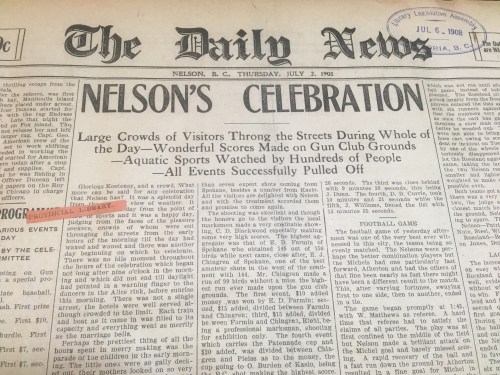
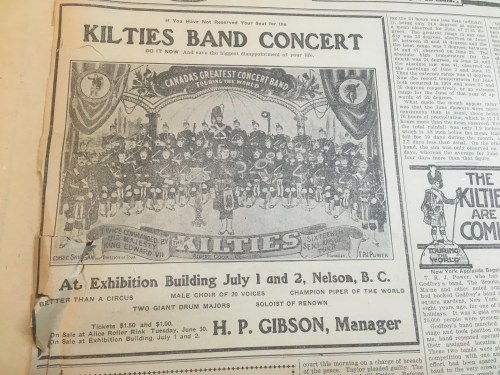
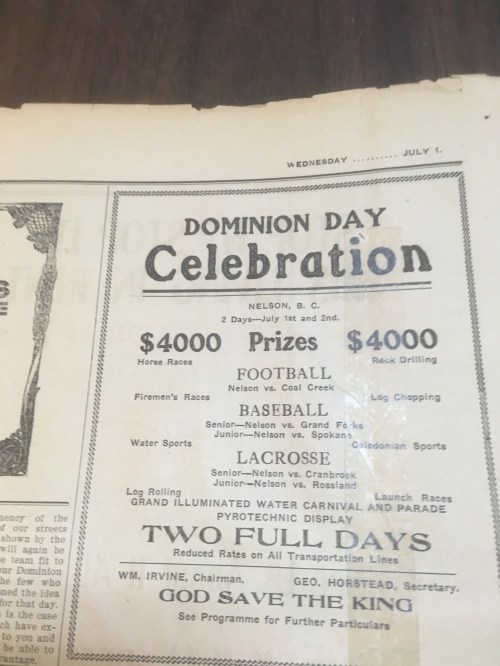
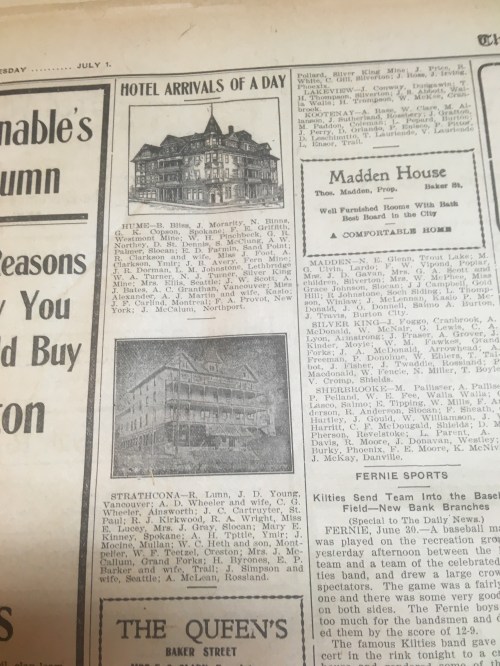
For Nelson children, their time to shine and be the focus of attention was the annual Children`s Parade down Baker Street that was one of the first events in the annual two-day holiday celebrations marking Canada`s birthday.  Here are photos from the album from 1906 and 1908 of the Children`s Parade, as well as a clipping from the Nelson Daily News of July 2, 1908 describing the first day of parades and associated July 1st events.  Also included here are a couple of newspaper ads of other special events, as well as the daily report of who was staying at local hotels during the celebrations.

mar24200002

1906 Children`s Parade, Winnie Foote photo

mar24200001

Two photos in Foote album of the 1908 Children`s Parade

mar24190025

Another Win Foote photograph of the 1908 Children`s parade, identified as such but not included in the album.  Print quality is better, likely because it was not exposed to viewing as much as the album has been over more than a century.  Family photo.

IMG_9883

IMG_9880

Ad describes on of the 1908 holiday events.

IMG_9881

IMG_9882

Nelson Daily News reported a long list of visitors staying a local hotels during the Dominion Day celebrations.  NDN July 2, 1908.

rba_20171213_0017

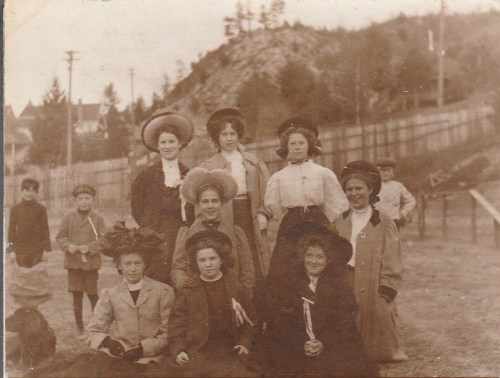
This photo in family files is not identified, but it is very likely taken in the civic field with the Gyro Bluffs in the background.  The young ladies have ribbons from winning something, which may well have been during the Dominion Day sports events.   My cousin (once removed) Blake Allan told me he thought the girl in the centre of the front row was his aunt Isobel Foote Murphy.  I am not certain about that, but there must have been either a family member or a good friend in the group for Win to paste it into her scrapbook.  Family photo.


Eddie and Isobel Murphy were a pioneer couple across the lake from Nelson, British Columbia from 1920s to 1950

Leave a comment

by Sam McBride

I never knew my great-uncle Arthur Edward “Eddie” Murphy (1894-1950) as he died a year before I was born, but I feel a connection to him because my parents gave me my middle name of Edward in his honour.  His wife Isobel Bessie Murphy (1897-1988) was a younger sister of my grandmother Winnifred Mae McBride (1889-1960).

Eddie played and excelled at just about every team sport going on in Nelson, including hockey, baseball and lacrosse.  He was perhaps best known as an expert rower who led Nelson team to victory in regattas in Kootenay Lake, the Okanagan, Vancouver and Portland.  He and his brother Howard were prominent in Nelson with their Murphy Brothers Painting and Decorating business, which continued a business started in the 1890s by their father William James Murphy.  Isobel had a key role in the operation as interior decoration consultant.

leigh and ken mcbride at bottom left and friends in picnic by lake (1)

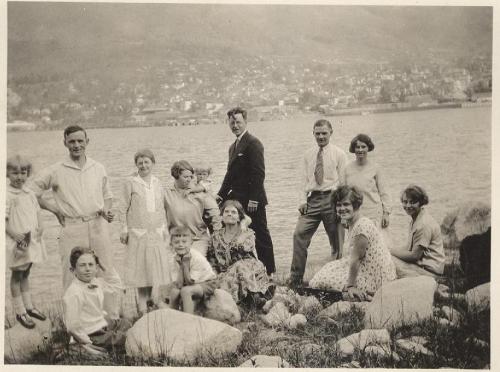
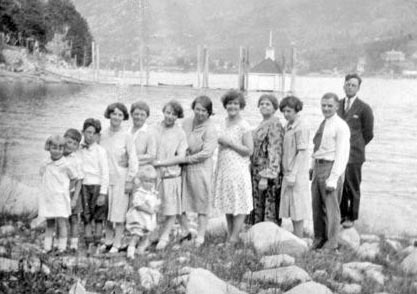
Gathering of family and friends in 1925 at Murphy beach across the lake from where the Prestige Inn in Nelson is located today.  Eddie Murphy is the the man on the left, and his wife Isobel is lady second from the right.  At bottom left are their nephews Leigh and Ken McBride.  Man in dark suit is Wilfrid Laurier Allan, who was secretary-treasurer of the Wood Vallance Hardware Company in the 1930s.  Family photo.

I remember Isobel well from growing up in Nelson, where she was a popular member of extended family.  She was a smart businesswoman who was renowned as an interior decorator with extensive knowledge of paint, colours, wallpaper, antiques, rugs, carpet and other aspects of home furnishing and decoration.  By the early 1970s she had largely retired, but still ran the Murphy Signs business in Nelson which included a variety of signs and billboards.  She was in top form until suffering a stroke in late 1974 that resulted in substantial dementia.  The last 13 years of her life were in the Mount St. Francis long-term care home in Nelson.

red disk jan 23 2013 1647

Another photo of the group of family and friends in 1925 near the Murphy beach, looking back towards the city of Nelson. Family photo.

Isobel was one of four Foote sisters who arrived in Nelson in July 1900 with their mother Edith James Foote.  They joined their father John James “Jim” Foote who had arrived in Nelson in 1899 to start a job as blacksmith at the Silver King Mine.  The family lived in a rented cabin on Silver King townsite for two years until moving to Nelson when Jim began working in construction for the City of Nelson.  Their home by Hall Mines Road and Cottonwood Creek was rented from former Nelson alderman Thomas Slader.

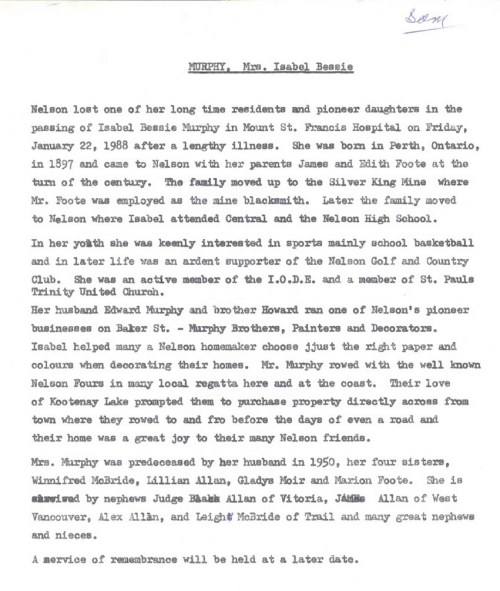
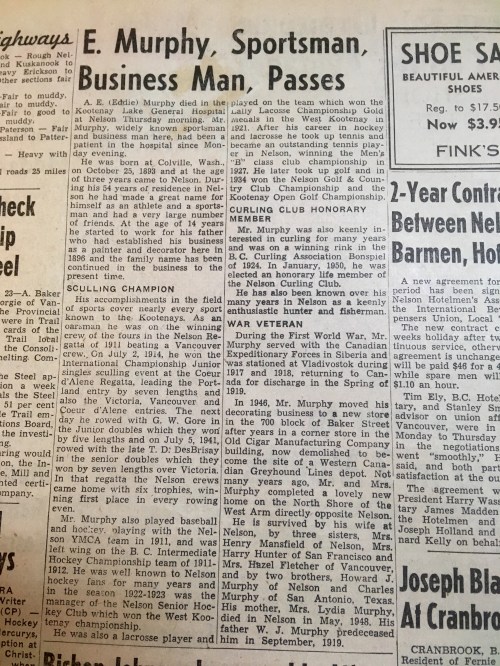
The story of the lives of Eddie and Isobel Murphy are told well in their obituaries below.  The Eddie Murphy obit, likely written by his widow Isobel, was in the Nelson Daily News in March 1950.  The submission for Isobel’s obituary was written by her nephew Judge Blake Allan.  Eddie and Isobel never had children of their own, and were almost like second parents for the children of her sisters Winnie and Lillian.

IMG_E1448

obit in Nelson Daily News, March 1950, after Eddie died at age 56.

z isobel

Isobel Murphy obit January 1988, written by nephew R. Blake Allan

leigh with aunt isobel

Isobel Murphy with her nephew Leigh McBride, about 1970.  Family photo.

ed murphy 001 - Copy - Copy

Eddie Murphy with a prize catch, late 1940s.  Family photo.


First-hand account from the Canadian attack on the Hitler Line on May 23, 1944 by Seaforth Highlanders officer Major L.M. McBride from Nelson, British Columbia

1 Comment

Note from editor Sam McBride: The following report was written by my father Major Leigh Morgan McBride (1917-1995) in response to a request in 1968 by Professor Reginald Roy of the University of Victoria who was producing a regimental history of the Vancouver-based Seaforth Highlanders of Canada regiment.  Parts of this report were quoted in the regimental history, and later also in the Mark Zuehlke book “The Liri Valley – Canada’s World War II Breakthrough to Rome.”  Leigh lost his left eye in the action he describes, and spent several months in German hospitals and prison camps before repatriation in early 1945 in a prisoner exchange.  While in a POW camp, he learned from letters from his parents that his brother and fellow Seaforth officer, Capt. Kenneth Gilbert McBride, was killed by a road mine explosion near Rimini, Italy on September 16, 1944.


By Leigh Morgan McBride

The morning of May 23rd, 1944 in the Cassino area was very foggy – the heaviest fog I remember seeing in Italy.  Originally Major E.D. (Davie) Fulton* was to be in command of “D” Company of the Seaforth Highlanders of Canada but he and C.Q.M.S. Staines were involved in a highway accident and if I remember correctly, Davie either broke a leg or sustained other injuries which sent him to hospital.  In any event, as a result of the accident I was in command of “D” Company when it participated in the attack on the Hitler Line.

The start line was at the edge of the woods – we were the forward company on the right and the “A” Company under Major J.F. McLean D.S.O. was the other forward company on our left.  There had been sporadic shelling of our battalion area for the previous few days.  However, as soon as we got under way from our start line and into the wood we immediately came under heavy fire, both machine gun and artillery, and our casualties were heavy.

Copy of leighportraitfixed

Major L.M. McBride c. 1942

Our squadron of the North Irish Horse (note in pen on carbon copy: our supporting tanks) had been warned to beware of any enemy hiding up the trees.  As our tanks lumbered forward over the uneven ground the range of fire of the machine guns would suddenly lower hundreds of yards and our company would be the recipient rather than tree-borne Germans.  The visibility that morning was virtually nil with the heavy fog or mist plus the smoke from shells and mortar bombs and right from the outset we had difficulty with our radio communications.  We tried about three times to get the machine gun fire from our tanks stopped but with little success and this, coupled with the heavy fog resulted in Dog company being scattered from “hell to breakfast”.

The different units all seemed to get completely broken up into small groups sometimes with other companies or even with the Pats who had started on our right flank.  Taking the small group of company headquarters that was still intact I started to pick my way very carefully through enemy wire trying to make sure that I just stepped on hard ground which had not been disturbed and as I moved through the wire my runner Johnson was stepping right in my footsteps.

Seaforth_crest_in_colour_from_decal[1]Suddenly there was a tremendous explosion and I woke up on the ground back in front of the wire but Johnson had been killed instantly as had Warner the older of the two signallers.  The younger radio operator had a bad gash on his cheek and I helped him over to a nearby ditch that would give him some cover until he got proper medical attention and patched him up temporarily with a field dressing.  That eliminated all of company headquarters except myself, and trying to locate the three platoons I came across a private from the Pats and we went on together through the fields of hay or some type of crop which was almost waist-high.  Suddenly, we came under machine gun fire and hit the dirt.  Every time we moved in the deep hay it of course showed up and we got another blast for our trouble.

By then we realized that the heavy firing we heard was between us and the woods and that it was either Jerry tanks or 88s dug in so as to be almost invisible until you stumbled over them.  The only thing to do was hope that our own tanks would be able to help, but we did not know at that time what a terrific pasting our tanks had taken from the dug-in tanks and 88s.

jan11 180008b

McBride in Italy. c. 1943

I am not sure what happened next – whether we were on the receiving end of a shell or mortar bomb but whatever it was hit me in the left eye and when I more or less came to it was to find several Germans looking down at me.  They put a bandage on my eye and when it started to get dark they put me in an ambulance and we no sooner got under way when a large shell went off beneath the vehicle, and some unfortunate Jerry who had a bunk below me in the ambulance got almost the full brunt of the explosion.  I don’t know how badly he was hurt but it sounded pretty grim.  I got shrapnel in my left shoulder and left leg but none of it too serious.  After that I have a recollection of a very bright light in an operating room which must have been in Rome as my German records show an operation taking place there.  The next thing I remembered was waking up in a German Red Cross train somewhere near Verona in northern Italy.

I felt before the attack on the Hitler Line that 2nd brigade would have had a much better plan exploiting the penetration on the left flank which had been breached by 1st brigade.  Even if we attacked where we did, I am sure it would have been less costly  to the battalion had we attacked several days earlier, however, perhaps there was some perfectly valid reason for the delay which would be apparent at higher levels.

jan11 180007

McBride (right) with fellow Seaforth officer Borden Cameron during the 30th anniversary reunion in April 1975 in Italy

Our front was so narrow that it left no alternative than a direct frontal assault.  The hay or alfalfa completely hid the enemy and yet they still had an excellent unobstructed field of fire at our infantry and the North Irish Horse tanks.  We had tremendous artillery support that morning but much of its effect was wasted because the enemy were dug in so well and because the visibility was so poor because of the very heavy ground mist or fog that hung over the ground.  In Sicily and the month-long battle of the Moro River crossing and Ortona we never operated under such chaotic conditions as we encountered in the Hitler Line.  “D” Company got completely scattered going through the wood and because of the heavy small arms fire and shelling and the fog it remained broken up in small groups.

I have read with interest the chapter on winter patrols northwest of Ortona.  After reading of Keats, Shelley, Byron et al wintering in sunny Italy it was a rude shock to encounter the winter of 1943-44.  Although we were virtually at sea level the weather was terribly cold for days on end and then it would be followed by heavy and constant rainfalls and everything turned into a sea of mud.  I think you described it very graphically when you described Lt. Gildersleeve’s boots.  Incidentally, I think the functioning wireless set mentioned in footnote 48 on page 408 very likely was that belonging to “D” Company as the one signaller was killed and the second wounded when we were in the middle of the wire.

I am sending your material (maps, war diary excerpts, etc) under separate cover and apologize for the delay I writing but we recently moved our offices and everything has been somewhat disorganized since last fall.  Very best wishes to you in your project.

Everything in chapter IX seemed correct and the only error I could spot was the weight of the Churchill tank which you stated to be 39 tons.  My recollection is that they were 40 tons but I could easily be wrong (note on carbon copy in pen: I wasn’t).

Feb.13, 1968

Kind regards,

L.M. McBride


* E. Davie Fulton (1916-2000) went on to serve as federal Minister of Justice in the Diefenbaker cabinets from 1957 to 1963.

30th anniversary reunion in 1975 of Canadian soldiers in Italy in Second World War

Leave a comment

By Sam McBride

The “Canadians in Italy” reunion of Canadian veterans who served in the Italian Campaign in World War Two was held in Sicily and mainland Italy between April 22, 1975 and May 3, 1975, commemorating the 30th anniversary.

dec 23 20180001

Cover of souvenir album of the reunion.  Photo by John Evans is of Canadian veterans beside reflecting pool during ceremony at Cassino War Cemetery.  Published by Minister of Supply and Services Canada 1976.


Approximately 300 veterans joined with the official party led by the Hon. Daniel Joseph MacDonald (1918-1980), minister of veteran affairs, other dignitaries and a selection of young people from across Canada.  Participants included the three Victoria Cross recipients from the campaign: John K. Mahoney; Paul Triquet and E.A. “Smoky” Smith.

dec 23 20180004

itinerary, page 1

itinerary, page 2.  Also in the schedule were “Briefings in Ottawa and arrival in Rome, April 20-22, 1975”.

During the war Minister MacDonald was a sergeant in the Italian Campaign with the Prince Edward Island Highlanders, and later the Cape Breton Highlanders.  He lost an arm and a leg in the bitter fighting December 21, 1944 for Coriano Ridge in the assault on the Gothic Line.  Today, the headquarters of Veterans Affairs Canada in Charlottetown is named in his honour: the Daniel J. MacDonald Building.
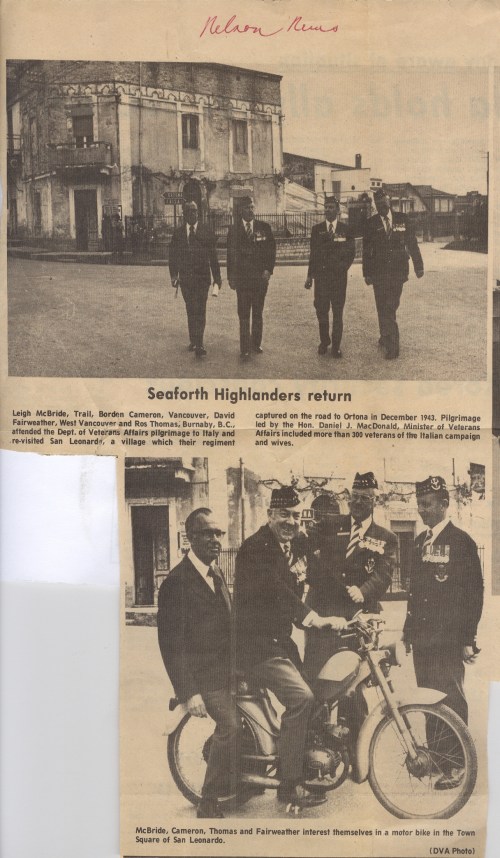
may 1 19 scans0002

photos with caption information from Veterans Affairs published in the Nelson, B.C. Daily News in May 1975.  Leigh McBride was born and raised in Nelson before moving to nearby Trail, B.C. in 1969.
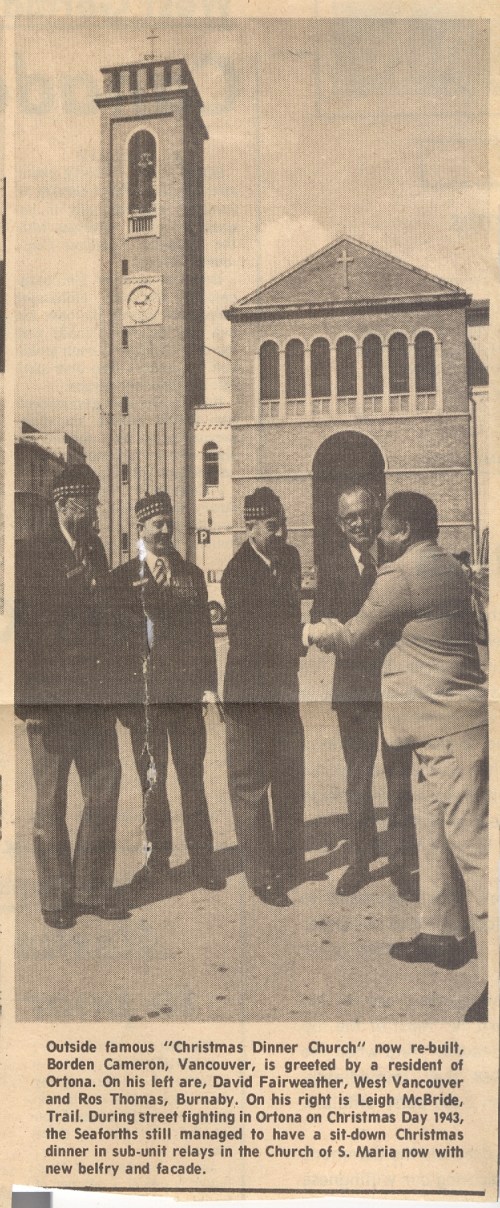
may 1 19 scans0001

another photo with caption in the Nelson Daily News, May 1975
 

mar26190024


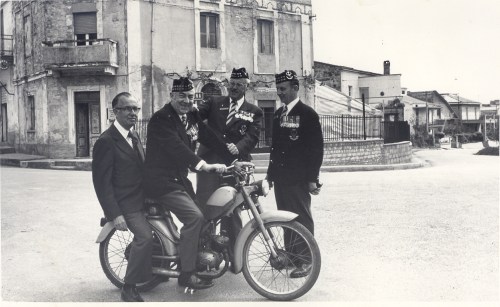
ortona pic0001It was the first time Canadian vets returned as a group to the scene of the fierce battles of their youth, and paid their respects to fallen comrades in cemeteries from Agira in Sicily to Argentan north of Ravenna on the Adriatic Coast.  According to Veterans Affairs information at the time, a total of 91,500 Canadians served in Sicily and Italy, of whom 25,254 were casualties, including 5,900 killed in action.
jan11 180012

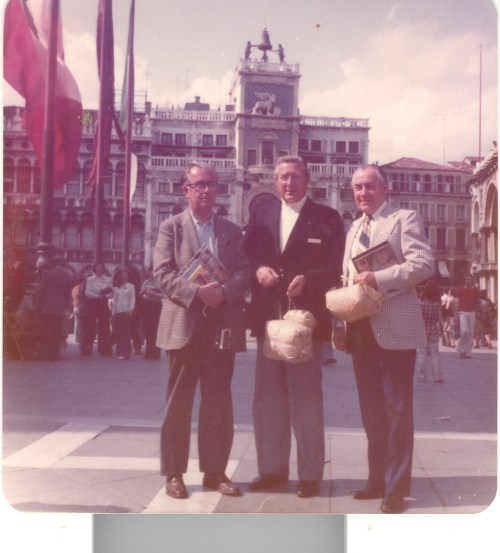
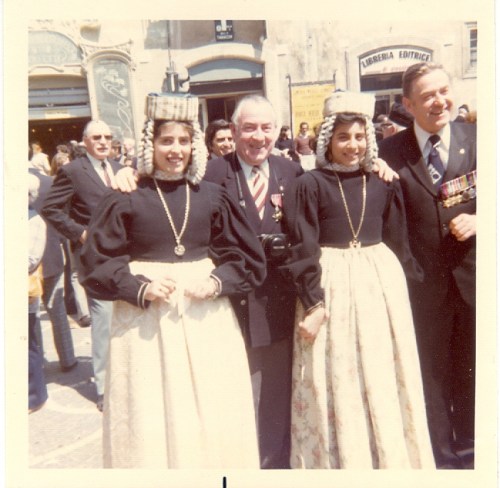
Seaforth Highlanders Leigh McBride (left) and Borden Cameron (right) with General Bert Hoffmeister (middle) during a side trip to Venice. Family photo.

The tour was described as a “pilgrimage”, and included events in famous names such as Salerno, Naples, Rome, Anzio, Cassino, Ortona, Bari, Reggio, Ragusa, Catania, Florence, Rimini and Ravenna, and 25 cemeteries.

There was some overlap with other ceremonies for a separate commemoration: the country of Italy’s 30th anniversary of the liberation from German rule in 1945.
leighitalygroup0001b

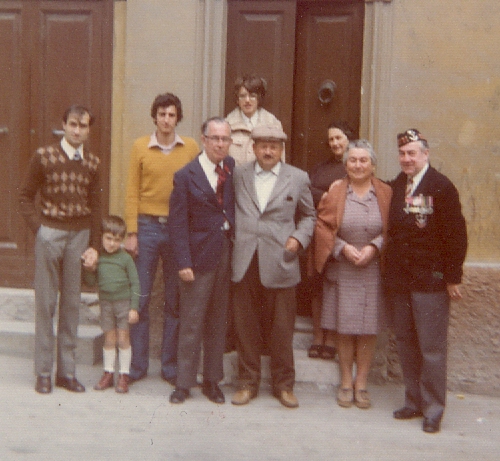
Welcomed by local residents.  Family photo.

I recall that my father, retired Major Leigh Morgan McBride (1917-1995) of the Seaforth Highlanders of Canada, initially did not want to go to the “Canadians in Italy Reunion”.  After coming home to Nelson, British Columbia in 1945 he preferred to put the war experience behind him, though he maintained strong friendships with several Seaforth veterans such as his commanding officer Col. Syd Thomson (who was my godfather), Captain D. Borden Cameron and Major John McLean.

Leigh suffered a bullet wound in his shoulder in the Allied invasion of Sicily in August 1943, and then May 23, 1944 at Cassino he suffered shrapnel wounds to his arms, legs and face that resulted in the loss of his right eye.  The only survivor of his unit, he was found unconscious by German soldiers, and taken to hospital in Rome for treatment, and then to prisoner of war camps in Germany.  He returned to Canada in February 1945 in a prisoner exchange.  On September 16, 1944, while Leigh was at the Oflag 7B prison camp, his younger brother, Capt. Kenneth Gilbert McBride (1920-1944) was killed near Rimini when his carrier vehicle ran over a road mine.
jan11 180010

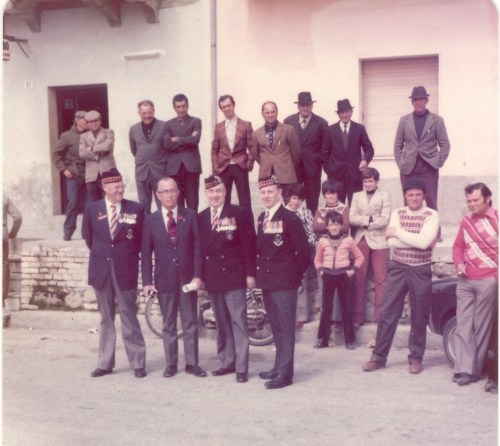
Posing for photo with local residents.  Family photo.

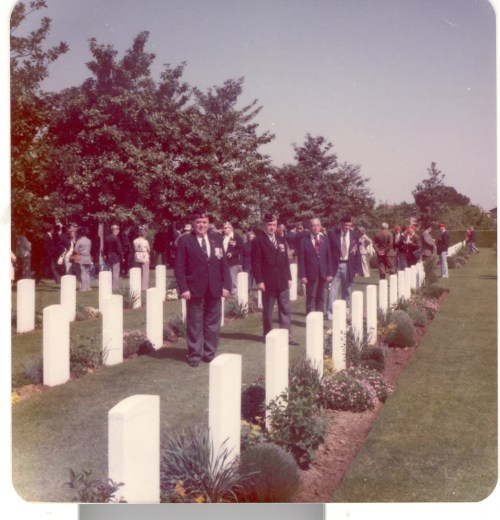
With strong encouragement from Borden Cameron (the quartermaster who organized the famous Seaforth Christmas 1943 dinner at the Ortona church in the middle of the battle), Leigh decided to attend the reunion.   He was particularly looking forward to visiting brother Ken’s grave in Coriano Ridge Cemetery near Riccione for the first time.   Paying his respects at Ken’s grave was an extremely moving experience for him, as it was for me when I visited the cemetery as a tourist in 2005.  This posting includes a candid photo Borden took of Leigh standing by the gravestone and reflecting on Ken’s death, which was devastating for their parents, particularly mother Winnie who never recovered from the shock, as well as Leigh, other relatives and Ken’s many friends.

On September 20, 1944 the parents were thrilled to hear the news that Leigh, who had been missing for four months, was alive and in a POW camp.  They were still celebrating two days later when a telegram came that said Ken had died six days earlier.  The main reason why news of Leigh being alive and a POW was slow to reach Canadian authorities was because was being treated in German hospitals during most of the “missing” period, and the usual mechanism of informing via the Red Cross was not available in hospitals as it was in POW camps.

jan11 180014 - Copy

Remembrance ceremony under way.  Family photo.

Participants in the tour got from place to place in sleek Fiat buses.  Leigh told his family he was extremely impressed with how Italy had recovered from the war, when people were starving and living in dilapidated homes damaged by the warfare.  He particularly enjoyed side trips to Venice and Mount Etna.  The experience led him to become an aficionado of Italian art and architecture.  Unfortunately, by the time he retired from his job with the legal department of Cominco Ltd.
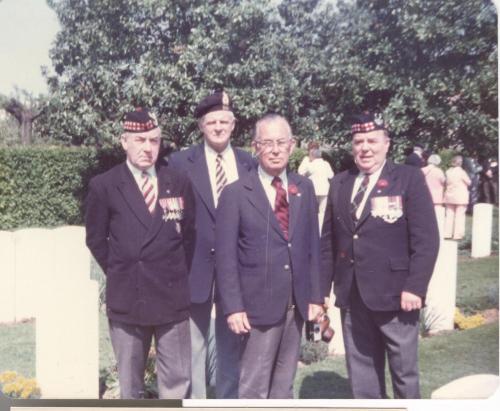
leigh with seaforth buddies 1975

Borden Cameron, Leigh McBride and fellow veterans.  Family photo.

In retrospect, the 30th anniversary was probably the best time for the reunion in Italy to be held, as participants were generally still in good health, were advanced enough in their careers to be able to take a couple of weeks off work, and could afford the cost of the flights to and from Italy and other expenses not covered by Veterans Affairs or the local hosts.
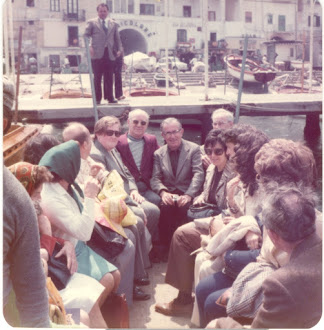
jan11 180005

Leigh joins other tourists during a side trip to Venice in late April 1975..

Leigh would not have been able to attend a 40th anniversary reunion in 1985 because he was suffering from the early stages of Parkinsons Disease.  Ten years later he died at age 77 in a care home in Trail on August 12, 1995, a couple of months after the 50th anniversary of the liberation of Italy.
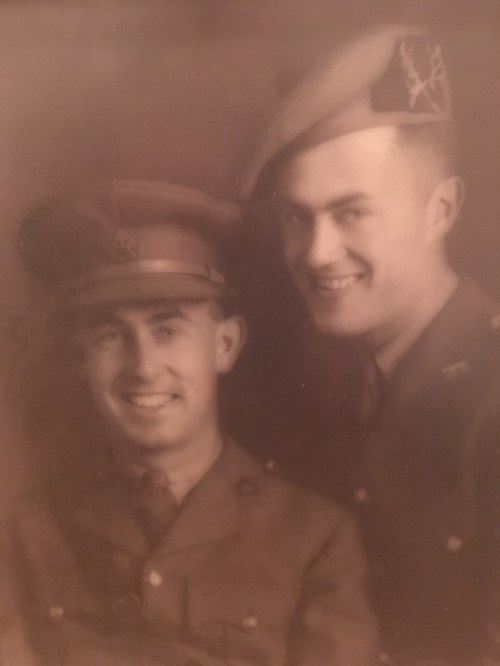
IMG_5833

1942 photo of Leigh McBride (left) and his brother Ken, who was killed in action near Rimini in September 1944 and is buried at Coriano Ridge Cemetery.  Family photo.

As part of the publicity associated with the reunion, Veterans Affairs distributed photos with identification and caption information to the local newspapers of participants.  Both the Nelson Daily News and the Trail Daily Times ran the material in early May 1995, and the Trail paper passed on the photo prints to Leigh for the family album, from which I am very pleased to be able to scan and share images in this posting.  Local residents, some of whom lived through the war years, showed their Canadian visitors heartfelt welcomes and appreciation, as shown in several of the photos.  A highlight was a parade of the Canadian veterans through Rimini to a response by locals that was described by writer Maurice Western in the May 15, 1975 Saskatoon Star-Phoenix newspaper as “tumultuous”.
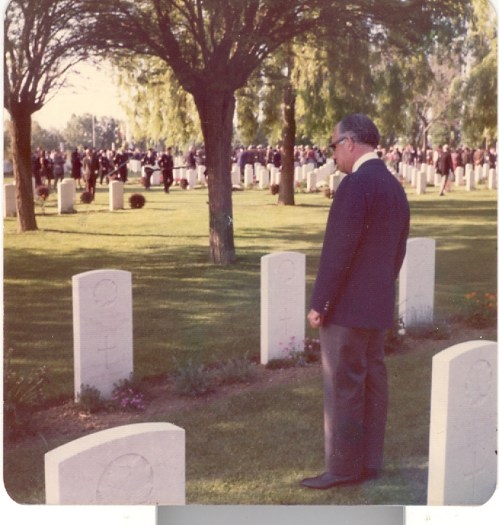
dec 20 180003

Leigh McBride, seeing his brother Ken’s grave for the first time at Coriano Ridge Cemetery.  Photo taken by Borden Cameron.  Family photo.
jan11 180011

jan11 180006

ceremony at Coriano Ridge Cemetery.  Family photo.
dec 20 180004


dec 20 180005

Cemetery ceremony.  Family photo.


Peters-Dewdney wedding in Victoria in 1912 linked two families prominent in Canadian politics

Leave a comment

by Sam McBride

It is 107 years since my maternal grandparents Mary Helen Peters and E.E.L. “Ted” Dewdney married June 19, 1912 at St. Paul`s Anglican Church in Esquimalt, the municipality immediately north of Victoria, British Columbia.

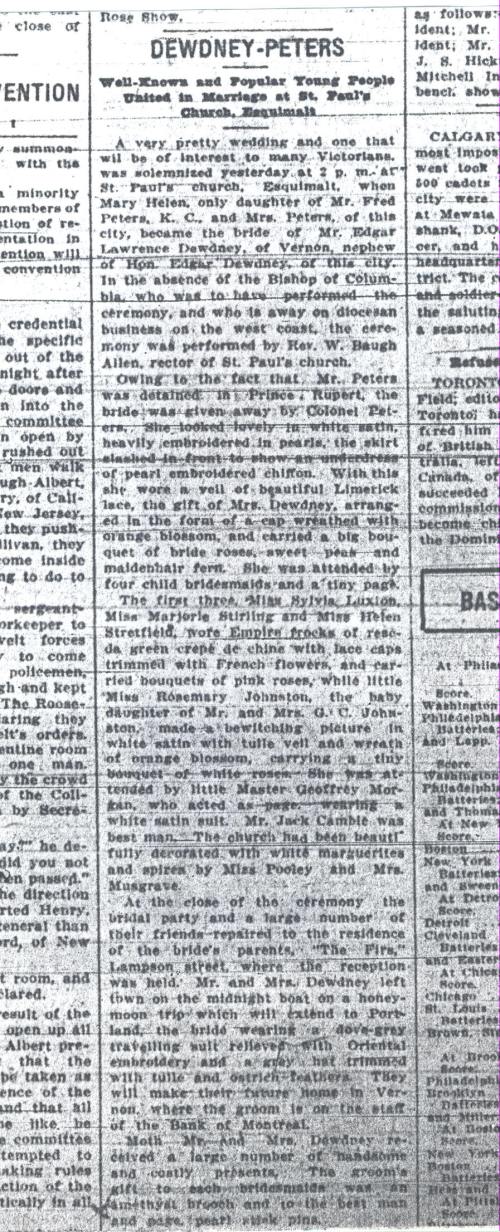
The reception following the wedding was held at the Peters’ residence on Lampson Street known as “The Firs”.  The Victoria Times and Colonist newspapers each ran articles on the wedding based on information provided by the family, but with different leads and commentary.

ted and gran jpg

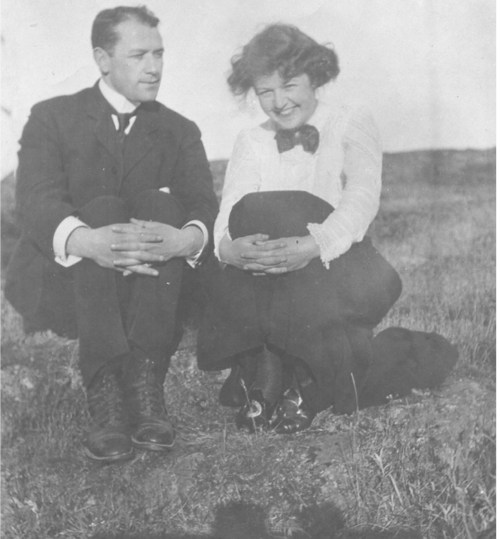
Ted Dewdney and Helen Peters, shortly before their wedding in June 1912.  Family photo.

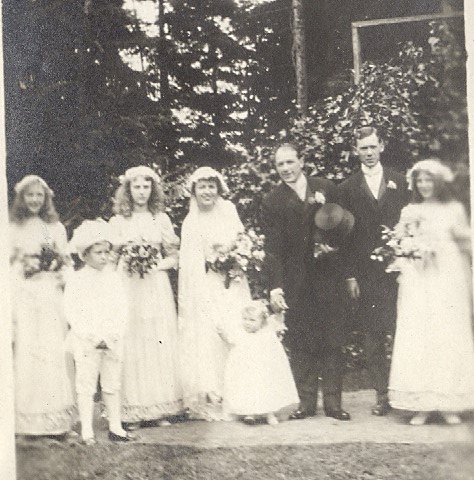
According to the newspaper reports, the best man was Jack Cambie (who, like Ted, worked for the Bank of Montreal); the bridesmaids were teen-agers Sylvia Luxton, Marjorie Stirling and Helen Stretfield, as well as toddler Rosemary Johnston; and young Geoffrey Morgan served as page.

graninweddingdress

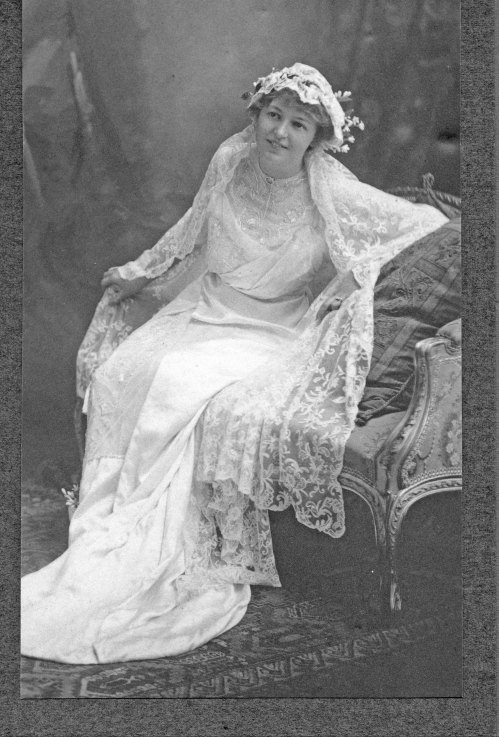
Studio photo of Helen wearing her wedding dress.  Family photo.

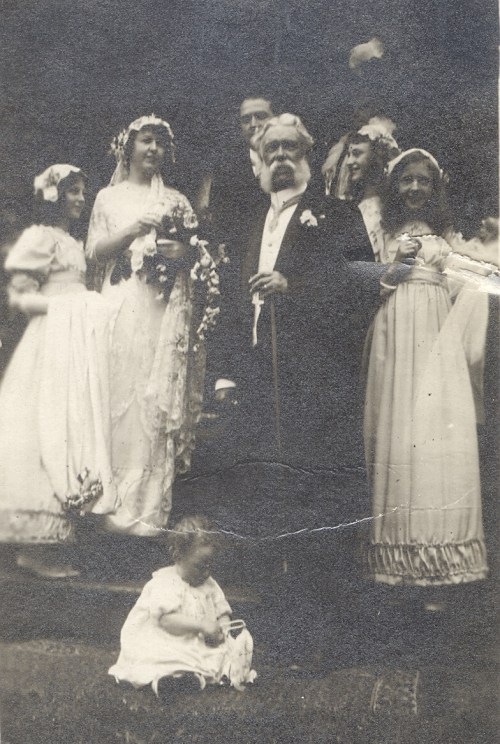
Among the guests was Ted`s famous uncle, the Hon. Edgar Dewdney, 77, builder of the Dewdney Trail through the British Columbia interior, and later as a senior minister in the cabinets of Sir John A. Macdonald.  He has the distinction of being the only Canadian to serve as Lieutenant Governor in two separate jurisdictions: Northwest Territories in the 1880s and B.C. in the 1890s.  After both of Ted’s parents had died when he was age 11, he was legally adopted by his uncle Edgar Dewdney, and lived for several years in the lieutenant governor’s residence in Victoria known as Cary Castle.

Ted’s maternal grandfather William Leigh was Victoria’s city clerk, serving from 1864 until his death in 1884.

jan2 190011 (2)

Helen and Ted and the wedding party.  Family photo.
Helen`s father Frederick Peters (former premier of PEI) was working in Prince Rupert as city solicitor and could not make it to the wedding due to a civic emergency, so the role of father of the bride in the ceremony was taken by his second cousin, Colonel James Peters, who had lived in Victoria off and on since arriving in 1887 in command of the first West Coast defence force. In 1912 Col. Peters had retired from his position as district officer commanding for BC, and was serving as alderman in the new municipality of Esquimalt.

Frederick Peters served as premier of Prince Edward Island from 1891 to 1897, when he resigned to move west.  His brother Arthur Peters served as premier from 1901 until his death in 1908.  Both men were Liberals and also served as attorney-general.

Helen’s mother Bertha Hamilton Gray was a daughter of Col. John Hamilton Gray and Susan Bartley-Pennefather.  Col. Gray was head of the PEI colonial government (equivalent to premier) from 1863 to 1865, and served as host and chairman of the historic Charlottetown Conference of September 1864 that got the ball rolling towards Canada becoming a self-governing nation in 1867.

red disk jan 23 2013 1630

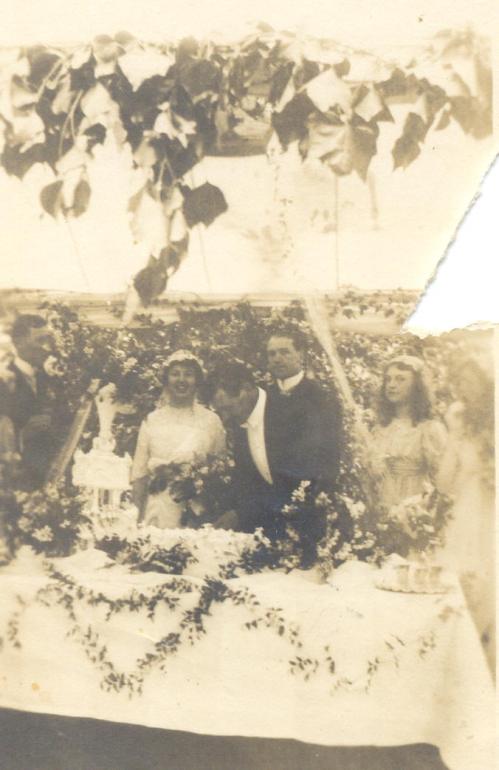
cutting the wedding cake.  Family photo.
Helen was born in Charlottetown in 1887 and came west with her family to Oak Bay in 1898, when her father Fred joined Sir Charles Hibbert Tupper in a law partnership based in Victoria that served clients there as well as Vancouver and Dawson City in the gold-rush Yukon. Fred and Tupper parted ways in about 1902, and the Peters family moved to Esquimalt in 1909 before moving to Prince Rupert a couple of years later. Ted and Helen began their marriage in Vernon, and then moved on to Greenwood, New Denver, Rossland, Trail and finally to Nelson as the bank transferred him from place to place as an accountant and later as branch manager.

edgar with helen and ted wedding

Hon. Edgar Dewdney (with his distinctive mutton chop facial hair) with the bride Helen, and his nephew Ted is partially obscured behind him.   Family photo.
Ted was born in Victoria in 1880, son of Walter Dewdney and Carrie Leigh. After he became an orphan at age 11, he was legally adopted by his uncle Edgar. I never knew Ted because he died in 1952 when I was a baby, but Helen was an extremely close grandmother because after Ted`s death she came to live with my family in Nelson and was like a second mother to me. She often talked of the old days and wrote down some of her memories in notes and letters, but I wish I had thought to do a tape-recorded interview with her before she died in 1976.

3 wedding report

report of the wedding in June 20, 1912 Victoria Times newspaper.

75th anniversary of Nelson, B.C.`s “Black Day of World War 2“ on May 23, 1944

Leave a comment

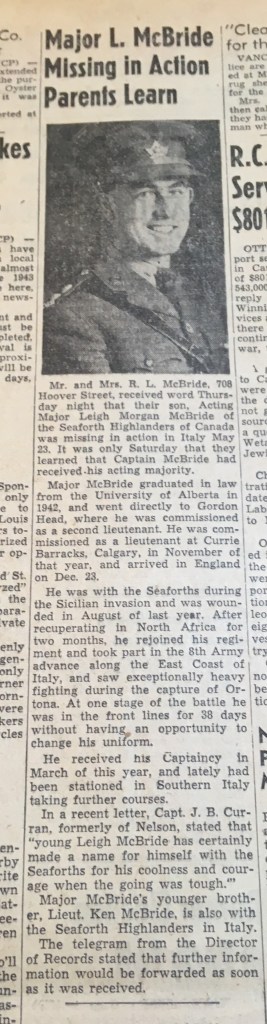
This is the 75th anniversary of the attack of Canadian forces on the Hitler Line southeast of Rome. Sylvia Crooks, author of “Homefront and Battlefront: Nelson, BC in World War 2”, wrote that May 23, 1944 was “Nelson’s Black Day of World War 2”, as two Nelson boys were killed and two others went missing in action, including my dad Leigh.

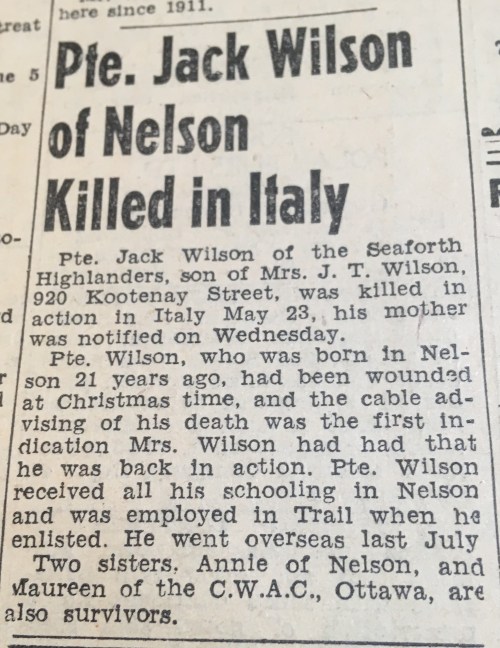
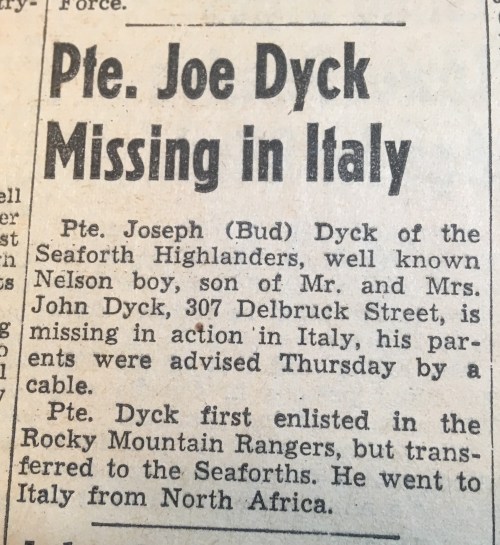
Ray Hall and Jack Wilson died, and Leigh McBride and Joe Dyck were seriously injured and taken prisoner. The news was a huge hit on the remote community of 7,000 in southeastern British Columbia.

IMG_6032The Dyck family did not learn that Joe was alive and a POW until July 1944, and my McBride grandparents did not find out Leigh was alive and a POW until September 1944.
Leigh was the only survivor of a forward unit, and had suffered shrapnel wounds to his legs, arms and face, causing the loss of his left eye.

He was discovered unconscious by German soldiers and taken to a hospital in Rome. Leigh came back to Canada in a prisoner exchange in February 1945, and Joe came back in July 1945. In 1968 Leigh wrote of the fateful day he was captured in notes for Professor Roy who wrote the Seaforth regimental history. Mark Zuehlke later referenced his comments in his Liri Valley book.

In her 2017 memoirs “Children of the Kootenays”, Shirley Hall Stainton described how the telegraph messenger boy came to their home on Latimer Street in Nelson with the tragic news of her brother’s death, and she watched him go on to the Wilson house just two houses away with similar news. She thought he may have just come down from the McBride house on Hoover Street a couple of blocks away with the telegram that Leigh was missing. The Dyck house was a few blocks up the hill on Delbruck.

All four of them were with the Seaforth Highlanders of Canada regiment. Leigh was 26, and the others about 5 years younger. The announcements were in the Nelson Daily News of June 2nd and 3rd of 1944.

One of Ray Hall`s last letters mentioned that he was serving under Captain Leigh McBride from Nelson.  That would have been after Leigh was promoted to Captain in March 1944.  At the time of the attack on the Hitler Line on May 23, 1944 Leigh was in command of D Company (aka Dog Company) but it is not clear in the records I have seen if Ray Hall was still in that company or had moved.

Leigh`s parents (my paternal grandparents) R.L. and Winnie McBride were thrilled to hear by telegram on Sept. 20, 1944 that Leigh was alive and recovering from wounds at a prisoner of war camp in Germany.   Tragically, after two days of celebrating and receiving congratulatory calls and letters from friends, they received a subsequent  telegram on Sept. 22, 1944 advising that their other son, Capt. Kenneth Gilbert McBride, had been killed in action near Rimini, Italy on Sept. 16, 1944.


IMG_6035

Ray was the only brother of Shirley Hall Stainton, who described their experiences growing up in the Slocan Valley when their father was a cook at mining camps, in her book “Children of the Kootenays“

IMG_6039

One of four clippings in the Nelson Daily News of either June 2, 1944 or June 3, 1944, as it took about a week for war news to get back to Nelson from Italy.

IMG_6038

Leigh was able to contact Bud Dyck while they were in different POW camps in Germany­.  When I was living in Edmonton in 2005 I saw his name mentioned in a Royal Canadian Legion story in an Edmonton newspaper, and contacted him through the Legion.  He told me he had served in a unit commanded by my uncle Ken McBride, who regularly gave him the “honour`of being picked for dangerous night raids.

Amazing 35-minute drive from Trail, BC to Nelson in 1945 to receive phone call from son freed from German POW camp

Leave a comment

by Sam McBride

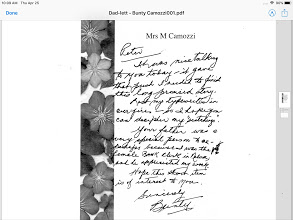
In 2006 Margaret “Bunty” Peterson Camozzi of Trail contacted my uncle Peter Dewdney with recollections of working in the 1930s for his father E.E.L. “Ted” Dewdney as a bank clerk at the Bank of Montreal in Nelson, and also of working as a stenographer for the Wood Vallance Hardware Company in the 1940s, when my other grandfather, Roland Leigh McBride (1881-1959), was manager.  My Dewdney cousins recently passed on the fascinating letter to me, knowing of my interest in discovering, and sharing, the family history.

Bunty noted that Ted Dewdney (1880-1952) was a very special person to her, perhaps because she was the first female bank clerk in Nelson, and he appreciated her work.

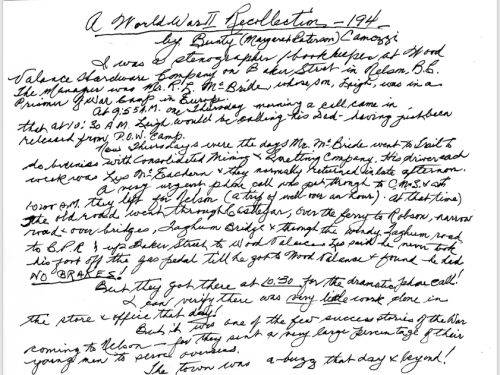
IMG_1222Her story about a remarkable day at the Wood Vallance store in early February 1945 during World War Two may be a bit of an exaggeration as to driving time between Trail and Nelson, but it illustrates the great sense of excitement about a father getting a long-distance phone call from his son Leigh in Switzerland after his release from a German prison camp in a prisoner exchange.
The last time R.L. McBride saw son Leigh was when he was on leave in his hometown of Nelson in December 1942 before travelling to Britain to join his Seaforth Highlander regiment in training in preparation for war action.  Leigh was a 25-year-old lieutenant when he landed on the beaches of the Allied invasion force that attacked Sicily in July 1943.  He led troops in battles across the island of Sicily and then through mainland Italy, including the famous Battle of Ortona in Christmas 1943.  He was promoted to captain and then major.  On May 23, 1944 Leigh was the only survivor of his unit that received a direct shell blasts from German defenders during the attack by Canadian forces on the Hitler Line at Cassino.  He was discovered unconscious by German soldiers, who took him to a hospital in Rome and later to Oflag 7B and other prison camps in Germany.  He had wounds to his arms, legs and face and initially could not see at all, but eventually recovered sight in one eye but his left eye was lost forever.

As the company headquarters did not know what happened to him, Leigh was listed as “missing in action” for four months until word came back through the Red Cross on Sept. 20, 1944 that he was in a German POW camp.  His parents were ecstatic to hear that he was alive and recovering.  Tragically, just two days later, on Sept. 22, 1944 they received a telegram from Ottawa that their other son, Capt. Kenneth Gilbert McBride, also with the Seaforths, was killed in action near Rimini, Italy.

The only good news they received in the next few days was that Leigh’s injuries were extensive enough that he might qualify for a prisoner exchange.  In early February 1945 he was sent to Constance, Switzerland for the prisoner exchange, and came home via the port of Marseilles on the Swedish repatriation ship Gripsholm, which landed in New York City, where he transferred to train service that took him to Vancouver, where he was greeted by his mother, Win Foote McBride.  They returned to Nelson on the Kettle Valley Railway
Some time soon after he was free, arrangements were made that allowed him to phone his father in Nelson.  Bunty recalled that word came from authorities on a Thursday at about 9:55 am that the call would come through at 10:30 am at the Wood Vallance store.  The problem was that R.L. McBride was about 50 miles away in Trail meeting with his biggest client, the Consolidated Mining and Smelting Company of Canada Ltd., which he did every Thursday.

IMG_1224

scan of memories of Bunty Camozzi written in 2006

R.L. told his driver, Les McEachern, to drive as fast as he could, and somehow they made it to Nelson in time to take the call.   Bunty noted that the joy in the office was such that there was not much work accomplished in the store that day.  She said it was a rare example of “good news” during the war years when bad news tended to dominate the lives of residents and their loved ones in the military.

As someone who has driven from Trail to Nelson many times over the years, I find it hard to believe the drive could have been done in just 35 minutes.  Even today, with major improvements to the highway over that last 75 years, someone would have to have a high-power car and substantially exceed every speed limit to come close to that travel time.  But it was obviously a dramatic feat of driving which could easily have ended tragically in a crash, particularly as there was a problem with the car’s brakes.

Bunty Camozzi died in Trail in 2012 at age 94.  I am so pleased that she took the time to record her memories of my two grandfathers, Ted Dewdney and R.L. McBride.


Wood Vallance Hardware Company was a dominant retail enterprise in Nelson, B.C. and region from 1904 until 1989

2 Comments

by Sam McBride

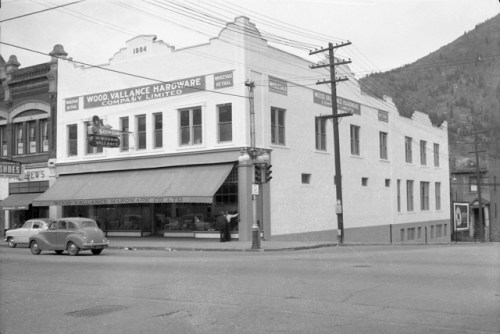
For most of the twentieth century, the Wood Vallance Hardware Company Limited based in Nelson, British Columbia was a household name in the city, and reached out to customers throughout southeastern B.C. and worked with suppliers from as far west as Victoria, B.C. and east to Montreal, Quebec.

thumbnail_Sandon Byers1b

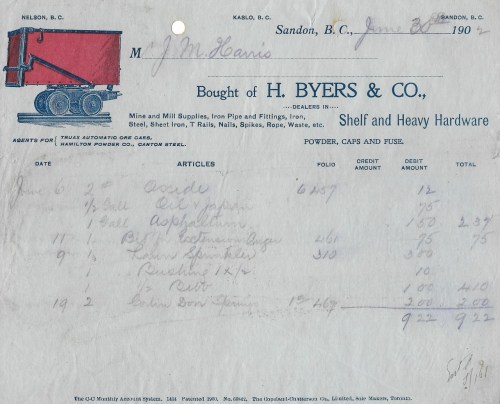
1902 bill from Byers Hardware in Sandon, which operated until 1904 when Wood Vallance Hardware arrived and centralized hardware facilities in Nelson.  Image courtesy Ed Mannings.

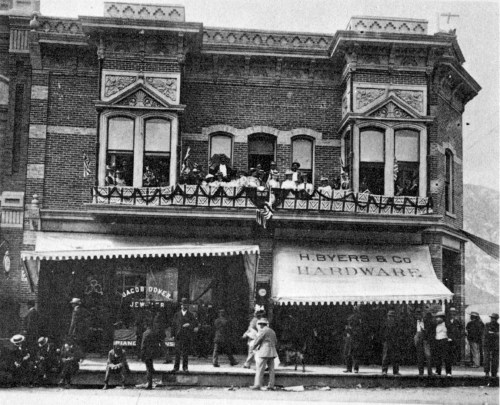
The corporate story for Wood Vallance began with the company’s formation in 1849 in Hamilton, Ontario.  The story of Wood Vallance in the West Kootenay arose from the winding down of business of the predecessor company in the region, the H. Byers Hardware Company, which had hardware stores in the mining boom towns of Sandon, Kaslo and Nelson.

a1103767-f228-4478-8ebe-b4ae3e86cba5

Original Byers Hardware store in Nelson at Baker and Josephine streets.  Touchstone Archivess

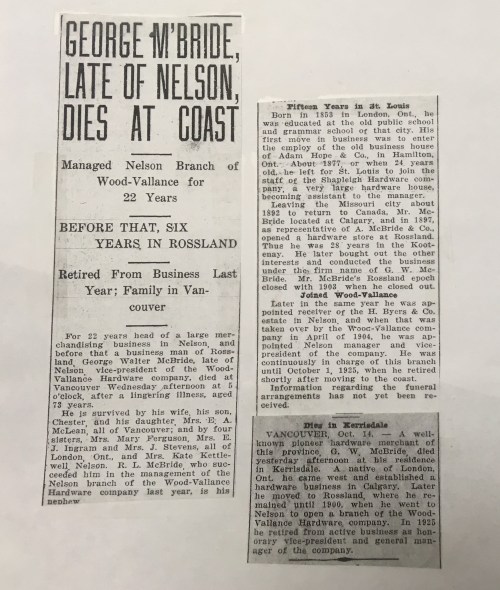
G. Walter McBride, a London, Ontario native who gained extensive experience in the hardware was  business in St. Louis and later in Calgary and then Rossland, was chosen as receiver for the bankruptcy proceedings.  The business opportunity attracted the interest of the Wood Vallance Hardware Company Limited, which purchased the business from Hamilton Byers.  The new company would be an autonomous subsidiary of the Wood Vallance group which included substantial operations in Winnipeg, Calgary and Vancouver as well as Hamilton.

wd vallance storeearly

Wood Vallance store in Nelson, about 1920s.  From McBride family collection.

In April 1904 the new Nelson-based Wood Vallance Company shut down the Sandon store, sold the Kaslo store, and expanded the premises of the former Byers store on Baker Street to be a prominent business in the field of industrial, commercial and household hardware, including sales of  mining and forestry supplies for the region.

thumbnail_Nelson Wood Vallance1b

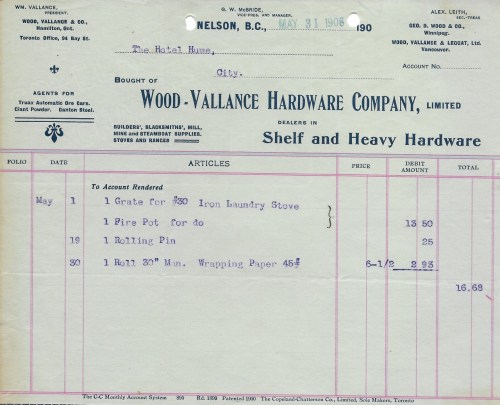
1906 bill for the Hume Hotel.  Owner J. Fred Hume was a major customer of Wood Vallance Hardware, and a close friend of R.L. McBride and Roy Sharp.  Image courtesy of Ed Mannings.

Walter McBride sold his Rossland store and came to work for Wood Vallance in Nelson as manager, with his nephew Roland Leigh McBride – who had gained experience working with hardware stores in Calgary, Rossland and Sandon – was appointed assistant to the manager.  Also working in the new business was Roy Sharp, who had worked at the Byers store in Nelson since 1901 and was given the job of driving a one-horse delivery wagon.  Also joining the staff were well-known Nelson businessman and sportsman Alf Jeffs, and Alex Leith, who came to Nelson from the Wood Vallance office in Hamilton to serve as secretary-treasurer of the new operation.

1990-013-010 - Copy - Copy.jpg

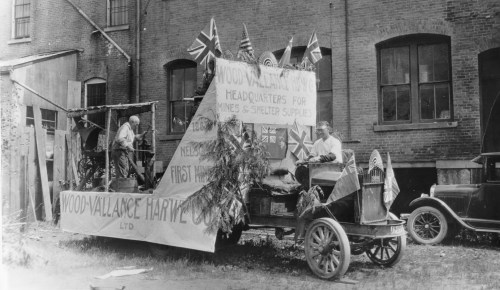
float in Nelson parade, about 1930.  McBride Family Collection

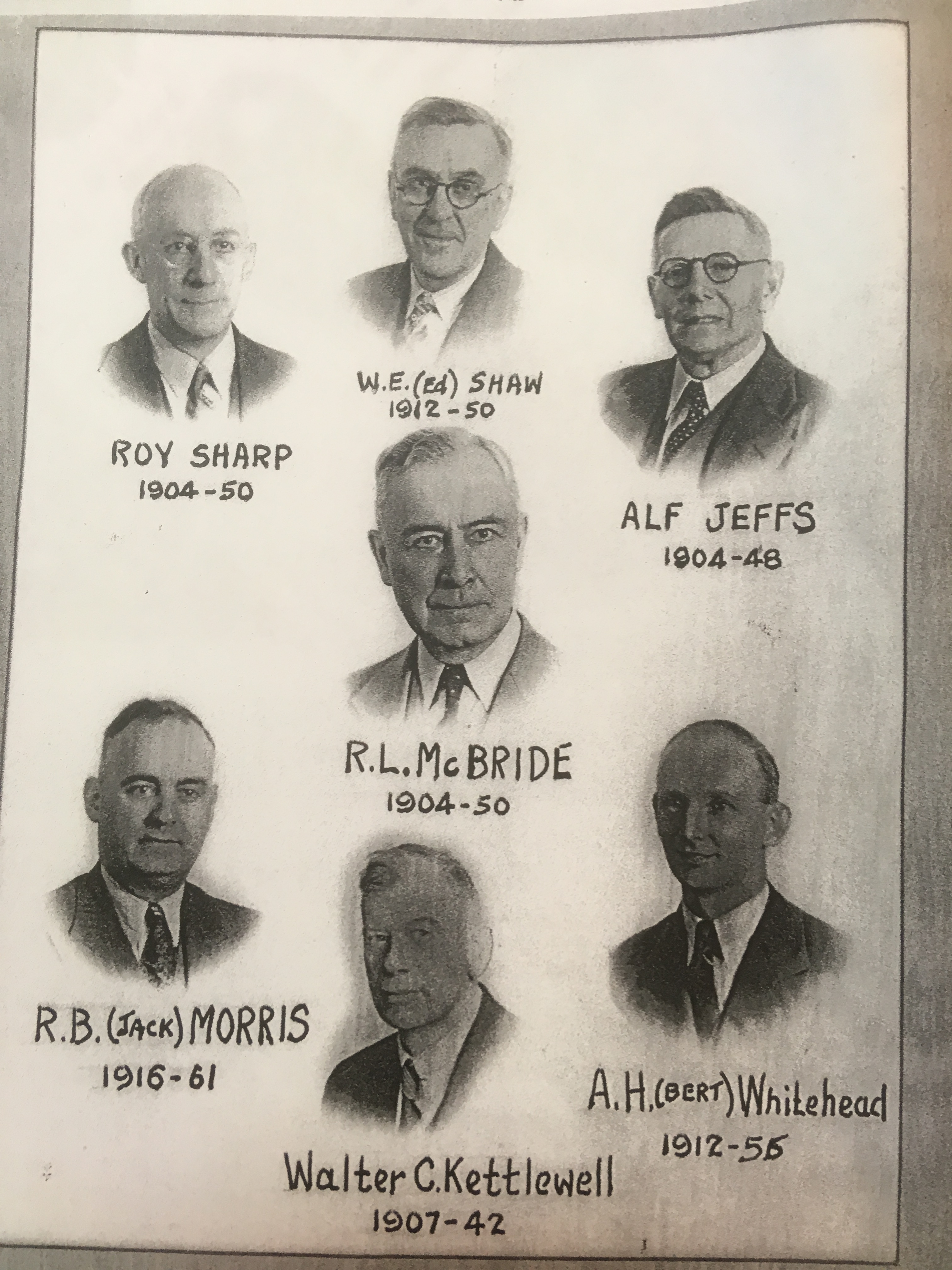
R.L. McBride and Roy Sharp would continue as a team at Wood Vallance until they retired together in 1950 after 46 years of service.  Jeffs would work for 44 years until retiring in 1948.

IMG_6471

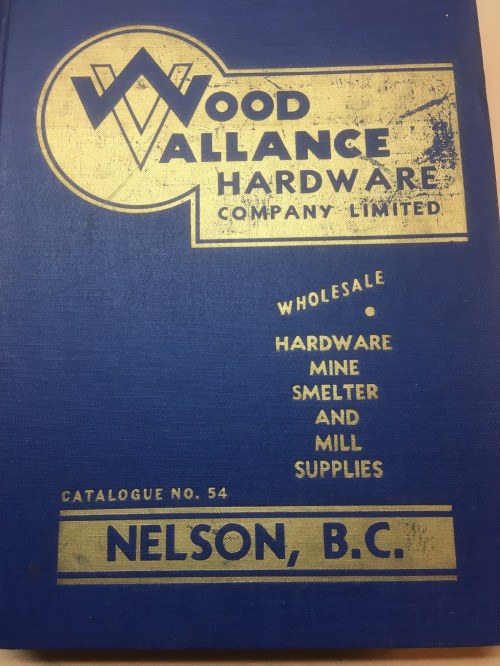
Thousands of products were in the 650-page Wood Vallance catalogue.  Touchstone Archives

Walter McBride was manager for 20 years before retiring in 1925, succeeded as manager and later president of the company by R.L. McBride.

gw mcb died oct 13 1926

G.W. McBride, first Wood Vallance manager, died Oct. 13, 1925.  He was a half-brother of my great-grandfather Richard McBride of London, Ontario.  Touchstone Archives

Alex Leith worked for Wood Vallance in Nelson until his death in 1932 – one week before his retirement was scheduled to begin.  In 1919-1920 Leith and R.L. McBride were among the founders of the Nelson golf course,  and he would serve several years as President of the club and donate the Alex Leith Trophy which went to the Nelson club champion until the Ken McBride Memorial Trophy was established in 1945.

mar12190003

The Wood Vallance Trophy in Kimberley was one of many sports-related sponsorships and donations over the years.  It continues to be awarded in annual tournaments. From Nelson Daily News, 1943.

In 1906 the Consolidated Mining and Smelting Company of Canada Ltd (also known as CM&S, and later as Cominco and then Teck) was incorporated.  This included the smelter in Trail and associated mines in West Kootenay as well as the huge Sullivan Mine orne Kimberley in the Sullivan Mine.  The CPR-owned company would eventually become the largest non-ferrous smelter in the world and a huge success, but in its early days its finances were shaky because of problems in processing the complex lead-zinc ore, as it had to be hand-sorted in a very inefficient assembly line.

IMG_6513.JPG

Wood Vallance long-service staff recognized in 1961 photo display.  Touchstone Archives.

Around 1910 CM&S was short of funds, and about to go under because no one would offer them credit.  The one supplier that gave them credit was the Nelson-based Wood Vallance Hardware Company.  This help was greatly appreciated by CM&S, and the start of an extraordinary, mutually beneficial, unofficial relationship between the two companies. Tom Lymbery writes about it in his book “Tom’s Gray Creek: A Kootenay Lake Memoir, Part Two”.  The remarkable connection lasted until the 1980s.

IMG_6537

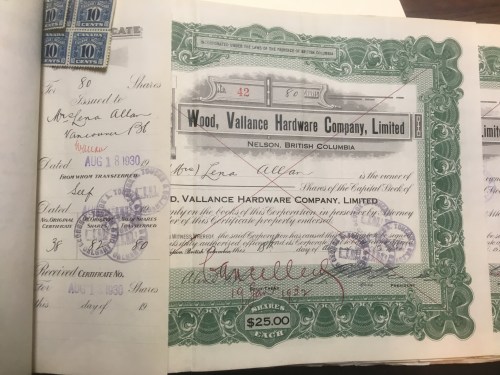
Wood Vallance share certificate. Touchstone Archives.

IMG_6512.JPG

IMG_6534

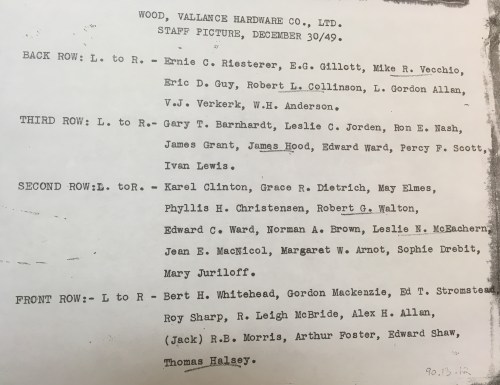
December 1949 Wood Vallance staff photo and identification.  Touchstone Archives.

In addition to using Wood Vallance as a supplier, Cominco would contract Wood Vallance to handle part of its Purchasing function, for industrial supplies like rails and steel.   As part of the enduring strong relationship, manager and president R.L. McBride would travel from Nelson to Trail every Thursday to meet CM&S executives and staff about purchasing requirements.

By the 1920s Cominco had developed differential flotation processing technology that made the Sullivan mine profitable, and they expanded by leaps and bounds, with Wood Vallance growing along with them.

32442679-1c6e-4c5e-a8ca-b9a13777792d

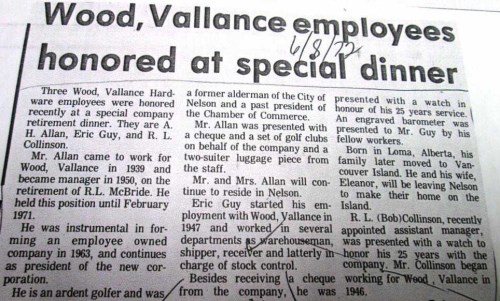
Nelson Daily News June 8, 1972.  Touchstone Archives.

Tom Lymbery noted that “Wood Vallance gave us excellent service, and the range of stock was amazing”.

“These days we would need at least 20 suppliers to obtain the stock we were receiving in our weekly shipments from Wood Vallance,” Lymbery wrote, recalling decades of Wood Vallance business with his family at the Gray Creek Store.

IMG_6469

A corporate change in 1963 enabled purchase of shares by employees.  Touchstone Archives.

Of the original 1904 staff, Alf Jeffs retired in 1948 and died in 1950.  R.L. McBride and Roy Sharp retired together in 1950.

Sharp died in 1953 and McBride in 1959.  Lifelong friends as well as work colleagues, they and family members are buried with memorial stones side-by-side in Nelson Memorial Park.

By the 1980s the business world had changed, and the stewards of the company agreed that it should wind down as a corporation, with final pay-outs to employees and final dividends for shareholders.

IMG_6520.JPG

1972 long-service staff photo display.  Touchstone Archives.

Subsequently, the name Wood Vallance has been used for storefronts, but the corporate entity of the past is long gone.  In retrospect, Wood Vallance had a significant role in Nelson’s transition from a boom-and-bust mining town to a regional centre of commerce and administration.

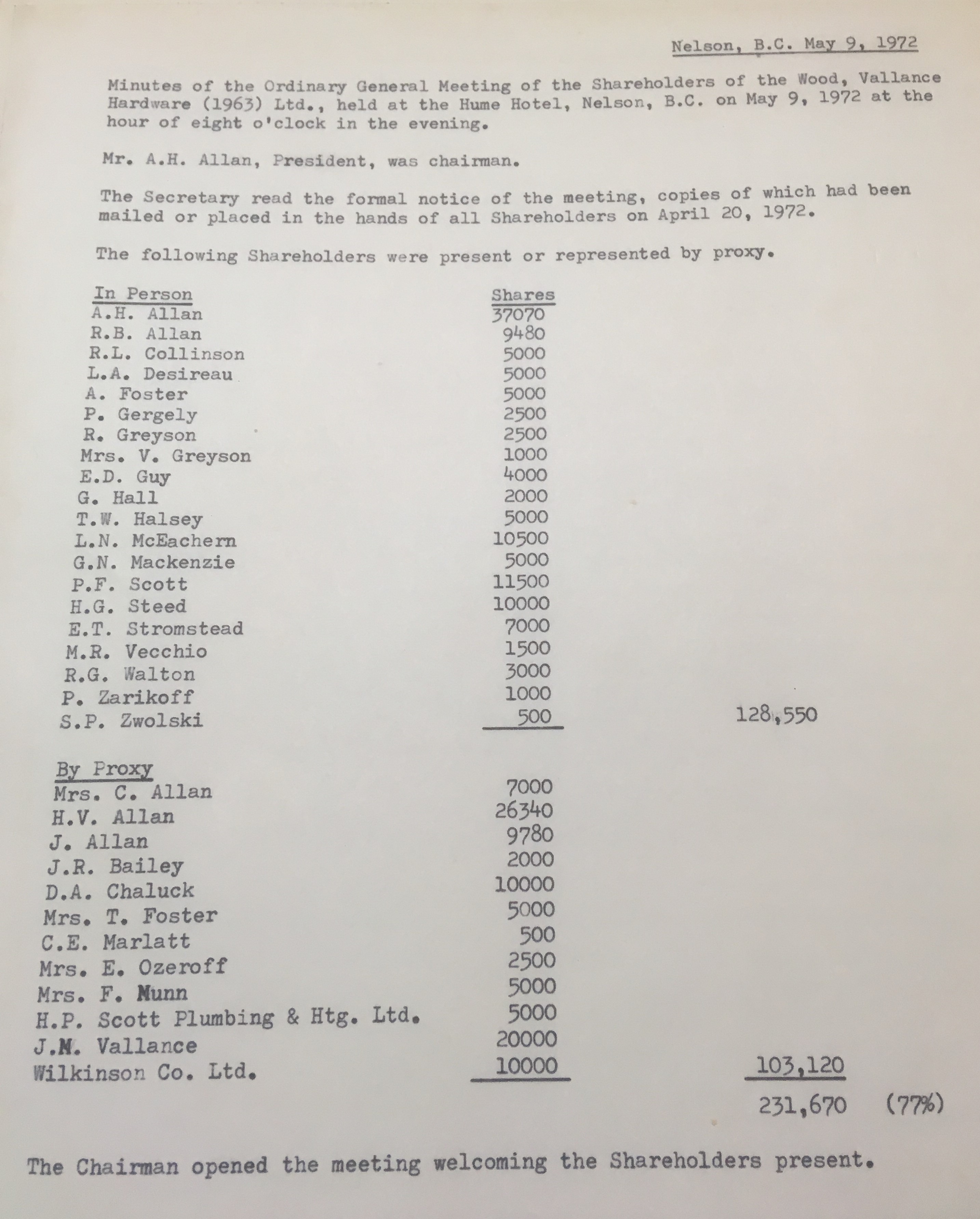
List of Wood Vallance shareholders in 1972. Touchstone Archives.

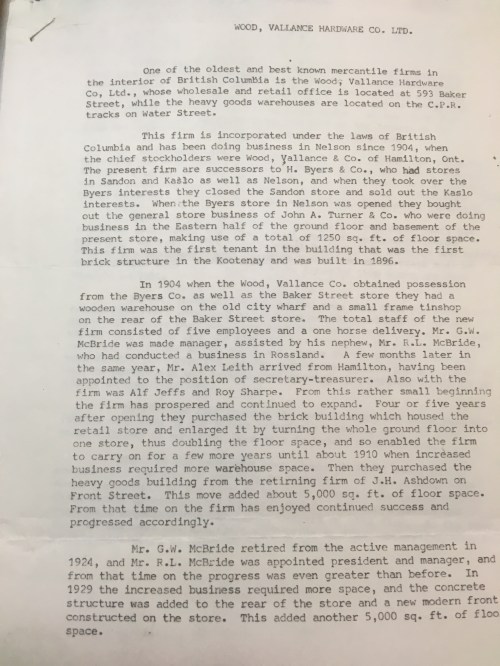
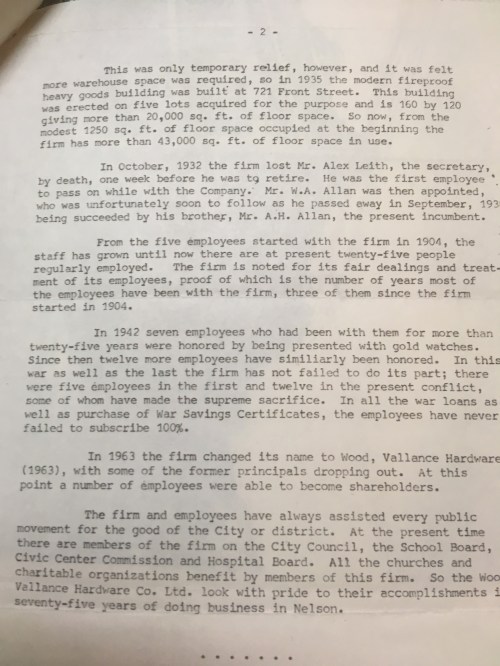
The two-page corporate history below was written during the World War Two years, with the final section added as an update towards the company’s 75th anniversary in 1979.

pg1 wv

first page of 2-page Wood Vallance corporate history

pg2 wv

second page of 2-page corporate history


Experimenting with photo scenes with friends in pioneer Nelson, BC

2 Comments

by Sam McBride

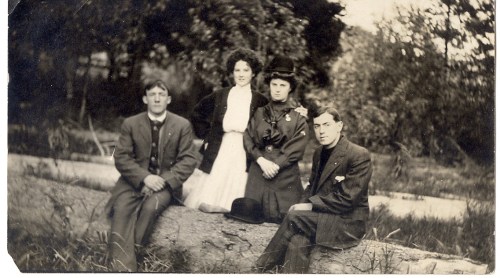
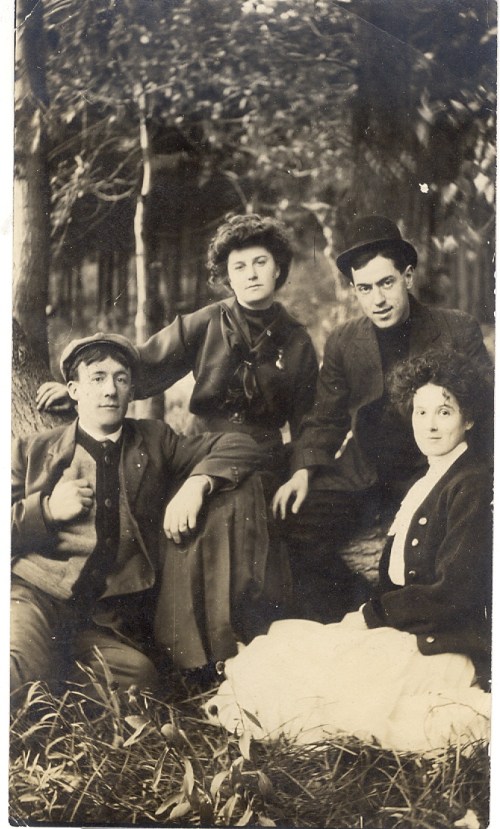
My paternal grandmother Winnifred Foote was a camera buff who enjoyed experimenting with photography with friends in the early 1900s in Nelson, BC.

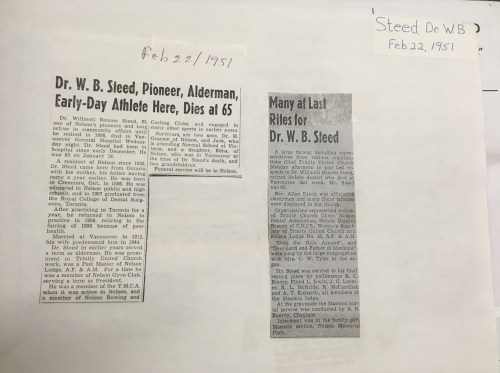
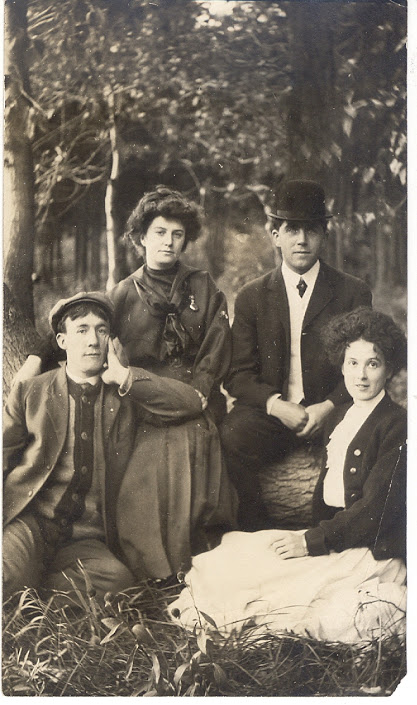
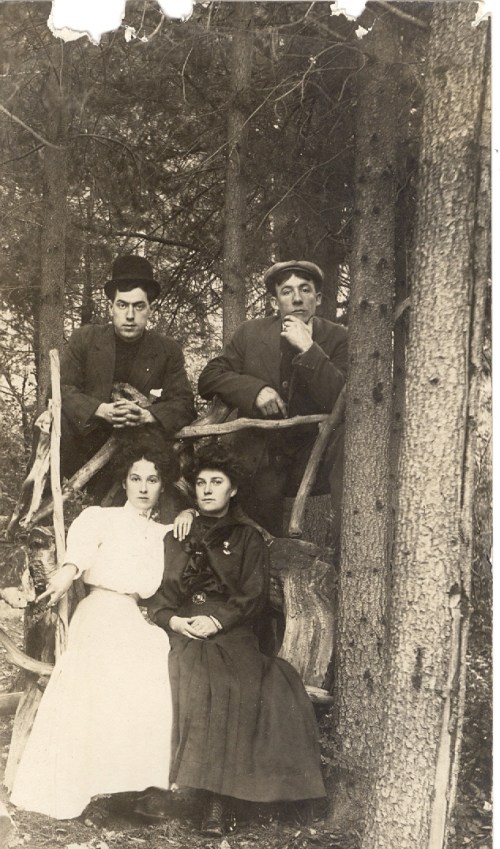
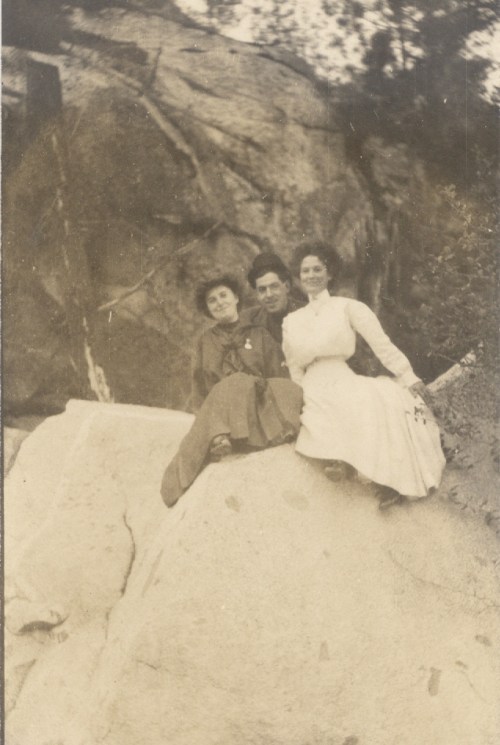
Here are some pics in various settings and posings of her friends Roy Sharp, Emily Wilkinson, Dr. Wilmott Steed and an unidentified lady with Wilmott which I originally thought was his future wife Elizabeth “Bessie” Lillie but I learned it was someone else.  The year was likely between 1908 and 1910.  You can imagine that at some point in the afternoon the subjects of the photos told Winnie that enough was enough.

march 29 2017 scans0017b

from left, Roy Sharp, Emily Wilkinson, Wilmott Steed and unidentified lady.  Approx. 1908 photo by Winnie Foote.

On September 5, 1911 Roy and Wilmott were ushers at the wedding of my grandfather R. Leigh McBride and Eva Hume, who was Winnie’s best friend.  A year later, on September 11, 1912, Roy and Emily married.  Just a week later, on September 18, 1912, Wilmott and Elizabeth married.  Tragically, Eva Hume McBride died due to childbirth complications on November 23, 1912.  Two years later, on December 23, 1914, Winnifred and R. Leigh McBride married.

march 29 2017 scans0018The three couples would remain close friends in Nelson for life.  Their children would be childhood playmates, as the Sharps and Steeds were both just a few houses away from the McBride house at 708 Hoover Street, where Winnie took numerous photos of Dawn Sharp as well as Graham, Jack and Edna Steed bicycling and playing with young Leigh and Ken McBride.
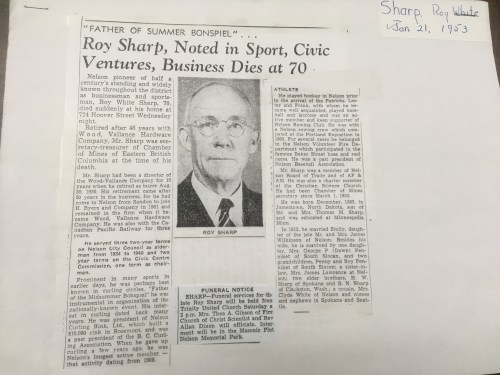
march 29 2017 scans0014Roy was a close colleague of R.L. McBride at the Wood Vallance Hardware Company for almost 50 years, and is best known in local history as the Father of the Nelson Midsummer Curling Bonspiel, which was a huge event when I was growing up in Nelson.  Wilmott was the first of several generations of Nelson dentists.   Details of the lives of R.L. and Win McBride are in previous postings in this blog.  The stories of the Steed and Sharp couples are summarized in their obituaries published in the Nelson Daily News.

may 5 180025

march 29 2017 scans0019.jpg


mar24190037


mar25190017


IMG_E6454

IMG_E6457

willmott steed obit


IMG_3278


Older Entries Newer Entries