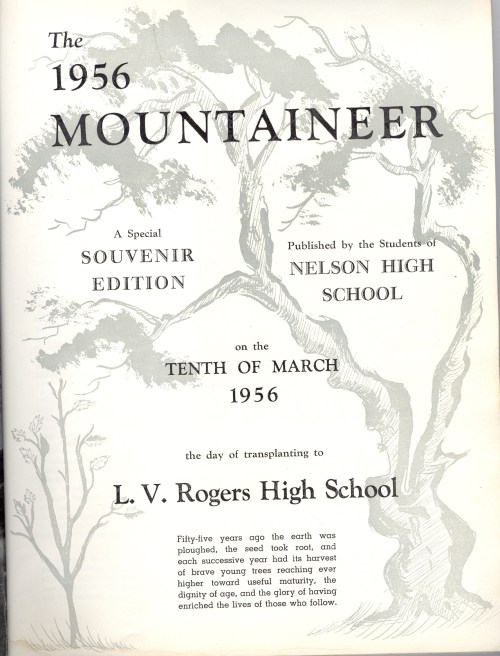
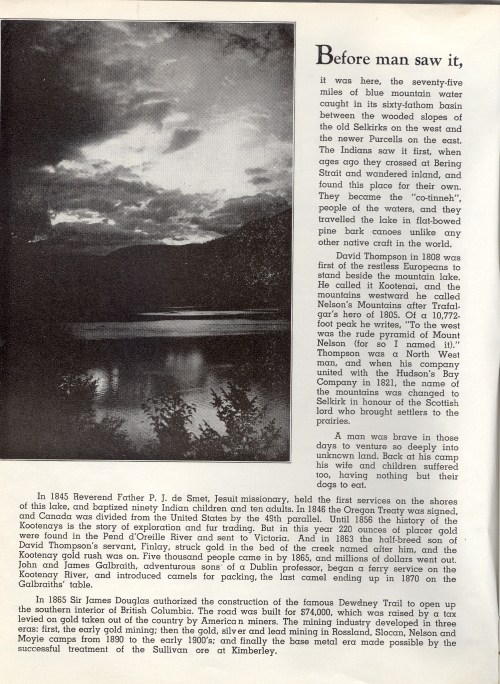
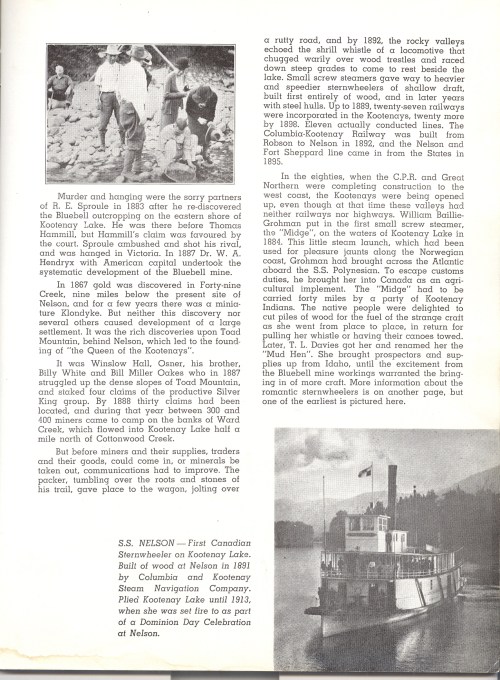
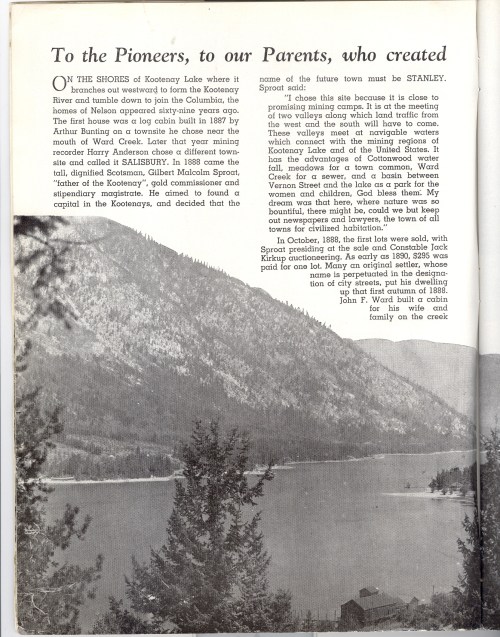
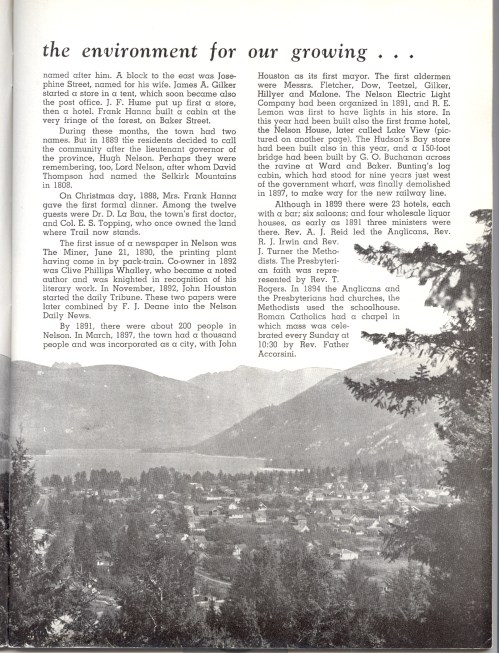
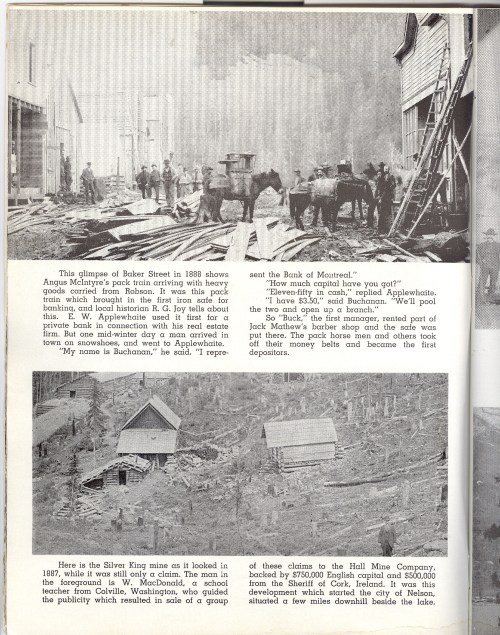
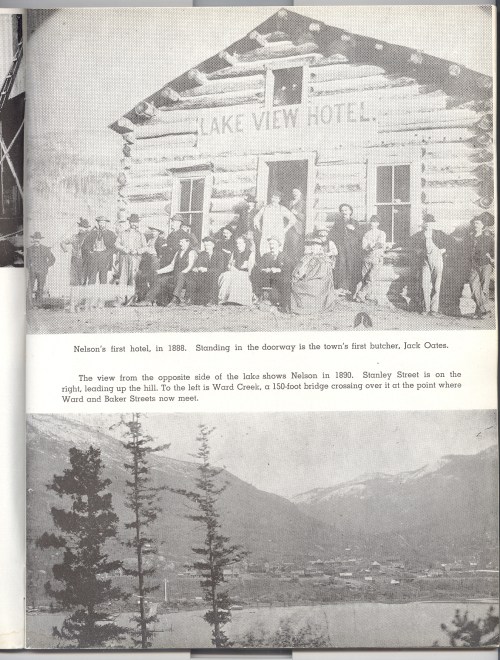
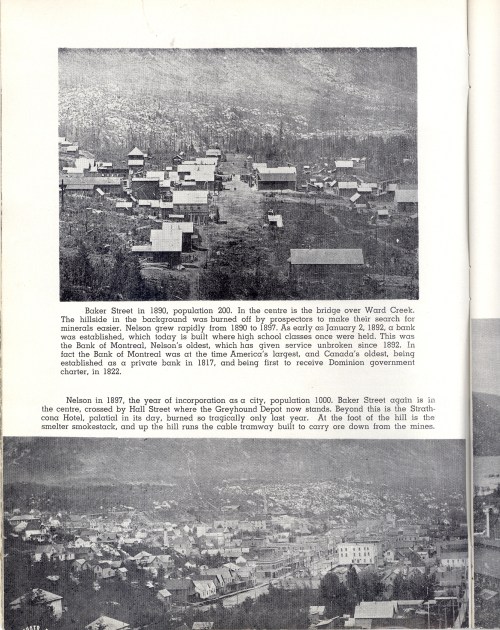
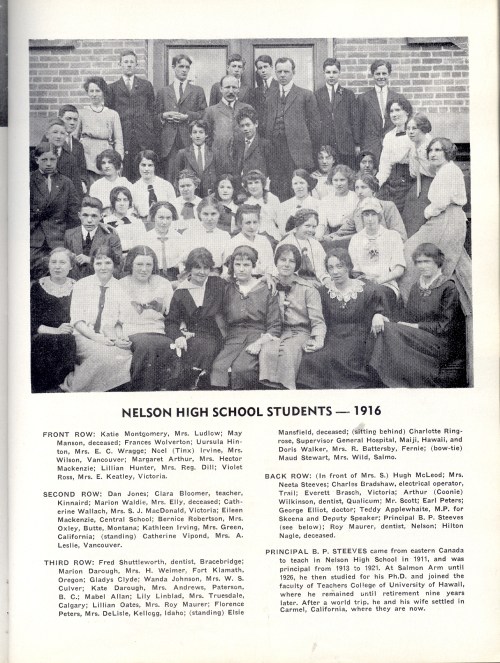
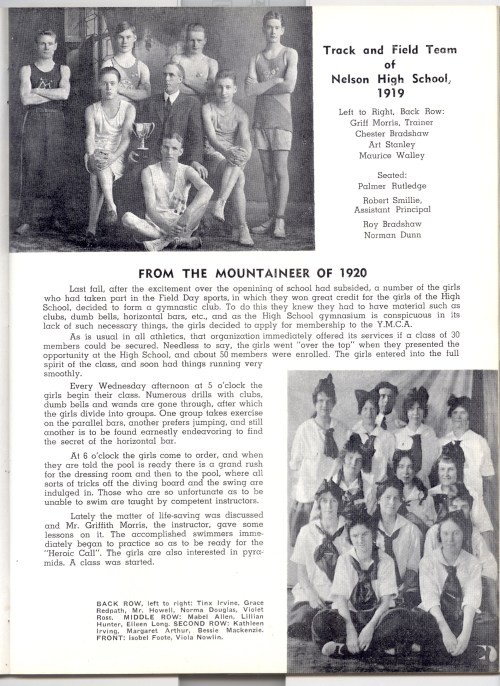
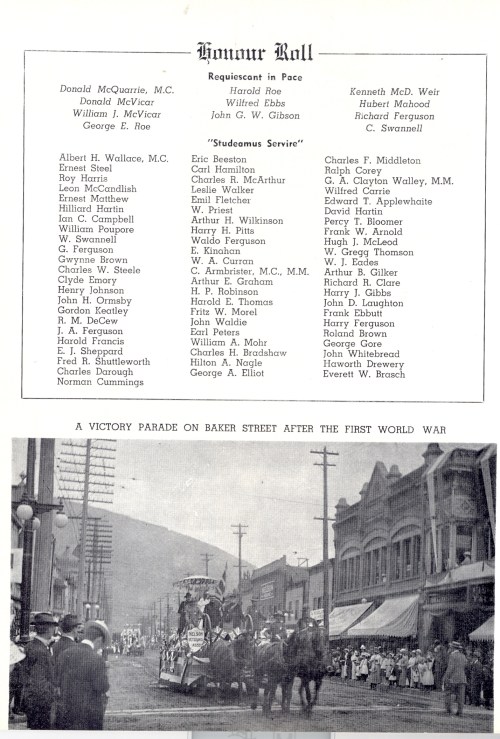
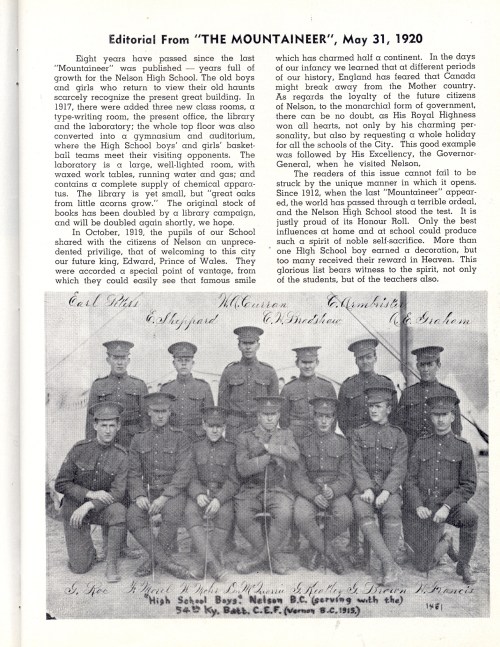
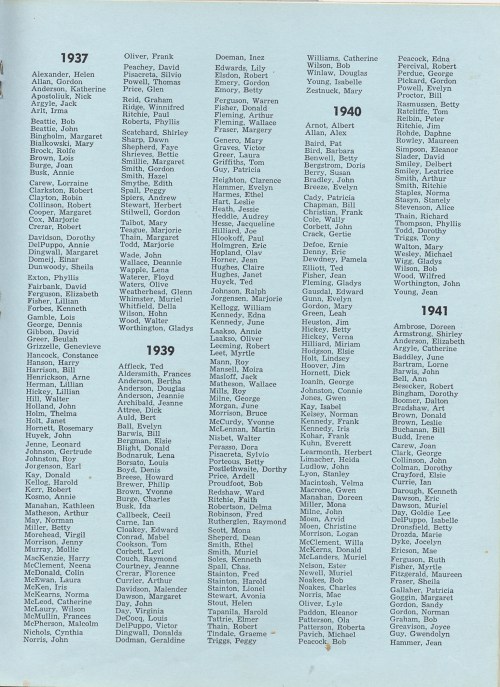
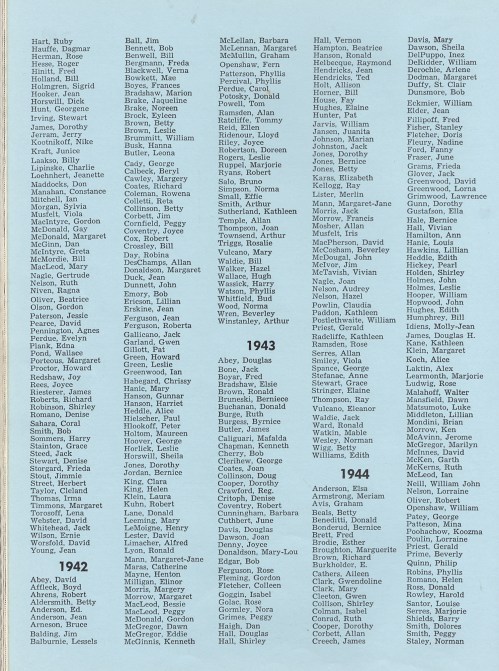
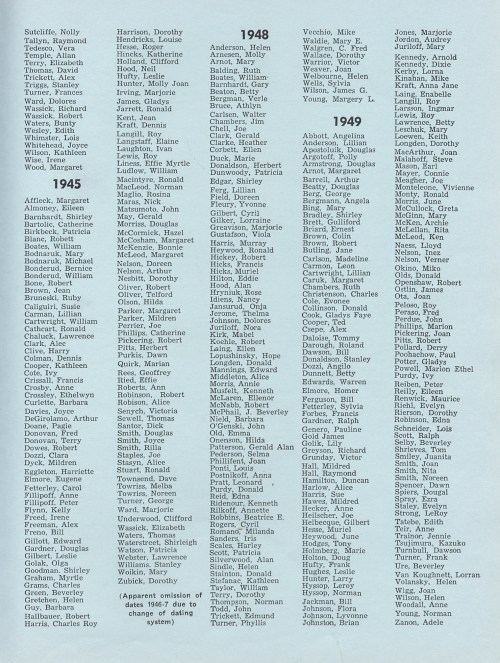
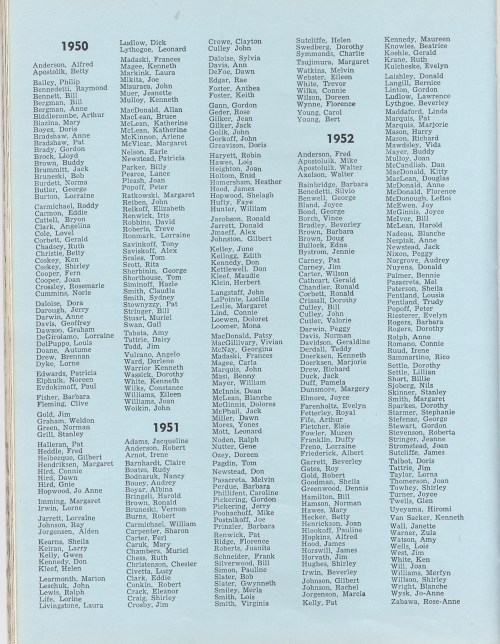
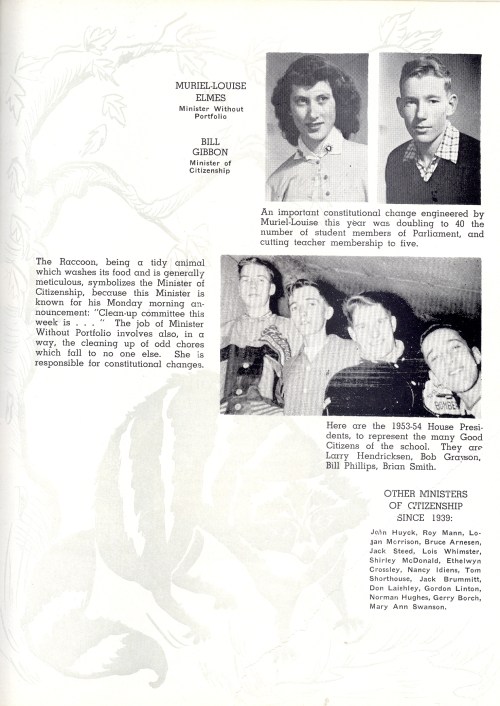
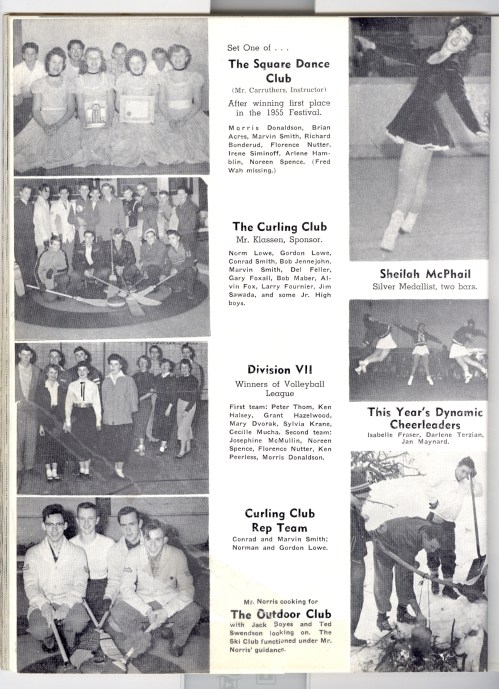
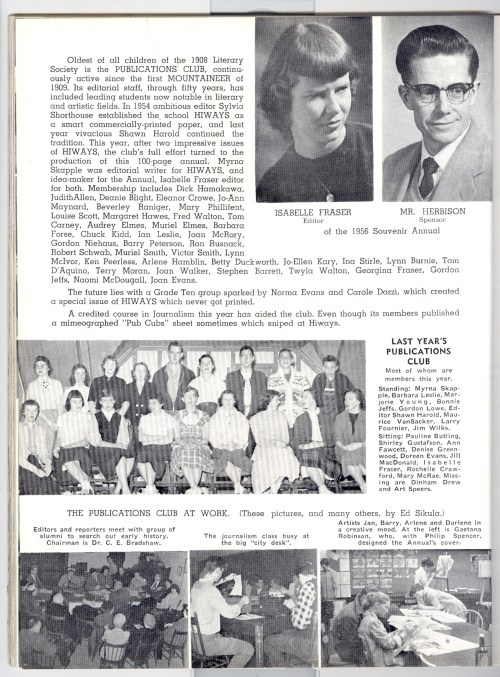
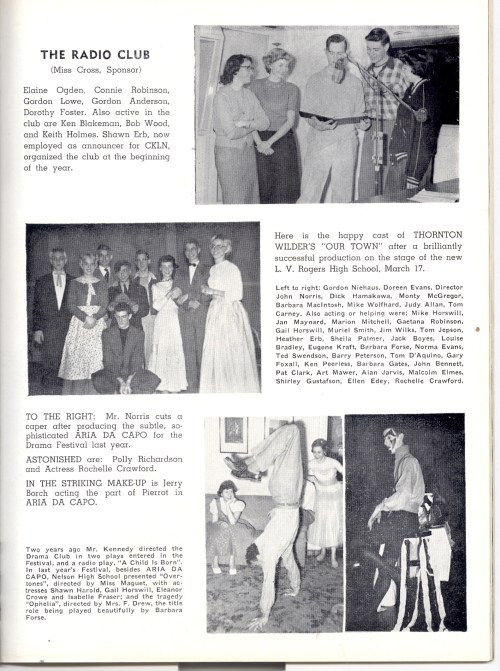
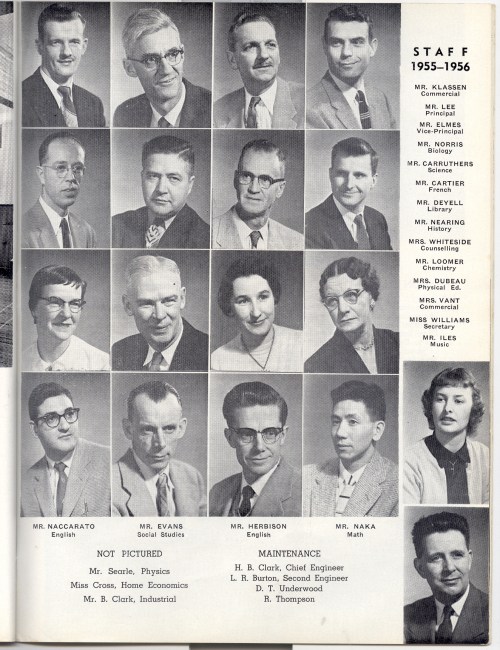
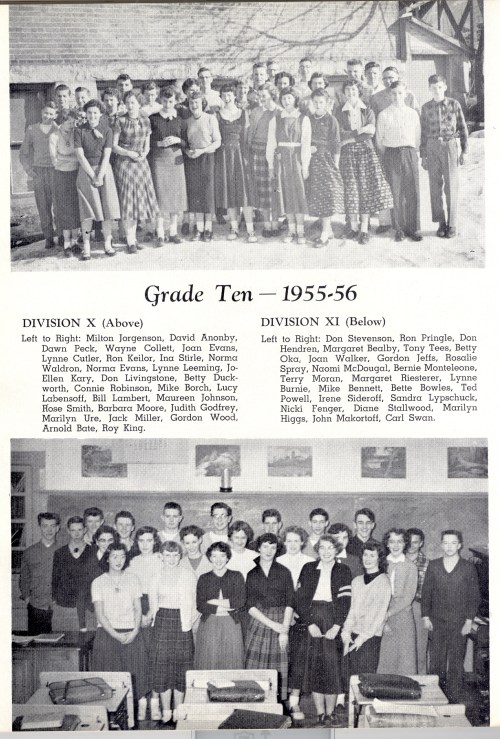
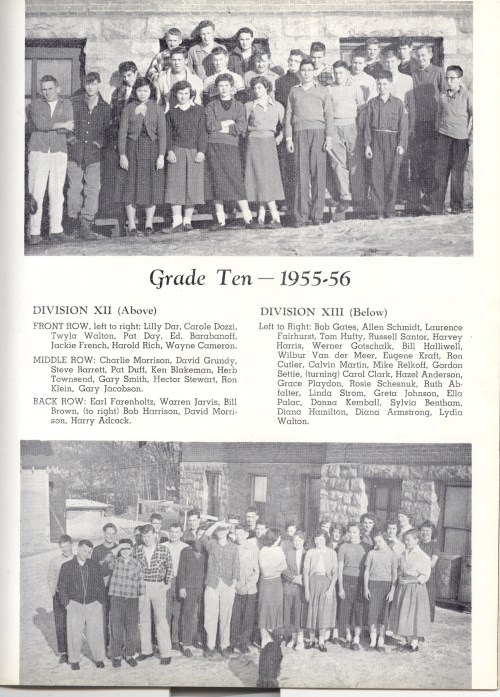
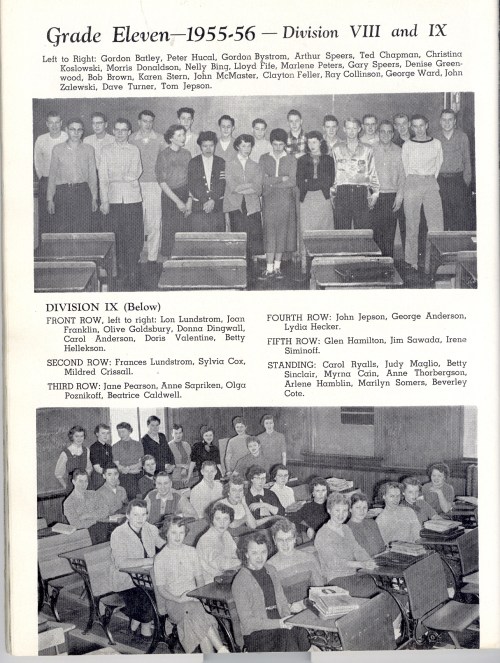
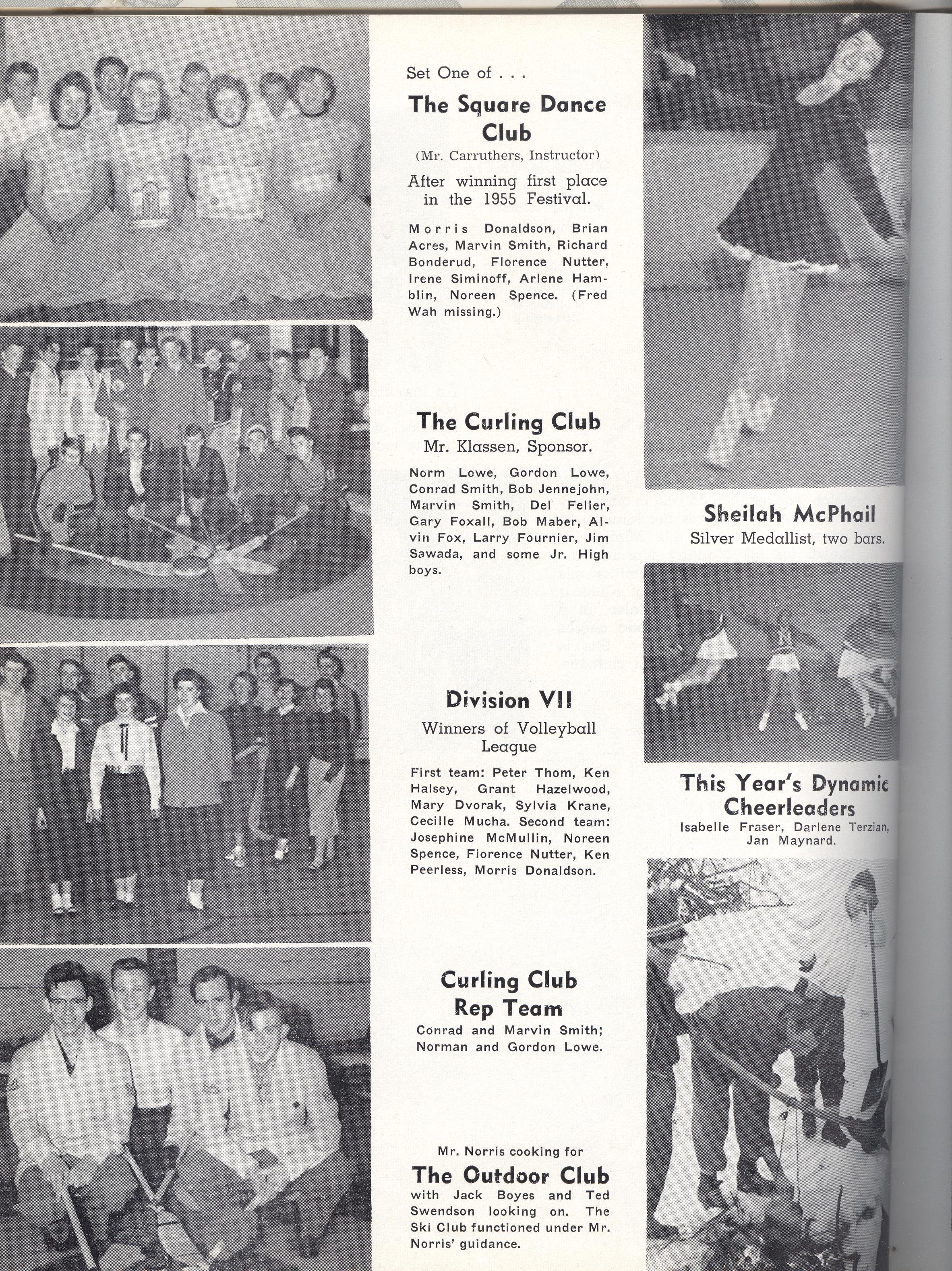
Special edition Mountaineer yearbook commemorates move in 1956 in Nelson B.C. from Nelson High School to new L.V. Rogers High School

Leave a comment

fby Sam McBride

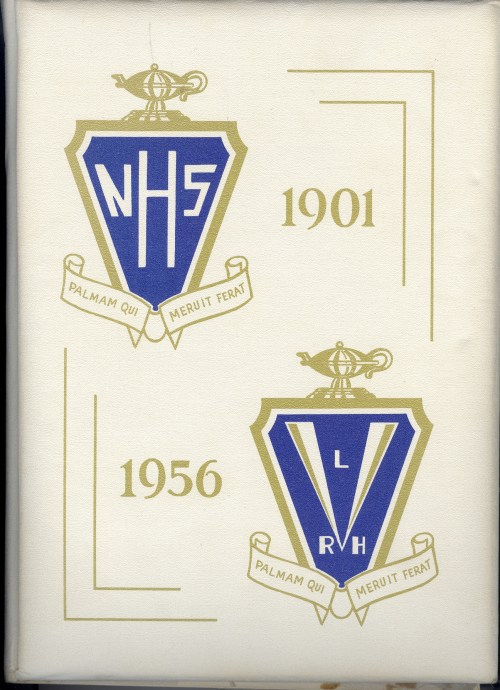
One of my favourite local history publications is the special edition of The Mountaineer — the annual high school yearbook in Nelson — in 1956.

It was before my time as a student at L.V. Rogers High School in the late 1960s, but there has always been a copy of the yearbook in our family home because my dad received a souvenir copy at the opening ceremony of the new high school in 1956 when he was a school trustee.  Our copy has a distinctive, sponge-like cover.  The Shawn Lamb Archives at Touchstones in Nelson has a copy of the yearbook with the special white cover, as well as more economical copies with blue paper cover.

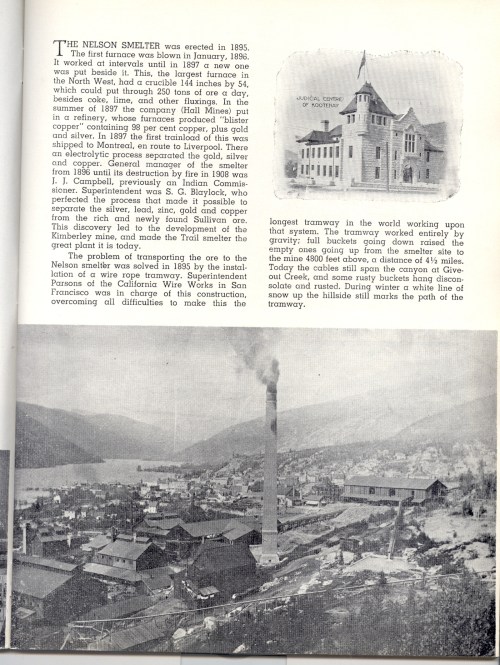
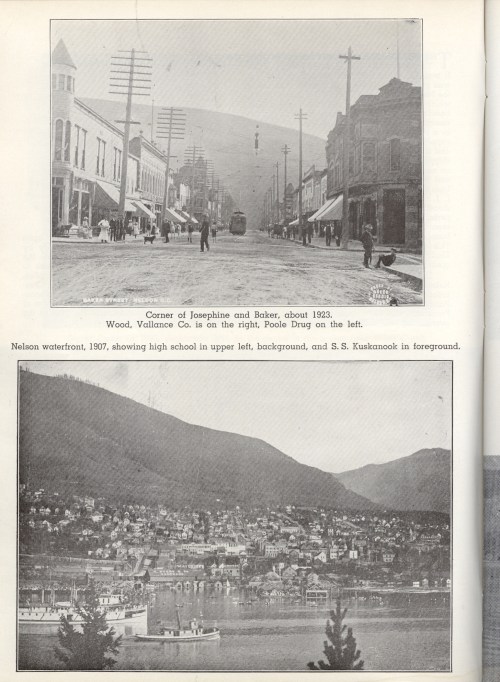
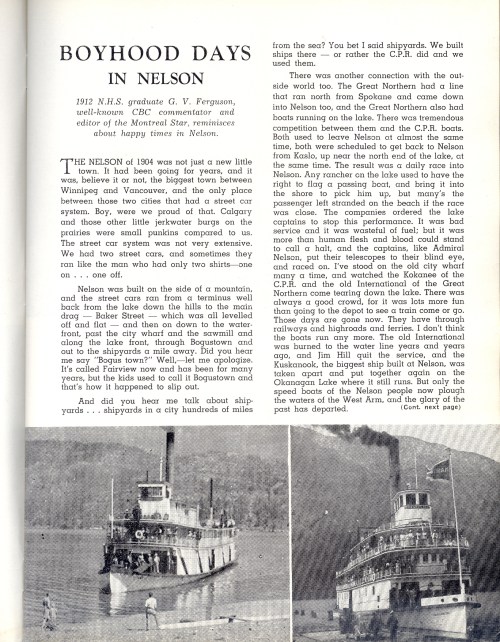
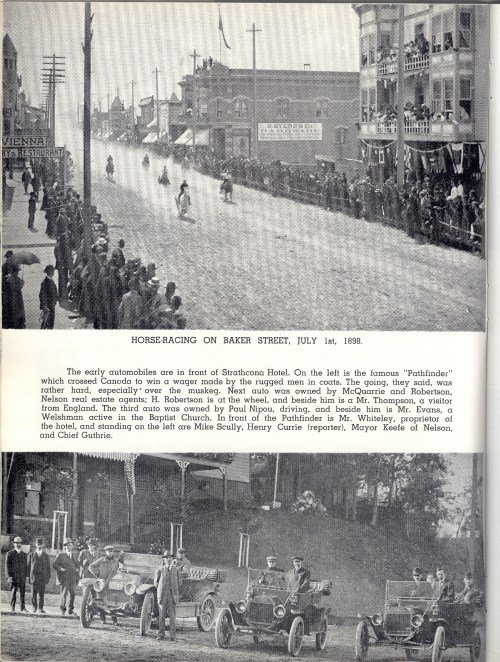
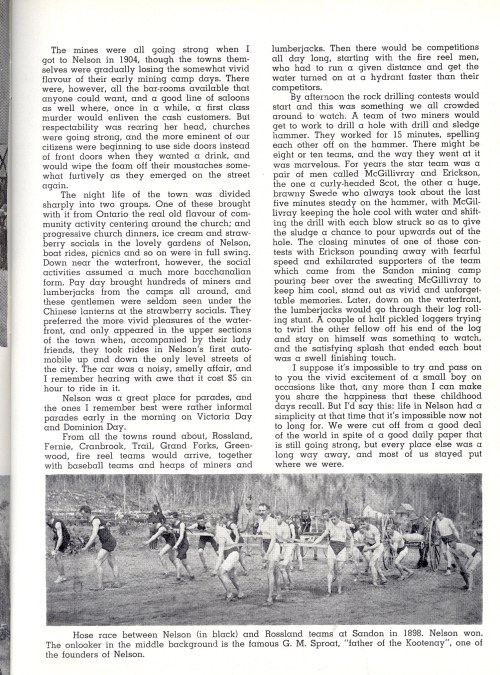
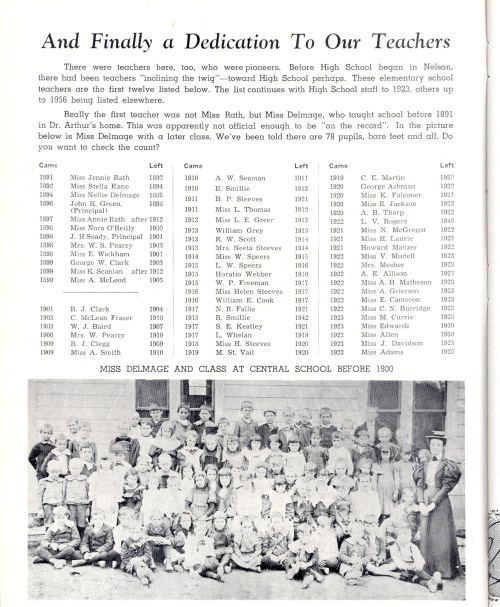
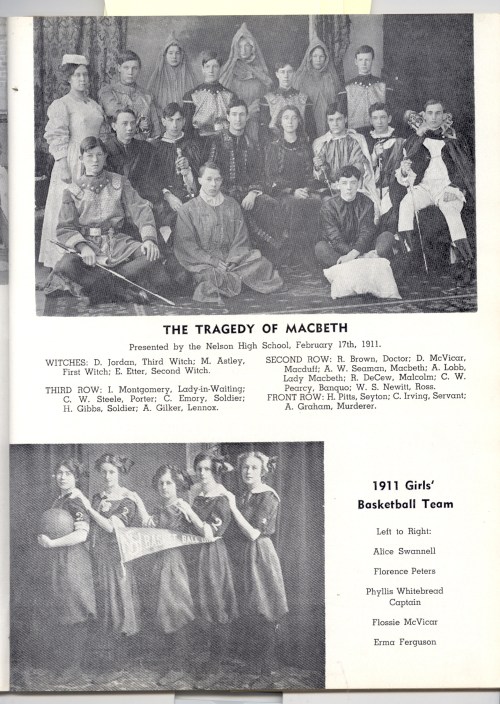
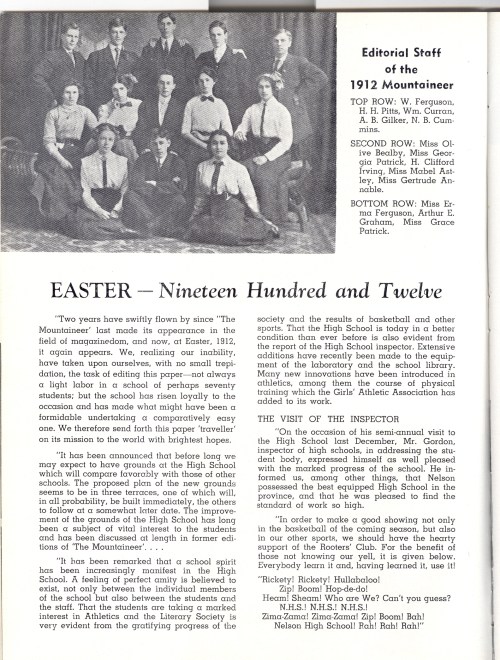
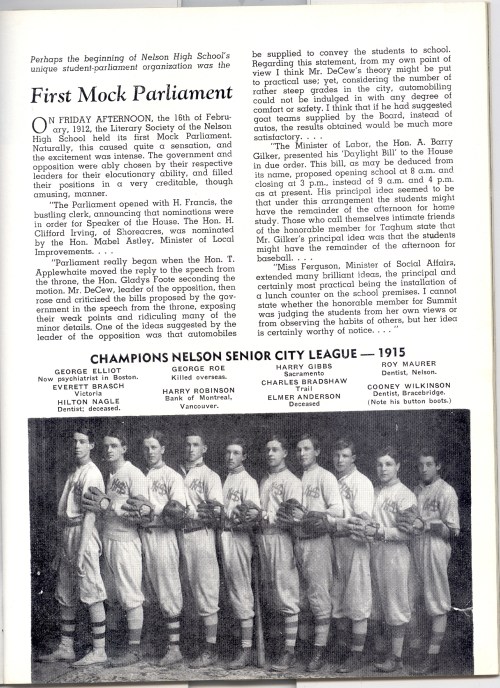
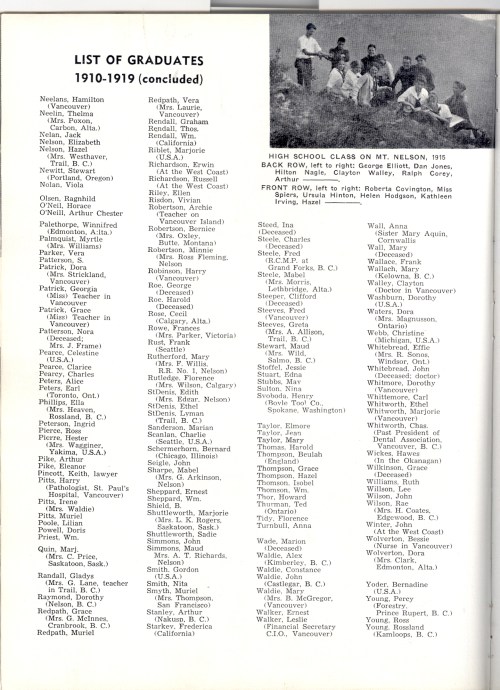
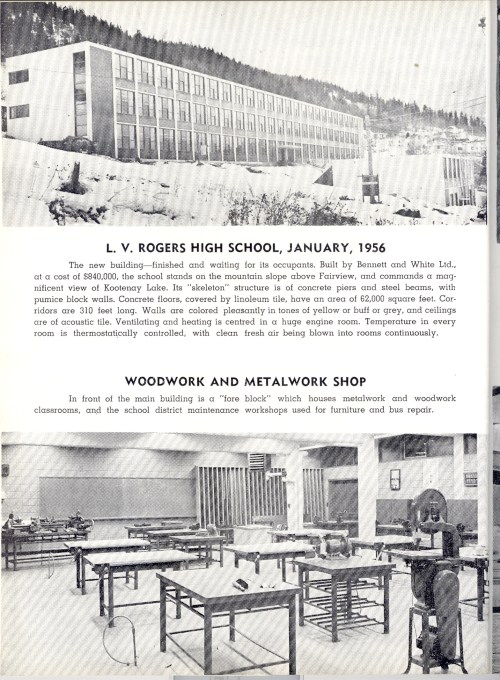
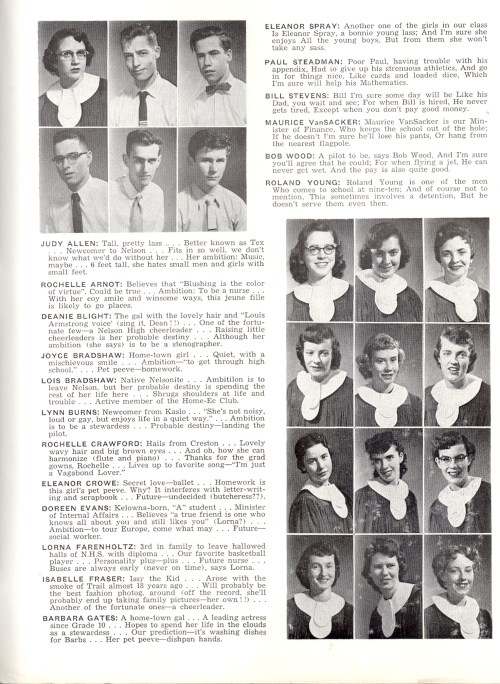
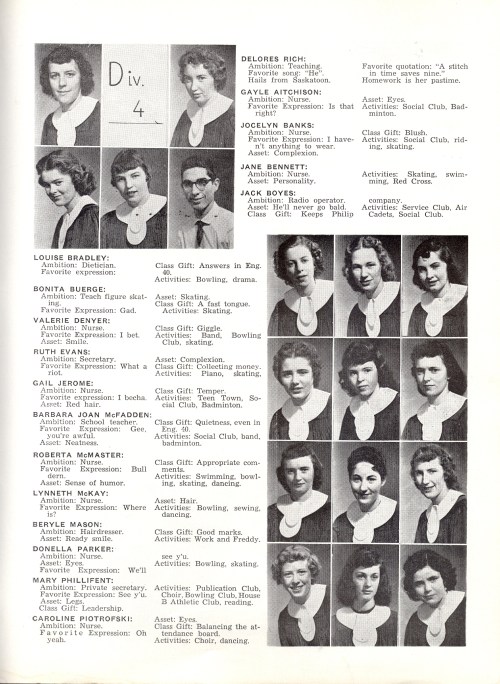
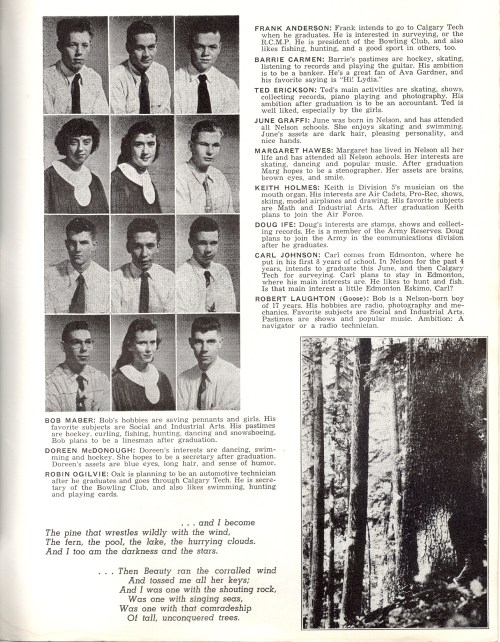
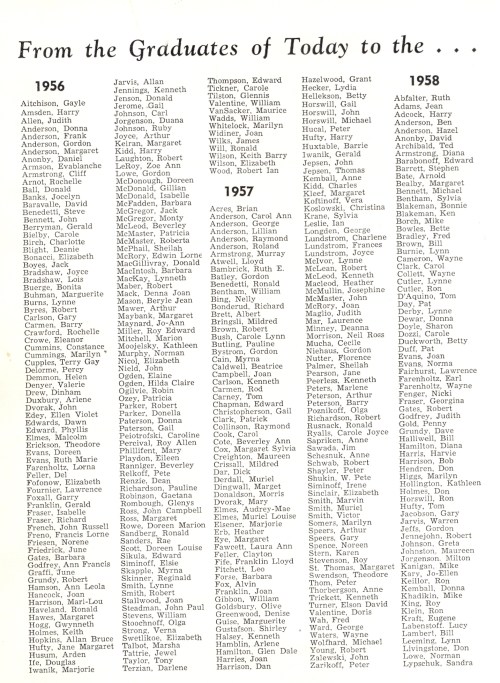
Students from the school`s Publications Club did an amazing job in producing a 104-page publication that paid homage to the pioneers and buildings of Nelson.  They diligently researched and produced lists of students, teachers, trustees and just about everyone else connected to high school education in the time from the first Nelson High School in 1901 until March 1956, when the school moved from the old Nelson High School at Hendryx and Latimer streets to a brand new site in Upper Fairview, where the school continues to serve the students of today.

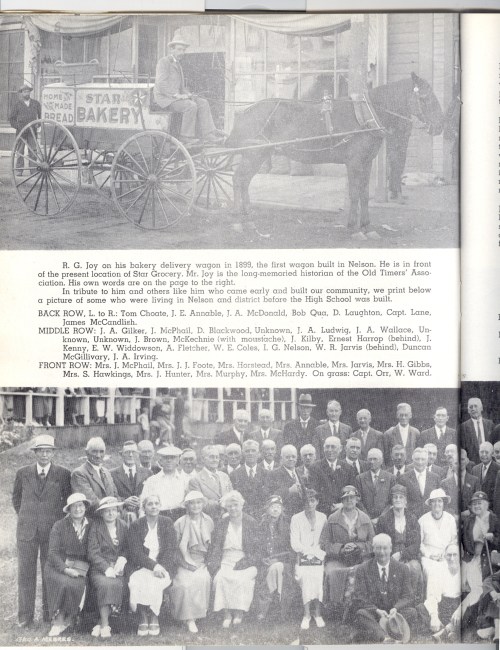
Production of the annual yearbook had been sporadic over the years.  This one was the first Mountaineer since 1948 — and they made up for lost time with an excellent product.   Below is a table of contents of the 1956 Mountaineer and scans of the pages.  My favourite part of the publications is the lists, because they include many of my relatives, including my father Leigh McBride, mother Rose Pamela “Dee Dee“ Dewdney, her brother Peter Dewdney, my dad`s brother Kenneth Gilbert McBride, their cousins Blake Allan, Jim Allan and Alex Allan, my great-aunts Isobel Foote Murphy, Lilian Foote Allan and Gladys Foote Moir, as well as a photo of their mother Edith Foote among a large group of the Pioneers Club that consisted of Nelsonites who were living in Nelson before 1900.  Admittedly, the lists are not complete, particularly as records in the early years were skimpy.  One of those missed is my paternal grandmother Winnifred Foote McBride, who grew up in Nelson and was 13 in 1901.

My article in the Nelson Star on the 1956 Mountaineer is at http://www.nelsonstar.com/news/370801101.html

Below are a Table of Contents for the publication, and then scans of the pages.

The 1956 Mountaineer

Contents

Before Man Saw It…4

To the Pioneers, to our Parents, who created the environment for our growing………6

Boyhood Days in Nelson, by 1912 NHS graduate G.V. Ferguson..13

Nelson Pioneers who lived in the city before 1900…16-17

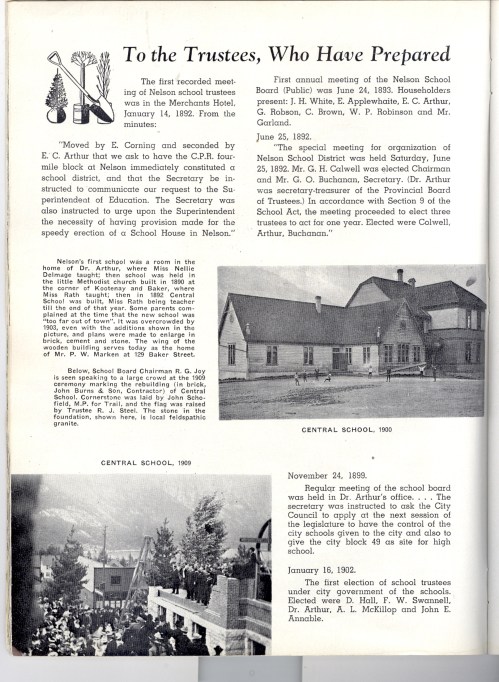
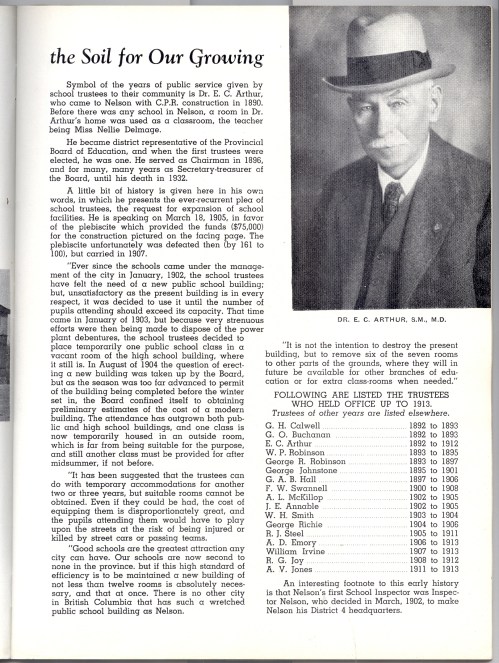
To the Trustees, Who Have Prepared the Soil for Our Growing…..18

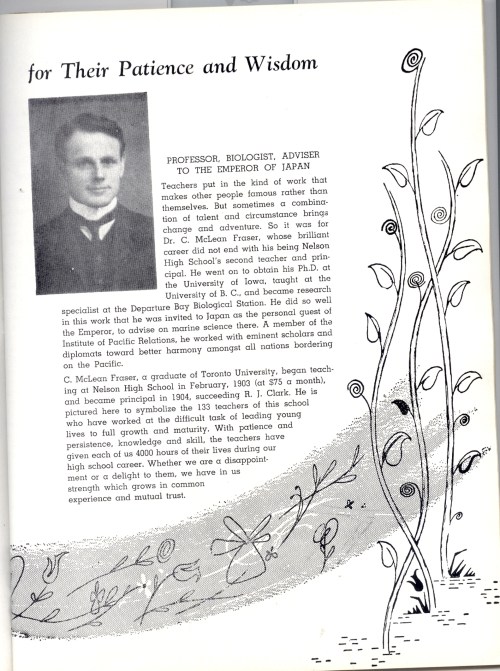
And Finally a Dedication to Our Teachers for Their Patience and Wisdom ……………..20

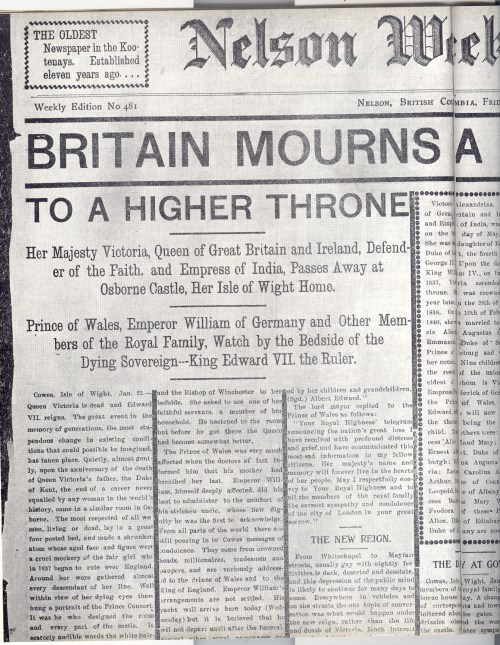
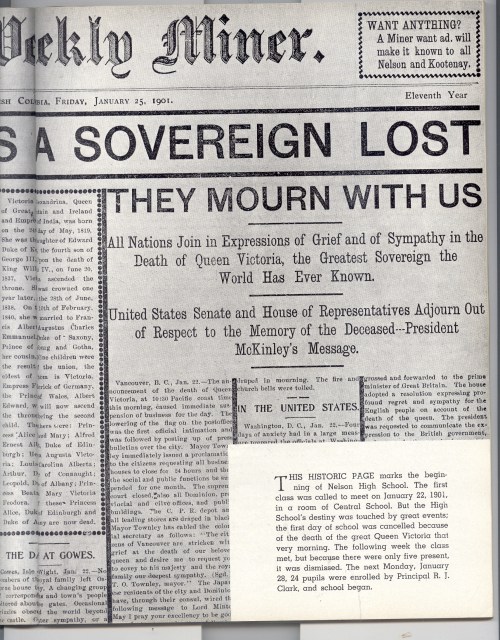
Daily Miner headlines on first day of class of Nelson High School…………………………22

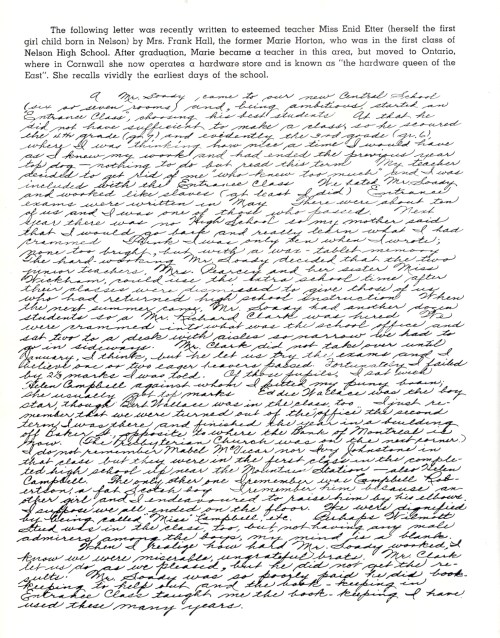
Letter to Teacher Enid Etter from student in first NHS class……..24

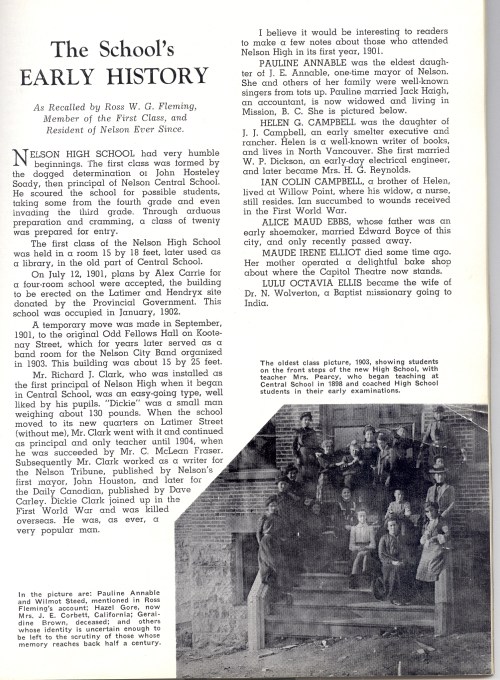
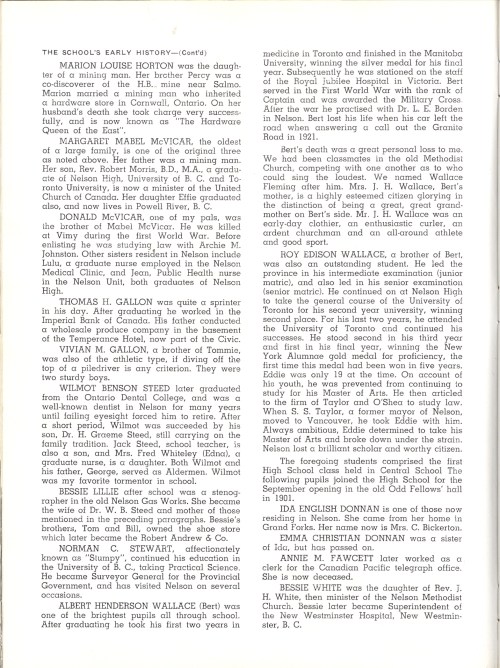
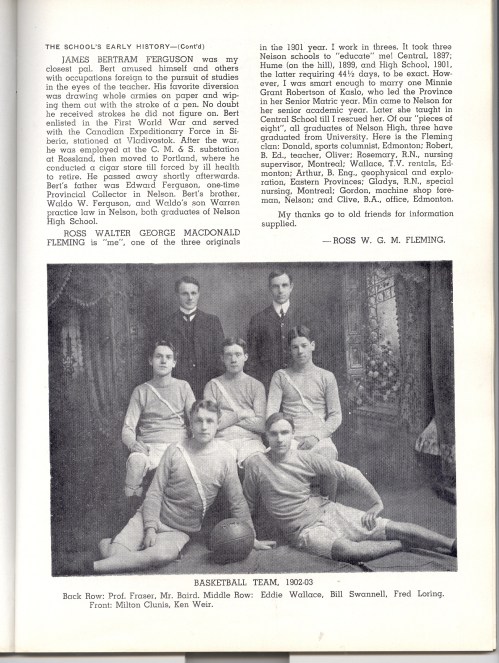
The School`s Early History, by Ross W.G. Fleming of first class……….25

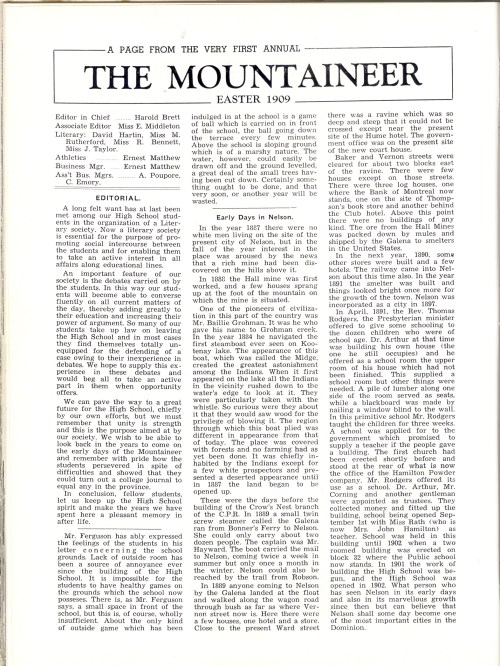
A page from the first annual Mountaineer in 1909……..28

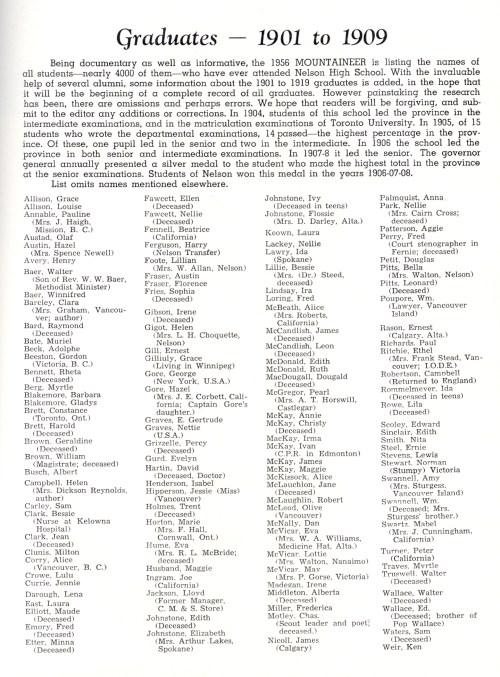
Graduates – 1901 to 1909…..29

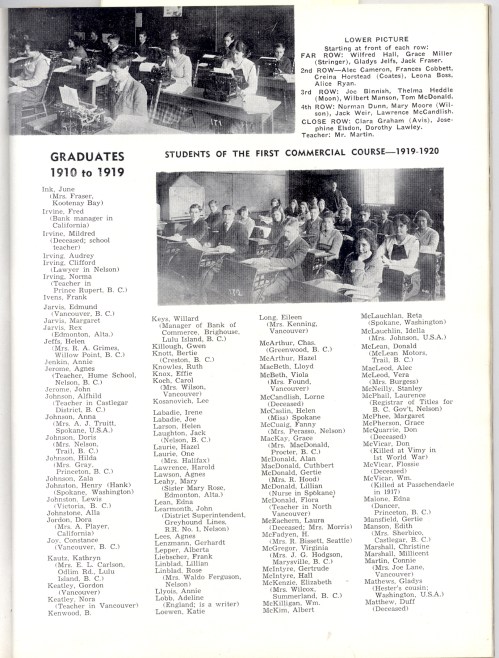
Graduates – 1910-1919……..30

Some Recollections, by James B. Curran………38

From the Mountaineer of 1920……39

Honour Roll – World War One…………40

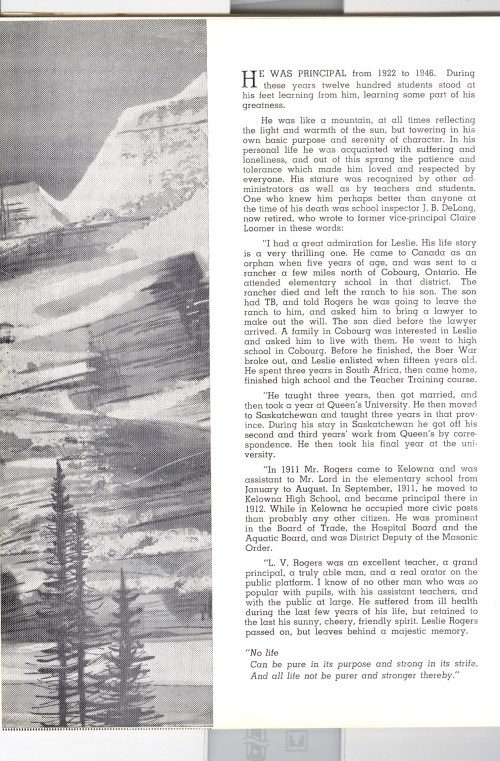
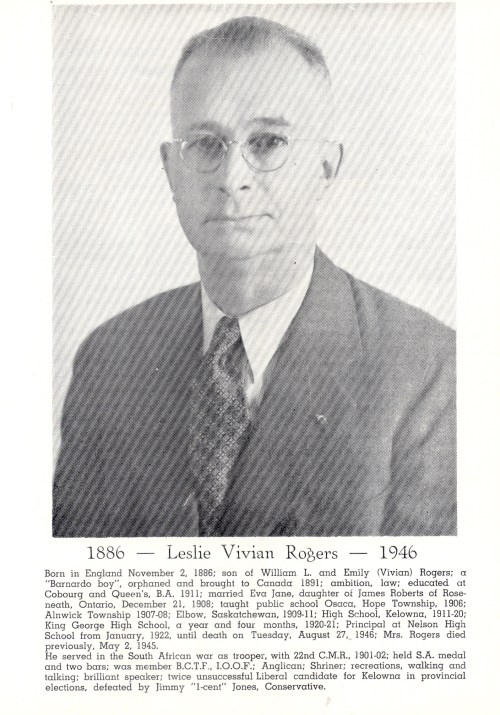
Leslie Vivian Rogers 1886-1946…………42

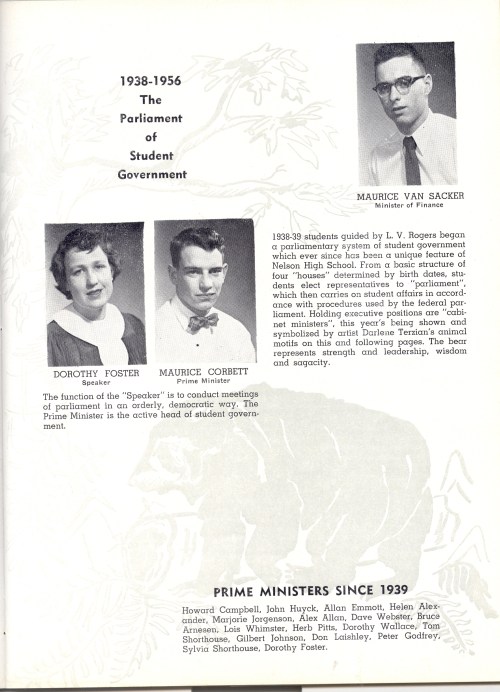
Parliament and Prime Ministers…….44

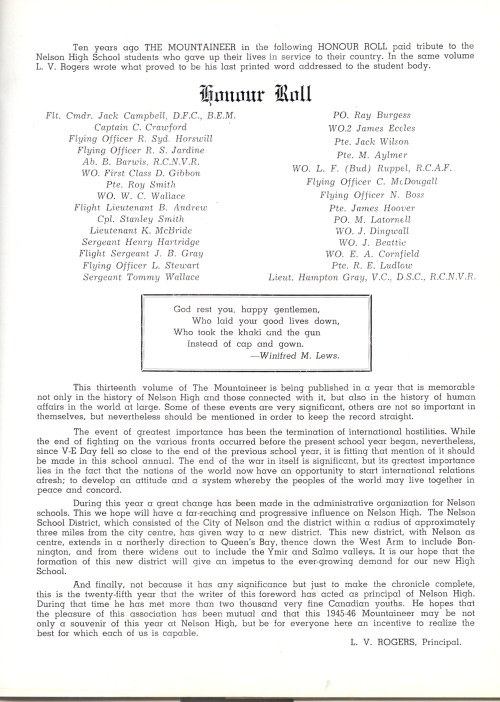
Honour Roll – World War Two………….47

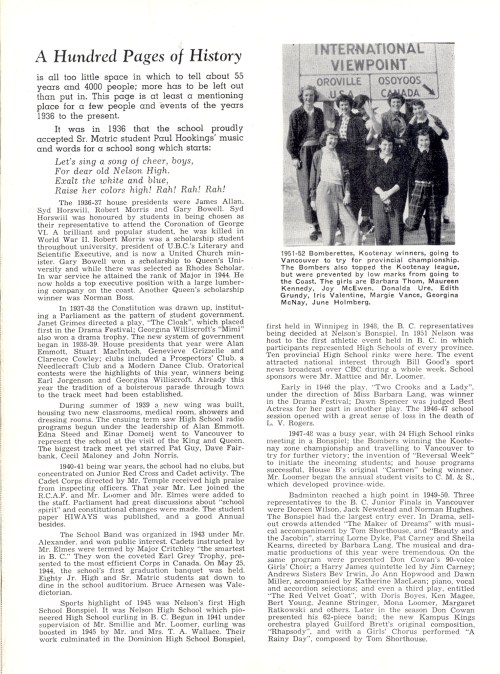
A Hundred Pages of History……48

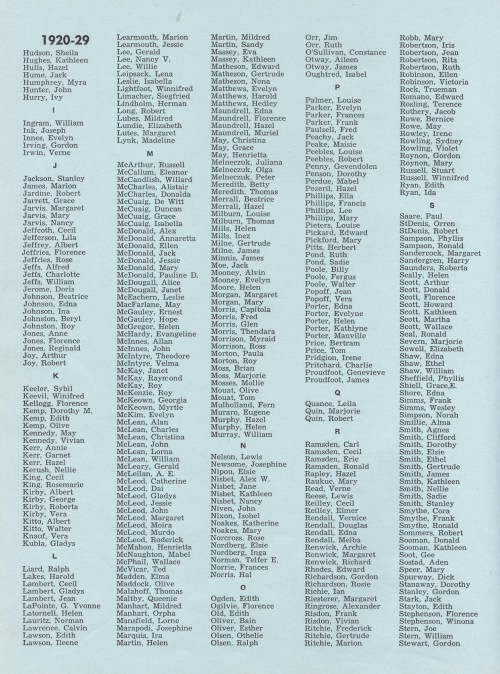
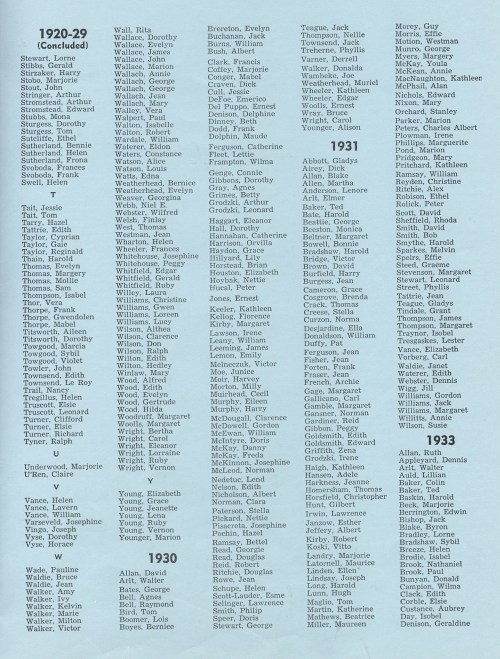
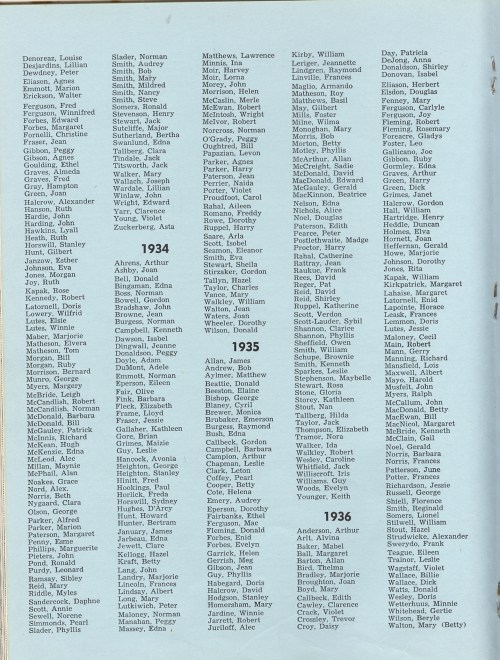
Nelson High School students 1920-1952………..49

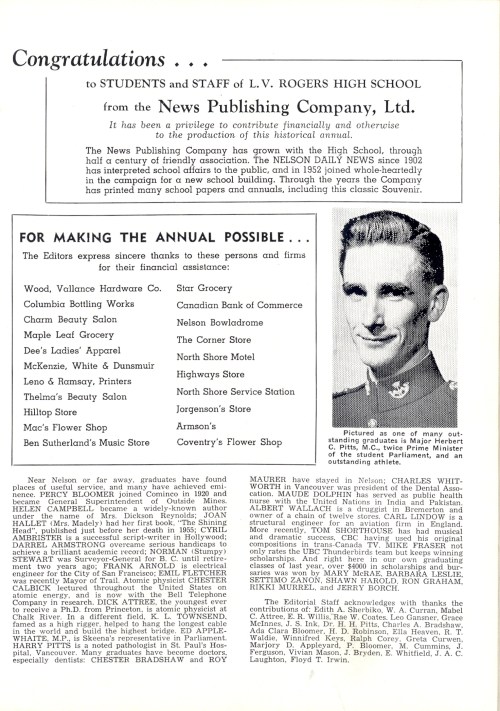
Congratulations, and alumni news…………………….57

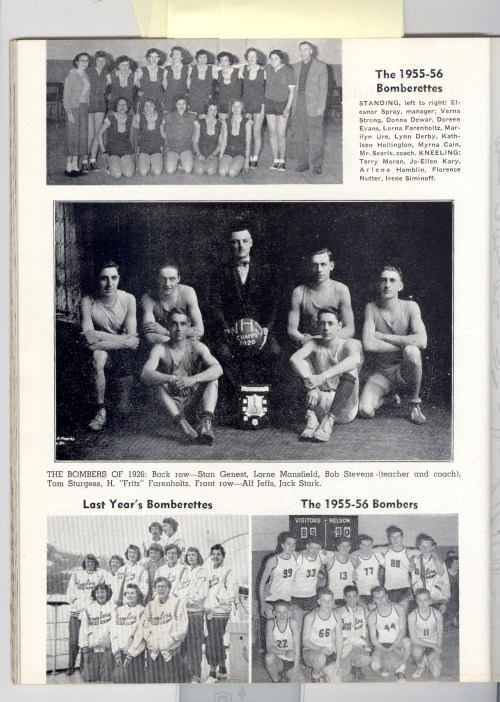
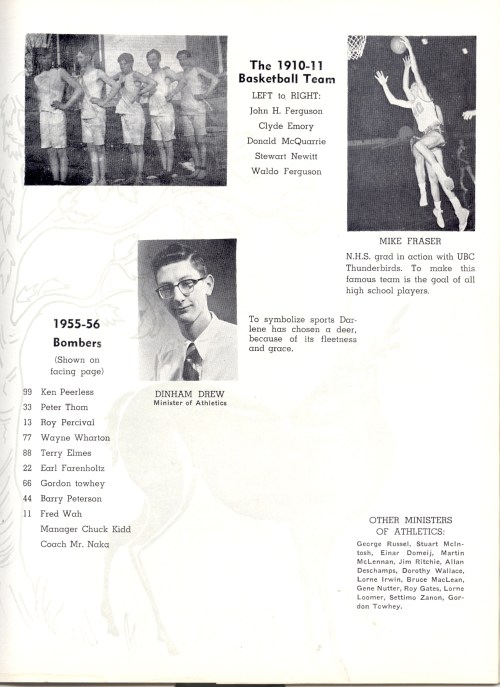
Ministry of Athletics……………………….58

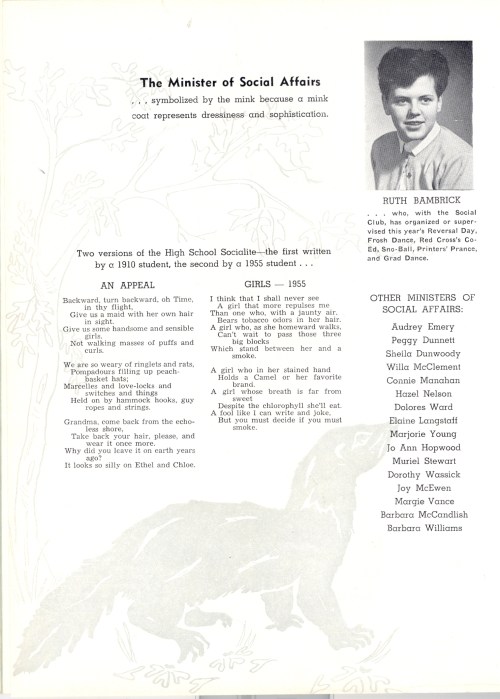
Ministry of Social Affairs…………………………………60

School clubs……………………….62
Publications Club…………………………………64

Radio Club………………………………………65

Members of Nelson District School Board Since 1914……66

NHS and Junior-Senior High PTA Presidents……….67
First Junior High in B.C (Trafalgar)………………………..67

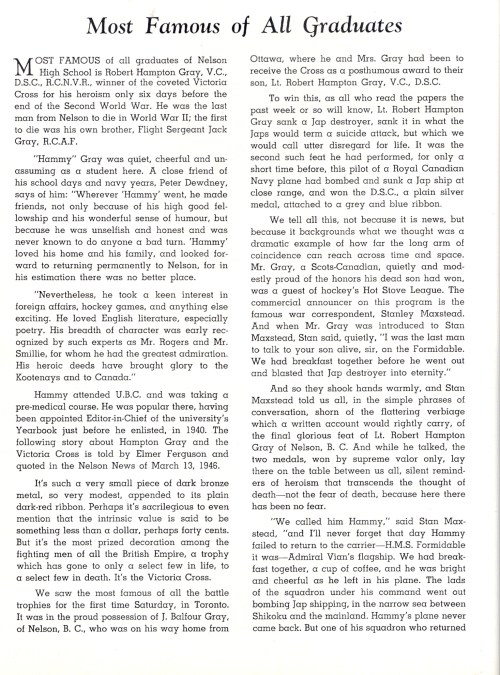
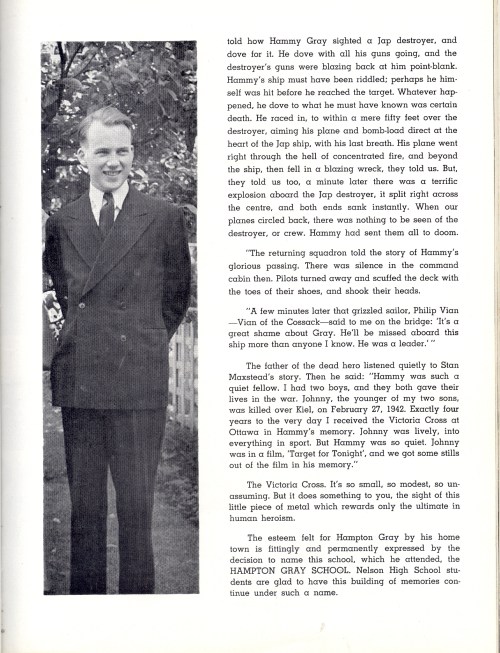
Most Famous of All Graduates (Hammy Gray)……….68

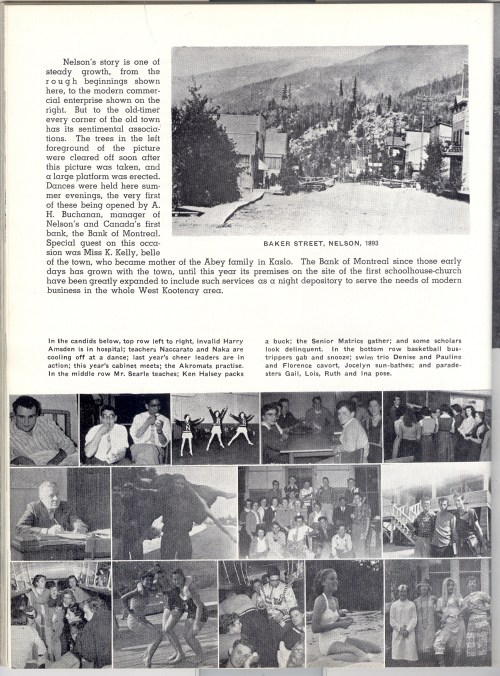
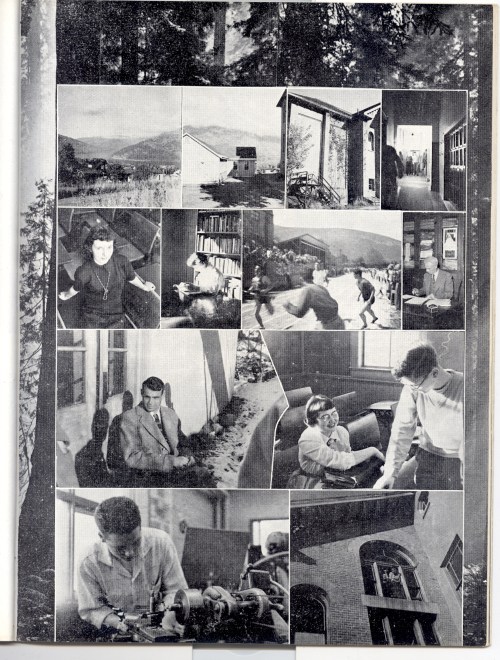
Nelson and NHS scenes………………..70

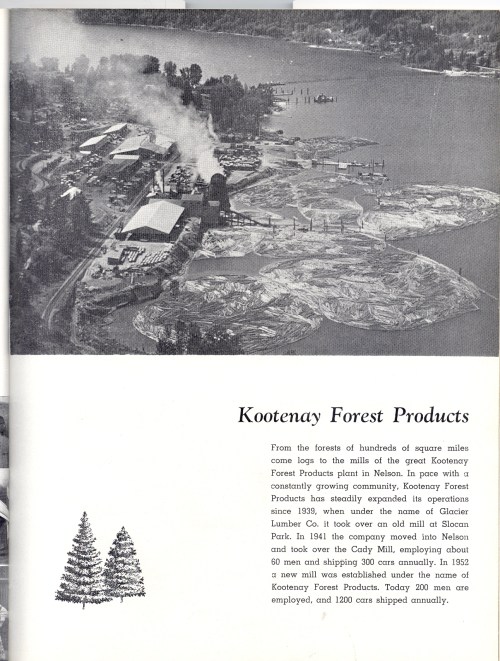
Kootenay Forest Products ad………………..71

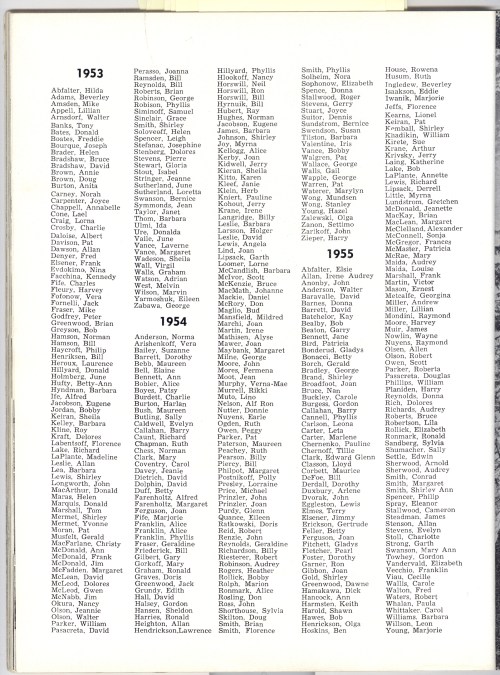
NHS Grads 1953-1955……………72

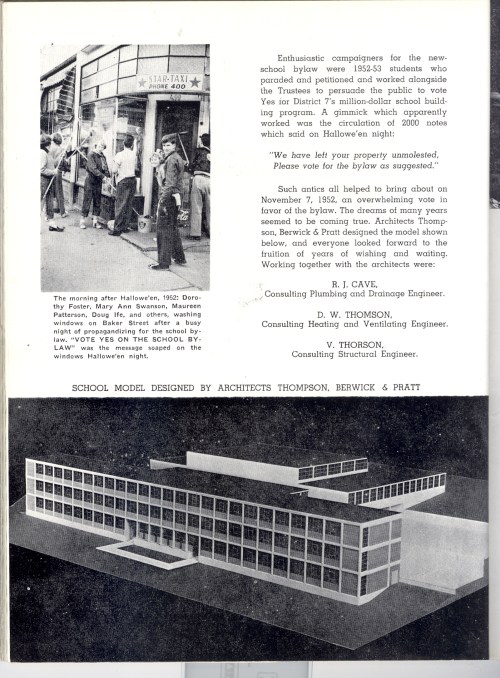
Vote Yes on the School Bylaw of November 1952…….74

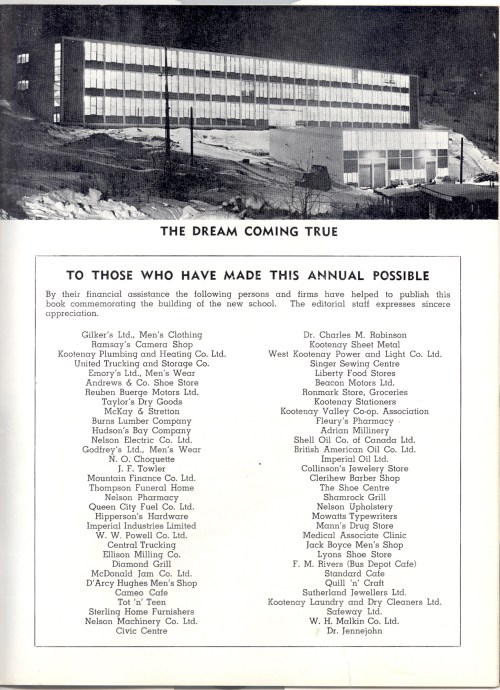
To Those Who Made This Annual Possible…………75

L.V. Rogers High School – January 195………………76

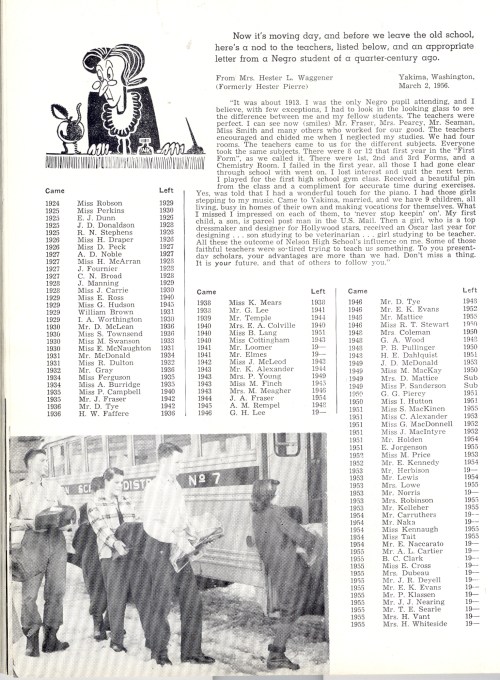
List of NHS teachers since 1923…………….78

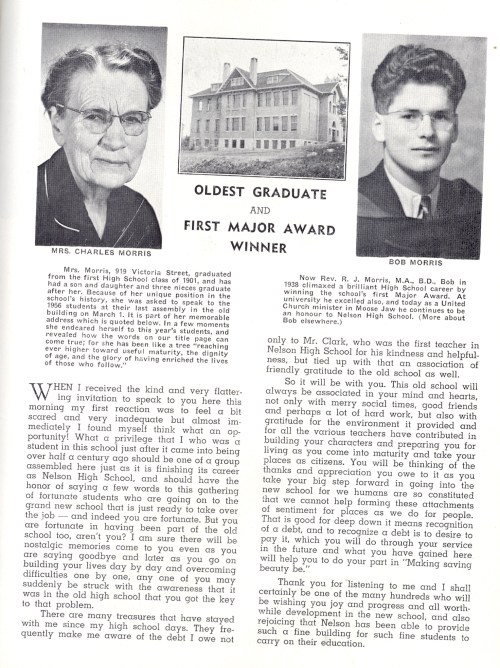
Oldest Graduate and First Major Award Winner……………79

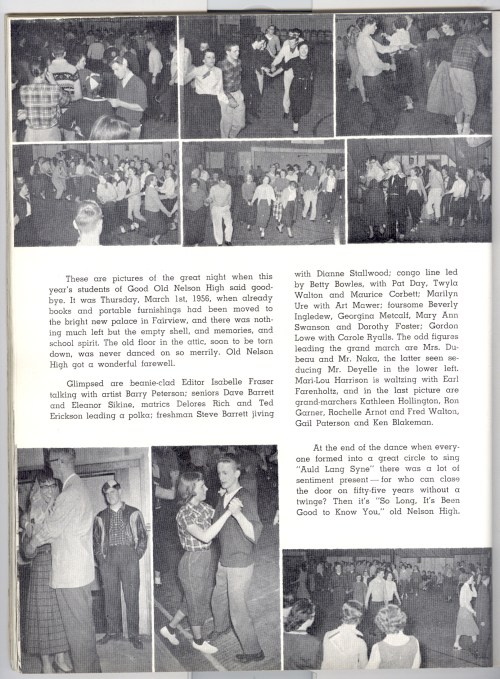
Saying Goodbye to NHS in March 1956……………………………..80

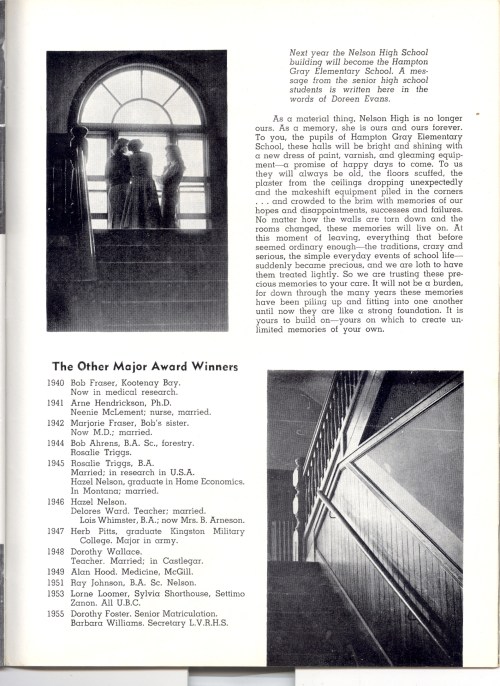
NHS to become Hampton Gray Elementary School………….81

Other Major Award Winners 1940-1955………81

Official Opening of L.V. Rogers High School March 10, 1956 program….82

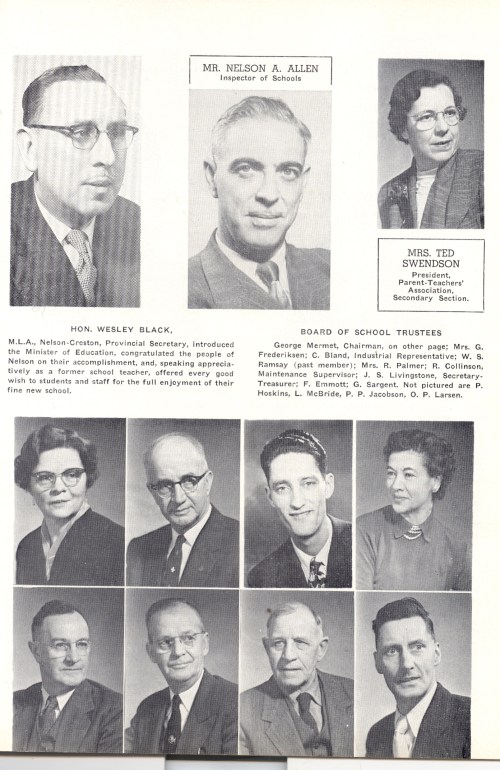
MLA, Inspector of Schools, PTA President……………83

Board of School Trustees………83

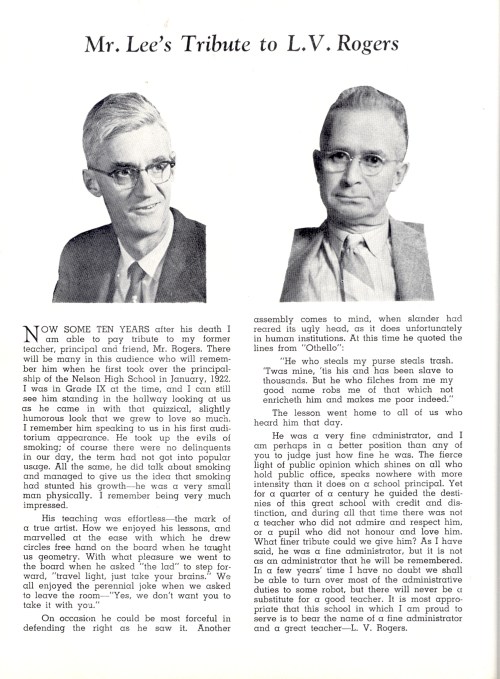
Mr. Lee`s Tribute to L.V. Rogers…………..84

Speech of Minister of Education Ray Williston…….85

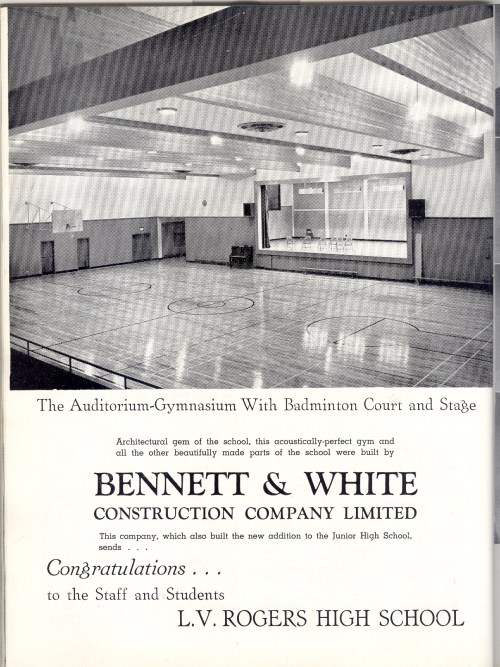
Bennett and White Construction Company……..86

NHS/LVR Staff 1955-1956…………….87

Grade Ten……………………..88

Grade Eleven………..90

The Mountaineer……………….92

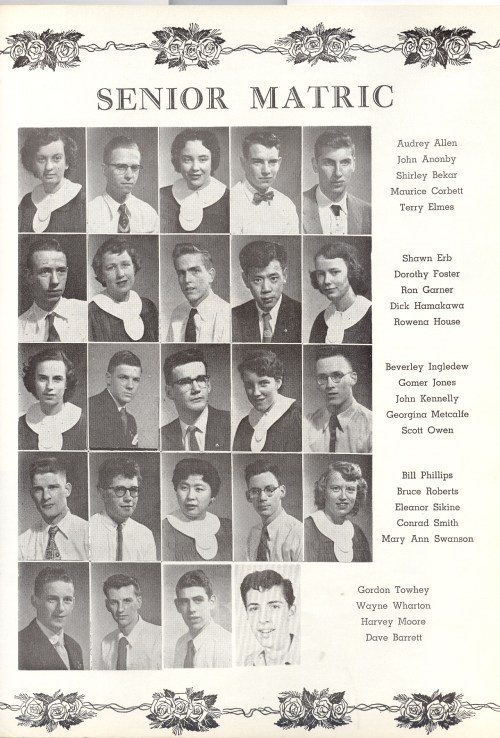
Senior Matric…………………..93

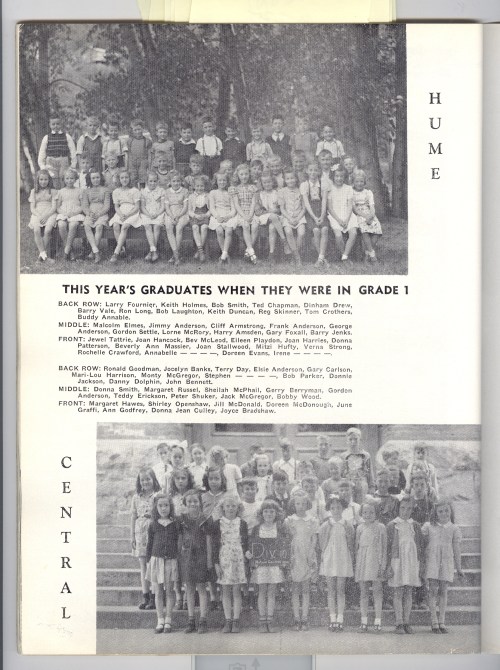
This Year`s Graduates When They Were in Grade 1………94

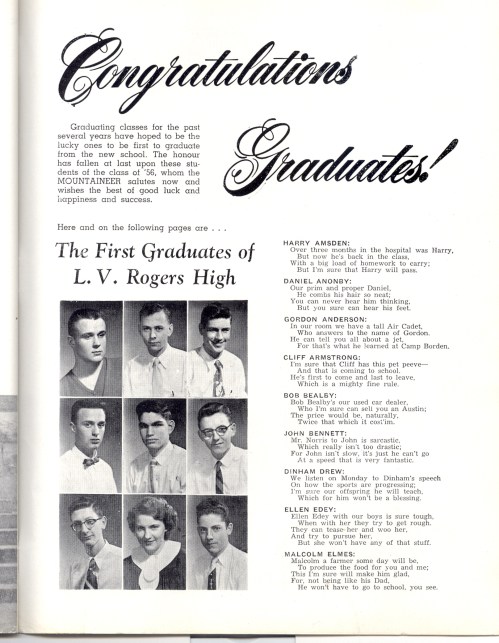
The First Graduates of L.V. Rogers High………………95

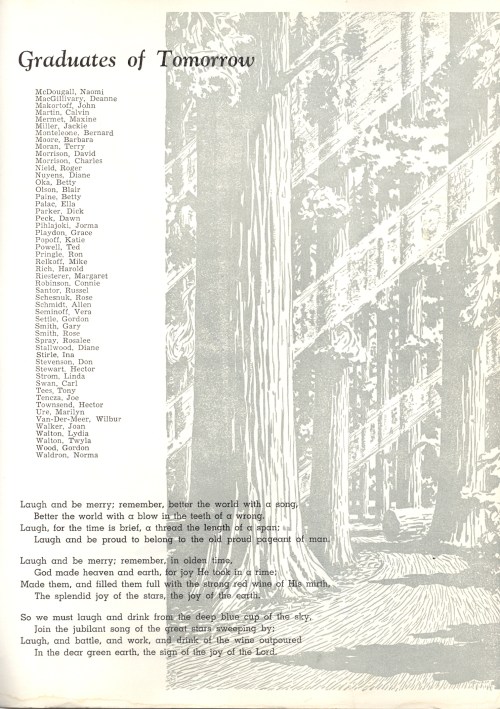
From the Graduates of Today to the Graduates of Tomorrow (List of Grads 1956-1958)…….102

Thanks from Editorial Staff………..104

cover of 1956 Mountaineer yearbook deluxe cover of souvenir Mountaineer
insidecoverlvr56 inside cover
insidecover2lvr56 opposite page of inside cover
1 lvr56 1


2 lvr56 2
3 lvr56 3
4 lvr56 4
5 lvr56 5
6 lvr56 6
7 lvr56 7
8 lvr56 8


9 lvr56 9


10 lvr5611 lvr5612 lvr5613 lvr5614 lvr5615 lvr56

16 lvr56 16
17 lvr56 17

18 lvr5619 lvr56920 lvr5621 lvr5622 lvr5623 lvr5624 lvr5625 lvr5626 lvr56

27 lvr56 27

28 lvr5629 lvr5630 lvr5631 lvr5632 lvr5633 lvr5634 lvr5635 lvr5636 lvr5637 lvr56

38 lvr56 38

39 lvr5640 lvr5641 lvr5642 lvr5643 lvr5644 lvr5645 lvr5646 lvr5647 lvr5648 lvr5649 lvr5650 lvr5651 lvr5652 lvr5653 lvr5654 lvr5655 lvr5656 lvr5657 lvr5658 lvr5659 lvr5660 lvr5661 lvr5662 lvr5663 lvr56

64 lvr56 64

65 lvr5666 lvr5667 lvr5668 lvr5669 lvr5670 lvr5671 lvr5672 lvr5673 lvr5674 lvr5675 lvr5676 lvr5677 lvr5678 lvr5679 lvr5680 lvr5681 lvr5682 lvr5683 lvr5684 lvr5685 lvr5686 lvr5687 lvr5688 lvr5689 lvr5690 lvr5691 lvr5692 lvr5693 lvr5694 lvr5695 lvr5696 lvr5697 lvr56

98 lvr56 98
99 lvr56 99

100 lvr56101 lvr56102 lvr56103 lvr56103lvr56

backcoverlvr56 back cover

From Inkerman House toddler to Victoria Cross mother: Bertha Gray Peters

Leave a comment

“I wish you could have known Dally,“ my mother, Dee Dee, said to me hundreds of times over the years.
peters pics imported aug 27 2012 011

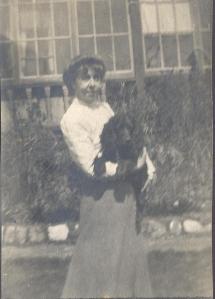
Bertha with pet dog in Victoria, British Columbia, circa 1905.  Family ciollecgtion.

Also: “Dally was so smart!“, “Dally was interested in everything“, and “Dally would have known the answer to that question“.
sep 13 2013 charlottetown 027

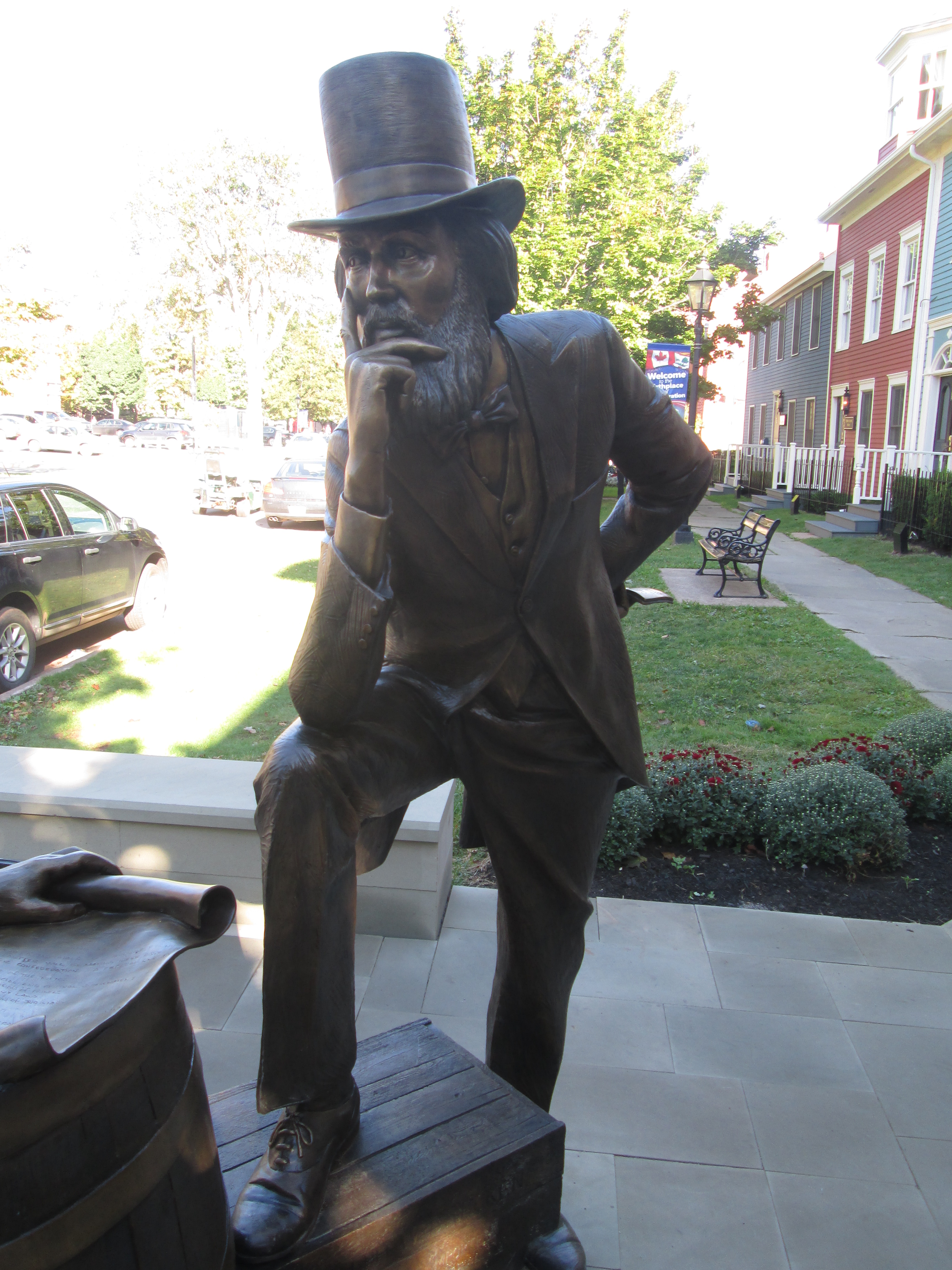
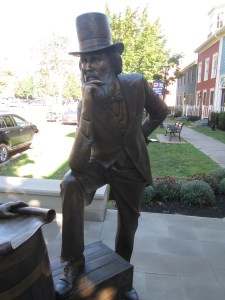
Bertha`s father, Col. John Hamilton Gray, who was host and chairman of the historic Charlottetown Conference of 1864, is featured in this sculpture in downtown Charlottetown, Prince Edward Island.  Sam McBride photo.

Dally was the nickname used by Dee Dee and her siblings for their maternal grandmother, Roberta Hamilton Susan Gray Peters, who lived with her daughter Helen Dewdney`s family in southeastern British Columbia from 1916 until her death three decades later at age 84.  Her sisters in the Gray family called her Bertie, and she was known in the community as Bertha, which is how I choose to refer to her.  No one in the family recalled the origin of the nickname Dally.

As a boy, I found my mother`s lavish praise of her grandmother somewhat annoying.  My thinking was: she died five years before I was born – why talk so much about someone I am never going to meet?

In recent years, however, my research into the life of her son, Victoria Cross recipient Frederic Thornton “Fritz“ Peters, has given me insight into why Bertha was so memorable to Dee Dee, as well as other family members and friends.  I was impressed that one person`s life could span so much of Canada`s history, and that her spirit and sense of humour held up despite experiencing a stream of disappointment and tragedy during her years as a mother and widow.
inkerman house in colour

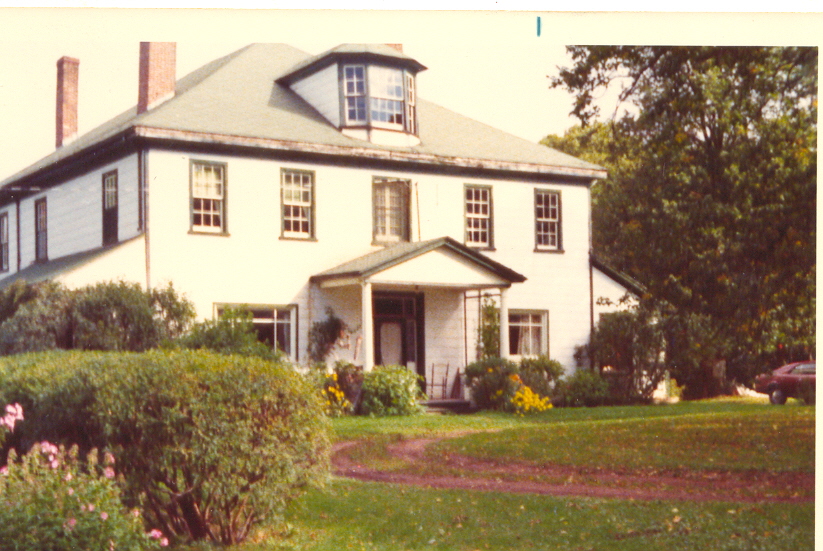
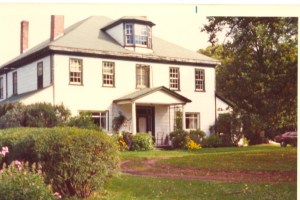
The Gray family residence known as Inkerman House, where two-year-old Bertha was introduced to the Fathers of Confederation who were invited to Inkerman by Col. Gray to an after-dinner party on Saturday, Sept. 3, 1864.  Family collection

At age two in September 1864, Bertha was brought forward and introduced to the Fathers of Confederation her father brought home to the Gray estate known as Inkerman House from the Charlottetown Conference for an after-dinner party.   Eighty years later, in February 1944, she received, as her late son Fritz`s next-of-kin, the U.S. Distinguished Service Cross medal from a delegation of American officers and brass band representing President Roosevelt and General Eisenhower.

Bertha was the youngest of five daughters of Col. John Hamilton Gray and Susan Ellen Bartley Pennefather.  Sister Mary Stukeley Hamilton Gray was three years older, and the other three sisters were much older.   The eldest sister, Harriet Worrell Gray, 19 years her senior, was out of the house before Bertha was born, as the parents sent her as a teen-ager to England to live with, and care for, her aging Pennefather grandparents.   Sisters Margaret Pennefather Stukeley Gray and Florence Hope Gibson Gray were, respectively, 16 and 14 years older than Bertha.
BC Coeurd'Arene 7-05 Scottsdale 11-05 00160

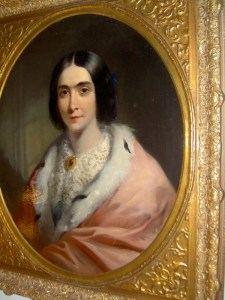
Painting of Bertha`s mother Susan Bartley Pennefather at age 17, shortly before her marriage to Col. Gray.  Family collection.

After Susan`s death in 1866, Margaret assumed the “mother“ role for her younger sisters.  Florence took over in 1869 after Margaret left home to marry shipbuilder Artemus Lord.  A couple of weeks after Margaret`s wedding, the widower Col. Gray married Sarah Caroline Cambridge, and they would have three children, of whom only Arthur Cavendish Hamilton Gray survived to adulthood.

In addition to tutoring their little sisters, Margaret and Florence did their best to shield them from angry outbursts of their stern father, whose career as a British Dragoon Guards cavalry officer left him obsessed with discipline and punctuality.

In a family of ardent readers, Bertha stood out as the most voracious reader of them all.  In addition to the large family collection of novels, poetry and history, Bertha`s thirst for knowledge led her to read through dictionaries and encyclopedias.   In later years, her wide-ranging knowledge helped Bertha win cash prizes as a solver of difficult crossword puzzles in contests sponsored by newspapers.

Bounding with energy, young Bertha was always up for outings, and encouraged her sisters to organize social events that included her.  Regarding her father with a mix of fear and admiration, she enjoyed participating in discussion of current events and politics at the dinner table.  As descendants of United Empire Loyalists, the Grays were wary of the United States of America, which was slowly recovering from its Civil War in Bertha’s girlhood.   The Grays saw no conflict in being strongly pro-British Empire and at the same time proud Canadians.  Throughout her life, Bertha introduced herself to new acquaintances as a “Daughter of Confederation”,  since her father was a Father of Confederation.
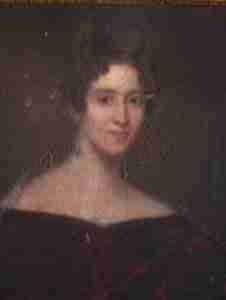
Painting of Margaret Carr Bartley c. 1830, around the time of her marriage to Major Sir John Lysaght Pennefather

Painting of Margaret Carr Bartley c. 1830, around the time of her marriage to Major Sir John Lysaght Pennefather.  Family collection.

A common topic of sister talk among the Grays was the mystery of their grandfather Bartley`s family.  Their mother Susan was born in Jamaica in about 1825, the only child of Margaret Carr and Lieut. William Bartley of the 22nd regiment of the British Army.  As was common for soldiers stationed abroad in that era, Bartley became ill and died in Jamaica.   His commanding officer, Major Sir John Lysaght Pennefather of Anglo-Irish aristocracy, took charge of looking after the widow and baby.  He later married Margaret, who gained the title of Lady Pennefather.  Her new husband insisted on being recognized as Susan`s father.  Communication with the Bartley relations ceased, and Susan did not learn of her real father until told just before her marriage to John Hamilton Gray.

Bertha and her sisters speculated about titles and inheritances they could have missed out on because of the loss of contact with the Bartleys.  This led Florence to take on the role of family historian.  Bertha`s handwritten copies of Florence`s inquiry letters and replies exist today in the Peters Family Papers.

Florence left home in 1876 to marry mining executive Henry Skeffington Poole, settling first in Stellarton, Nova Scotia and after 1900 in Guildford, England.

By 1880 both Pennefather grandparents had died.  Released from caregiver duties,  Harriet married Rev. Henry Pelham Stokes in London later that year.
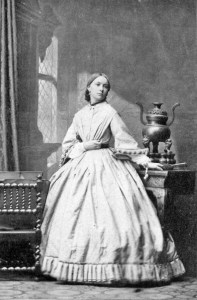
Bertha’s eldest sister, Harriet Worrell Gray (1843-1882), was 19 years older than Bertha. Harriet looked after her Pennefather grandparents in England, and married Henry Pelham Stokes in her late 30s after the grandparents had both died. Family photo.
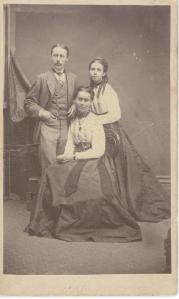
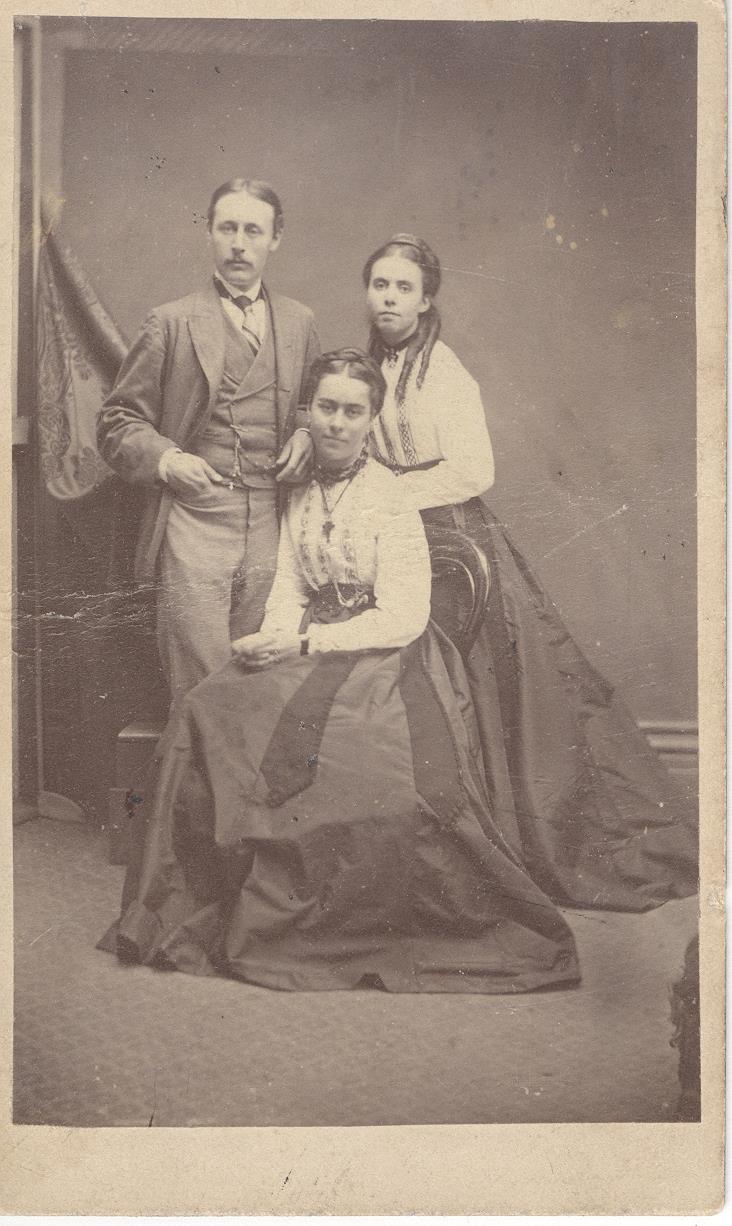
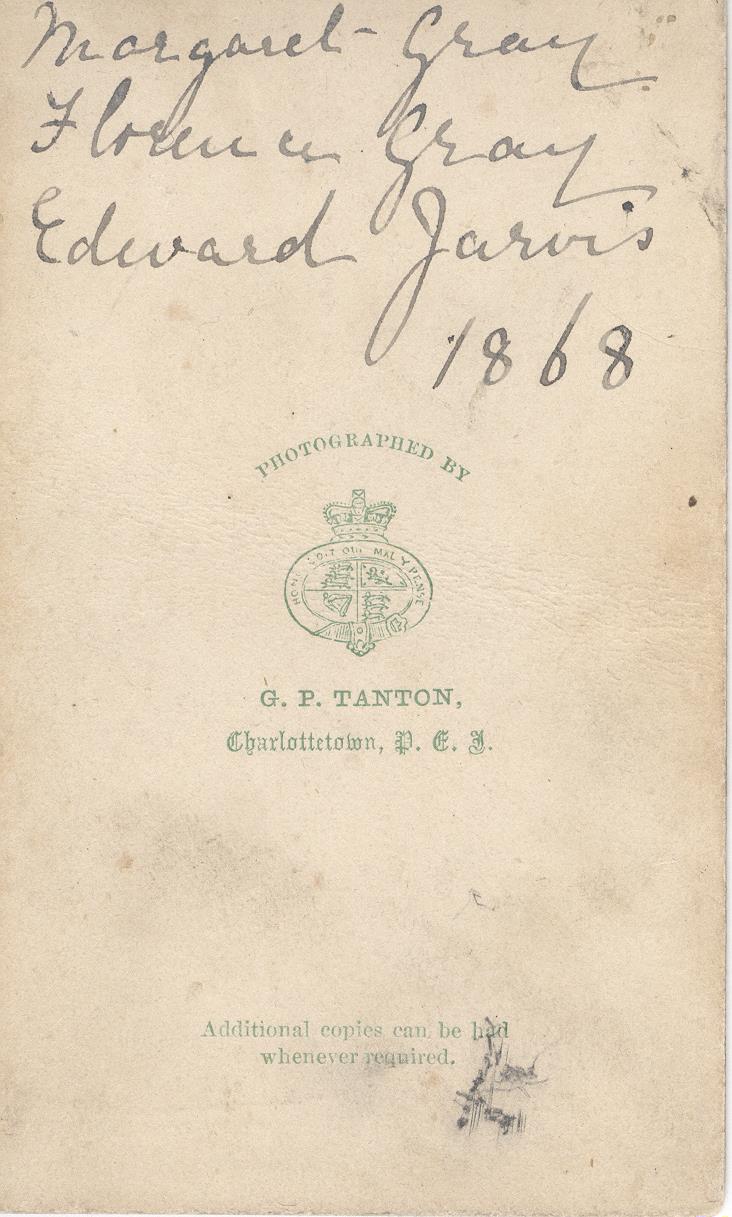
1868 dated photo: Sitting: Bertha’s sister Margaret Pennefather Stukeley Gray (1845-1941), who married Artemus Lord and continued to live in Charlottetown. Behind her is another sister, Florence Hope Gibson Gray (1848-1923) who married Henry Skeffington Poole and moved to Stellarton, Nova Scotia with him, and later in retirement to Guildford, England. The man is their cousin Edward Worrell Jarvis (1846-1894), son of Edward James Jarvis and Elizabeth Gray. Jarvis went on to an extraordinary career as an engineer, railway designer, militia soldier, lumber executive and mounted policeman.

The Gray family was comfortable financially but not wealthy.  Years later, she told her daughter Helen that as a young girl she envied Frederick Peters and his brothers at Sidmount House because each boy was treated to his favorite dessert on festive occasions, while she was never presented with a choice.
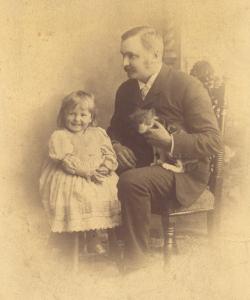
helen cat and father fred

Bertha`s husband Frederick Peters with daughter Mary Helen Peters, their first child, born August 31, 1887 in Charlottetown.  Family collection.

All seats of St. Paul`s Church in Charlottetown were filled on October 19, 1886 for the marriage of Bertha Gray and Fred Peters.  The Examiner reported the union of “one of Charlottetown`s most popular and rising young barristers to one of Charlottetown`s finest daughters.“  Following the ceremony, the bride and groom left for a three-month honeymoon in England before settling in their Westwood home purchased from the Hon. Daniel Davies.   In future years, Bertha`s fondness for England continued, as she took every opportunity to travel there for extended stays, particularly in London, in her mind the Centre of the Universe.

The last Gray sister to wed was Mary, who in June 1888 married Montreal lawyer William Abbott, son of future prime minister Sir John Joseph Caldwell Abbott.  Actor Christopher Plummer is a grandson of William`s brother Arthur Abbott.

August 1887 saw the birth of Mary Helen Peters, first child of Fred and Bertha.  She would always be known by her middle name Helen.  The first son, Frederic Thornton Peters, born in 1889, gained the nickname “Fritz“ because of his great interest in toy soldiers and armies.  John Francklyn “Jack“ Peters was born in October 1892, and then the fraternal twins Gerald Hamilton “Jelly“ Peters and Noel Quintan Peters were born on November 8, 1894 – exactly 48 years before the action in Algeria where their brother Fritz would earn the Victoria Cross.  In 1899, after the family moved across the country to Oak Bay on Vancouver Island, another daughter, Violet Avis Peters, was born.

helen with noel and gterald on lawn in victoria with dog and cat

Children Helen, Gerald (holding cat) and Noel in Victoria, circa 1905

Fred Peters worked in a law partnership with his brother Arthur Peters and Ernest Ings.  He gained a seat in the provincial legislature in 1890, and within a year became leader of the Liberal Party, and then premier and attorney-general.   Despite political success, the family was experiencing financial woes, as the Cunard inheritance received by Fred’s mother Mary Cunard had run its course.   Fred desperately wanted to improve his finances, as he and Bertha expected to continue to live to a style to which they had become accustomed.
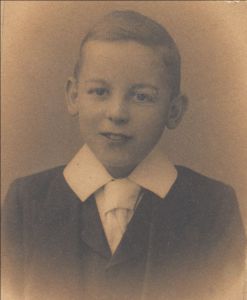
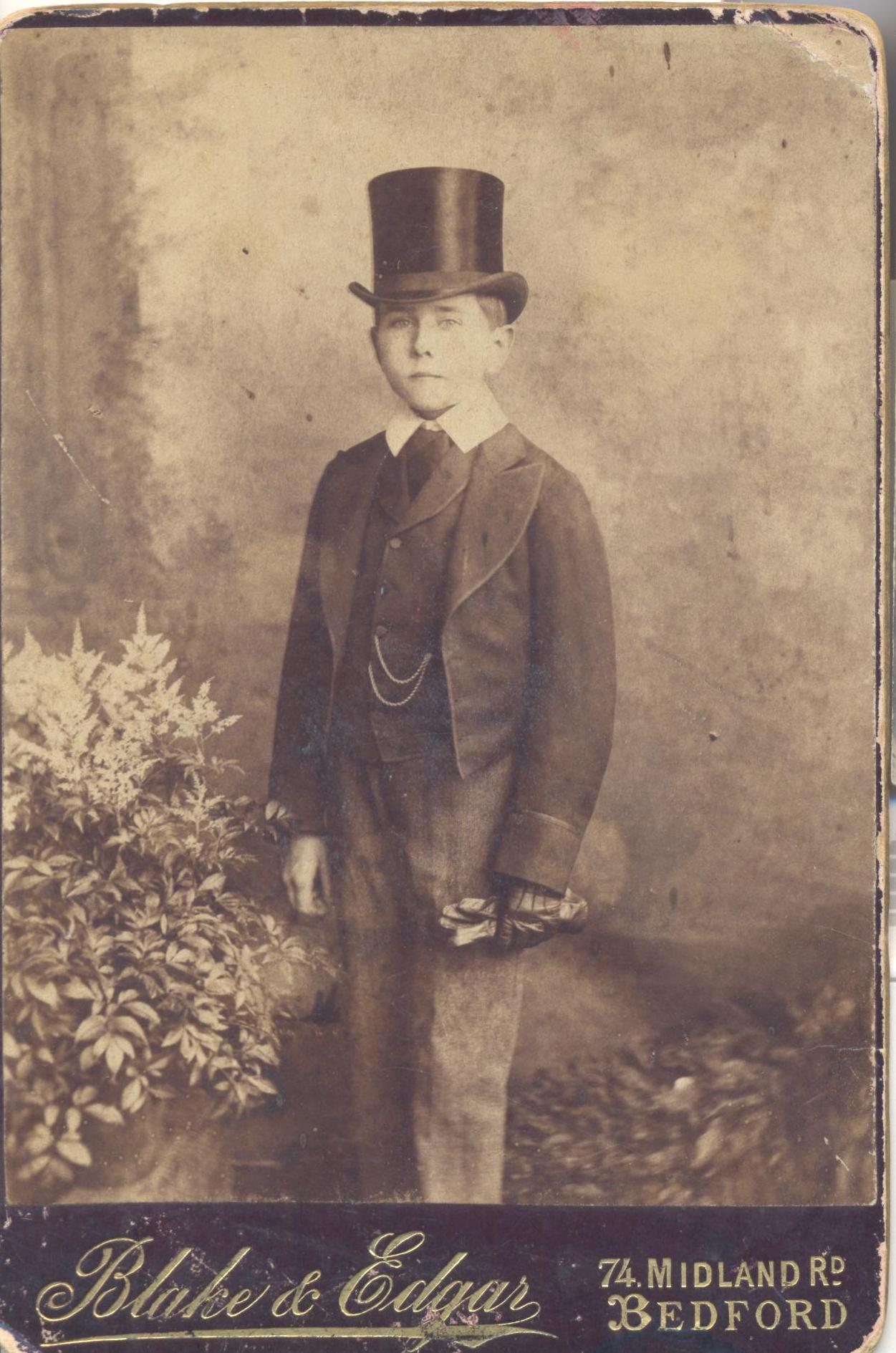
3 fritz at bedford chap 2sm

Son Frederic Thornton Peters, known to family and friends as Fritz, in 1901 in Bedford, England.

Bertha came to her marriage with high expectations, and was not pleased to hear of money problems.  Her demands that the children be educated at private schools in England were likely a factor in her husband abruptly resigning as premier in mid-term in October 1897 so as to earn higher income in far-off Victoria, B.C.

In raising the children, Bertha was the strict parent, emphasizing discipline and the importance of living up to the traditions of the family and the British Empire, while Fred was an affectionate, sentimental  father who read stories to his children and tucked them into bed at night.  She saw no need to treat her children equally, choosing Gerald as her favourite and Noel, who had a moderate mental disability, as her least favourite.

Early in the First World War she decided to travel to England on her own to be close to her sons in military overseas service, particularly Gerald, who was her best friend and soulmate as well as favoured son.   By the time she arrived in July 1915, Private Jack Peters had died four months earlier in the Second Battle of Ypres, but was listed as missing and believed to be a prisoner of war.   In late May 1916, while staying at a rented  cottage near Dover where she hosted Lieut. Gerald Peters on his leaves, word came from Germany via the Red Cross that Jack was definitely not a P.O.W., so was assumed to have died in action 13 months earlier.  Just a couple of weeks later she learned that Gerald was missing following a June 3, 1916 counterattack at Mount Sorrel, also in the Ypres Salient.   Four weeks later his death was confirmed.
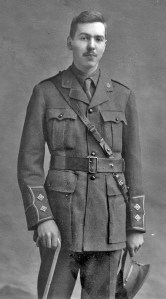
Lieutenant Gerald Hamilton Peters, spring 1916

Lieutenant Gerald Hamilton Peters, spring 1916

Engulfed by despair over Gerald’s death, Bertha went to stay at her sister Florence Poole’s home in Guildford before returning to Canada.   As was common at the time, Florence indulged in spiritualism as a means to contact dead loved ones in the afterlife.  Bertha began participating in séances as a way to contact Gerald, which infuriated her son Fritz who saw her spiritualism and excessive grieving over Gerald as signs of weakness at a time when maximum strength was needed to defeat the enemy.

Returning to British Columbia in November 1916, Bertha couldn’t bear to return to the family home in Prince Rupert because it was full of memories of Gerald and Jack, so instead went to live with her daughter Hel en Dewdney’s family in the mining town of New Denver in the mountainous West Kootenay region of southeastern B.C., while husband Fred continued alone in the isolated port of Prince Rupert serving as city solicitor and city clerk.  After Fred’s death in 1919, she lived permanently with the Dewdneys.

The last time she saw her Fritz was in July 1919 when he came back from England to organize his father’s funeral in Victoria, B.C.   She and Helen had only indirect contact with Fritz until receiving a letter from him in March 1942.

As a widow in her fifties, Bertha tried to earn income by writing novels and short stories, but all were rejected by publishers.    Using recipes and cooking skills from her P.E.I. heritage, Bertha often cooked for the Dewdney family, who generally enjoyed her meals but were on edge because, as a perfectionist, she would erupt in anger if something went wrong with the dinner.
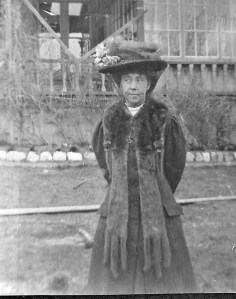
bertha in victoria 1906

Bertha, circa 1905

In a family of bridge aficionados, Bertha stood out as the best player, constantly striving to improve.     She rated each community in the Kootenay region by the quality of their bridge players.

dally new

Bertha, circa 1910. Family collection.

Bertha was in good health until a fall down stairs in about 1935 left her a bedridden invalid.   As the only child left in the house after her siblings left for marriage and university, Dee Dee became Bertha’s caregiver and audience for her stories and ideas about history and politics.  Her chores included daily trips to the Nelson library to borrow or return books requested by her grandmother.

After Fritz’s death in an air crash on November 13, 1942, Bertha wrote a flurry of letters to England to find out more about the action in Algeria on November 8th for which Fritz would receive the Victoria Cross and U.S. Distinguished Service Cross.  Separately, she asked Fritz’s friends to fill her in on Fritz’s life between the wars.

She was thrilled to hear from the British Admiralty office that Fritz would receive the Victoria Cross, but later was flabbergasted that the Americans went all out in honouring her with a full presentation ceremony for their DSC medal, while Britain just sent the VC medal to her in the mail.
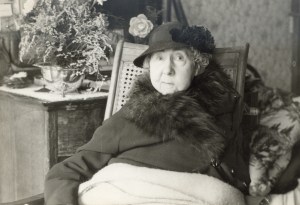
bertha gray peters 1944

Bertha after suffering a crippling fall down stairs at the Dewdney home in Nelson, B.C. in about 1935. Family collection.

Passing away July 30, 1946, Bertha was the last surviving daughter of Col. Gray.  Harriet died in London in 1882, Florence in Guildford in 1923, and Mary in Montreal in 1936.  Margaret, the only daughter to remain in P.E.I., was in excellent health until her death at age 96 in Charlottetown on December 31, 1941.

Inspired by her grandmother Bertha/Dally, Dee Dee became a professional librarian, and was an enthusiastic monarchist and anglophile.  Travelling to England in 1953 for the coronation of Queen Elizabeth II, she often mentioned in letters home that she wished her grandmother was alive to share the experience.

Today, when people ask me why I buy so many books on England and the monarchy, I lay the blame on my great-grandmother Bertha/Dally!

Bertha left a wealth of family letters in family files through her lifetime, which were subsequently looked after by her daughter Helen Dewdney, Helen’s daughter Dee Dee McBride, and now me.  In addition, in June 2020 I came in contact via Facebook with a lady in Alberta who had lived in the former Dewdney/McBride home in Nelson, B.C. in the 1980s, who discovered about a dozen additional letters in floorboards when they were renovating the house.  I greatly appreciated receiving the letters, which add substantially to our understanding of Bertha’s situation in the very stressful months of late 1916.  Most of them were sent to her from her sister Florence Poole in England, and include discussion of spiritualism, mediums and seances, which children Helen and Fritz disapproved of her practising as a means to contact son Gerald in the afterlife.

envelope of 1916 letter sent by Florence Poole to sister Bertha Peters, part of the stash of correspondence discovered in the 1980s and received by me in 2020.
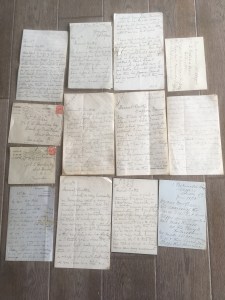
1911-1916 envelopes and front pages of letters to Bertha Gray Peters. Discovered in 1980s and forwarded to her great-grandson in 2020.

Sources:

The family history writings of Florence Gray Poole and Helen Peters Dewdney, and letters received by Bertha Gray Peters, in the Peters Family Papers; various newspaper accounts; One Woman’s Charlottetown:  Diaries of Margaret Gray Lord 1863, 1876, 1890; census, vital statistics and ship records; and the author’s recollection of family discussions.
 

Meeting in Castlegar June 16, 2015 to Organize Group to Preserve the Dewdney Trail

Leave a comment

There will be a meeting on Tuesday, June 16, 2015 at 7 pm at Chances Casino in Castlegar to organize an initiative to restore, maintain, preserve and protect the historic Dewdney Trail.  Many sections of the trail away from the highways could be preserved and made available as walking and hiking trails — yet another attraction for tourists.

The project coincides with the 150th anniversary of the completion of the Dewdney Trail that originated in Hope and went to the Similkameen and then through the Kootenays to Wild Horse Creek (near today`s Cranbrook) in the summer of 1865.

edgar dewdney with party inspecting  betw trail and rossland 001

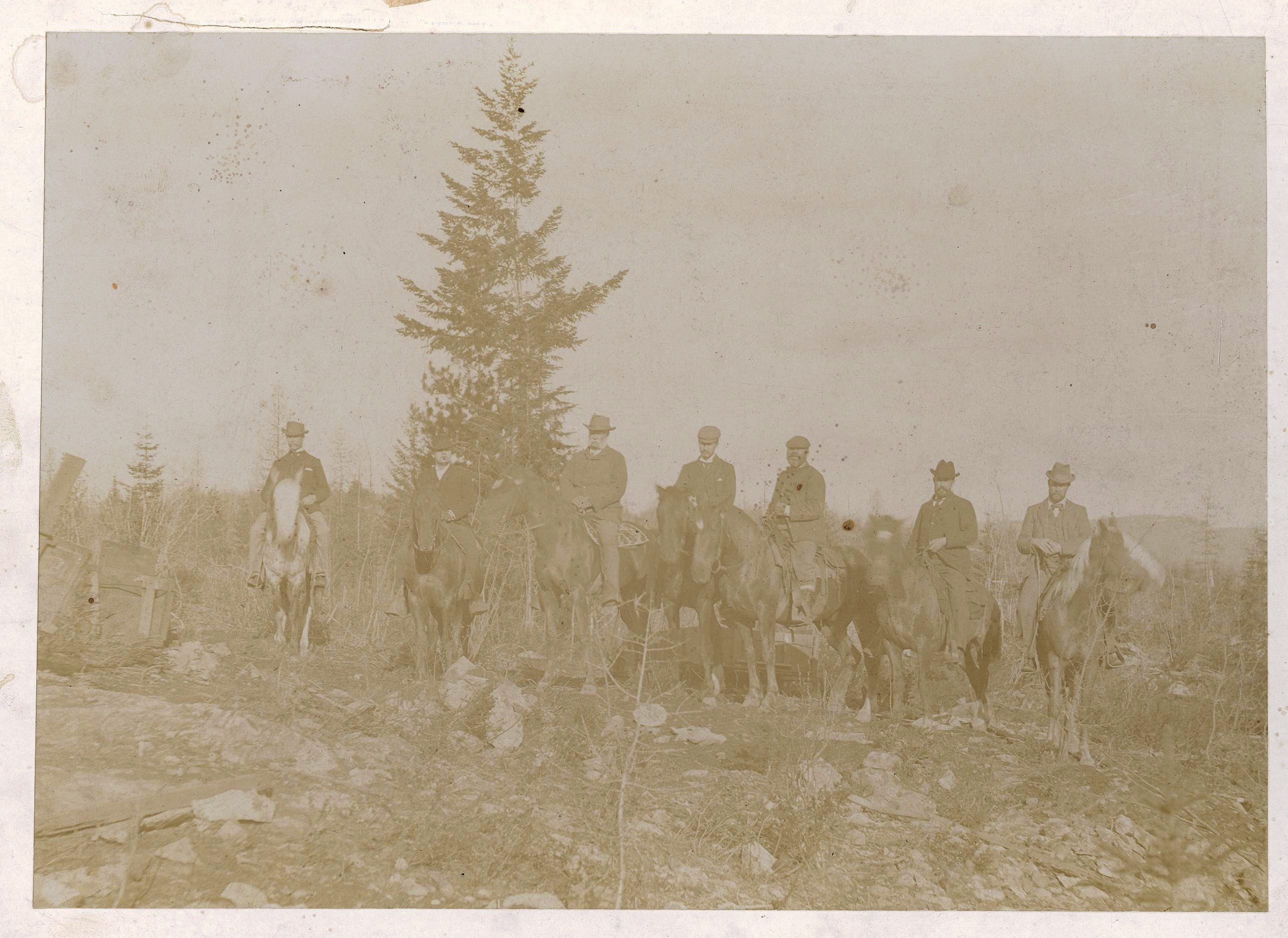
Engineer Edgar Dewdney (fifth from right) in a section of the Dewdney Trail between Rossland and Trail.  Family photo.

It was the first transportation route established across southern B.C.   At a time when the United States was in an expansionary mode, the Dewdney Trail  became a symbol of Britain`s, and then Canada`s, commitment to sovereignty over British Columbia, particularly the southern Interior from Hope through the Kootenays.

The 720-kilometer Dewdney Trail is named after Edgar Dewdney, a civil engineer who arrived in Victoria from Devonshire in May 1859.  A friendly giant at 6 feet, 4 inches in height, he stood out in any crowd as a memorable figure.   He blazed a trail from Hope to newly-discovered goldfields in the Similkameen, and later won contracts to extend the trail to gold diggings at Wild Horse Creek..

edgar sitting

Edgar Dewdney as a young, trail-building civil engineer.

Today, Highway 3 from Hope to Cranbrook largely follows the Dewdney Trail.  There is a well-maintained Dewdney Trail hiking section in Manning Park, and a short section in the Rossland South Belt that is great for hiking.   As well, a long section from Paterson to Christina Lake is in good shape, except for a few areas that are eroded due to heavy use by mountain bikes, while the rest of that section just needs brushing and windfalls cut.   Other repairs are needed on the Santa Rosa section damaged by construction of a power line, as well as logging damage on the Christina Lake section.

The May 28, 2015 issue of the West Kootenay Advertiser newspaper as a story about the June 16th meeting at the following link:  http://issuu.com/blackpress/docs/i20150528050424775?mobile=true

For further information, contact Richie Mann at 250 362-9465 or richiemann11@gmail.com, or Graham Jones at 250 362-9966 or jumbuck65@yahoo.ca.

Myths about the Frank Slide Baby Infuriated Nelson Piano Teacher Marion Leitch McPhail

2 Comments

by Sam McBride

Perhaps the most memorable character from my boyhood in Nelson, British Columbia was my piano teacher, Marion Leitch McPhail.  She was a superb pianist and a good teacher, but was often in a bad mood in my encounters with her.

PR2008.0058.12 Marion Leitch McPhail with daughter Sheilah, c. 1940. Courtesy Provincial Archives of Alberta PR2008.0058.12

I was warned by several people in my family to never ask her about the Frank Slide of 1903.   It was a subject that drove her to distraction — and with good reason: she was the baby who miraculously survived the slide, only to be the subject of myths, legends and jokes about it the rest of her life.   The tragic rockslide killed her parents and four brothers, but two older sisters survived as well as Marion.

My article about Marion as a survivor and piano teacher in Nelson was in the May 1, 2015 issue of the Nelson Star, viewable at  http://www.nelsonstar.com/news/302000401.html.  I have received great feedback from readers who saw the story in print or online, including several people who took piano lessons with Marion, between the 1940s and 1970s.  Students who reached the top levels of the Royal Conservatory of Music piano standards heaped praise on Marion, but others noted the lessons were not a positive experience for them.   One thing she did which would not be acceptable today was rap the knuckles of her students during the lesson.   I have heard from five ladies that this happened to them, but no men remember receiving the same punishment, which might indicate she was a bit harder on girls than boys.

oct312015 006

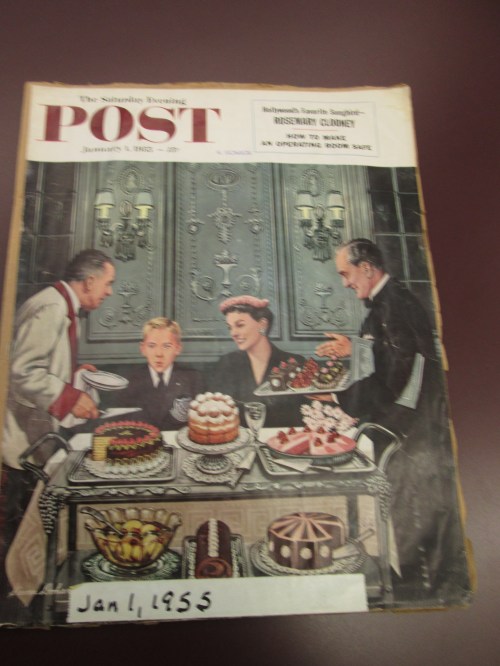
1955 issue of the Saturday Evening Post which had a feature story on the Frank Slide, including interview with Marion Leitch McPhail

In the 1930s Marion and her husband Larry were close neighbours of my grandmother Helen Peters Dewdney and her husband, my grandfather Ted Dewdney.  The McPhails resided at 808 Carbonate Street and the Dewdneys were about three houses away in the Hochelaga House for Bank of Montreal managers at the corner of Hendryx and Carbonate streets.   Helen had taken piano training at the Royal Conservatory of Music in London, England as a teen-ager in the early 1900s.  Marion, who was 13 years younger than Helen, took advanced piano training in Vancouver before settling in Nelson in the 1920s and supporting herself by giving piano lessons.  Larry and Ted knew each other well from the curling club, Nelson Little Theatre and other community organizations.  Both had prominent positions in the community — Larry as registrar of titles at the Land Registry Office and Ted as manager of the local branch of the Bank of Montreal.


Coincidentally, Larry was also a good friend of my paternal grandfather Roland Leigh McBride, who lived four blocks away on Hoover Street with wife Winnifred Foote and sons Leigh and Ken.   Like the McBrides, Larry McPhail was a keen golfer at the Nelson Golf and Country Club.

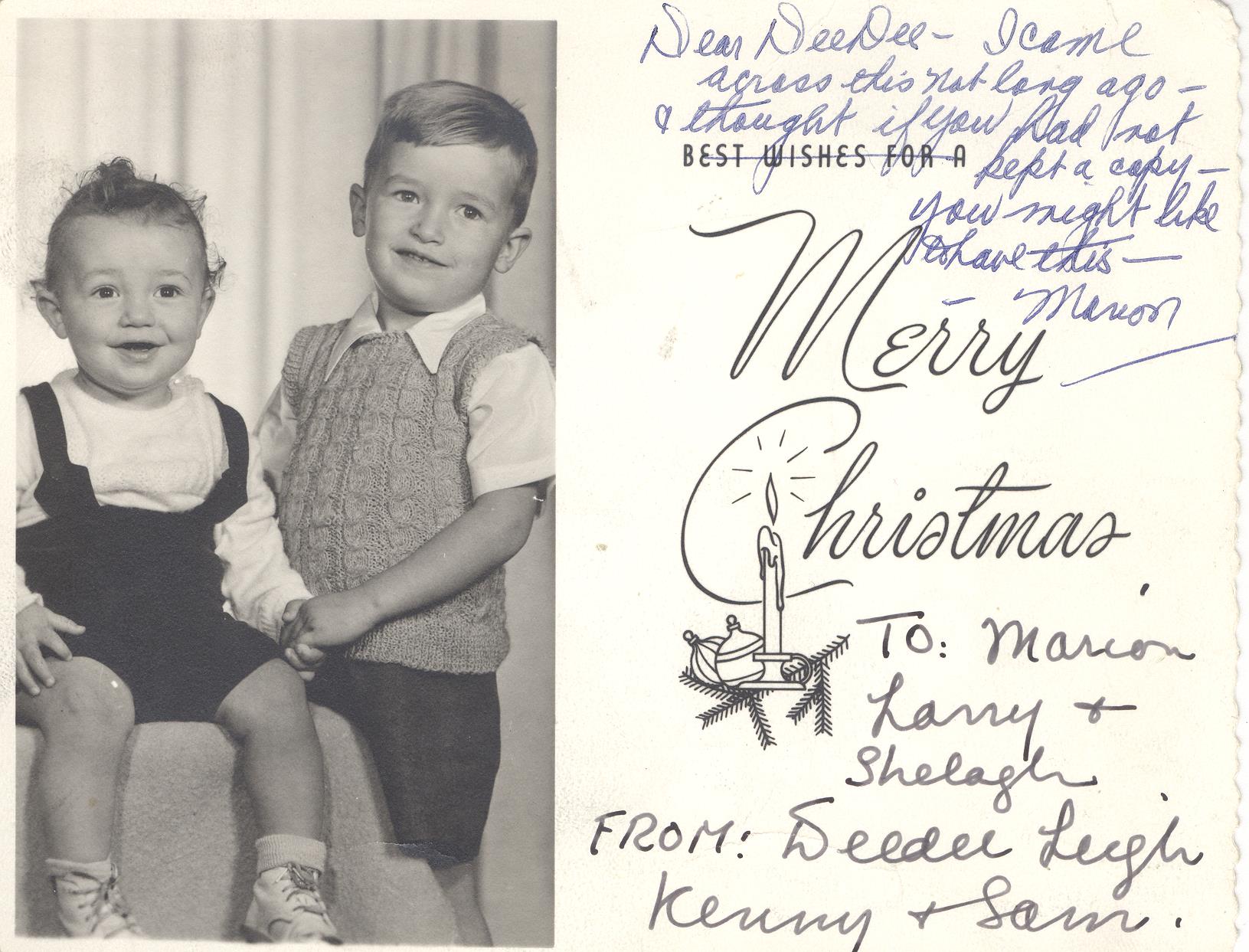
card returned by marion 001 Marion was a thoughtful friend. Here she sent back the 1952 Christmas card my mother had sent her several years later, thinking that Dee Dee may not have other copies of the card with a photo of her two boys Sam and Ken. She was right, as this is the only copy of the card in the family files. McBride Family collection.

My family files show that Larry and Marion attended the 25th wedding anniversary party of my Dewdney grandparents in 1937, and the 25th wedding anniversary party of my McBride grandparents in 1939.  They also attended the wedding and reception party of my parents Leigh and Dee Dee in 1948, and joined them in numerous social functions over the years.   Obituaries and funeral reports show that Larry was a pallbearer at the funeral of Ted Dewdney in 1952, and the funerals of other grandparents R.L. McBride in 1959 and Winnifred Foote McBride in 1960.  So there was a strong connection between my family and the McPhails, which was likely a factor in my parents choosing Marion to be piano teacher for my brother Ken, sister Eve and me in the late 1950s and into the 1960s.

Larry was a jovial fellow who often came home from work in the middle of my lesson with Marion.  The piano lessons occurred in the porch area of the house towards Carbonate Street, so he would have to come through the porch to enter the main part of the house, likely finding a spot free from the sound of the piano lessons.  I looked forward to Larry arriving because it was the only break I ever got in the 45-minute piano lesson, as Marion went to greet her husband and ask him how his day went.

Larry died from a heart attack in Nelson in 1965.  Marion retired from piano teaching after almost half a century of teaching in Nelson, and moved to Victoria, B.C. in 1971.  She died in Victoria in 1977 at age 76.

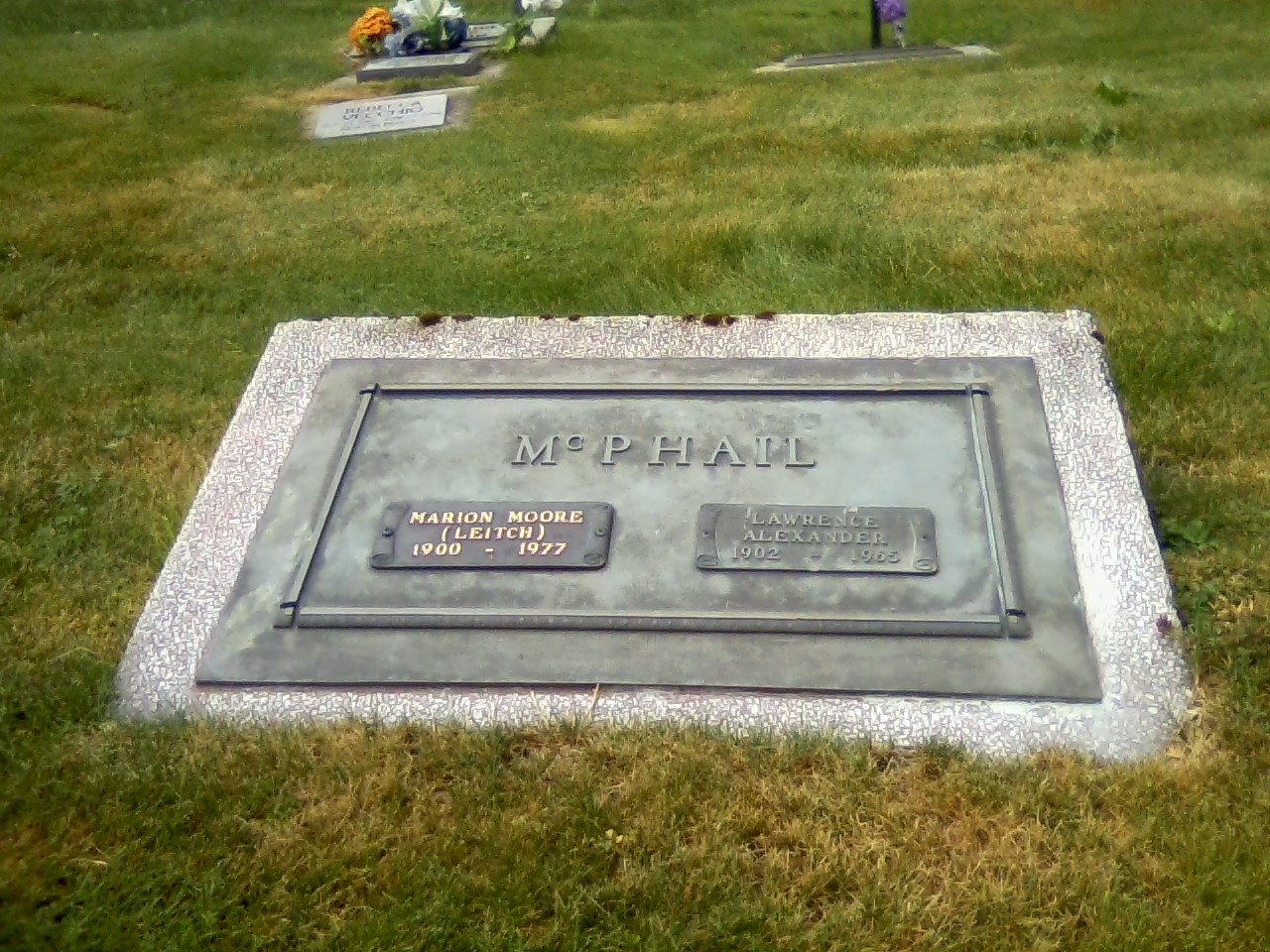
McPhail tombstone at Nelson Cemetery tombstone in Nelson Cemetery for the McPhails. Notice the maiden name Leitch is included. Marion hated the Ballad of Frankie Slide that said the Frank baby never knew her name. Sam McBride Photo
feb 11 frank slide with sign The Frank Slide in February 2011. Sam McBride photo.
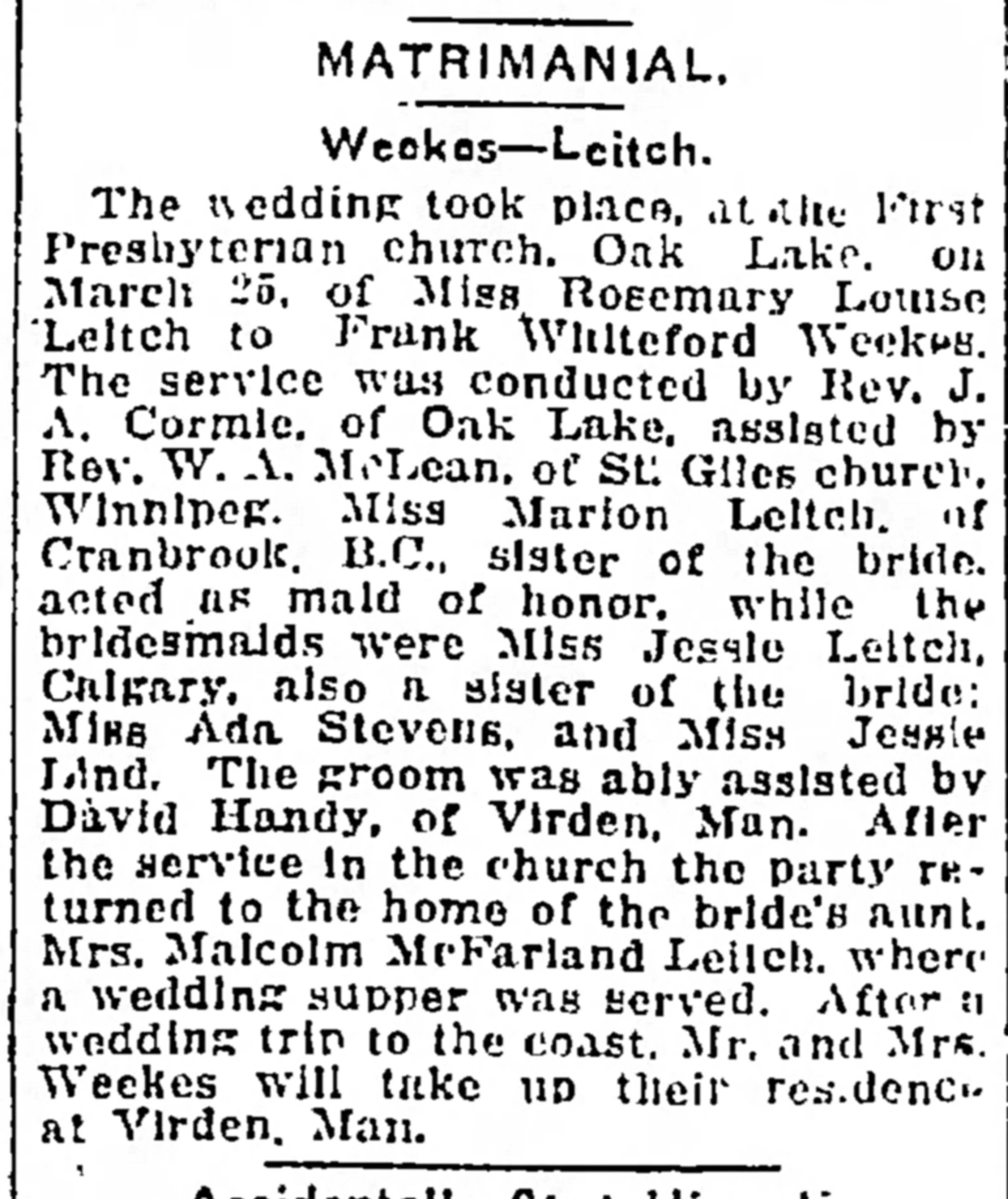
Manitoba_Morning_Free_Press_Tue__Apr_14__1914_bridesmaid This Manitoba Morning Free Press news story from April 14, 1914 notes that Marion was maid of honour at the wedding of her sister Rosemary Louise Leitch, known in the family as May. Eldest sister Jessie was a bridesmaid. Newspapers.com
feb 2011 download 155 Frank Slide today. Sam McBride photo.


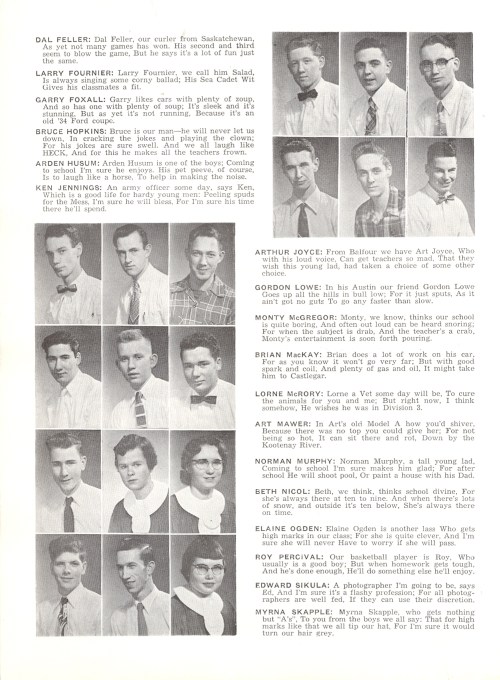
1956 lvr grad class with sheilah mcphail 001 Photos of Sheilah McPhail are in the special 1956 high school grad publication commemorating the arrival of the new L.V. Rogers High School in Nelson. ABOVE, she is top right in the right-side group of photos. BELOW, Sheilah figure skating. In addition to being a champion skater, she was an accomplished singer and pianist.

 sheilah mcphail in 1956 yearbook skating 001

Canadian Private Jack Peters Died A Century Ago in the Second Battle of Ypres

Leave a comment

The first of the Peters boys to die in battle was Private John Francklyn “Jack” Peters, born October 19, 1892 in Charlottetown, Prince Edward Island, the second son and third child of Premier Frederic Peters and Bertha Hamilton Gray.

9 jack peters no. chap 4

Last photo of John Francklyn Peters, taken in Prince Rupert, B.C. in about 1913. He died in action at Ypres even before he could be photographed in uniform. Family photo.

The circumstances of his death in the Second Battle of Ypres on April 24, 1915 are one of the mysteries of the Peters Family History. He was in the thick of one of the fiercest battles in Canadian history, a conflagration made worse by the surprise use of poison gas by the Germans at a time when their opponents had no respirators or other protection against it.

1c

Jack Peters as a baby, with sister Helen and brother Fritz in Charlottetown, Prince Edward Island, Family photo.

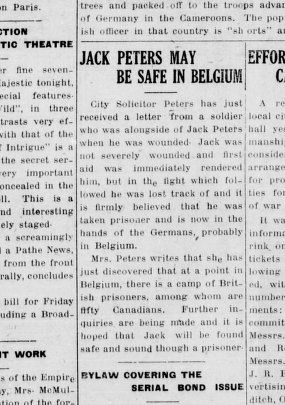
As a large number of Jack’s comrades in the 7th British Columbia Battalion were taken prisoner that day, Jack’s family hoped he was alive and safe as a prisoner while he continued to be listed as “missing”. Rumours that he was being held at the Celle Lager camp in Hanover proved to be wrong when the Red Cross reported in May 1916 that Jack was no among the POW’s.

His sister Helen Peters Dewdney (my grandmother) remembered Jack as a normal, happy-go-lucky boy, who would dutifully serve his country and Empire in wartime, but was happy to let older brother Fritz be the hero of the family. The Peters moved to Victoria, B.C. in 1898, and then to Prince Rupert, B.C. in 1911, as his father pursued better financial prospects.

jack with bike

Young Jack with his bicycle. Family photo

At the outbreak of war in August 1914 Jack was working as a bank clerk in Prince Rupert. Unlike his younger brothers Gerald and Noel, Jack had no difficulty passing the medical examination for army enlistment. He trained with the First Contingent through the winter of 1914-15 in Salisbury Plain in England, and embarked for France in February 1915.

jack peters as boy

Jack Peters as boy in Charlottetown. Family photo.


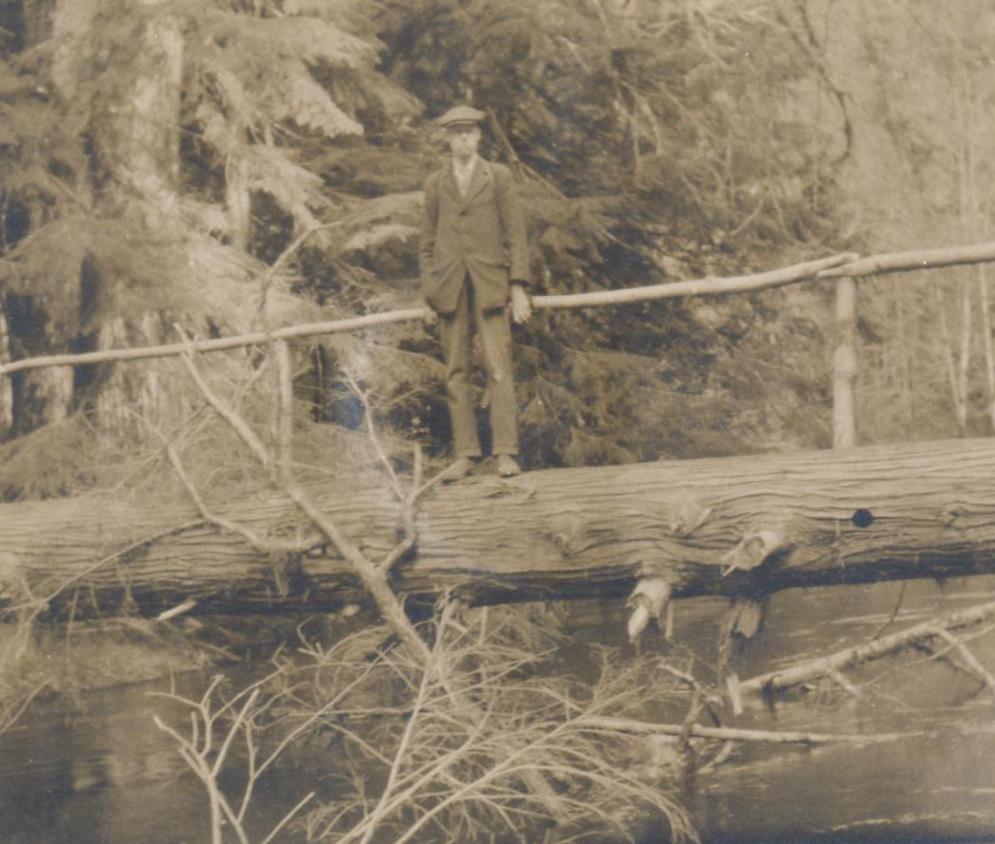
jack on log 001

Jack on a West Coast walking trail. Family photo.

Jack Peters was born October 19. 1892, the middle child of Frederick Peters and Bertha Gray of Charlottetown, Prince Edward Island.  Sister Helen Peters was five years older and brother Frederic Thornton “Fritz” Peters was three when Jack was born at the Peters family home known as Sidmount House.  At the time of Jack`s arrival, his father was the Hon. Frederick Peters, premier and attorney general of Prince Edward Island for more than a year.

 Two years later in 1894, fraternal twin brothers Gerald Hamilton Peters and Noel Quintan Peters were born.  In 1899, after the family had moved across the continent to Victoria, British Columbia, sister Violet Avis Peters was born, seven years younger than Jack.  His father had resigned as premier in October 1897, and moved his family to Victoria where he established a law practice with another well-known departing Maritimer, Sir Charles Hibbert Tupper.

jack at bedford

Jack in Bedford, England, about 1901. Family photo.

J.F. Peters

Young Jack Peters. Family photo.

Jack attended school in Victoria, and then in 1900 he went to England with other family members.  They resided at Bedford, north of London, where his mother Bertha`s stepmother moved after the death of her husband John Hamilton Gray in 1887.  Jack and brother Fritz were students at the Bedford Grammar School in the 1900-01 school year, and sister Helen attended the Bedford School for Girls.  The following year Fritz transferred to Cordwalles School in Maidenhead, known as a preparatory school for future Royal Navy officers, in line with Fritz`s dream of a naval career.  Jack continued at Bedford Grammar school for another two years.  We do not have details of his further schooling, but it appears from his letters that he returned to Victoria where he attended school and participated in militia training.  In January 1905 brother Fritz enlisted in the Royal Navy, and in November 1905 younger sister Violet died in a fireplace accident in the family home in Oak Bay, immediately east of Victoria.

five boys

Jack Peters is top left, in the yard of the Peters home in Oak Bay, B.C., around 1908. Family photo

In 1911 Jack moved with the family to the north coastal town of Prince Rupert where his father took the family when he accepted the position of Solicitor (lawyer) for the City of Prince Rupert.   At the time, it appeared Prince Rupert was going to be a boom town, and a port to rival Vancouver.   

feb 9 1916The following year sister Helen married Edgar Edwin Lawrence “Ted” Dewdney in Esquimalt, and the couple moved to Vernon where Ted was an accountant with the Bank of Montreal, with whom he had worked since 1897.  Perhaps assisted – or at least inspired – by brother-in-law Ted Dewdney, Jack went to work as a clerk at the Bank of Montreal branch in Prince Rupert.  About the same time, brother Gerald was employed as a clerk with the Union Bank in Prince Rupert.  Jack, Gerald and Noel all served in the Earl Grey`s Own  Rifles militia in Prince Rupert.

At the outbreak of the Great War in 1914 he and brothers Gerald and Noel rushed to enlist, but only Jack was accepted for war service.   Like Jack, Gerald was tall at 6 foot, one and a half inches, but Gerald`s chest measurement was below the army standard, so he was rejected.  Gerald later travelled to Montreal to enlist there, and this time passed the physical exam.   Noel was rejected because of a slight, but noticeable, mental disability, and was not accepted for military service until he was allowed to join the Canadian Forestry Corps in Britain in May 1917.

Jack was in the First Contingent of the Canadian Expeditionary Force, serving with the 7th British Columbia/Duke of Connaught battalion.   He trained at the Valcartier base in Quebec and then went overseas to England where he trained in Salisbury Plain with other Empire troops in the wettest winter weather on record.   He arrived in France in late February and was in minor trench action for the next couple of months, including the Battle of Neuve Chapelle.

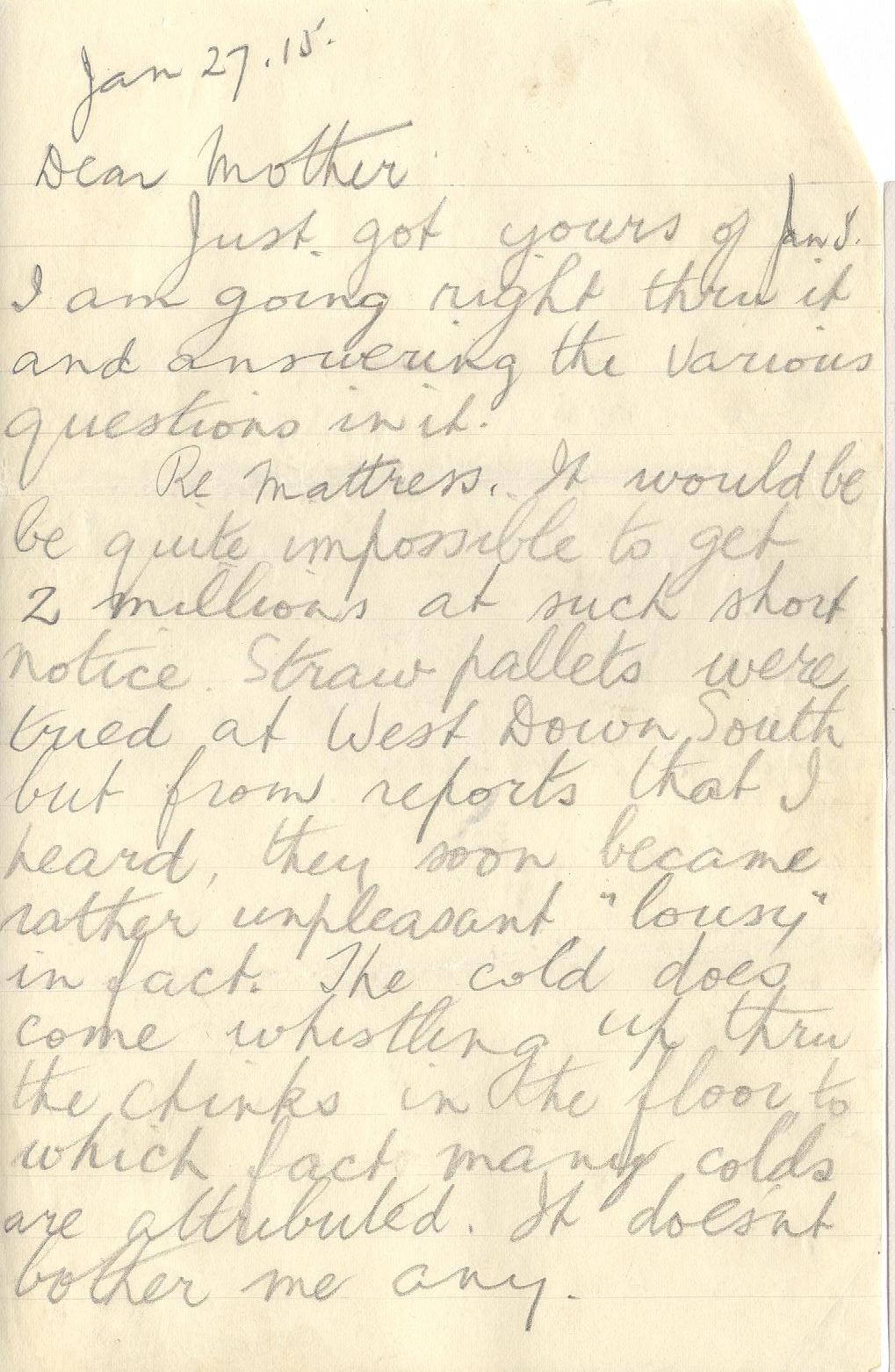
In a letter home to his mother in January 1915 he said “You needn’t worry about me because I don’t intend to put my head up above the trench to shoot the Germans.  Me for where the earth is thickest and highest.” He was happy to let his brother Fritz be the war hero of the family.

However, Jack would be the first of three Peters brothers to die in the world wars of the 20th century.  He was killed on Saturday, April 24, 1915 in the 2nd Battle of Ypres when Canadian troops made a courageous stand against a massive German attack that used poison gas for the first time on the Western Front.

The use of poison gas in artillery shells was forbidden by the Hague Conventions which both sides had agreed to in 1899 and 1906, but the German commander at Ypres thought he could get away with spreading the gas directly from canisters and piping from their own trenches, depending on the wind to take it to the enemy.  The completely surprised French colonial troops on the Canadians’ left panicked and ran away from their positions upon experiencing the greenish-yellow cloud of chlorine gas late in the afternoon of April 22nd, which left the inexperienced Canadians to fill a four-mile gap in the Allied line protecting the headquarters at Ypres and the coastal ports.

 Reinforcements promised by the French never arrived.  The Germans did not expect the gas to have such a dramatic impact – wind conditions and temperature were ideal for distribution of the heavier-than-air gas, unlike a previous attempt to use poison gas on the Russian front — and were not prepared with reserves to immediately take advantage of the break in the line.  They were ready by the early morning of Saturday, April 24th, launching a full-scale offensive with gas directly against the Canadians.

jan 27 jack

First page of letter home from Jack Peters in January 1915 from Salisbury Plain.


Jack in the 7th battalion would have been right in the middle of the vicious battle.  The Canadians found they could function somewhat under the gas by holding urine-soaked handkerchiefs against their faces and partially neutralizing the chlorine.  Records show that relatively few soldiers died from just the poison gas; they would be hit by bullets and shells when drawn away from their trenches by the gas and unable to defend themselves.  Flame-throwers were also introduced for the first time in the offensive, making a horrific situation even worse for the defenders.

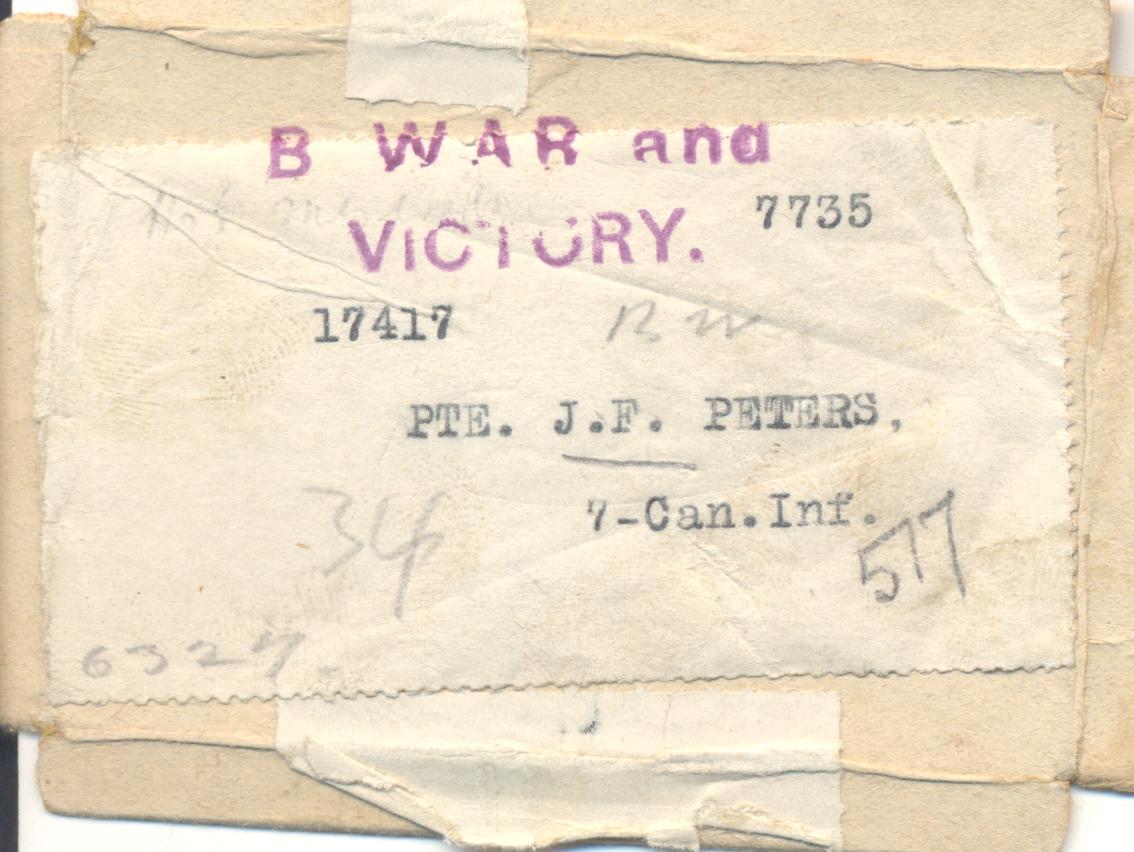
jack medals

Envelope his war medal came in the mail to his mother Bertha.

jack file 1 001If the Canadians had not held the new battle line, the enemy could have easily encircled 50,000 Allied troops and marched to the North Sea to capture ports (as happened at Dunkirk in May 1940 in the Second World War), which would have been a devastating blow to the Allies.  British General Sir John French gave the Canadians credit for extraordinary bravery and said they “saved the situation”.  The Germans began respecting Canadians as adversaries after this battle.

While we don’t know exactly what happened to Jack in the battle (witnesses died too), it is noteworthy that he was a part of what was arguably the most important defensive stand in Canadian history.

jack file 3 001

There were hundreds of Canadian prisoners taken in the shifting front that day, and for a period the military authorities thought Jack might be among prisoners in Belgium or Germany.  Dozens of soldiers of the 7th Battalion were taken prisoner after the Germans surrounded and captured the small village of St. Julien.  The Peters family felt 100% sure that Jack was safe as a prisoner, largely because Fred`s cousin Helen Francklyn in Bristol said a friend of hers in Switzerland found out that Jack was at the Celle Lager prison in Hanover.   However, the Red Cross found that the prisoner in question in Hanover was in fact someone else, so on May 29, 1916 Jack was officially presumed to have died “on or after April 24, 1915”.  Of 900 men and 24 officers in Jack’s battalion, 580 men and 18 officers were casualties in the 100 hours of frantic action that followed the first gas attack.  Four Victoria Crosses were awarded to Canadians in the battle, including Lieutenant Edward Bellew of Jack’s 7th battalion.  John McCrae, a surgeon in charge of a field hospital, wrote his famous poem “In Flanders Fields” on May 3, 1915, inspired by the death of a close friend in the same battle in which Jack died.

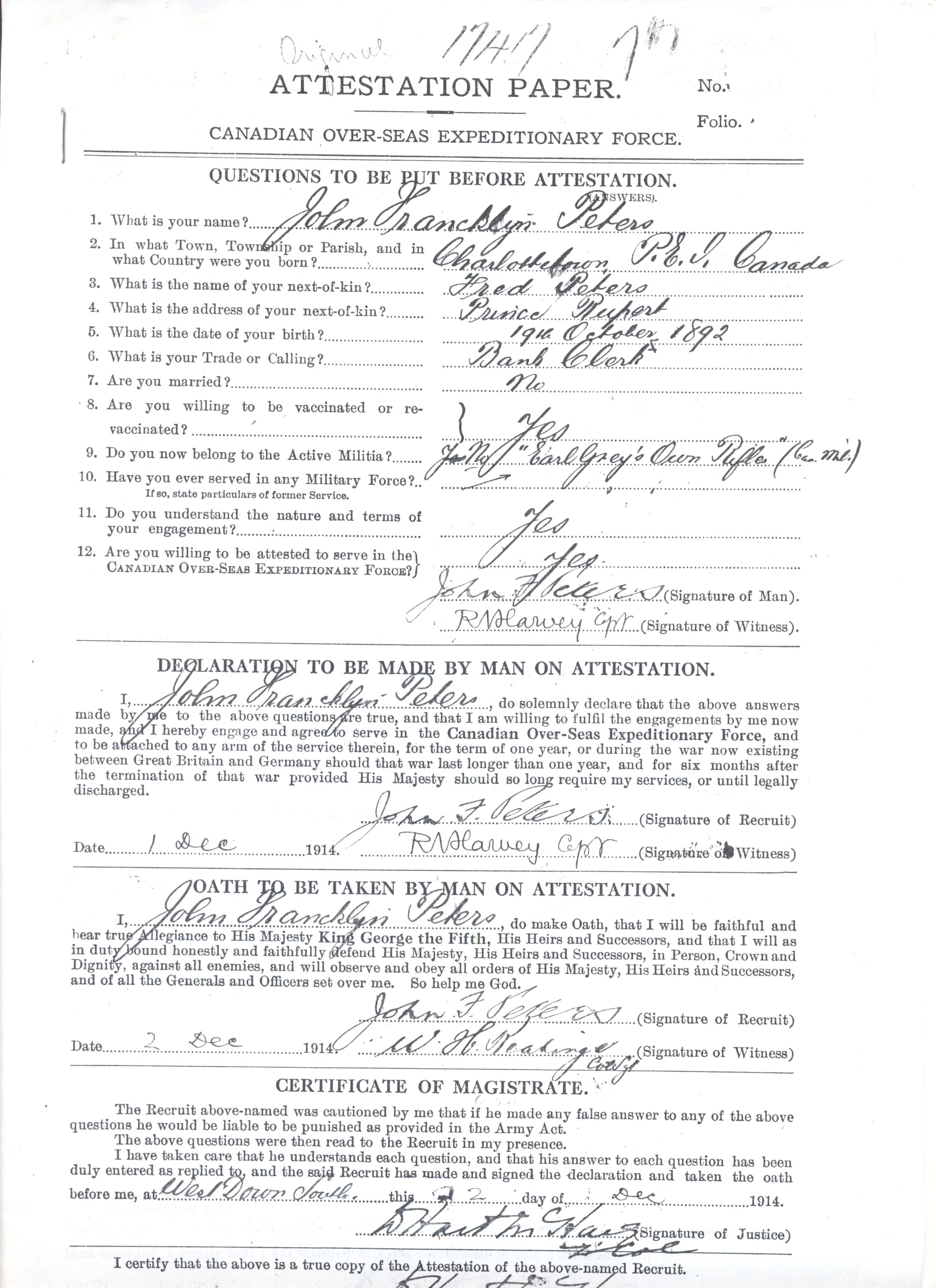
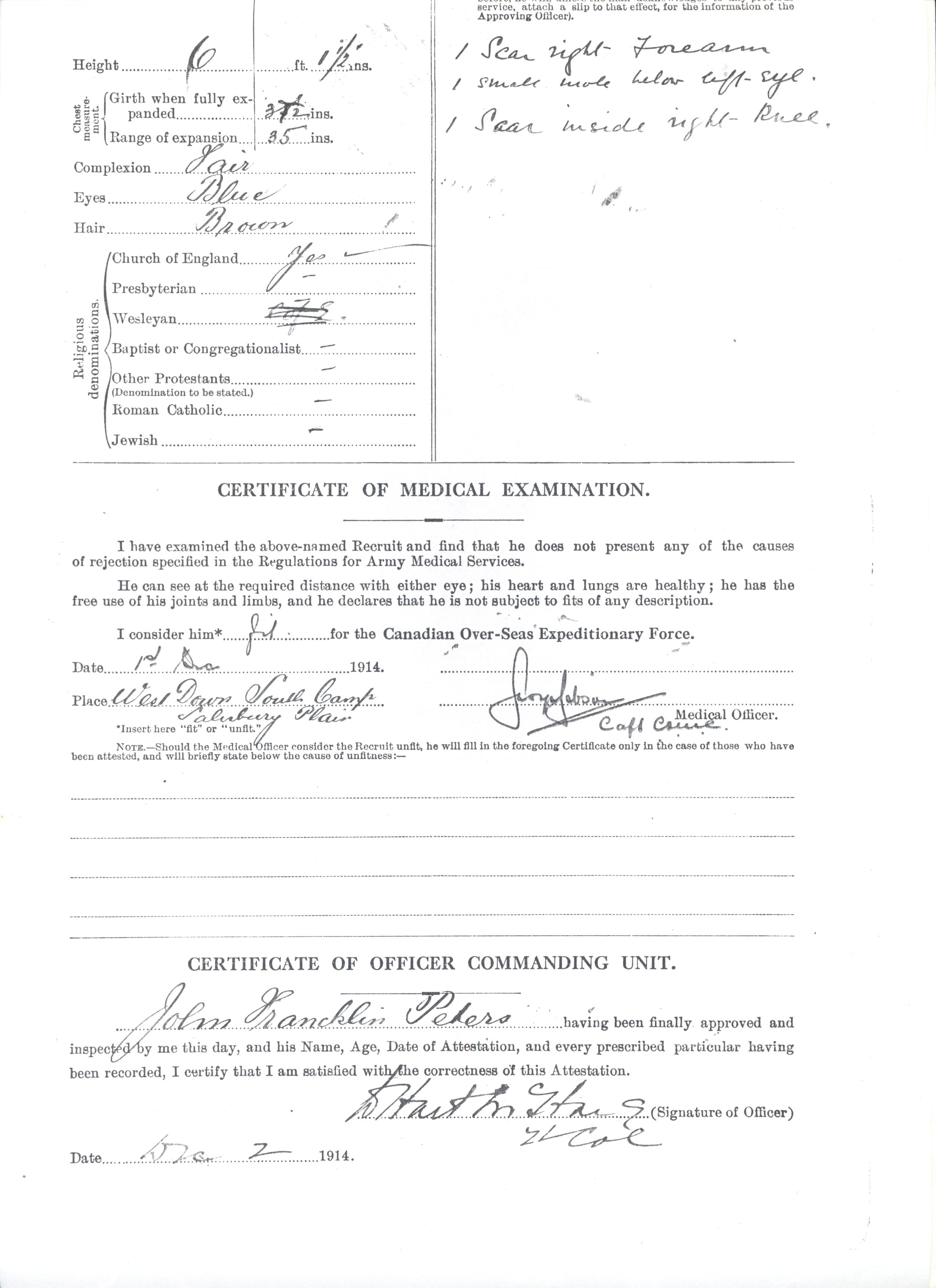
jack attest 1 001

jack attest 2a 001

Attestation papers signed by Lt. Col. William Hart-McHarg, commanding officer of the 7th B.C. Battalion. Both he and Jack died April 24, 1915 in the Second Battle of Ypres.

black stick from about sept 2012 968

St. Julien Canadian Memorial at Vancouver Corner, Ypres Salient. The inscription on the memorial, known as the Brooding Soldier, says: THIS COLUMN MARKS THE BATTLEFIELD WHERE 18,000 CANADIANS ON THE BRITISH LEFT WITHSTOOD THE FIRST GERMAN GAS ATTACKS THE 22ND-24TH OF APRIL 1915. 2,000 FELL AND HERE LIE BURIED

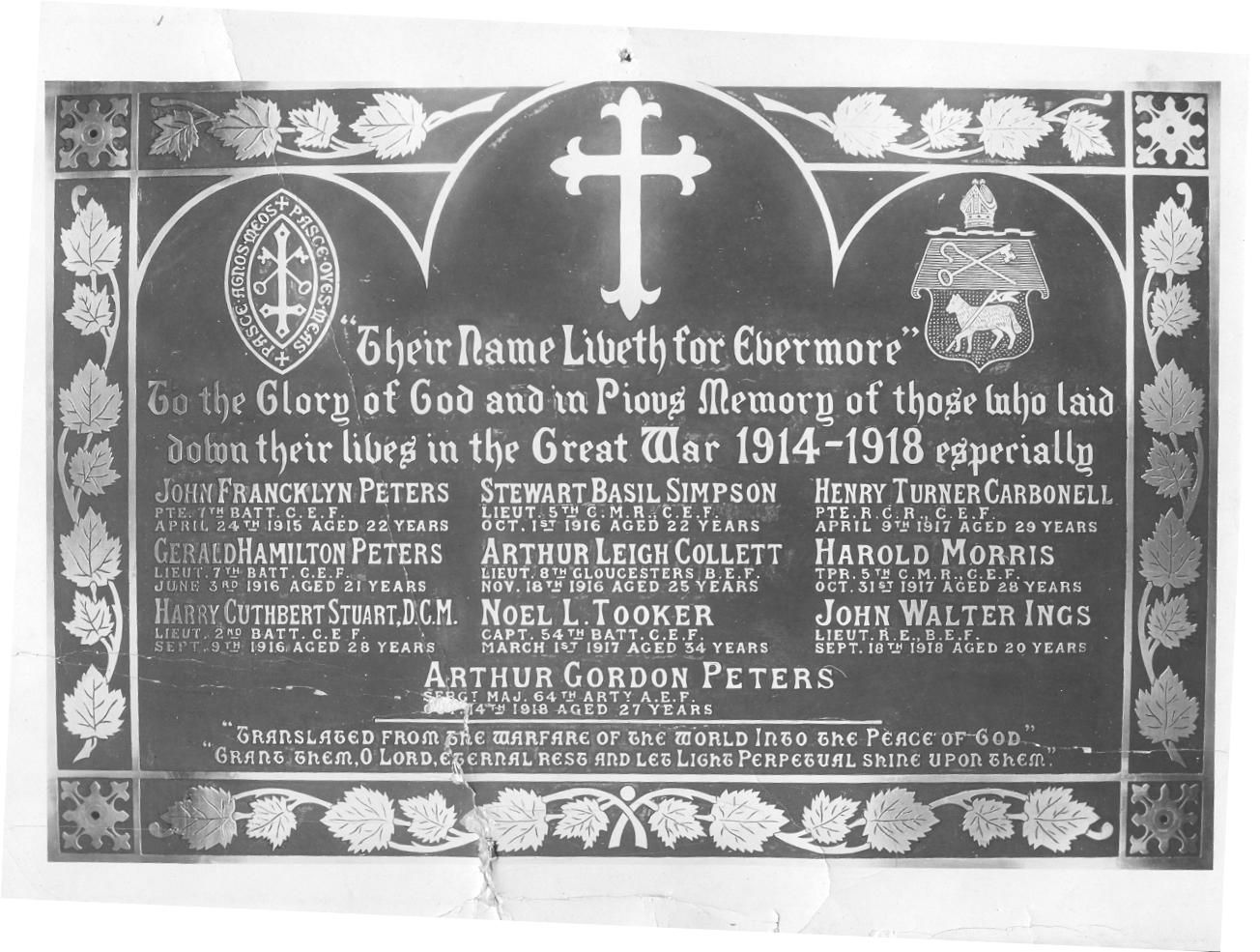
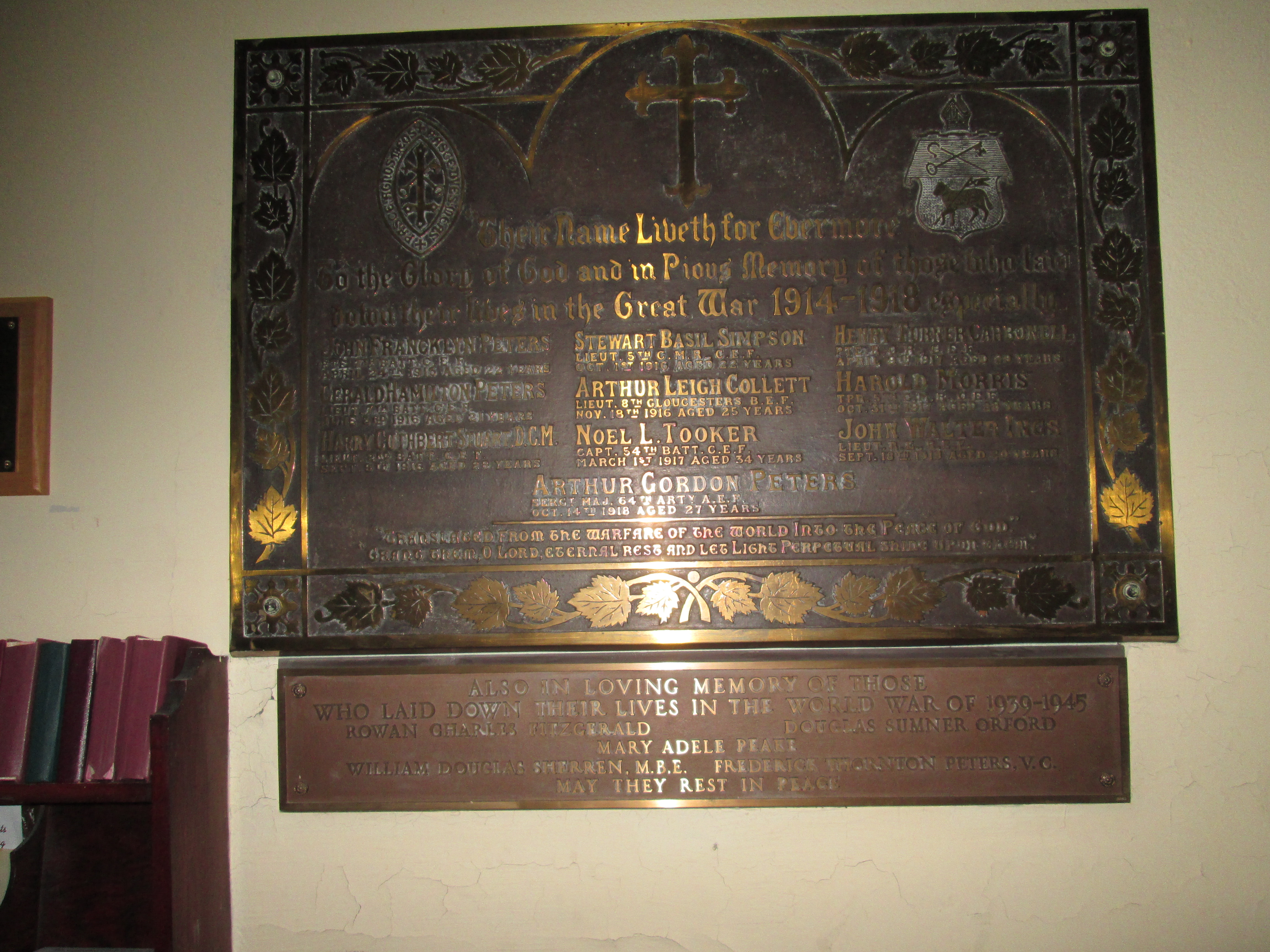
After being assured for so long that Jack was safe, his mother Bertha refused to believe he had died.   She did not accept his death until the war was over, and no further information on Jack had emerged.  She grieved much more for son Gerald, who died in the Battle of Mount Sorrel in June 1916.  Gerald was her favourite child, and they were exceptionally close.   A memorial plaque (image below) with the names of Jack Peters, Gerald Peters, their cousin Arthur Gordon Peters, and seven other Charlottetown boys who died in the war was installed at St. Paul`s Anglican Church in Charlottetown.  The names of Jack and Gerald Peters are also listed on the Menin Gate memorial in Ypres that includes the names of thousands of Allied soldiers who died at Ypres with no identified remains.


plaque in St. Paul`s Anglican Church in Charlottetown (McBride Collection)

Black and white photo taken many years ago of the war memorial plaque in St. Paul`s Anglican Church in Charlottetown (McBride Collection)

sep12 14 005

Colour photo of the above plaque taken in September 2014.  Note the addition of a newer plaque below with names of Fritz Peter and other PEI-born boys who died in Second World War.   .


sep12 14 007

Another plaque installed at St. Peters Anglican Church in Charlottetown remembers Jack Peters, Gerald Peters and their cousin Arthur Peters among the Great War dead , and Fritz Peters and Noel Peters who fought in the war and survived. Sam McBride photo.


Cousin E.W. Jarvis Had a Dramatic Life of Accomplishments and Adventure in the Canadian Frontier

Leave a comment

By Sam McBride

Edward Worrell Jarvis (1846-1894) was a nephew of Col. John Hamilton Gray, a first cousin of Bertha Gray Peters and her sisters, and a first cousin, once removed, of Frederic Thornton “Fritz“ Peters.   My relation to him is first cousin, three times removed.

edward jarvis closeup 1868 001

Edward Worrell Jarvis, son of Elizabeth Gray and PEI Chief Justice Edward James Jarvis.  (Detail of family photograph in Peters Family Papers)

His remarkable career included railway surveying and engineering in England and Canada (including an extremely challenging Canadian Pacific Railway winter survey through the Rocky Mountains in northern B.C. and Alberta), running a successful lumber business in Winnipeg, serving as a Major in command of the Winnipeg Field Battery in the Riel Rebellion of 1885, designing three bridges in Winnipeg (including the Broadway Bridge which opened in 1882 as the first bridge to cross the Red River), being the first registrar at the University of Manitoba, a founding member of the Manitoba Historical Society, alderman in the early years of Winnipeg, and superintendent with the Northwest Mounted Police (forerunner of the Royal Canadian Mounted Police), the position he held at the time of his death in 1894 at age 48.   When he applied to join the Institution of Civil Engineers (ICE) in 1874, the ICE members sponsoring his application included the distinguished engineers Sir Sandford Fleming and Marcus Smith of CPR fame.   For whatever reason, details of his career were missed in Gray family letters and memorabilia, likely because he was far away and out of touch with his relations in the Maritimes, who he would not have known well as he spent much of his boyhood at private school and later university in England after he became an orphan a six years of age.  There is no mention of him in the Canadian Dictionary of Biographies.

INTRODUCTION

One of my favourite images in the family collection that I have inherited is the photograph by G.P. Tanton of Charlottetown dated 1868 of a gentleman and two ladies.   The print is 2.25 inches wide and 3.75 inches high, on heavy paper backing.   The image has excellent black and white contrast in a brown, sepia tone colour.  In most studio photos from this era the subjects look serious and uncomfortable  (not surprising as they had to stay still for many seconds for the camera exposure), but with this photo Margaret Gray, at least, looks relaxed and has a trace of a smile.  The back of the chair she is sitting on is similar to chairs that exist today as family heirlooms.

edward jarvis marg gray and florence gray 1868 001

Edward Worrell Jarvis with his cousins Margaret Pennefather Stukeley Gray (sitting) and Florence Hope Gibson Gray in Charlottetown in 1868. Photo from Peters Family Papers.

On the back of the print, the people in the photo are identified as Margaret Gray, Florence Gray and Edward Jarvis.  We know from other photographs that Margaret Pennefather Stukeley Gray (1845-1941), who would have been 23 at the time the photo was taken, is seated and her sister Florence Hope Gibson Gray (1848-1921), 20, is standing behind her.

back of pic of edward jarvis and marg and florence gray 001

back of photo print (Peters Family Papers)

The father of the young ladies, Col. John Hamilton Gray, was retired from politics and in charge of the Prince Edward Island militia when the photo was taken.  Four years earlier, Col. Gray was premier of PEI and host of the Charlottetown Conference of 1864 which set the stage for Canada being established as a self-governing nation in 1867.  Gray`s wife Susan Ellen Bartley Pennefather, who died in 1866, was in failing health at the time of the Charlottetown Conference, so daughters Margaret and Florence served as hostesses when their father invited his fellow Fathers of Confederation to his estate known as Inkerman House for an after-dinner party on Sept. 3, 1864.

Margaret married Charlottetown shipbuilder Artemus Lord in 1869 and resided in Charlottetown for the rest of her life.  Florence married mining engineer Henry Skeffington Poole and they settled in Stellarton, Nova Scotia, and after about 1900 resided in England.

Until recently, all I knew about the young man in the photo was that he was Edward Jarvis, son of Edward James Jarvis (1788-1852 and Elizabeth Gray (1803-1847), sister of Col. Gray.   As chief justice of Prince Edward Island, Edward James Jarvis was prominent in the community.   The only thing mentioned about young Edward Jarvis in Florence Gray`s notes about the Gray family was that he “died unmarried“.   The Canadian Dictionary of Biographies has a full entry about Edward James Jarvis, but no mention of his son Edward.  When I learned from PEI baptismal records that the son`s full name was Edward Worrell Jarvis, this led to details from various sources of his remarkable life in Western Canada as an engineer, surveyor, businessman, soldier, policeman and civic leader.


EDWARD WORRELL JARVIS

Edward Worrell Jarvis was born in Charlottetown on January 26, 1846, and baptized August 22, 1846 at St. Paul`s Anglican Church in Charlottetown.   He was the first child of his father Edward James Jarvis and Elizabeth Gray, but his father had eight children in his first marriage to Anna Maria Boyd (1795-1841).  Nineteen months after Edward`s birth his mother Elizabeth died in childbirth on Sept. 6, 1847.  Edward`s father died in 1852 when he was six.  Though an orphan, he had a large extended family of step-brothers, step-sisters, cousins, uncles and aunts.  He and his Gray cousins were all grandchildren of Robert Gray, a United Empire Loyalist in Virginia who helped organize a regiment in support of the King, and was in the thick of the fighting in the Carolinas against rebel forces in the American Revolutionary War.  Edward’s paternal grandfather Munson Jarvis of Connecticut was also a United Empire Loyalist, settling in New Brunswick after eviction by American rebels.

scanapr 23 160003

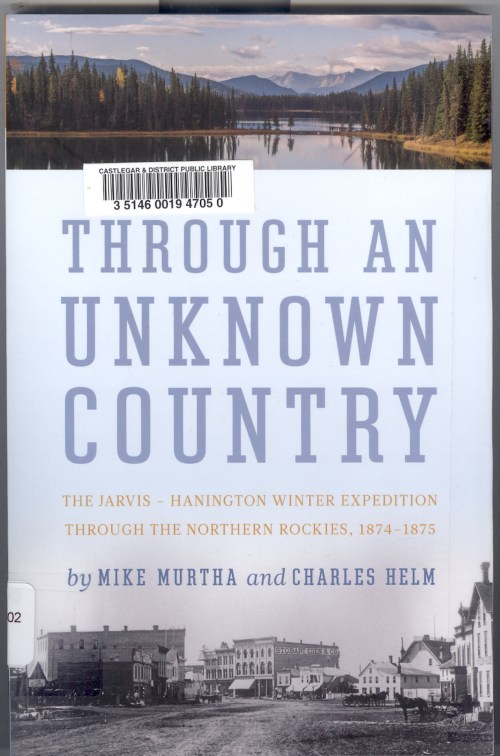
This excellent book about the Jarvis-Hanington winter survey expedition for the CPR came out in early 2016.

According to his obituary in a Manitoba newspaper published after his death in 1894, Edward Worrell Jarvis went to school in England and graduated from Cambridge University.   According to the British Institute of Civil Engineers, he worked as an engineer under the tutelage of Walter M. Brydone, chief engineer for the British Great Northern Railway.   Jarvis worked on the Spalding to March railway in England, east of Birmingham, between 1864 and 1867 before returning to Canada in 1868 when he was employed as an assistant engineer by the Government of Canada, under renowned engineer and surveyor Sir Sandford Fleming, on the Intercolonial Railway in Nova Scotia and New Brunswick, including responsibility for construction of a 15-mile section and a 12-mile section of the track.


From 1871 to 1873 E.W. Jarvis was in charge of 50 men exploring and surveying 360 miles of the CPR rail line, and then in 1873-74 was in charge of an additional 180 miles through the Rocky Mountains.

???????????????????????????????

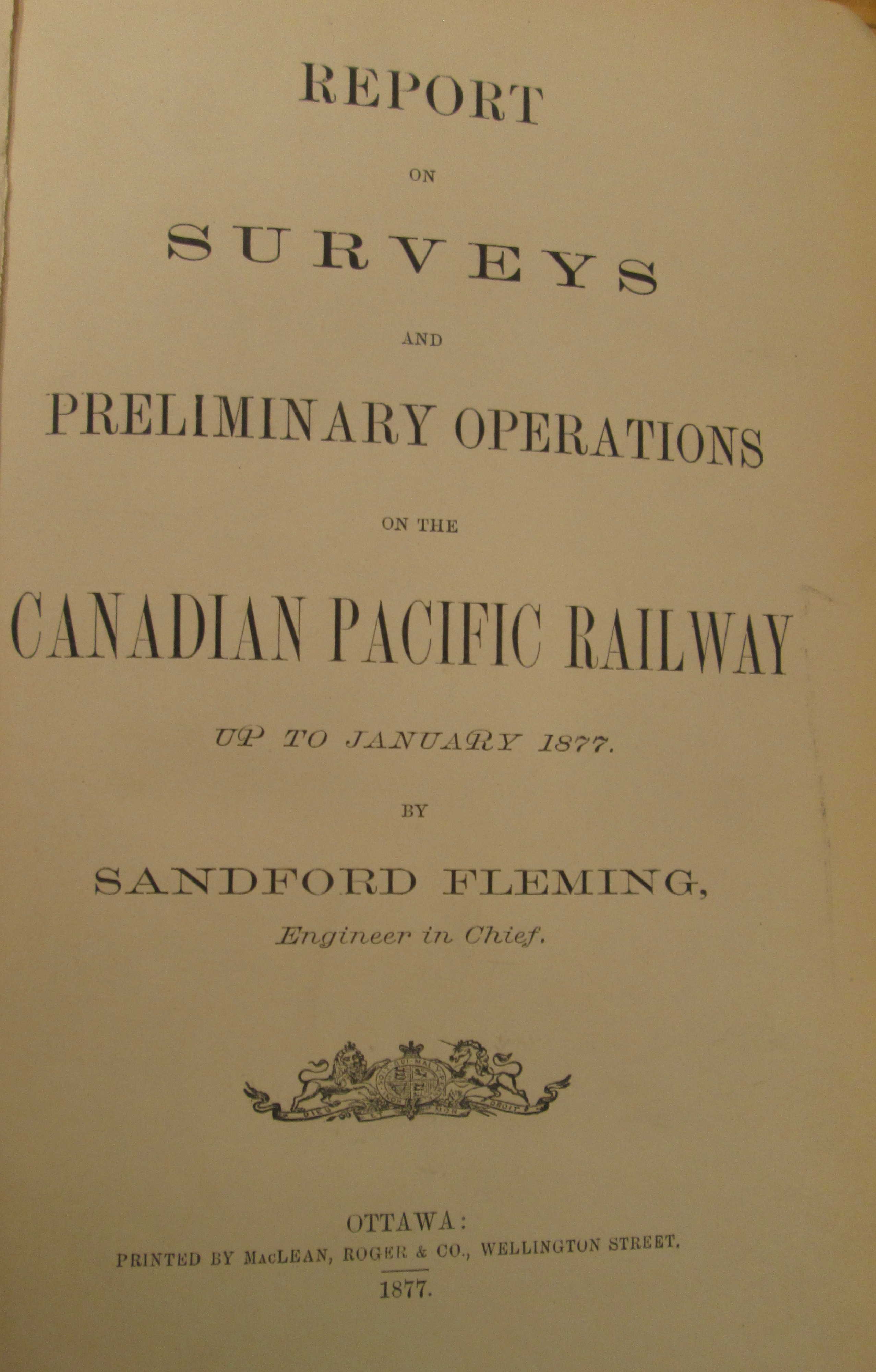
Details of the bone-chilling survey of the Smoky River Pass led by E.W. Jarvis in the winter of 1875 are in Sandford Fleming’s 1877 report of CPR route surveys.

In January 1875 Jarvis led a survey team in a horrific winter expedition to survey the Smoky River Pass north of the Yellowhead Pass as a possible route for the CPR line.   Following instructions from Sandford Fleming (who at that time had decided on the Yellowhead Pass for the CPR, but wanted the Smoky River Pass checked out to see if it could be considered a possible route), Jarvis set off from Fort George (near current site of Prince George, B.C.) with his assistant, C.F. Hanington, Alex Macdonald in charge of dog trains, six Indians and 20 dogs.   The plan was to go through the pass, conduct the required work, and arrive at Edmonton.

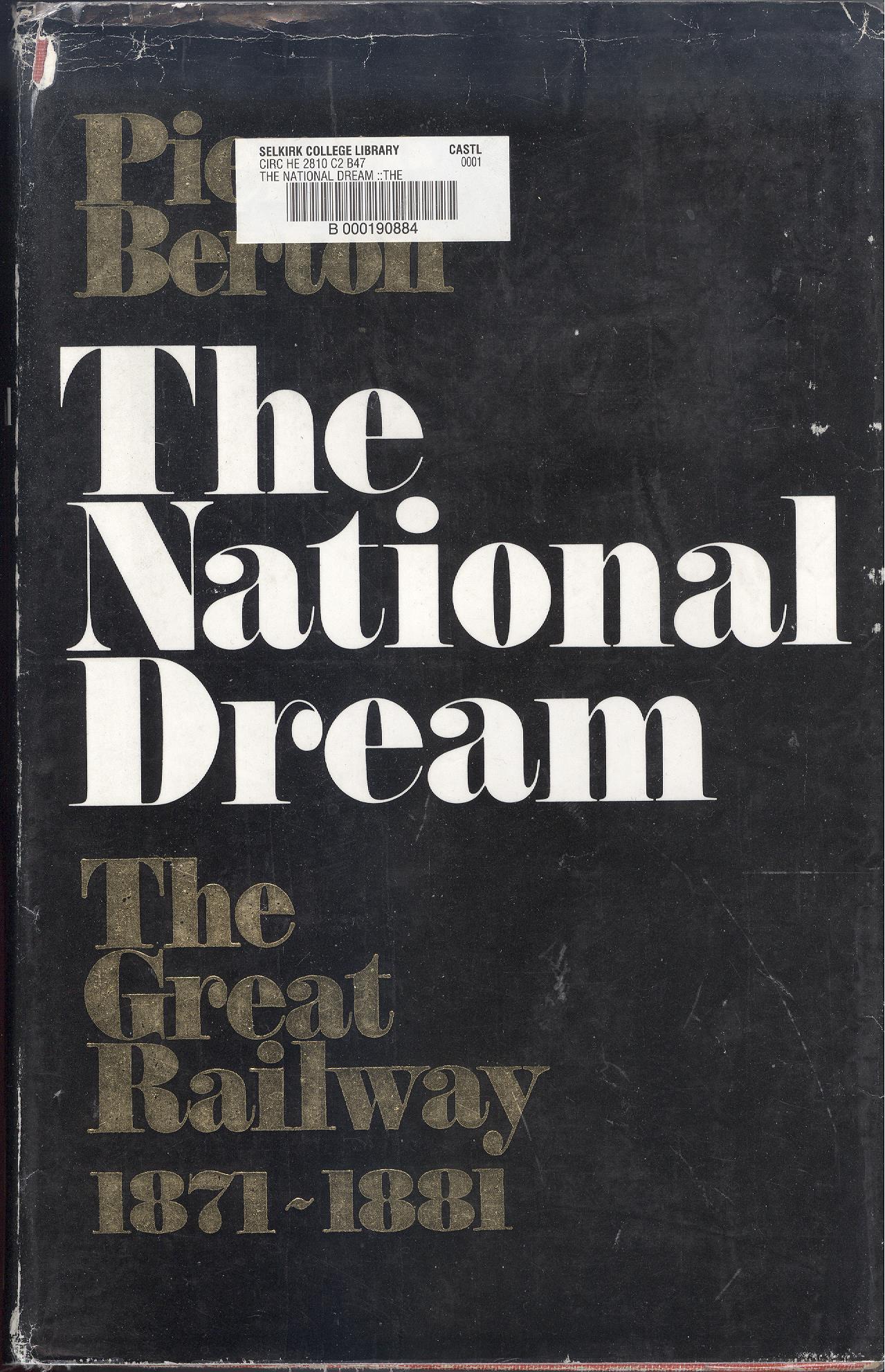
In “The National Dream“, Pierre Berton devoted two full pages to the harrowing expedition led by E.W. Jarvis.  “The party travelled light with only two blankets per man and a single piece of light cotton sheeting for a tent,“ Berton said.  “They moved through a land that had never been mapped.  A good deal of the time they had no idea where they were.  They camped out in temperatures that dropped to 53 below zero.  They fell through thin ice and had to clamber out, soaked to the skin, their snowshoes still fastened to their feet.“

ntional deram 001By March 1875 the dogs used for the Jarvis Expedition were dying daily.  Berton notes that “even the Indians were in a mournful state of despair, declaring that they …would never see their homes again, and weeping bitterly.“  Somehow the group managed to make it to Edmonton, where Jarvis found his weight had dropped to a starving 125 pounds.  After a brief break they set off again across blizzard-swept prairie for Fort Garry, south of modern-day Winnipeg, Manitoba.  In total, the expedition spent 116 days on the trail, travelling 1,887 miles – 932 of those miles on snowshoes and 332 of them with all their goods on their backs, as the dogs had died.

Berton posed the question: Why did they do it.  Not for money or adventure, he concludes.  Rather , “each man did it for glory, spurred on by the slender but ever-present hope that someday his name would be enshrined on a mountain peak… or, glory of glories, would go into the history books as the one who had bested all others and located the route for the great railway.“

Later in 1875 Jarvis began working as a lumber merchant in Winnipeg, Manitoba.  According to Berton, he was “doing a roaring business in lumber and starving no more.“  He was later a partner in the lumber business of W. J. Macaulay and Company.  Between 1880 and 1883 Jarvis designed three bridges in Winnipeg:  the Louise and Broadway Bridges over the Red River and the Main Street Bridge over the Assiniboine River.

In the Riel Rebellion of 1885 he was a Major in command of the Winnipeg Field Battery of the Canadian artillery, and was mentioned in despatches.

Among other distinctions, Jarvis was the first registrar of the University of Manitoba, a founder of the Manitoba Historical Society, an early alderman on the Winnipeg City Council, and an officer in the Northwest Mounted Police.

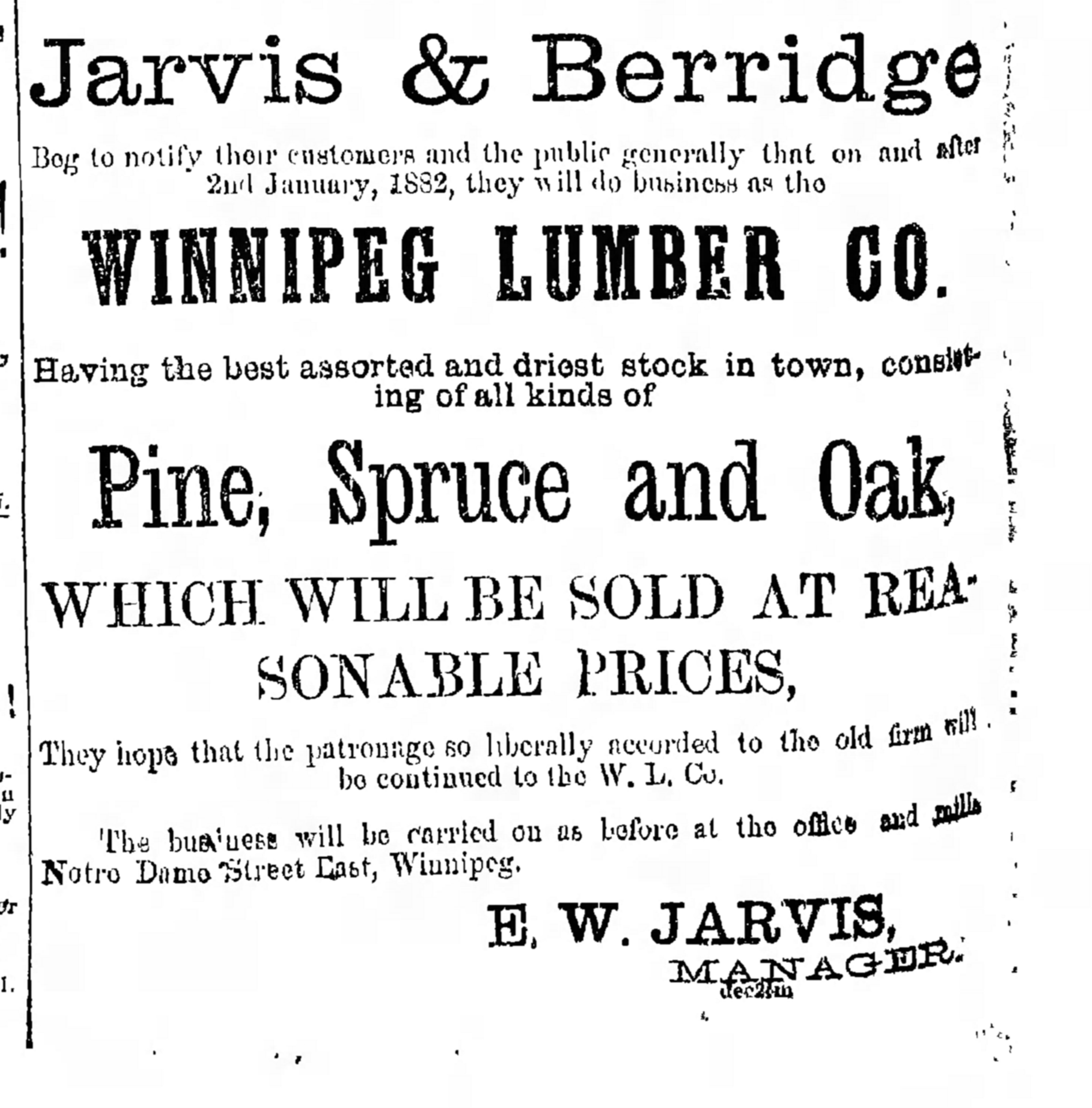
Manitoba_Free_Press_Wed__Jan_18__1882_jarvis lumber ad

lumber ad in Jan. 18, 1882 Manitoba Free Presss


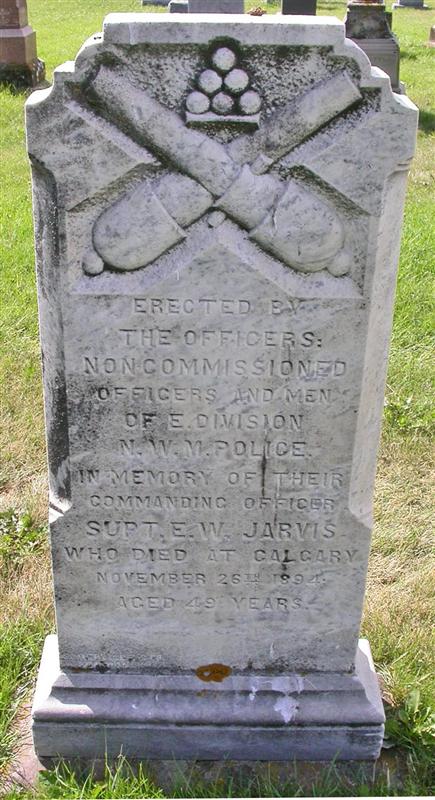
Jarvis Edward Worrallgrave

Text of tombstone: “Erected by the officers, non-commissioned officers and men of E. Division N.W.M. Police in memory of their commanding officer Supt. E.W. Jarvis who died in Calgary November 26th 1894 Aged 49 years.“  Photo courtesy of the Alberta Family History Society.


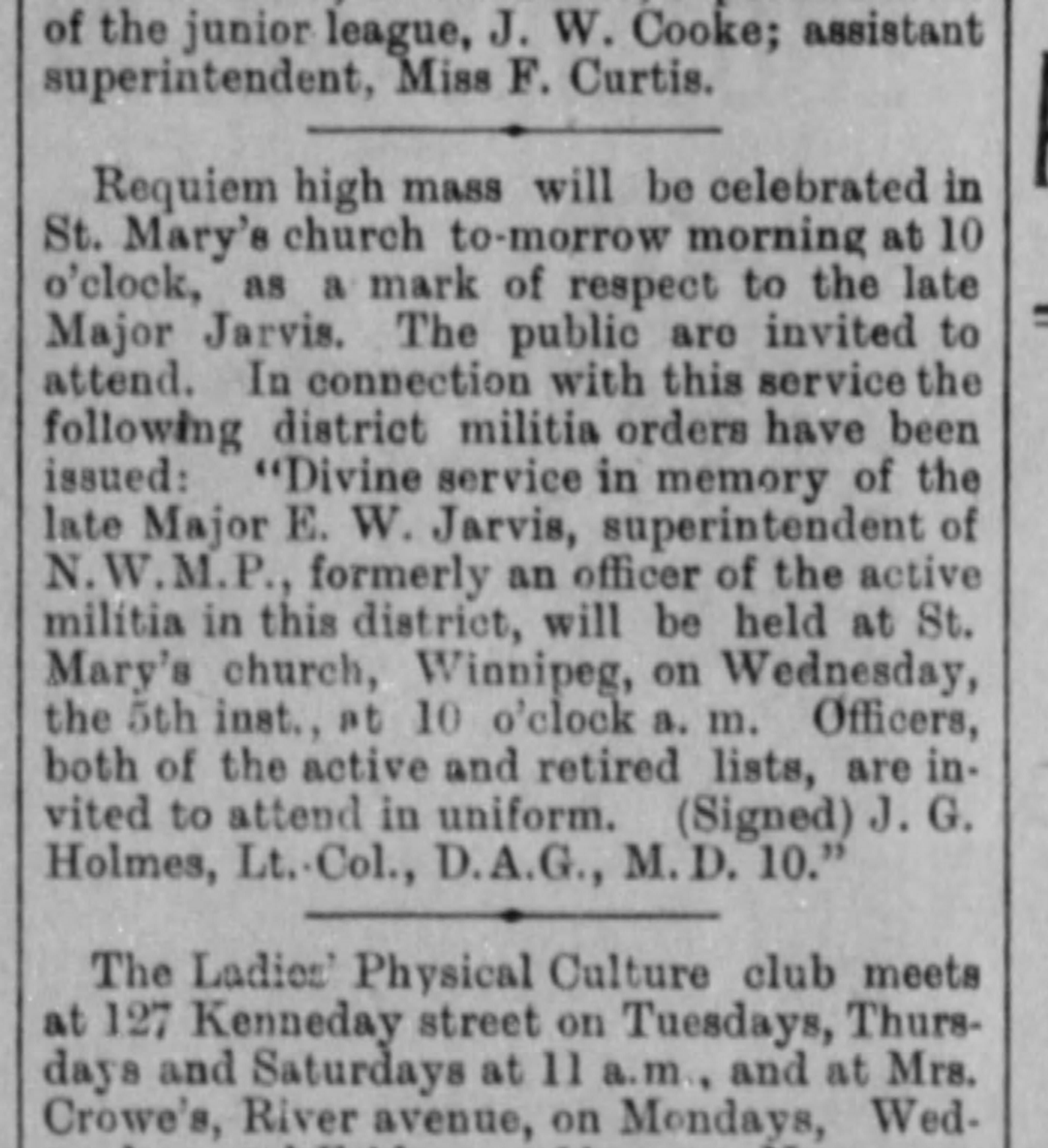
ew jarvis funeral in The_Winnipeg_Tribune_Tue__Dec_4__1894_

obituary from Winnipeg Tribune Dec. 4, 1894

Jarvis joined the NWMP in 1886 when the federal government decided to double the size of the force from 500 to 1,000 when they realized that additional policing resources were needed in the wake of the Riel Rebellion.   Jarvis was among 29 new officers appointed in this expansion of the force.  His military service was a factor in his selection as an officer, as was the fact that he was born in Prince Edward Island, because the government wanted the various regions of the country to be represented in the group of new officers.   Superintendent Jarvis was one of five of the new NWMP officers to have served in the Riel Rebellion.   Jarvis` experience with the NWMP is described in the book “Red Coats on the Prairies“ by William Beahen and Stan Horrall.  In addition to his command duties, Jarvis was tasked with reviewing NWMP regulations, and testing new ammunition proposed for the NWMP manufactured by the Dominion Cartridge Co. of Montreal.   He concluded that is was “impossible to shoot well with bullets supplied by the Dominion Cartridge Company“.   When telephone service was introduced for the NWMP between Moose Jaw and Wood River in 1887, Jarvis designed and produced two receivers to be used with the new communication system.   It was Jarvis who put forward the idea of a musical band for NWMP headquarters as a worthwhile form of recreation for the men in the NWMP, who otherwise often turned to drinking and associated misbehaviour when they were off duty.   The men would not be paid extra for being in the band, but they would be excused from tedious duties.   According to Beahen and Horrall, Jarvis was surprised when the NWMP commissioner approved his suggestion of a band.  As it turned out, Inspector W.G. Matthews, who was appointed conductor of the band, was largely responsible for the first Mounted Police Musical Rides, which became an institution with the force that continues to the present day.  The authors note that C.W. Dwight, an NWMP constable from a well-to-do family in Toronto, said in a letter that his Commanding Officer in “A“ Division (Supt. Jarvis) was “a thorough gentleman and his treatment of men at all times considerate and impartial.“

red coasts 001

As an idea-oriented engineer with wide-ranging knowledge and capabilities, Jarvis was asked to make recommendations for improving the NWMP facilities and operations.  In his first annual report submitted November 30, 1886 he expressed a vision for practical improvements to the uniform which are largely in line with how the NWMP and later the RCMP uniforms later developed. “The Police uniform fits too well for a man actively engaged in rough prairie work, and is soon spoiled by duties required a camp fire,“ Jarvis wrote, adding  “I would suggest the issue of a `prairie dress` which would consist of dark brown cord or velveteen britches, long boots and spurs, a heavy blue flannel shirt (over which the stable jacket could be worn when required) and a broad-brimmed hat of soft felt to complete the outfit.  By adopting this, personal comfort and a uniform appearance would be gained, while the regular uniform would be saved for parade and duty in settled districts.  The forage cap is no use at all on the prairie.“

Tragically, Superintendent Jarvis died in Calgary on November 24, 1894 of cellulitis, a type of skin infection that can be fatal.   Because of his popularity, NWMP men from other divisions were allowed time to come to his funeral.   This ended badly, as many of the men gathered for the funeral got drunk and made a public exhibition of themselves, according to Beahen and Horrall.   One officer was found to be completely drunk in uniform in the lobby of the hotel the next morning at 9 am.

Jarvis is buried in the St. Mary`s Pioneer Cemetery in Calgary.  Jarvis Avenue in Winnipeg is named after him, as are Jarvis Creek in Alberta, Jarvis Creek in B.C., Jarvis Lake in Alberta, Jarvis Lake in B.C., Mount Jarvis in B.C., Jarvis Pass in B.C and Jarvis Street in Hinton, Alberta.  A collection of his journals are held by the Archives of Manitoba.


CLUES FROM MIDDLE NAMES IN GRAY FAMILY

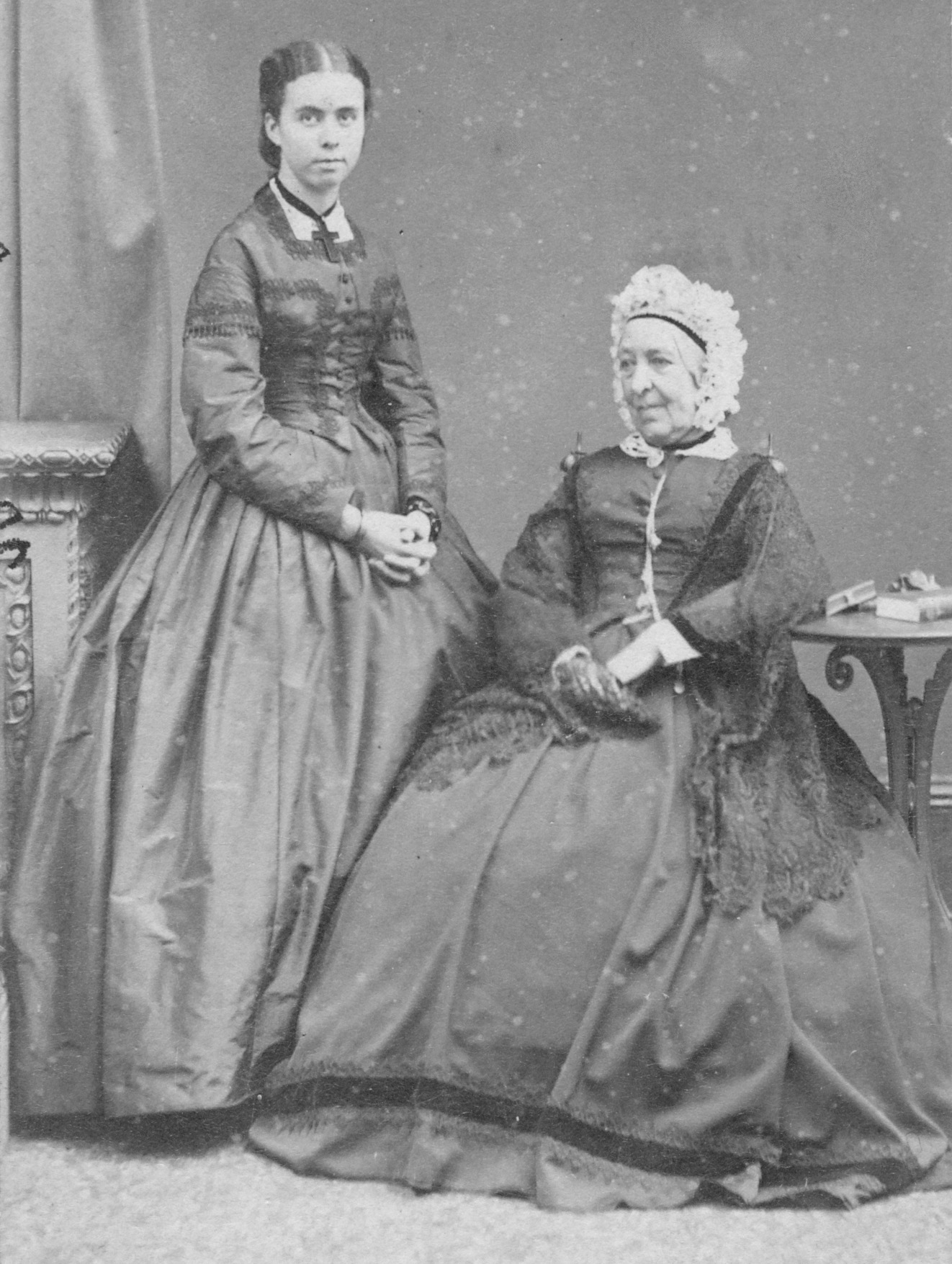
dally sister harriet gray

Harriett Worrell Gray, eldest daughter of John Hamilton Gray, in 1864.

Worrell (or alternate spelling Worrall) was also the middle name of his cousin Harriett Worrell Gray (first child of John Hamilton Gray and Susan Bartley-Pennefather), who was born three years earlier than Edward, in 1843.   We know from Loyalist Robert Gray`s autobiographical notes that he named his youngest son John Hamilton Gray as a tribute to the Hamilton family in Scotland who trained and employed him in their tobacco trading business in Colonial America.  One might assume that Robert Gray`s children John Hamilton Gray and Elizabeth Gray Jarvis also named children with middle names in appreciation for some special assistance or support for them at some time by the Worrell family.   A possible link would be the Worrell Estates near St. Peters Bay on the north coast of Prince Edward Island, in the vicinity of land granted to original proprietor George Burns, who was maternal grandfather of John Hamilton Gray and Elizabeth Gray.   See bio of Charles Worrell at  http://www.biographi.ca/en/bio/worrell_charles_8E.html

Hamilton Edward Jarvis Gray (1880-c.1889) was the last child of Col. John Hamilton Gray and his third wife Sarah Caroline Cambridge (1842-1906).   Col. Gray was 69 when his youngest son Hammy was born.  Hammy is listed as a beneficiary in his father`s will dated January 1887, and is not listed on the 1891 British census, though his mother and brother Arthur are on the census, indicating that Hammy likely died sometime between 1887 in Prince Edward Island and 1891 in England, where his mother had moved with her son Arthur.  The fact that Col. Gray would have Edward Jarvis as middle names for his son is perhaps a reflection of his admiration for the father E.J. Jarvis, his son E.W. Jarvis, or both.


THE TWO LADIES IN THE PHOTO

Margaret Gray Lord was the only one of Col. Gray`s five daughters to continue residing in Prince Edward Island through her lifetime.   In October 1864 she accompanied her father to the Quebec Conference where proposals for confederation were thoroughly discussed and carried forward.  By the 1930s, she was the last surviving partipant of the historic Quebec Conference.  She was presented to the King and Queen when the Royal Tour came to Charlottetown in 1939.   Through most of her adult life she kept a personal diary, which was the basis for the book “One Woman`s Charlottetown: the 1863, 1876 and 1890 Diaries of Margaret Gray Lord“ published in 1987.  Margaret was active in the Womens Temperance Movement in the early 1900s, perhaps recalling with disdain the inebriation of many of the Fathers of Confederation when her father brought them home for an after-dinner party that followed a late afternoon feast and libations in Charlottetown Harbour.  Margaret enjoyed excellent health until her death in Charlottetown at age 96 on December 31, 1941.

Florence Gray with her grandmother, Lady Pennefather (Margaret Carr Bartley)

Florence Gray with her maternal grandmother, Lady Pennefather (Margaret Carr Bartley), who lived in Aldershot, England and came to PEI to visit her daughter Susan and her family every couple of years.  Circa 1868.  Peters Family Papers photo.

Florence Gray Poole was keen on family history, and conducted substantial research and associated correspondence regarding the ancestry of both her parents.   Tragically, her son Eric Skeffington Poole, a second lieutenant with the British Army, was court martialled for desertion in the fall of 1916 after he was found to have wandered away in a daze from his assigned position in a front line trench.   Despite testimony from medical staff that he was experiencing the lingering effects of shell shock from the Battle of the Somme a couple of months earlier, Eric was convicted and shot at dawn in Poperinghe, Belgium on Dec. 16, 1916.  At the time, Florence`s husband Henry Skeffington Poole was very ill, and she worried that hearing of Eric`s fate would kill him.  She reached an agreement with authorities that she would not contest the execution and they would not publicize it.  Ironically, one of her other sons, Henry Raynaulde Poole, won a Distinguished Service Order (DSO) medal for valour in the Great War, and was an officer of the Order of the British Empire (OBE) and the French Legion of Honour.  Florence died at age 75 in 1923 in Guildford, England, six years after the death of her husband Henry.


SOURCES

Link to Memorable Manitobans web site http://www.mhs.mb.ca/docs/people/jarvis_ew.shtml

link to an article in Manitoba History that focused on the families of Edward James Jarvis and Alexander Ross as examples of Victorians families of their era. http://www.mhs.mb.ca/docs/mb_history/13/victorianfamily.shtml

RCMP memorial web site

http://www.rcmpgraves.com/database/depotdynasty.html

British Engineering Society publication

http://www.gracesguide.co.uk/Edward_Worrell_Jarvis#cite_note-1

Link to Edward James Jarvis, chief justice, PEI in Canadian Dictionary of Biographies

http://ww.w.biographi.ca/en/bio/jarvis_edward_james_8E.html

Link to Charles Worrell in Canadian Dictionary of Biographies.

http://www.biographi.ca/en/bio/worrell_charles_8E.html

Descendants of PEI Fathers of Confederation Enjoy Reunion Commemorating 150th Anniversary of the Charlottetown Conference

Leave a comment

By Sam McBride

The reunion of descendants of Prince Edward Island`s seven Fathers of Confederation was a memorable part of the celebrations of the 150th anniversary of the historic Charlottetown Conference of September 1864 which set the stage for the creation of Canada as a self-governing, transcontinental nation in 1867.

???????????????????????????????

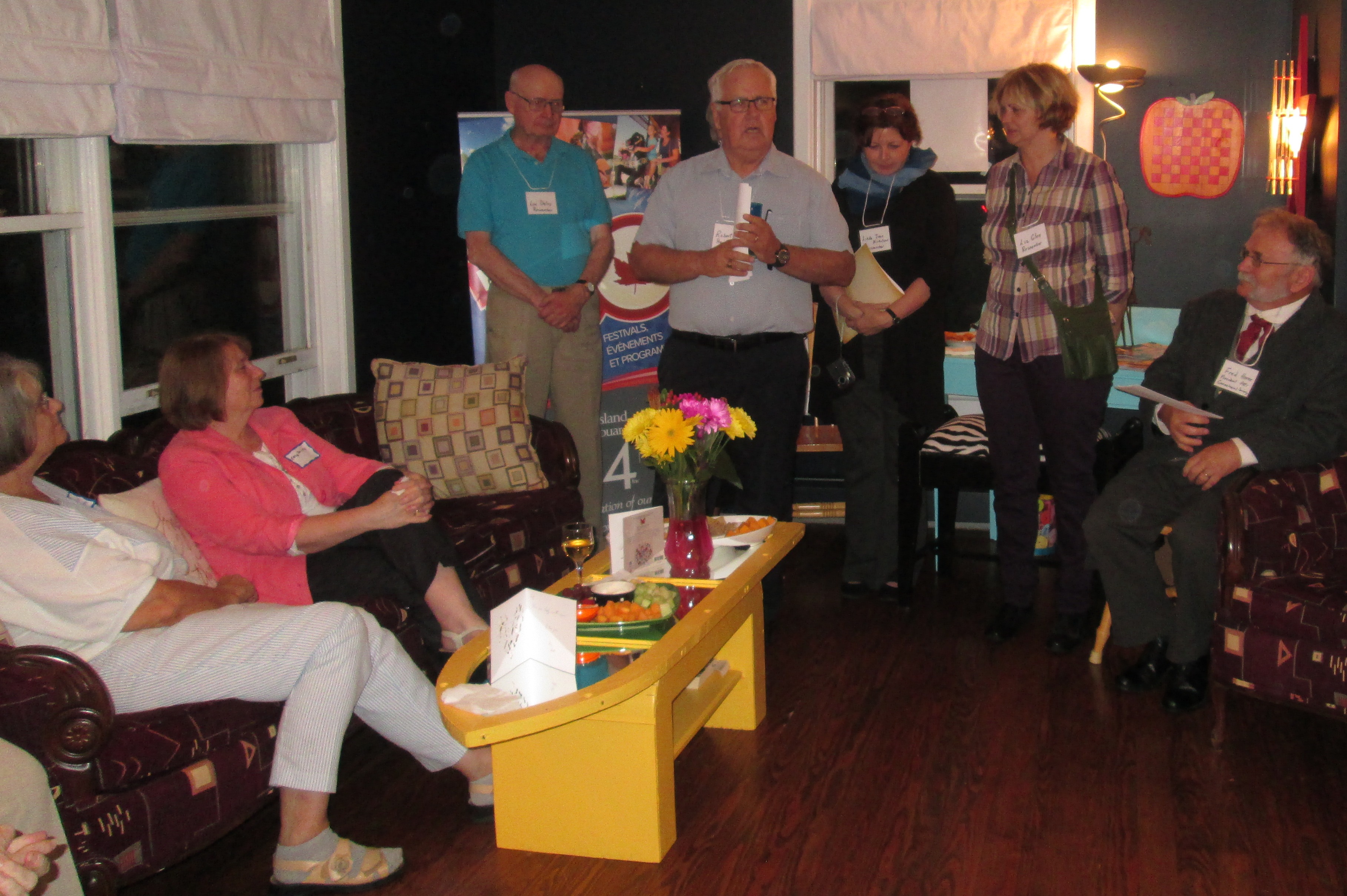
At the opening reception for the Descendants Reunion on Sept. 11th, project chairman Bob Pierce of the PEI Genealogical Society introduces the researchers who studied each of the PEI Fathers of Confederation and identified descendants.

Many thanks to the Prince Edward Island Genealogical Society (PEIGS), as well as the wider PEI heritage community, for bringing descendants together from many parts of Canada and the U.S. to share in a special experience honouring their renowned ancestors.

oct 1 2014 057

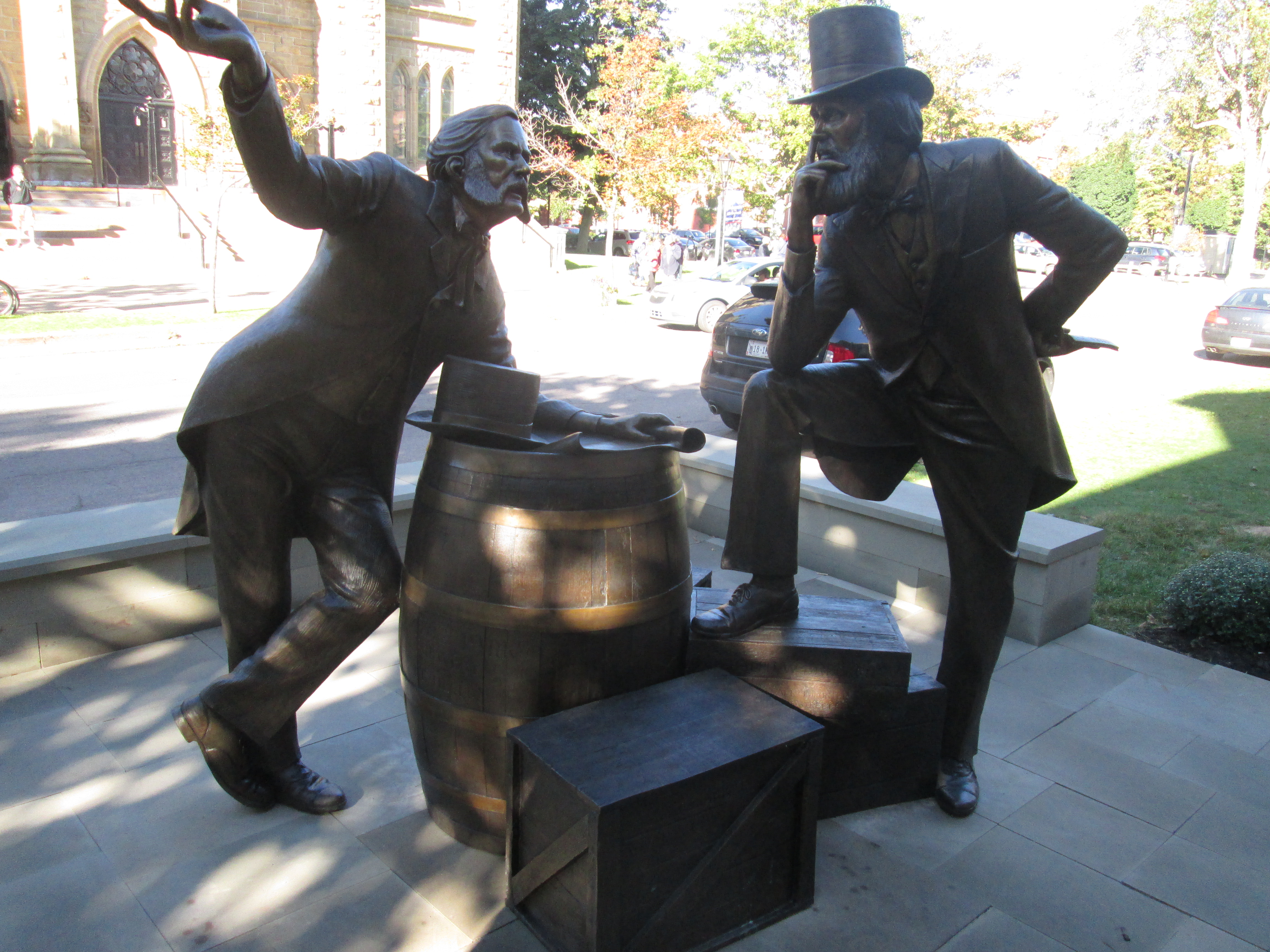
New sculpture near Province House of the two Fathers of Confederation named John Hamilton Gray was unveiled Sept. 4, 2014.   See Guardian story on the artist and the unveiling of the sculpture at http://www.theguardian.pe.ca/News/Local/2014-09-04/article-3858056/Bronze-statue-unveiled-on-Great-George-Street/1


charl sculpture collage

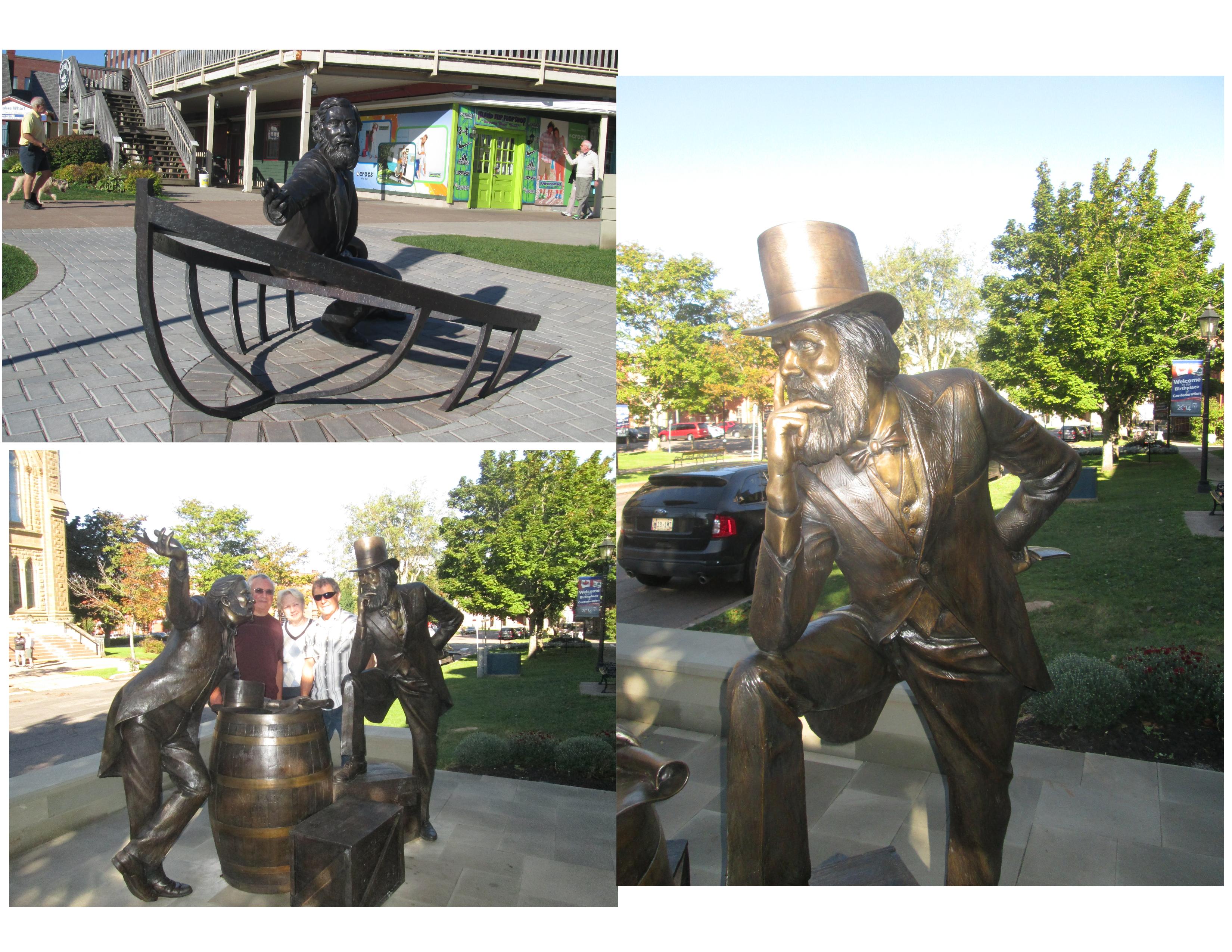
Top left: new sculpture of Father of Confederation William Henry Pope at Charlottetown`s picturesque waterfront, depicting him welcoming Charlottetown Conference delegates from a rowboat.  Bottom left: three of the great-great-grandchildren of PEI Father of Confederation John Hamilton Gray (right) pose with the new sculpture on Great Georges Street that shows PEI Premier Gray interacting in 1864 with his namesake (no relation) John Hamilton Gray, who was a Father of Confederation from New Brunswick. Right: detail of the PEI Gray enjoying the late summer sun.

2 poses re confederation

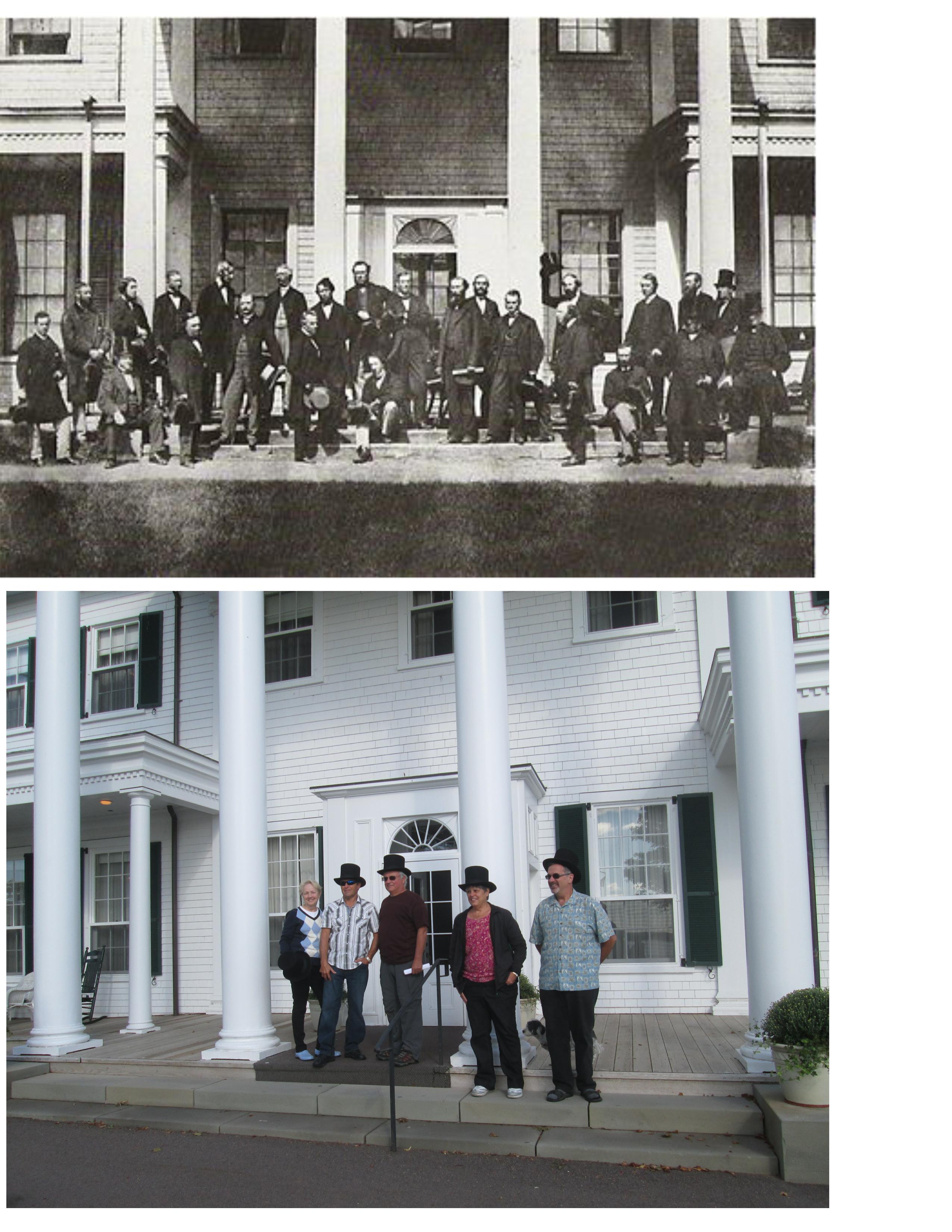
Top: the famous photo of the Fathers of Confederation at the Charlottetown Conference. Below: some of the descendants of PEI Fathers of Confederation John Hamilton Gray and Thomas Heath Haviland at the descendant reunion at the same location, which today serves as the official residence of the Lieutenant-Governor of PEI.

sep 13 2013 charlottetown 092

New brands of Fathers of Confederation beer launched this year as part of the commemoration of the 150th anniversary of the Charlottetown Conference.

???????????????????????????????

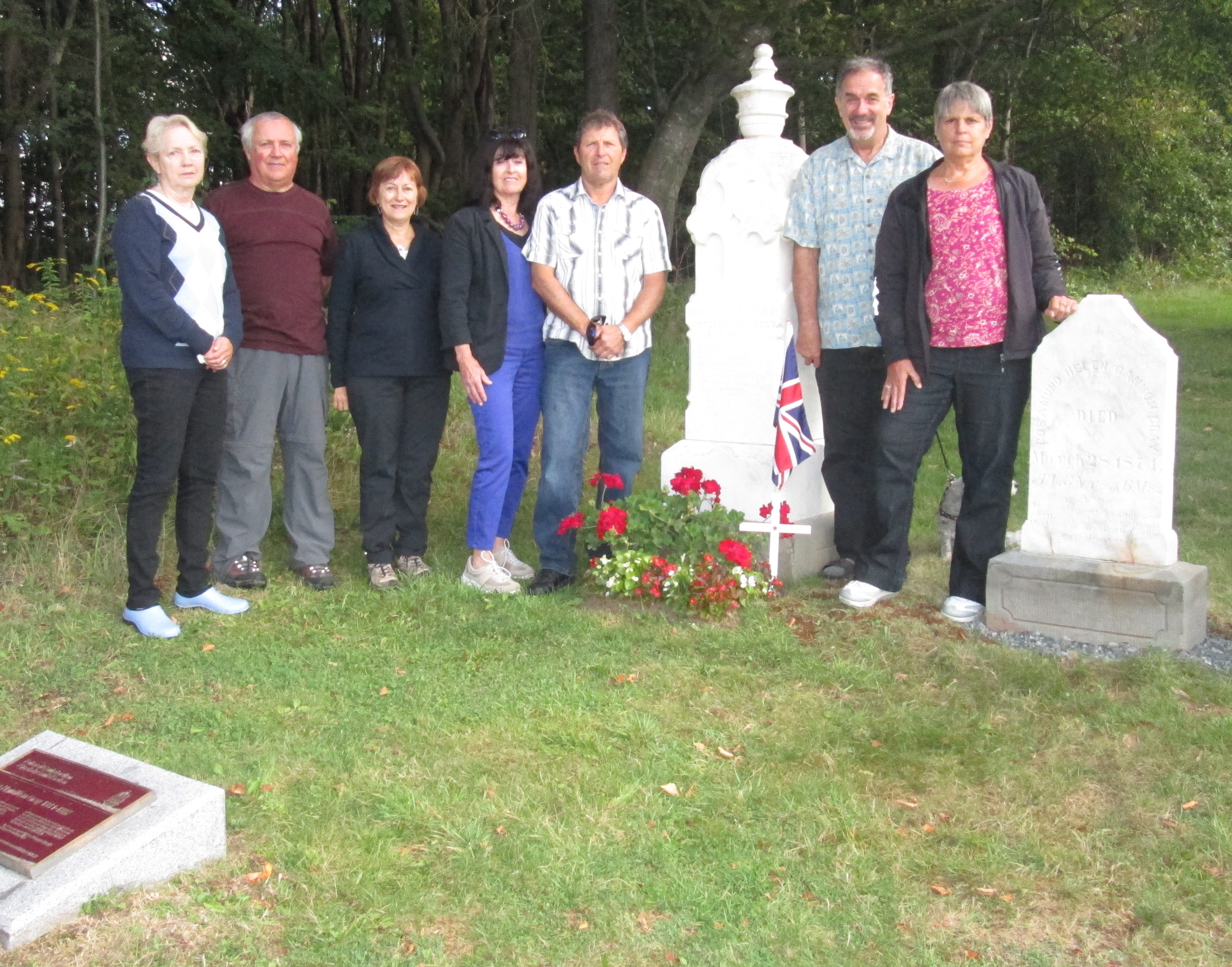
Reunion participants (PEI Gray and Haviland) beside the tombstones of John Hamilton Gray and his daughter Rosie Gray in Sherwood Cemetery in Charlottetown.

The reunion began with a welcome reception in Charlottetown where descendants met their PEIGS hosts, as well as PEI historians, researchers, archivists and representatives of the provincial government, including the Hon. Robert Henderson, Minister of Tourism and Culture. It was also a chance to meet descendents of other PEI Fathers of Confederation.  For me and other British Columbia descendants of John Hamilton Gray through his daughter Bertha Peters, it was the first time we met our third cousins in PEI descended from Bertha’s sister Margaret Lord.

???????????????????????????????

Reunion participants learn about the PEI Fathers of Confederation at a Sept. 12th presentation at the Carriage House by U of PEI history professor Ed MacDonald.

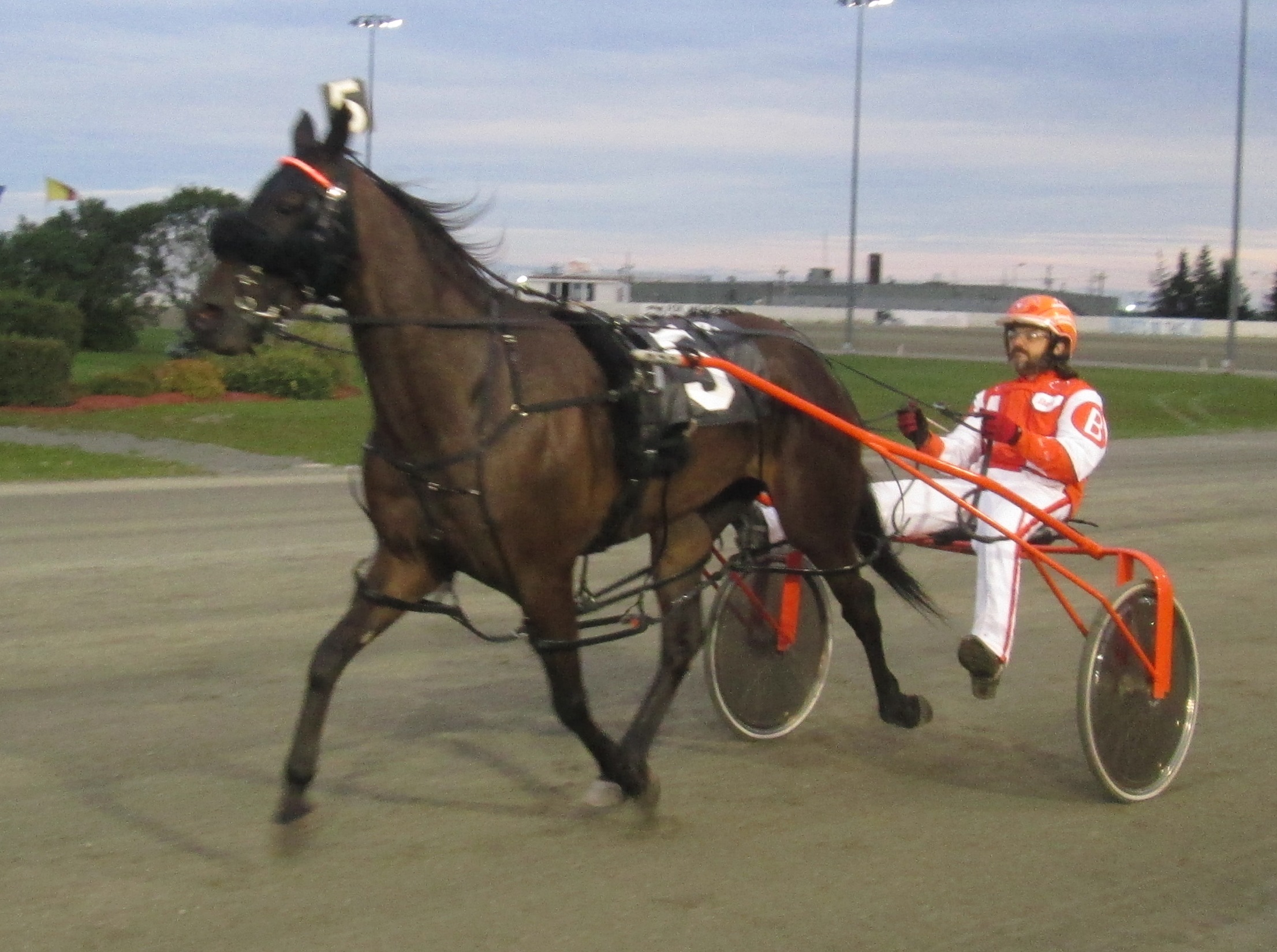
The three-day schedule of the reunion also included tours of locations, buildings, sculptures and cemeteries associated with our ancestor, a presentation on the PEI Fathers of Confederation by University of PEI history professor Edward MacDonald, and a fun evening at the Red Shores Race Track where the Fathers of Confederation Descendants Race was run, and reunion participants presented a cooler to the winning horse and driver in the winners circle. We also enjoyed a tour of the PEI Brewing Co. to see how their beers honouring the Fathers of Confederation were made, and taste the results.  In the months leading up to the reunion, the Charlottetown Guardian newspaper presented a series of feature stories by writer Louise Campbell on each PEI Father of Confederation and their descendants.

???????????????????????????????

Reunion participants enjoyed exciting races at the Red Shores Racetrack on Sept. 13th, which included a Fathers of Confederation Descendants race and presentation to winning horse and rider.

The largest contingent in the gathering were descendants of William Henry Pope, who was Colonial Secretary of PEI at the time and is probably best-remembered in Canadian history for the painting of him in a rowboat greeting John A. Macdonald and other delegates from Upper and Lower Canada as they arrived in Charlottetown harbour to meet with Maritime colony delegates for the first time. Descendants of Col. John Hamilton Gray – who had large role in the conference as chairman of the conference and host of a major social event — made up the second-largest delegation of descendants.  Pope and Gray were enthusiastic supporters of Confederation early on, while most of the other PEI delegates were against joining the Canadian union.  PEI eventually joined Confederation in 1873 – six years after the founding of Canada in 1867 – when the island faced a financial crisis involving railway debt, and the deal to join Canada resolved that problem, along with land issues.

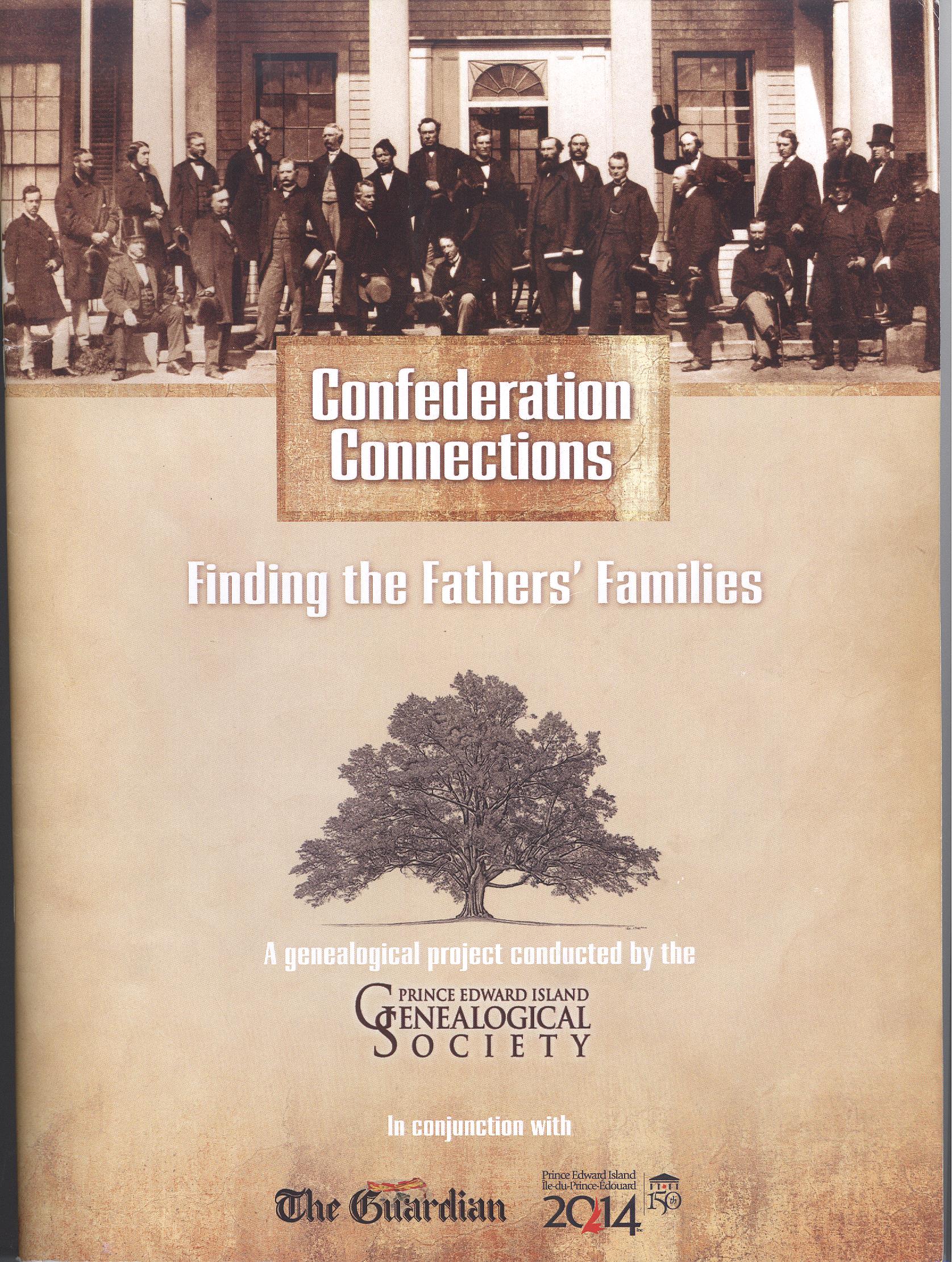
confederation connections book 001

Commemorative book published for reunion participants, including stories and descendant trees of each of the seven PEI Fathers of Confederation.

My mother Dee Dee Dewdney McBride and grandmother Helen Peters Dewdney often talked of their ancestor Col. John Hamilton Gray who was premier of PEI at the time of the Charlottetown Conference and rated as a Father of Confederation.   In the family, Gray was viewed as one of three ancestors who were PEI premiers.  His son-in-law Frederick Peters (father of Helen) was premier in the 1890s, and his brother Arthur Peters was premier in the early 1900s.  Helen never knew her famous grandfather John Hamilton Gray, as he died 18 days before she was born in Charlottetown in August 1887, but she often heard stories of him told by her mother Bertha, who lived with the Dewdney family as a widow when her grandchildren were growing up in B.C.  Bertha brought with her a dining room table from Inkerman House that her father bequeathed to her in his will, and continues to be a treasured heirloom of her descendants.  She regularly commented to visitors that “the Fathers of Confederation sat around that table“.  Bertha was at Inkerman House on Sept. 3, 1864 when her father hosted the Charlottetown Conference delegates for an after-dinner party, but had no memory of it as she was just two years old.  Years later her father and older sisters told her of the memorable night when the family home was filled with distinguished-looking men, most of them in various stages of inebriation.  The group came to Inkerman House directly from a jovial dinner party on HMS Queen Victoria in Charlottetown harbour where an ample supply of drinks were served, and a spirit of friendship and unity developed.

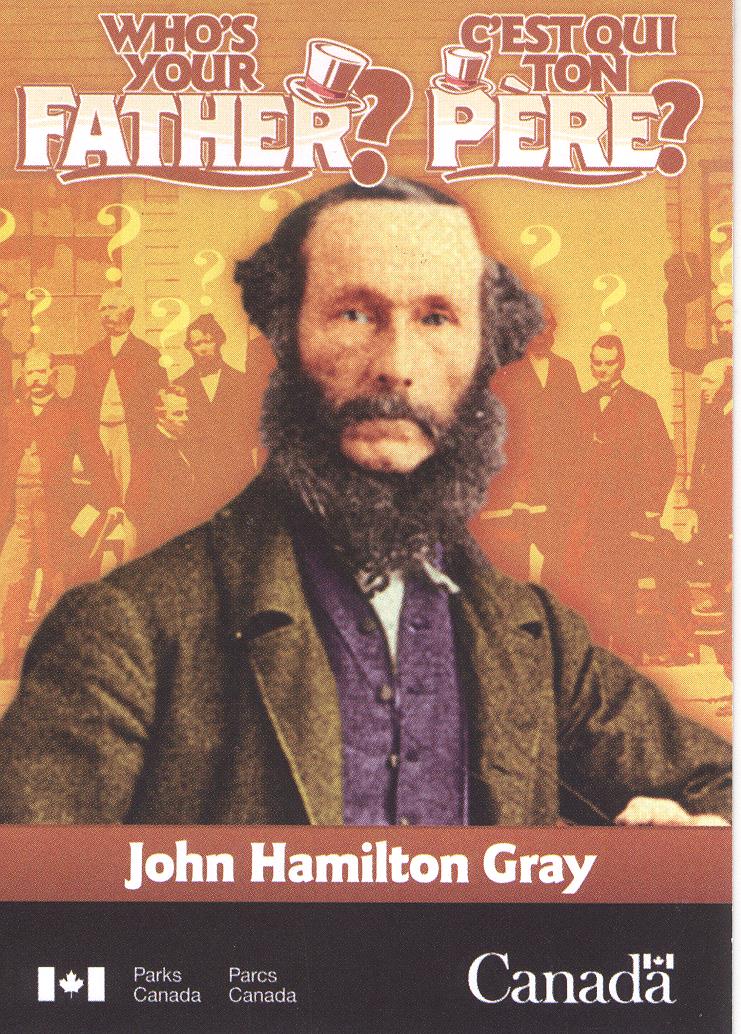
front of JH Gray souvenir card 001

Souvenir card for John Hamilton Gray in the Parks Canada “Who`s Your Father?“ quiz. http://www.whosyourfather.ca.

As he also attended the Quebec Conference of October 1864, Col. Gray qualifies as a Father of Confederation. (As a historical standard, individuals rate as Fathers of Confederation if they attended at least two of three conferences: the Charlottetown Conference of 1864, the Quebec Conference of 1864 and the London Conference of 1866. They are included as Fathers of Confederation even if they were adamantly against the union of the British colonies at the time).

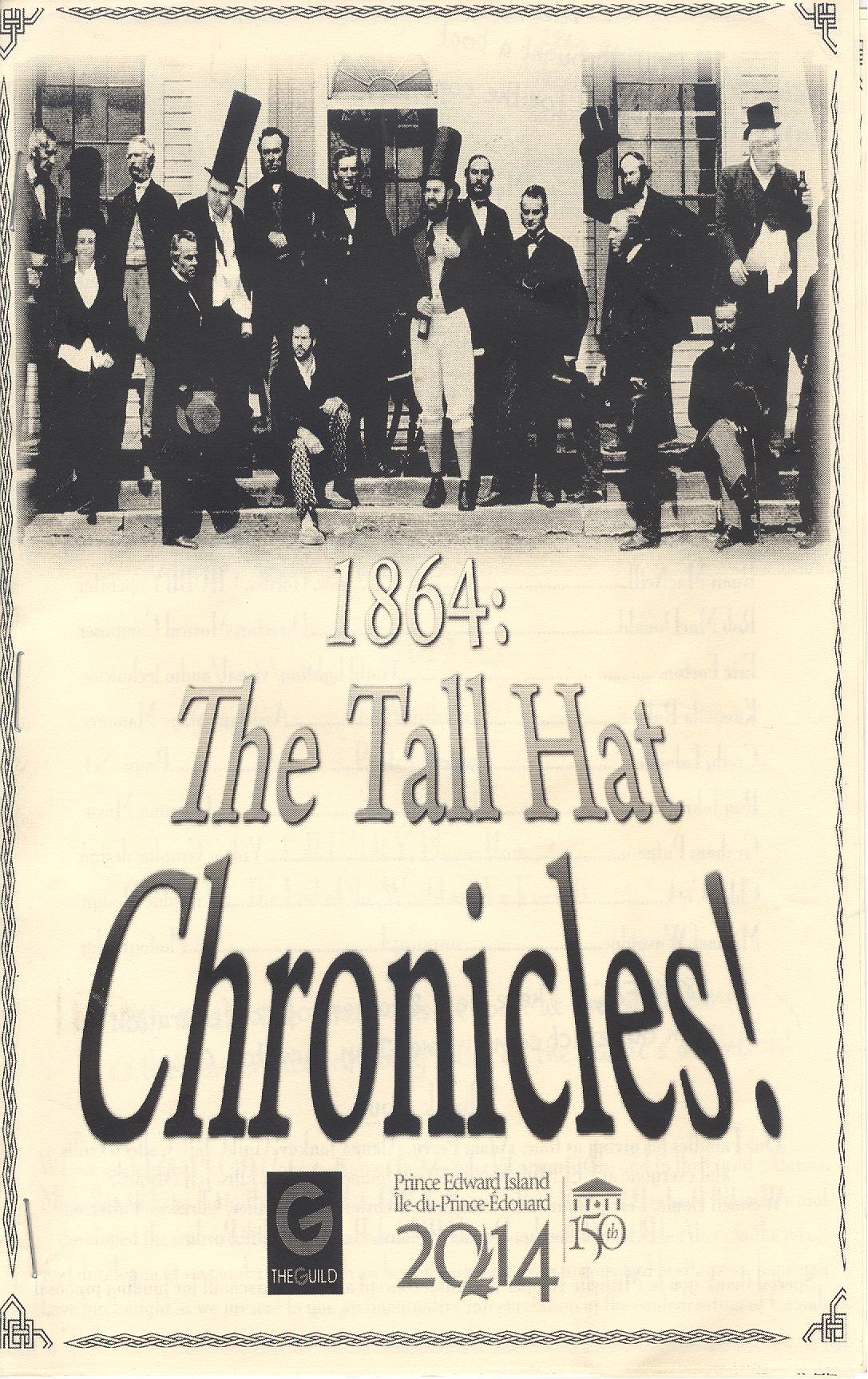
program for tall hat chronicles 001

Program for a theatrical production at the Guild theatre in Charlottetown spoofing the famous characters. events and imbibing of 1864.

Identifying and locating the descendants was a big challenge for the PEIGS, as they normally research backwards in time to identify the names and stories of ancestors. It is more difficult to identify the descendants of today, because the census and vital statistics data genealogists usually rely on are not available because of government regulations protecting the privacy of living persons.  Fortunately, the electronic media of today was a big help in determining and contacting descendants.

sept 11 b 2014 018

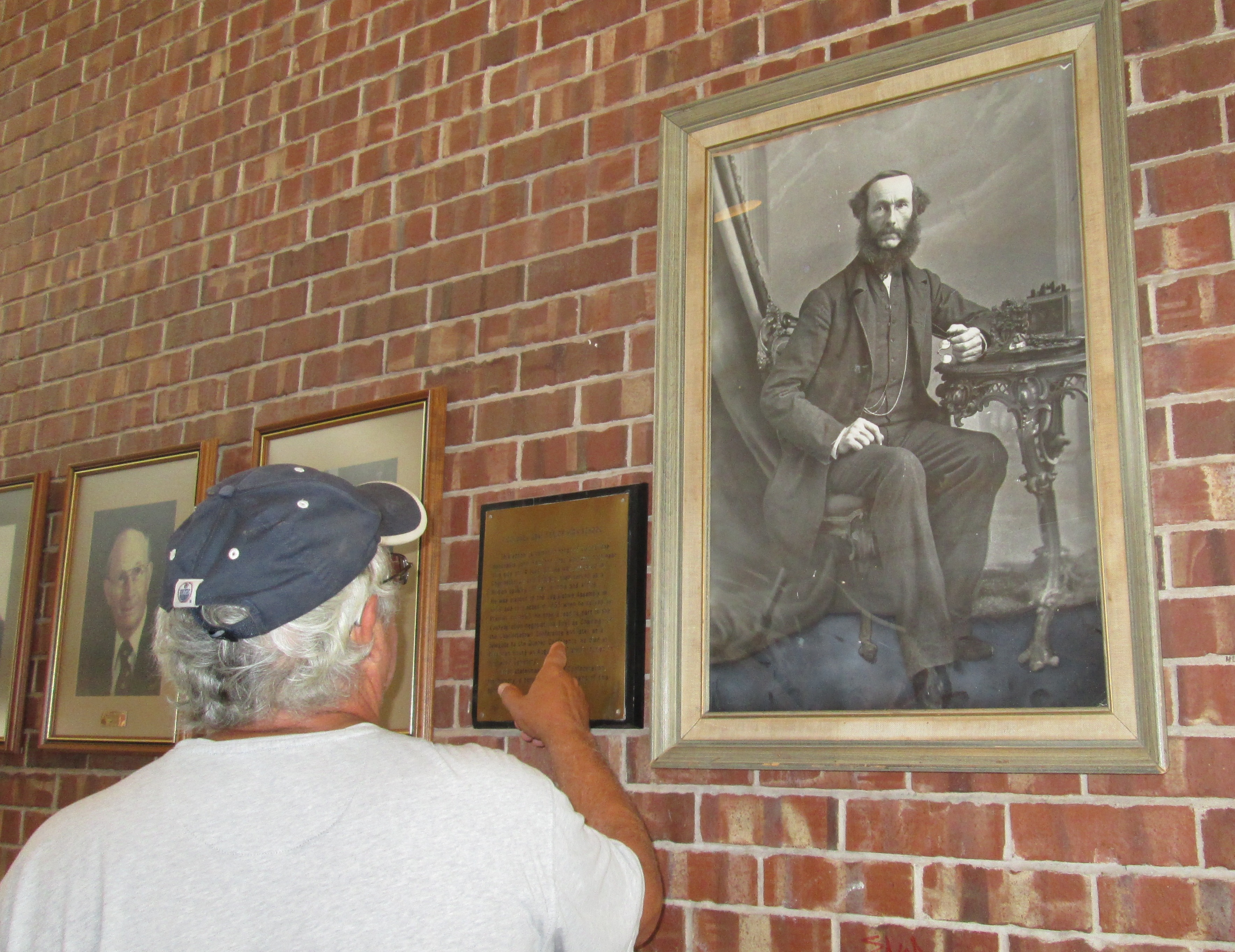
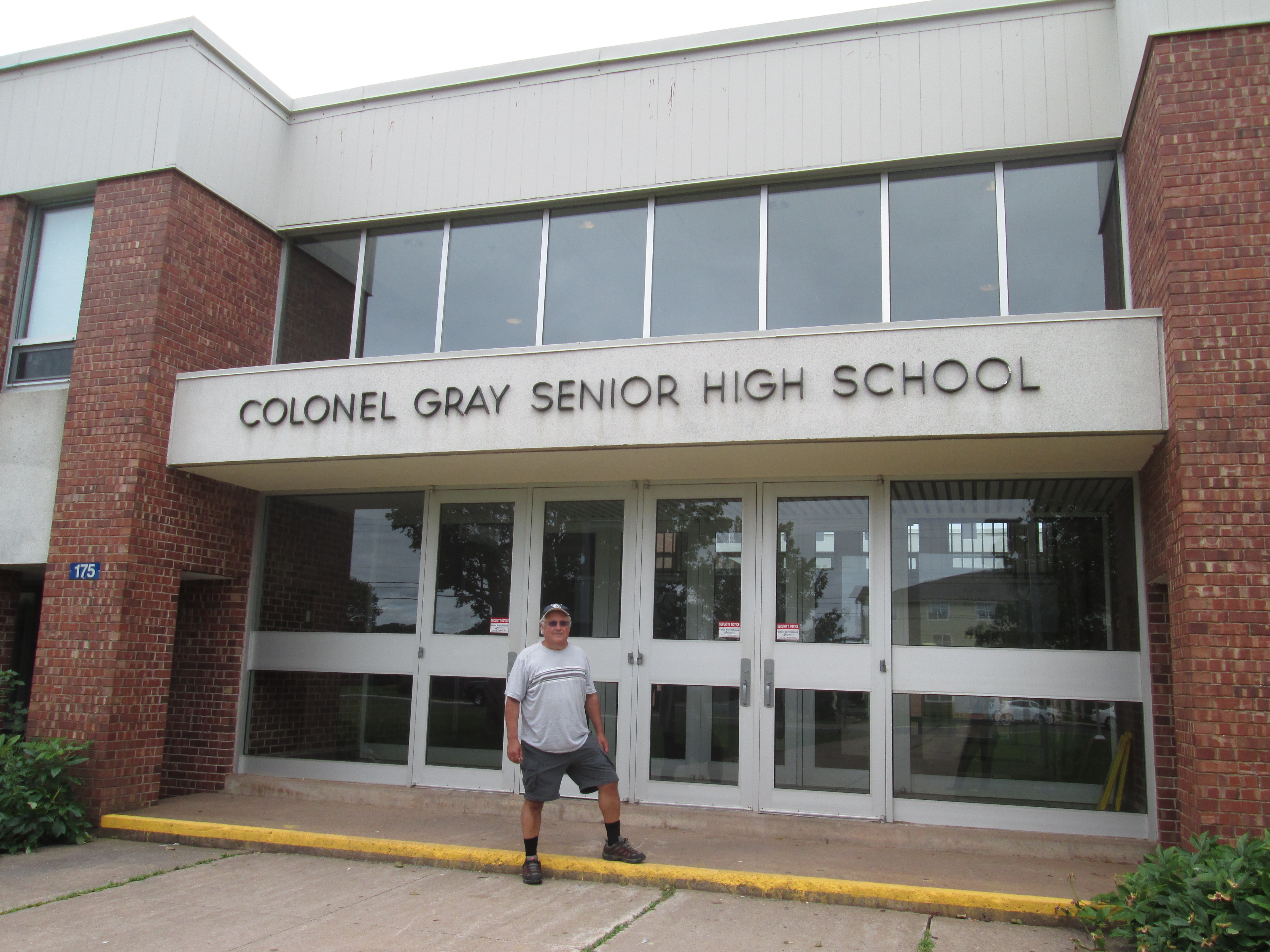
Checking out the large framed print of Premier Gray at the Colonel Gray Senior High School in Charlottetown, which is one of many venues in the area named after him. He was only premier of PEI for a year and a half, but it turned out to be a crucial time in the history of PEI and Canada.

sept 11 b 2014 016

The descendants reunion was one of 150 events held in PEI in 2014 commemorating the 150th anniversary, including leadership conferences, heritage conservation conferences, historic costume-making classes, garden exhibitions, theatrical presentations, and music events highlighted by a Shania Twain concert.  See http://pei2014.ca/home.php?page=month_activities&subtype=%&region=%&pagegroup=5

???????????????????????????????

jh gray

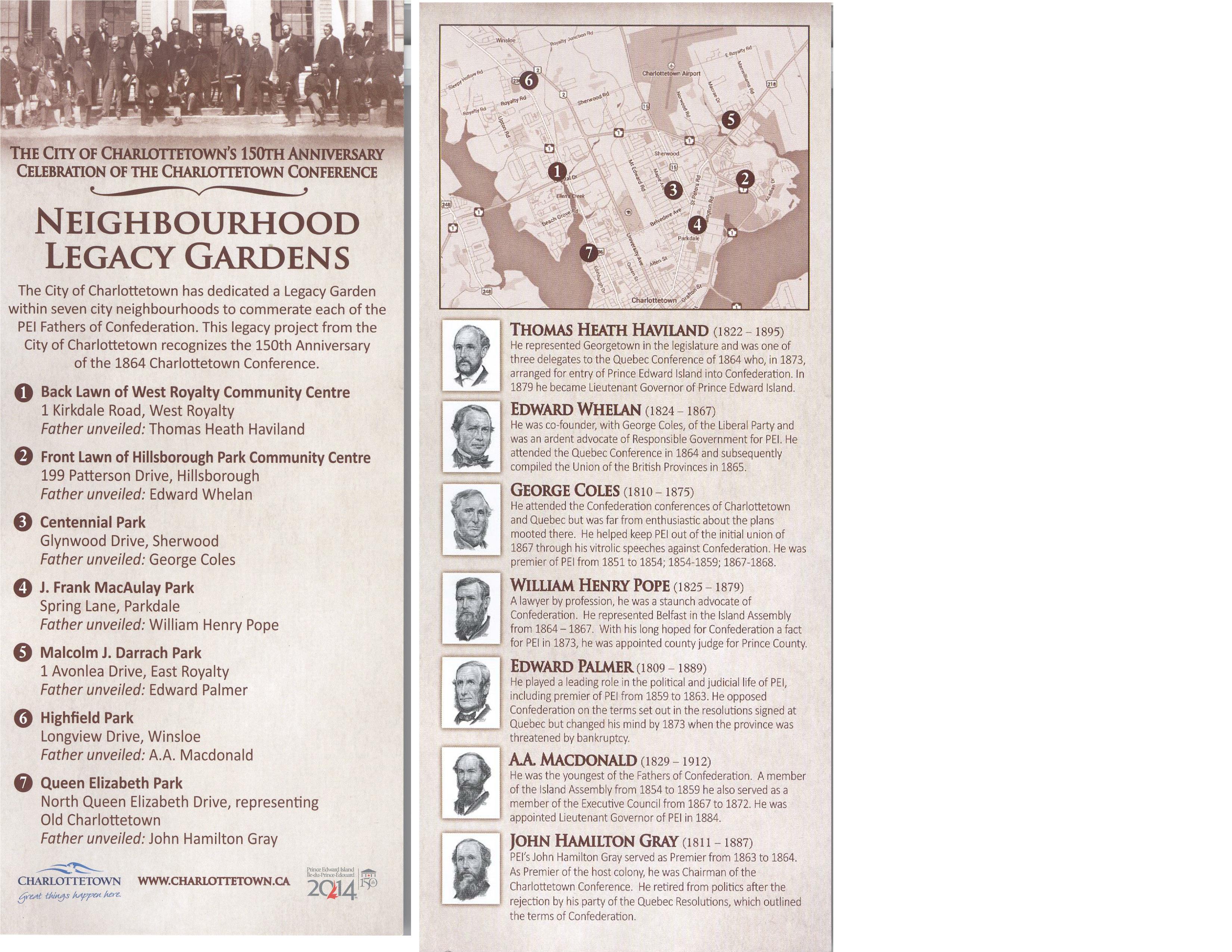
One of the sesquicentennial projects in Charlottetown in 2014 unveiled new gardens in the city`s parks named after each of the PEI Fathers of Confederation.

pei gardens

There was something about John Hamilton Gray that led people to name things or children in his honour.   Charlottetown has a park, high school and numerous commemorative plaques named after him.   In the years before the Confederation Bridge was built, one of the car ferries was named MV John Hamilton Gray, which conveniently referred to both the PEI and New Brunswick Fathers of Confederation with the same name.  Likewise, the new sculpture on Georges Street commemorates both John Hamilton Grays.   Dozens of the PEI Gray`s descendants have the word Hamilton in their full name.  It was originally a tribute by Gray`s father Robert Gray`s business colleagues, but for generations after Premier Gray it became a tribute to him, beginning with his children Mary Stukeley Hamilton Gray, Bertha Hamilton Susan Gray, Arthur Cavendish Bentinck Hamilton Gray and Hamilton Edward Jarvis Gray.    One of the Gray descendants participating in the reunion in Charlottetown was my B.C. cousin Richard Hamilton Dewdney, whose father Frederic Hamilton Peter Dewdney also hearkened back to the Father of Confederation who was greatly admired by his family, partly for his role in the formation of Canada and partly for his distinguished career as a cavalry officer in the British Army.

???????????????????????????????

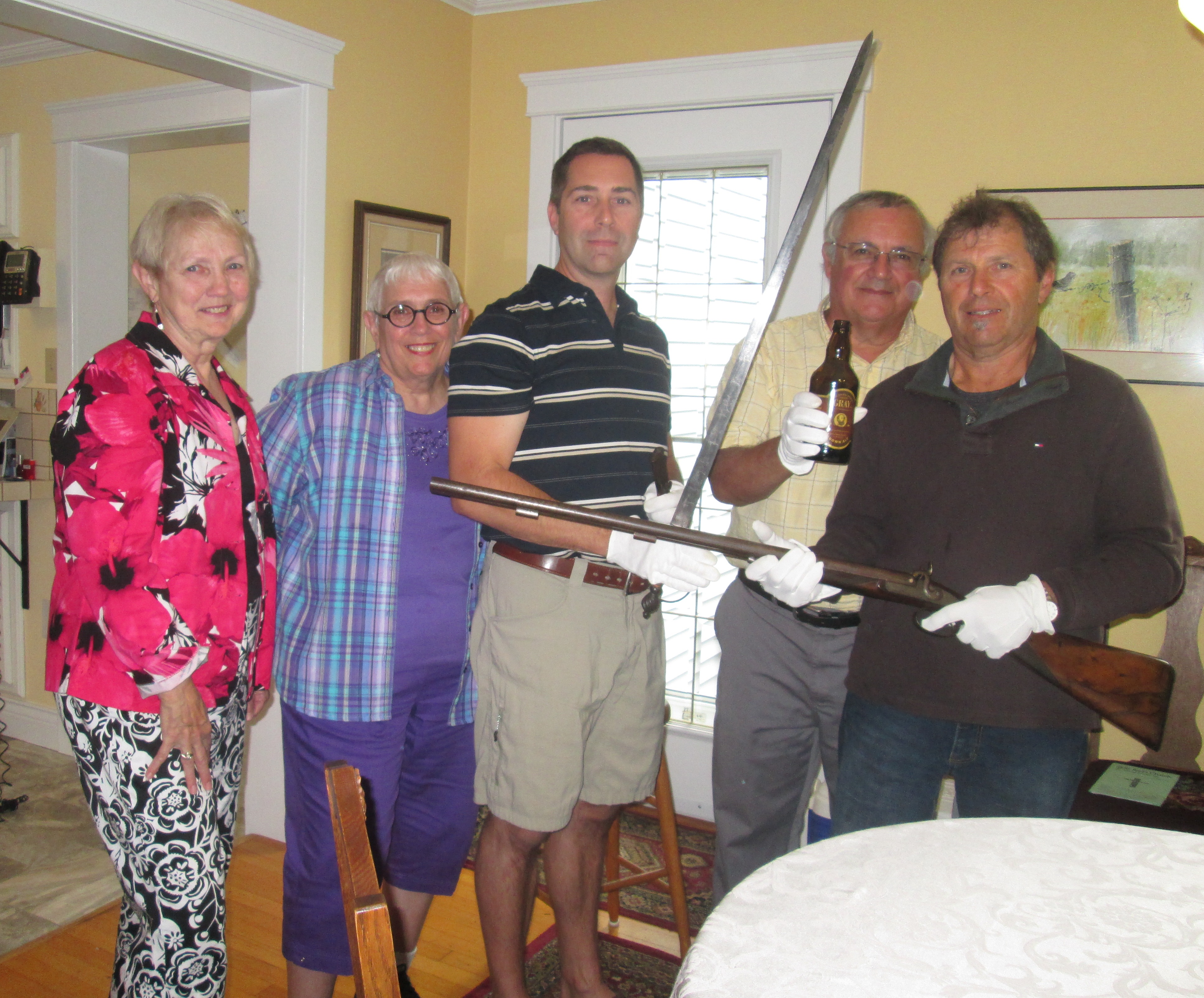
At a gathering Sept. 14 of Gray descendants in Charlottetown, visitors from B.C. checked out two valuable Gray family heirlooms with white gloves to avoid damaging them: a sword used by Col. Robert Gray in the Revolutionary War (with lettering “The Kings American Regt“) and a fowler rifle used by Gray`s son John Hamilton Gray engraved with his name. From left are host Sandi Lord Hurry, her sister Joanne Lord MacLeod, Sandi`s son Ernest “Tyler“ Hurry and their third cousins from B.C. Sam McBride and Richard Hamilton Dewdney.

sep 14 2014 pei 045

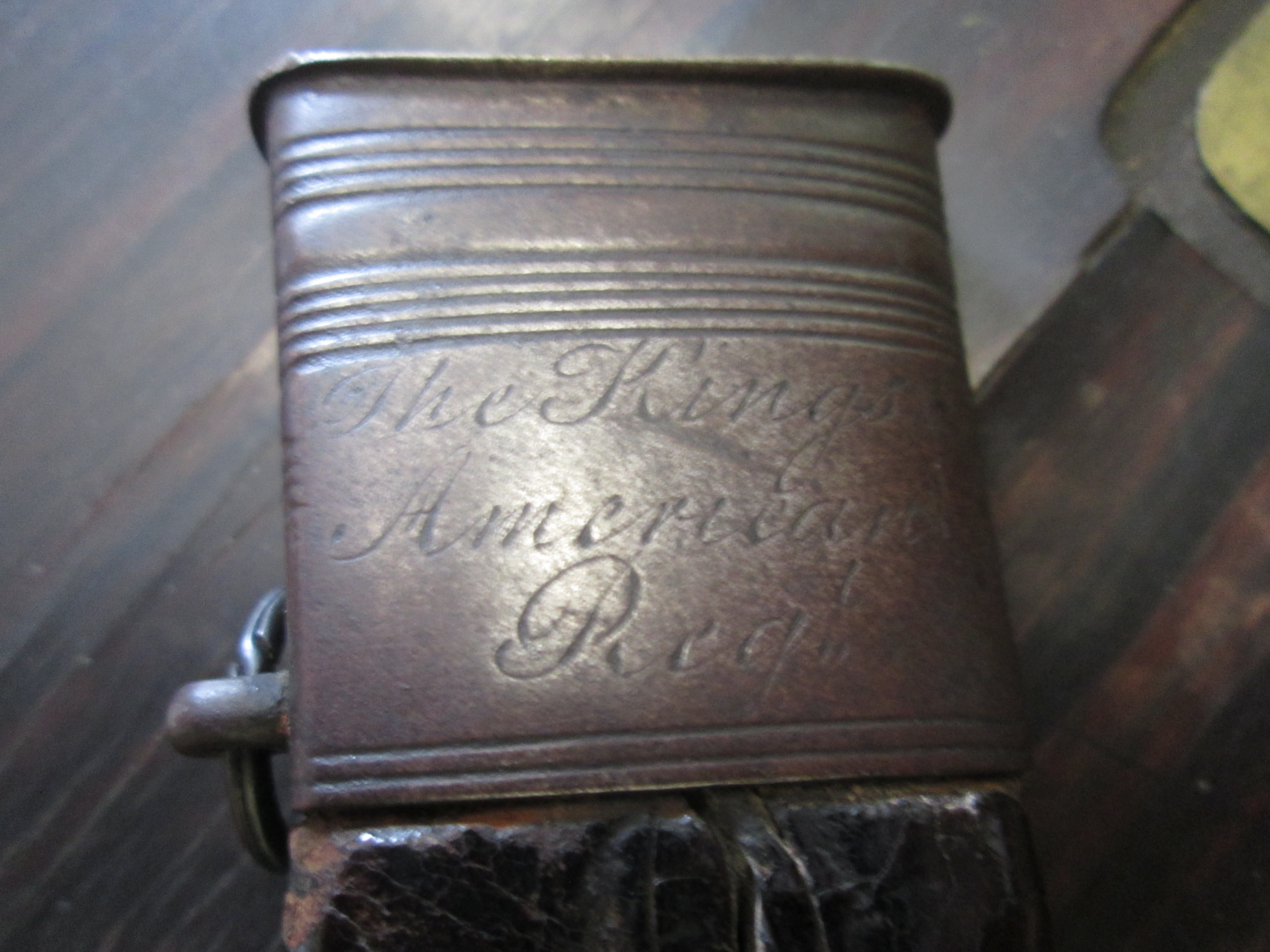
Scabbard of the Robert Gray sword from the American Revolution has the writing The Kings American Reg.


invitation to 125th charl conf anniversary 001

In my family history files I found an invitation my mother received in 1989 for the 125th anniversary of the Charlottetown Conference. Unfortunately, she never made it to the event.

Capt. F.T. Peters Was Only Canadian to Receive Multiple Awards for Valour in Both World Wars

Leave a comment

The year 2014 marks the centennial of the start of the First World War, and also the 75th anniversary of the start of the Second World War — global conflicts that killed 112,000 Canadians and radically changed life for Canadian families.

Captain Frederic Thornton “Fritz“ Peters, VC, DSO, DSC and bar, U.S. DSC, RN (1889-1942) was one of very few Canadians to serve in active combat in both world wars.   And he is the only Canadian to receive three awards for valour in each of the world wars, including the highest decoration of British Commonwealth, the highest decoration from the United States, and the second highest decoration of the British Commonwealth.   For military honours received over a 35-year period, Canadian medals authority John Blatherwick concluded Fritz Peters was “the bravest Canadian“.

As a lifelong bachelor, the only family Fritz had for many years  was his mother Bertha Peters (1862-1946) and his sister Helen Peters Dewdney (1887-1976) and her family.   As a widow, Bertha moved in 1919 to live full-time with Helen`s family, first in New Denver, and then, successively, in Rossland, Trail and Nelson as Helen`s husband Ted Dewdney was transferred by his employer, the Bank of Montreal.   Bertha and Helen were well-known in the region as organizers of bridge tournaments and community theatre productions and music performances.

While the family was proud of Fritz`s many awards for heroism, any talk of his medals inevitably led to grieving memories of his younger brothers Private Jack Peters and Lieutenant Gerald Peters who died early in the First World War serving with the 7th B.C. Battalion in fierce battles in the Ypres Salient in Belgium.

Fritz`s boyhood was split between his early years in Charlottetown, Prince Edward Island, where the Peters were descendants of United Empire Loyalists and a Father of Confederation, and Victoria, B.C., where his father, P.E.I. Premier Frederick Peters, moved the family for better financial prospects in 1898 when Fritz  was eight.    His family gave him the nickname “Fritz“ as a toddler because of his German-like enthusiasm for toy soldiers and marching.

3 fritz at bedford chap 2sm

Fritz Peters at age 11 in Bedford

Watching Royal Navy warships from his Oak Bay backyard as they sailed to and from the naval base at Esquimalt inspired young Fritz to choose a career in the navy.   He went to a prep school for future naval officers in England in 1901, and four years later enlisted as a cadet in the Royal Navy.  As a midshipman, he won his first medal for rescue work following the Messina Earthquake in Sicily in 1908.  After extensive service in China, he retired as a lieutenant in 1913 and returned to B.C. where he worked as a CPR engineer in the B.C. Interior before rushing to England to re-join the Royal Navy when war broke out in 1914.

On January 24, 1915, as first officer on the destroyer HMS Meteor, he received the highest honour for bravery awarded in the Battle of Dogger Bank, the first clash in the North Sea of the fleets of Britain and Germany.   Braving flames and scalding water from damaged boilers, he was credited with saving the lives of two sailors after the Meteor`s engine room was hit by a German shell.    At Buckingham Palace to receive the Distinguished Service Order (DSO) medal, second only to the VC as an award for valour, from King George the Fifth.

Peters` letters home during the war show the only thing he feared was boredom at sea.   One of his colleagues said Fritz had “massive courage”, and another said he was “tough as old rope”.

In 1918, Lieutenant-Commander Fritz Peters received the third-level award for valour, the Distinguished Service Cross (DSC) for “complete disregard of danger, exceptional coolness and ingenuity in his attacks on enemy submarines“, according to the citation.  After the war, the navy wanted to keep him in the peacetime force, but he decided to retire once again and join some naval colleagues in the Gold Coast colony in West Africa now known as Ghana, where he managed a cocoa plantation.  He later ran an engineering works in England that produced pumps for midget submarines.

The arrival of the Second World War in September 1939 led Peters to re-join the Royal Navy once again, at age 50.   Commanding a force of converted trawlers that sank two U-boats, he received a bar to the DSC he won the previous war.    In June 1940 he was seconded to the Secret Intelligence Service (MI6)  to command a school for spies and saboteurs in Hertford.   The students at the school included the Czech resistance fighters who assassinated the high-ranking Nazi Reinhard Heydrich in 1942.

ft peters c. 1942

Capt. Peters in 1942

Detesting a desk job, Peters resigned from the school in fall of 1940, and began alternating between service on warships, naval intelligence and secret intelligence work.   One of his colleagues at British Naval Intelligence was Ian Fleming, author of the James Bond books.   This has led to some speculation that Fleming may have based the Bond character partly on the fearless bachelor Fritz Peters, who, like Bond, held the rank of Royal Navy Commander.

After years of trying , his relatives in Nelson, British Columbia  were finally able to contact him in England in early 1942.   In his last letter home, dated March 31, 1942, he said was involved in war work that he could not write about, but he was well and looking forward to taking the offensive against the Nazis.   He was pleased to hear that his nephew and godson Peter Dewdney was a sub-lieutenant with the Royal Canadian Navy.

In the summer of 1942 Fritz was put in charge of a commando mission named Operation Reservist to capture the harbour of Oran, Algeria from Nazi-controlled Vichy French in the Allied invasion of North Africa.    On November 8, 1942 he led a 600-man force consisting mostly of American soldiers in two armour-plated Coast Guard cutters which broke through the harbour barrier at full speed.  Winston Churchill later described the attack as “the greatest naval action since (The Battle of) Trafalgar“.   The attackers hoped the French defenders would not fire on their former allies, but they responded in full force with fire from shore batteries and warships in the harbour – much of it at point blank range.   With most crewmen injured, Fritz had to secure the ship`s landing lines himself.  The ship reached its target berth, but casualties were so high that survivors were taken prisoner by the French.    Two days later they were released when the City of Oran surrendered to American troops.  Tragically, Fritz died on Friday, November 13th 1942 when the flying boat transporting him back to England crashed in heavy fog in Plymouth Sound off the southwest coast of England.   Due to the secrecy associated with his mission, his next-of-kin were not immediately notified of his death.  His sister Helen was listening to her radio in Nelson on November 17th  when a war report said “Captain T.F. Peters“ of the Royal Navy had died in an air crash.  Suspecting it was her brother Fritz with his initials transposed, she contacted the Nelson Daily News, who made inquires through the Canadian Press and Associated Press.  Two days later, the family received a telegram from the British Admiralty saying Fritz was lost at sea after an air crash, and presumed to have died.  Later, one of Fritz’s long-time naval colleagues said it was ironic that Fritz survived hundreds of brushes with death in his lifetime, only to die as a passenger in an air crash that did not involve conflict with the enemy.

All five of the passengers in the air crash died, but the 11 crew members from the Royal Australian Air Force survived.  The pilot, Wynton Thorpe, found Fritz still alive in the water and tried carrying him along for about an hour as he swam towards shore, but then let go of the body when it was obvious that Fritz had died.  A rescue boat from Plymouth picked up survivors about half an hour later.  Fritz`s body was never found.   He joined his brothers Jack and Gerald among the unidentified dead of the world wars.

final front tbc oct 2012 001

For extreme bravery in the face of enemy fire, Fritz posthumously earned the VC and the U.S. Distinguished Service Cross (DSC).    At the time, the awarding of the VC was played down by the British government, partly because Peters had been involved in spy work, and partly to avoid offending the French who had rejoined the Allies against the Nazis after Allied victories in North Africa.

Fritz’s` VC was the only one since the VC was established by Queen Victoria in 1856 to be won in action against the forces of France.   At age 53, he was the oldest of the 181 VC recipients in the Second World War.

On February 2, 1944 a delegation of U.S. officers and a brass band representing General Eisenhower and President Roosevelt came to the Dewdney home in Nelson to officially present Fritz`s mother Bertha  Peters, as his next-of-kin, with the U.S. DSC, the equivalent of the Congressional Medal of Honor.   The event was front-page news in Nelson and Trail newspapers, which noted it was the highest military decoration ever presented in the region.   Bertha, a strong Anglophile who generally disliked Americans, was amazed that they would go to such lengths in presenting her with their medal, while the British authorities just sent her the VC medal in the regular mail without even a cover letter.

Bertha died in Nelson at age 82 in 1946.  Her daughter Helen Dewdney travelled to Windsor Castle in England in 1956 to represent her late brother at ceremonies commemorating 100 years since the VC was established by Queen Victoria.  Helen moved from Nelson to Trail in 1969, and died in Trail at age 89 in 1976.
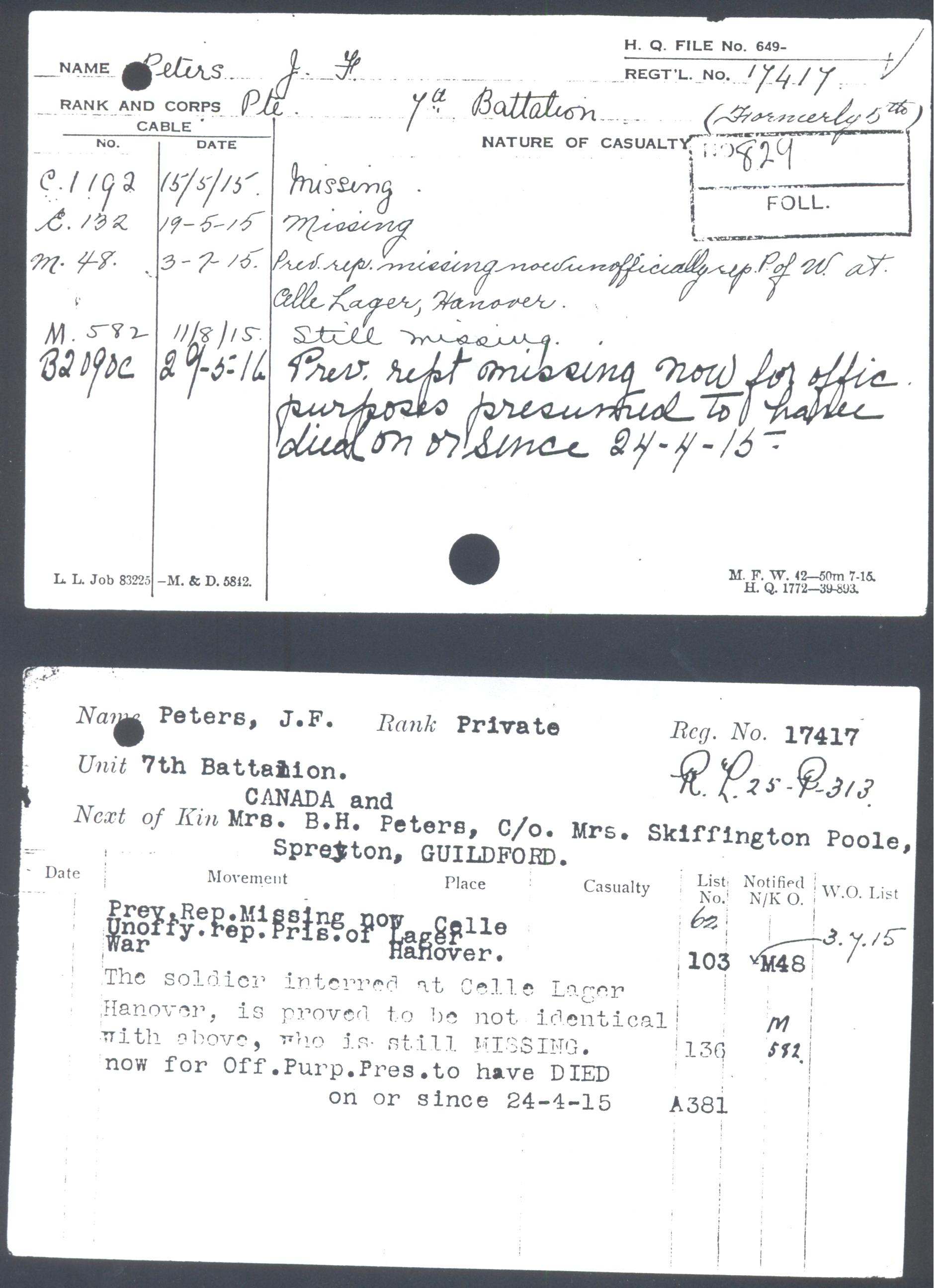
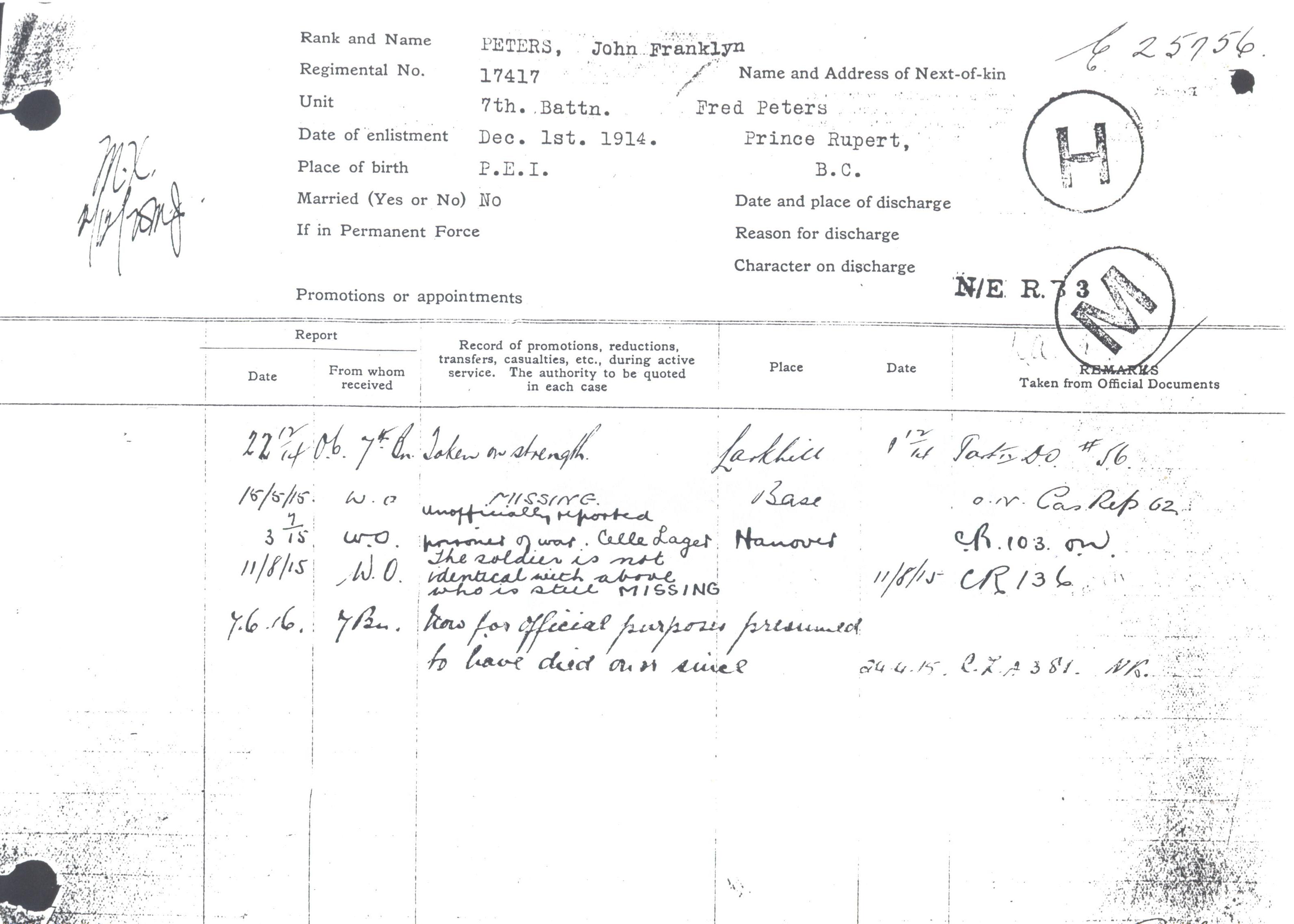
Mount Peters on the west side of Nelson, B.C. was named in honour of Fritz Peters in 1946.  The Trail, B.C. branch of the Royal Canadian Legion has a plaque honouring Fritz, and there is a painting of him along with other B.C. VC winners in the Legislature Buildings in Victoria.   In Canada, Peters is best-remembered in his native Charlottetown, where the Veterans Affairs office building has a substantial museum-style display that tells his story.  His medals are on display at the Lord Ashcroft Gallery of the Imperial War Museum in England.

2013 in review

Leave a comment

The WordPress.com stats helper monkeys prepared a 2013 annual report for this blog.

Here’s an excerpt:

A New York City subway train holds 1,200 people. This blog was viewed about 4,400 times in 2013. If it were a NYC subway train, it would take about 4 trips to carry that many people.

Click here to see the complete report.

71 Years Ago Today Fritz Peters Earned the Victoria Cross and U.S. Distinguished Service Cross in the Allied Invasion of North Africa

Leave a comment

Today, November 8, 2013 marks 71 years since the action in the harbour of Oran, Algeria where Capt. Frederic Thornton “Fritz“ Peters, VC, DSO, DSC and bar, DSC (U.S.), RN demonstrated extraordinary bravery in leading an attack on the harbour of Oran, Algeria held by Vichy French forces.

ft peters c. 1942

Capt. F.T. Peters in 1942, before leaving Scotland for Operation Reservist

Older Entries Newer Entries