By Sam McBride
Edward Worrell Jarvis (1846-1894) was a nephew of Col. John Hamilton Gray, a first cousin of Bertha Gray Peters and her sisters, and a first cousin, once removed, of Frederic Thornton “Fritz“ Peters. My relation to him is first cousin, three times removed.
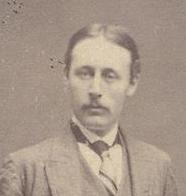
Edward Worrell Jarvis, son of Elizabeth Gray and PEI Chief Justice Edward James Jarvis. (Detail of family photograph in Peters Family Papers)
His remarkable career included railway surveying and engineering in England and Canada (including an extremely challenging Canadian Pacific Railway winter survey through the Rocky Mountains in northern B.C. and Alberta), running a successful lumber business in Winnipeg, serving as a Major in command of the Winnipeg Field Battery in the Riel Rebellion of 1885, designing three bridges in Winnipeg (including the Broadway Bridge which opened in 1882 as the first bridge to cross the Red River), being the first registrar at the University of Manitoba, a founding member of the Manitoba Historical Society, alderman in the early years of Winnipeg, and superintendent with the Northwest Mounted Police (forerunner of the Royal Canadian Mounted Police), the position he held at the time of his death in 1894 at age 48. When he applied to join the Institution of Civil Engineers (ICE) in 1874, the ICE members sponsoring his application included the distinguished engineers Sir Sandford Fleming and Marcus Smith of CPR fame. For whatever reason, details of his career were missed in Gray family letters and memorabilia, likely because he was far away and out of touch with his relations in the Maritimes, who he would not have known well as he spent much of his boyhood at private school and later university in England after he became an orphan a six years of age. There is no mention of him in the Canadian Dictionary of Biographies.
INTRODUCTION
One of my favourite images in the family collection that I have inherited is the photograph by G.P. Tanton of Charlottetown dated 1868 of a gentleman and two ladies. The print is 2.25 inches wide and 3.75 inches high, on heavy paper backing. The image has excellent black and white contrast in a brown, sepia tone colour. In most studio photos from this era the subjects look serious and uncomfortable (not surprising as they had to stay still for many seconds for the camera exposure), but with this photo Margaret Gray, at least, looks relaxed and has a trace of a smile. The back of the chair she is sitting on is similar to chairs that exist today as family heirlooms.
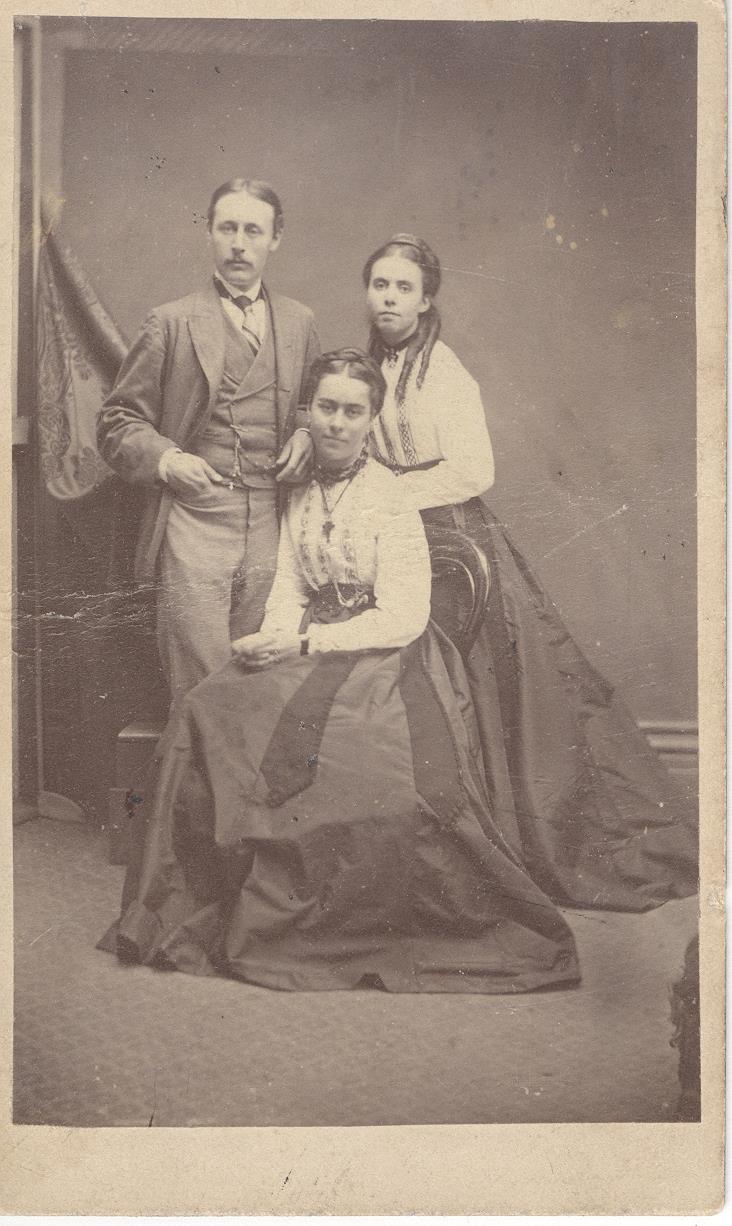
Edward Worrell Jarvis with his cousins Margaret Pennefather Stukeley Gray (sitting) and Florence Hope Gibson Gray in Charlottetown in 1868. Photo from Peters Family Papers.
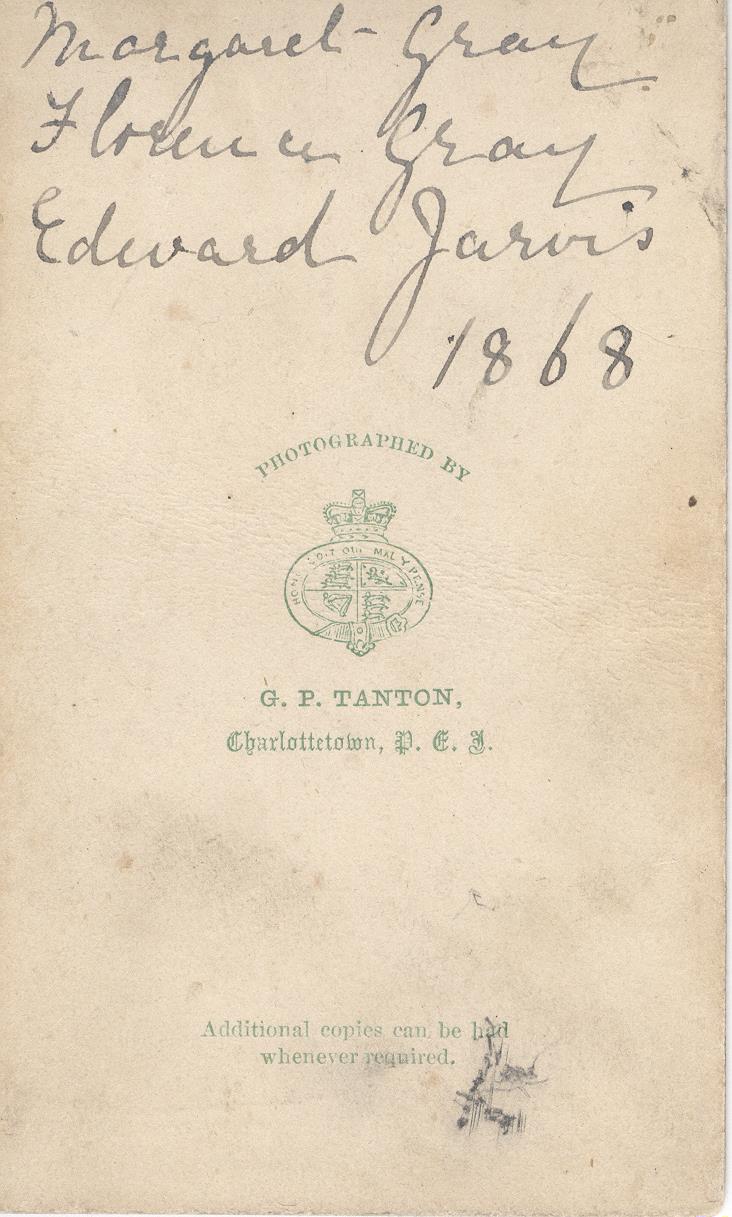
On the back of the print, the people in the photo are identified as Margaret Gray, Florence Gray and Edward Jarvis. We know from other photographs that Margaret Pennefather Stukeley Gray (1845-1941), who would have been 23 at the time the photo was taken, is seated and her sister Florence Hope Gibson Gray (1848-1921), 20, is standing behind her.
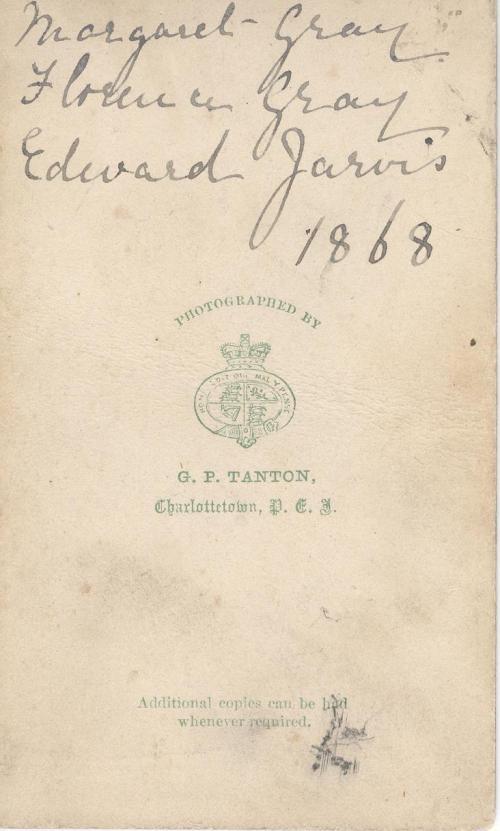
back of photo print (Peters Family Papers)
The father of the young ladies, Col. John Hamilton Gray, was retired from politics and in charge of the Prince Edward Island militia when the photo was taken. Four years earlier, Col. Gray was premier of PEI and host of the Charlottetown Conference of 1864 which set the stage for Canada being established as a self-governing nation in 1867. Gray`s wife Susan Ellen Bartley Pennefather, who died in 1866, was in failing health at the time of the Charlottetown Conference, so daughters Margaret and Florence served as hostesses when their father invited his fellow Fathers of Confederation to his estate known as Inkerman House for an after-dinner party on Sept. 3, 1864.
Margaret married Charlottetown shipbuilder Artemus Lord in 1869 and resided in Charlottetown for the rest of her life. Florence married mining engineer Henry Skeffington Poole and they settled in Stellarton, Nova Scotia, and after about 1900 resided in England.
Until recently, all I knew about the young man in the photo was that he was Edward Jarvis, son of Edward James Jarvis (1788-1852 and Elizabeth Gray (1803-1847), sister of Col. Gray. As chief justice of Prince Edward Island, Edward James Jarvis was prominent in the community. The only thing mentioned about young Edward Jarvis in Florence Gray`s notes about the Gray family was that he “died unmarried“. The Canadian Dictionary of Biographies has a full entry about Edward James Jarvis, but no mention of his son Edward. When I learned from PEI baptismal records that the son`s full name was Edward Worrell Jarvis, this led to details from various sources of his remarkable life in Western Canada as an engineer, surveyor, businessman, soldier, policeman and civic leader.
EDWARD WORRELL JARVIS
Edward Worrell Jarvis was born in Charlottetown on January 26, 1846, and baptized August 22, 1846 at St. Paul`s Anglican Church in Charlottetown. He was the first child of his father Edward James Jarvis and Elizabeth Gray, but his father had eight children in his first marriage to Anna Maria Boyd (1795-1841). Nineteen months after Edward`s birth his mother Elizabeth died in childbirth on Sept. 6, 1847. Edward`s father died in 1852 when he was six. Though an orphan, he had a large extended family of step-brothers, step-sisters, cousins, uncles and aunts. He and his Gray cousins were all grandchildren of Robert Gray, a United Empire Loyalist in Virginia who helped organize a regiment in support of the King, and was in the thick of the fighting in the Carolinas against rebel forces in the American Revolutionary War. Edward’s paternal grandfather Munson Jarvis of Connecticut was also a United Empire Loyalist, settling in New Brunswick after eviction by American rebels.
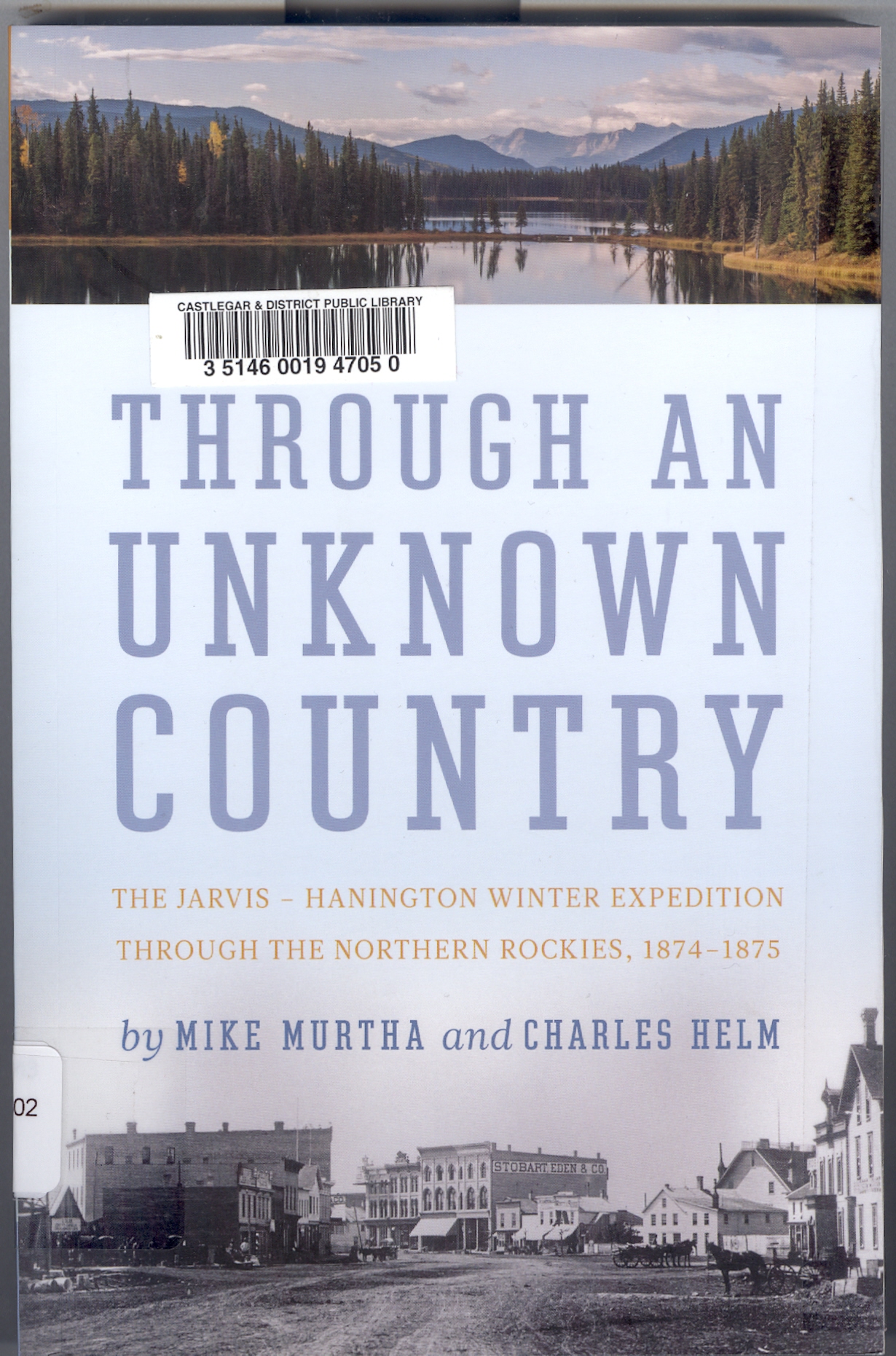
This excellent book about the Jarvis-Hanington winter survey expedition for the CPR came out in early 2016.
According to his obituary in a Manitoba newspaper published after his death in 1894, Edward Worrell Jarvis went to school in England and graduated from Cambridge University. According to the British Institute of Civil Engineers, he worked as an engineer under the tutelage of Walter M. Brydone, chief engineer for the British Great Northern Railway. Jarvis worked on the Spalding to March railway in England, east of Birmingham, between 1864 and 1867 before returning to Canada in 1868 when he was employed as an assistant engineer by the Government of Canada, under renowned engineer and surveyor Sir Sandford Fleming, on the Intercolonial Railway in Nova Scotia and New Brunswick, including responsibility for construction of a 15-mile section and a 12-mile section of the track.
From 1871 to 1873 E.W. Jarvis was in charge of 50 men exploring and surveying 360 miles of the CPR rail line, and then in 1873-74 was in charge of an additional 180 miles through the Rocky Mountains.
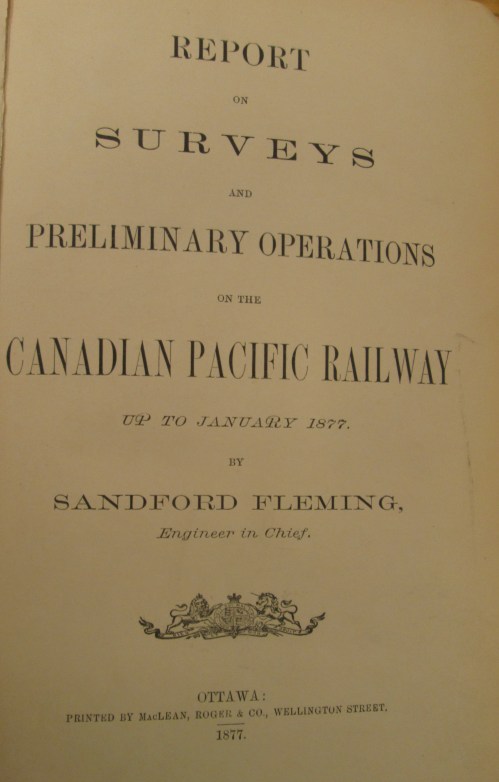
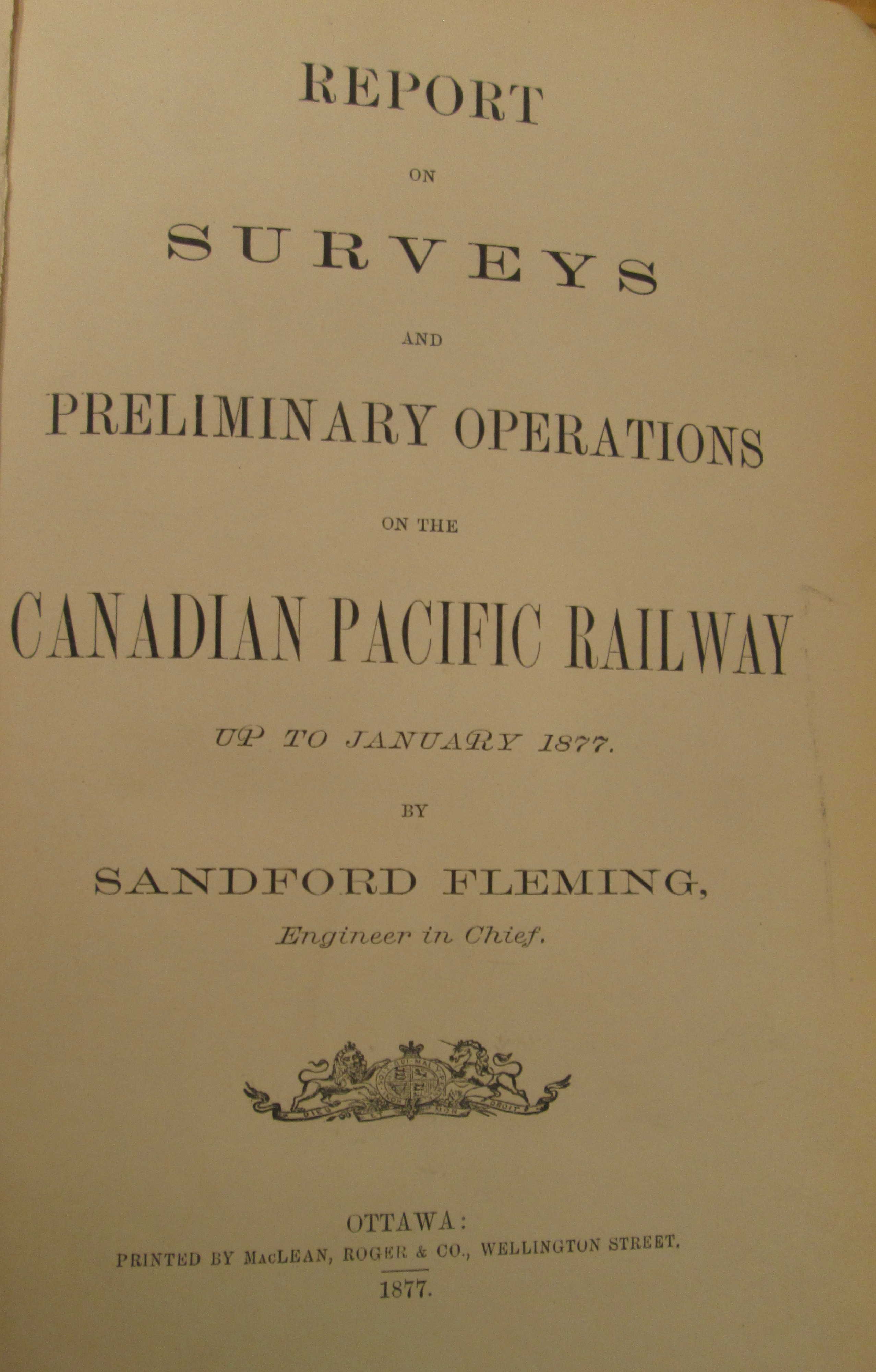
Details of the bone-chilling survey of the Smoky River Pass led by E.W. Jarvis in the winter of 1875 are in Sandford Fleming’s 1877 report of CPR route surveys.
In January 1875 Jarvis led a survey team in a horrific winter expedition to survey the Smoky River Pass north of the Yellowhead Pass as a possible route for the CPR line. Following instructions from Sandford Fleming (who at that time had decided on the Yellowhead Pass for the CPR, but wanted the Smoky River Pass checked out to see if it could be considered a possible route), Jarvis set off from Fort George (near current site of Prince George, B.C.) with his assistant, C.F. Hanington, Alex Macdonald in charge of dog trains, six Indians and 20 dogs. The plan was to go through the pass, conduct the required work, and arrive at Edmonton.
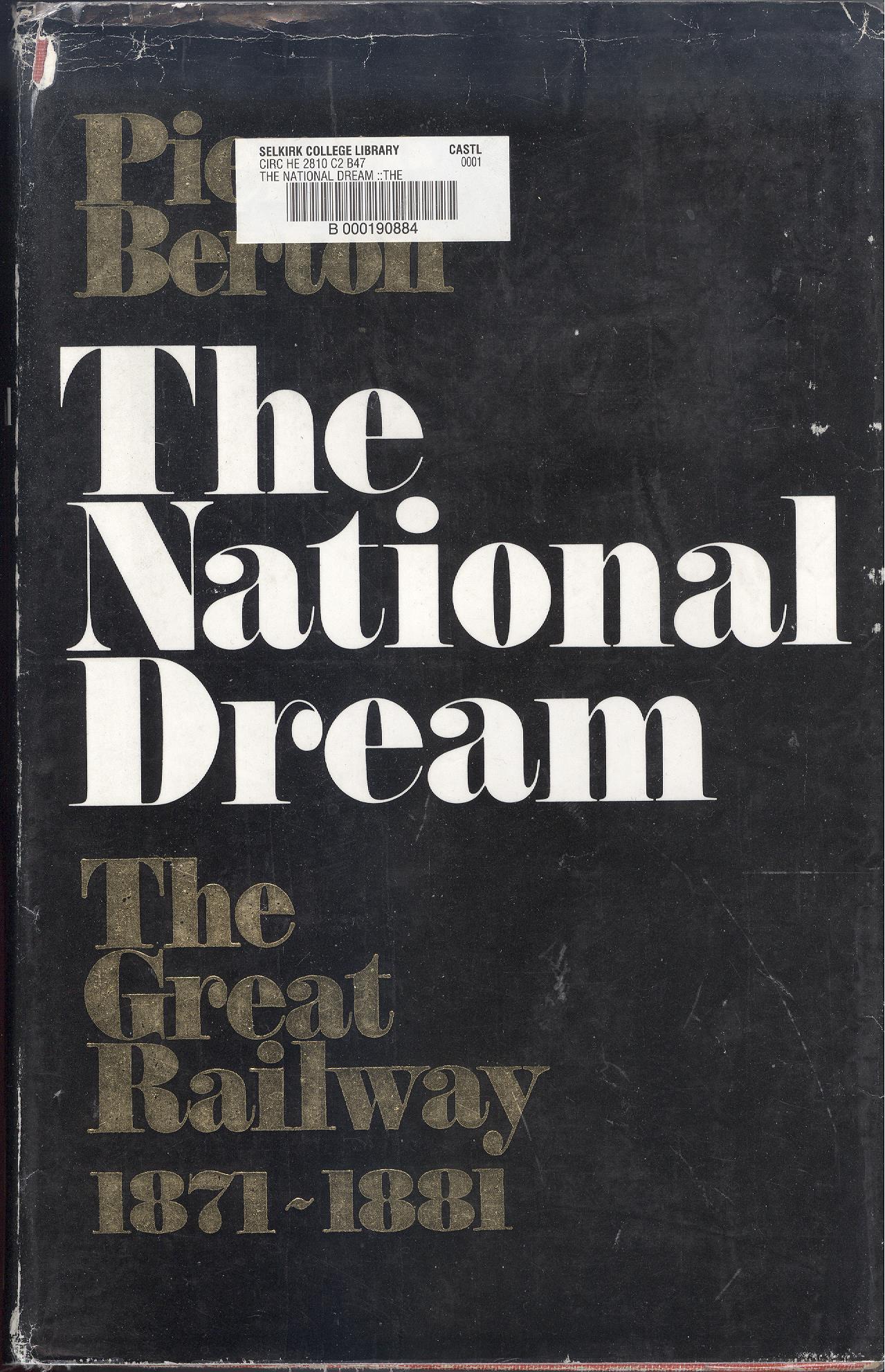
In “The National Dream“, Pierre Berton devoted two full pages to the harrowing expedition led by E.W. Jarvis. “The party travelled light with only two blankets per man and a single piece of light cotton sheeting for a tent,“ Berton said. “They moved through a land that had never been mapped. A good deal of the time they had no idea where they were. They camped out in temperatures that dropped to 53 below zero. They fell through thin ice and had to clamber out, soaked to the skin, their snowshoes still fastened to their feet.“
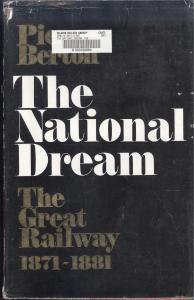 By March 1875 the dogs used for the Jarvis Expedition were dying daily. Berton notes that “even the Indians were in a mournful state of despair, declaring that they …would never see their homes again, and weeping bitterly.“ Somehow the group managed to make it to Edmonton, where Jarvis found his weight had dropped to a starving 125 pounds. After a brief break they set off again across blizzard-swept prairie for Fort Garry, south of modern-day Winnipeg, Manitoba. In total, the expedition spent 116 days on the trail, travelling 1,887 miles – 932 of those miles on snowshoes and 332 of them with all their goods on their backs, as the dogs had died.
Berton posed the question: Why did they do it. Not for money or adventure, he concludes. Rather , “each man did it for glory, spurred on by the slender but ever-present hope that someday his name would be enshrined on a mountain peak… or, glory of glories, would go into the history books as the one who had bested all others and located the route for the great railway.“
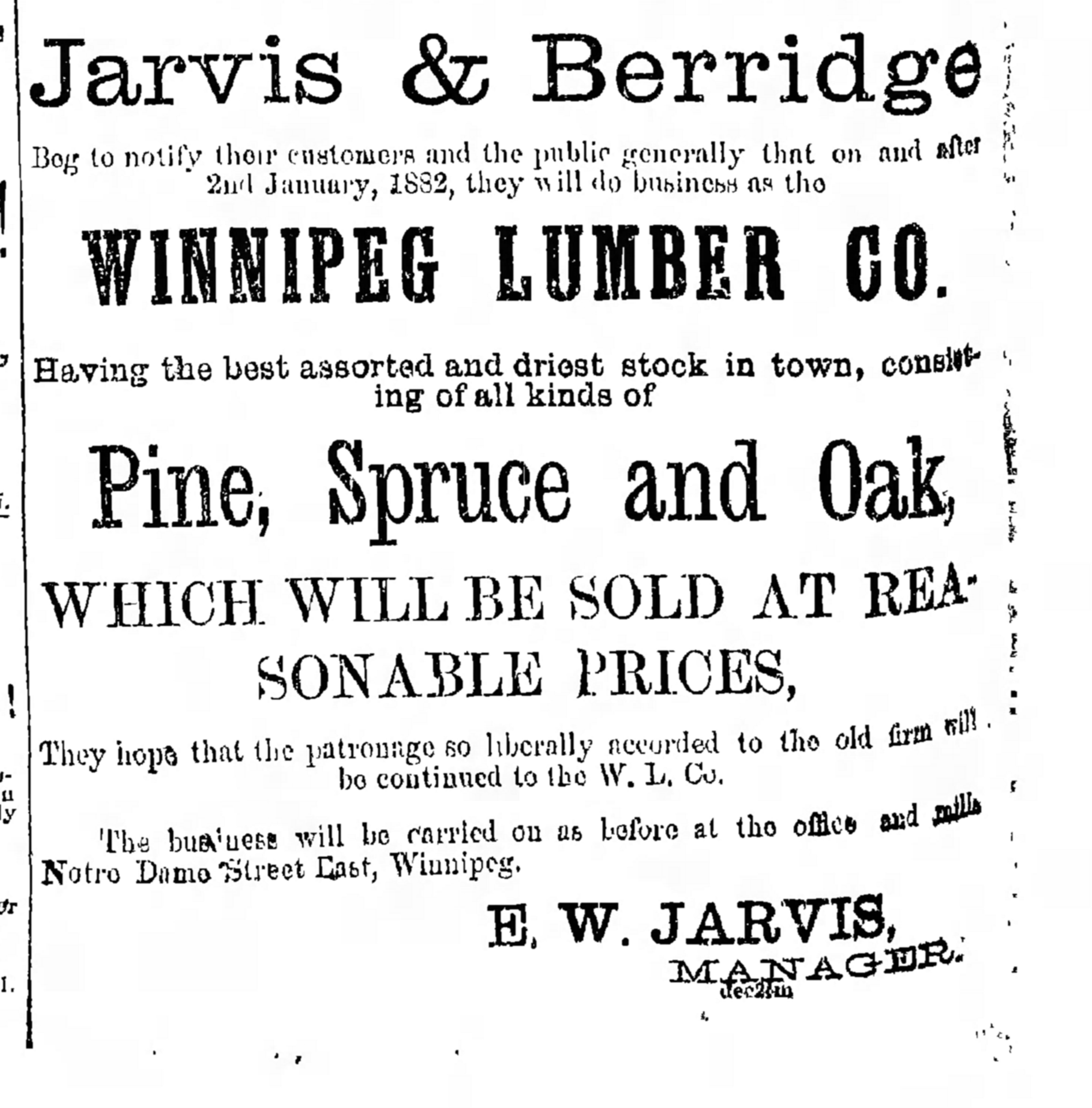
Later in 1875 Jarvis began working as a lumber merchant in Winnipeg, Manitoba. According to Berton, he was “doing a roaring business in lumber and starving no more.“ He was later a partner in the lumber business of W. J. Macaulay and Company. Between 1880 and 1883 Jarvis designed three bridges in Winnipeg: the Louise and Broadway Bridges over the Red River and the Main Street Bridge over the Assiniboine River.
In the Riel Rebellion of 1885 he was a Major in command of the Winnipeg Field Battery of the Canadian artillery, and was mentioned in despatches.
Among other distinctions, Jarvis was the first registrar of the University of Manitoba, a founder of the Manitoba Historical Society, an early alderman on the Winnipeg City Council, and an officer in the Northwest Mounted Police.
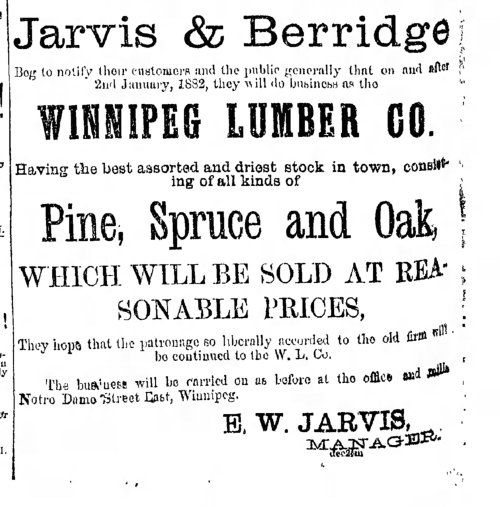
lumber ad in Jan. 18, 1882 Manitoba Free Presss
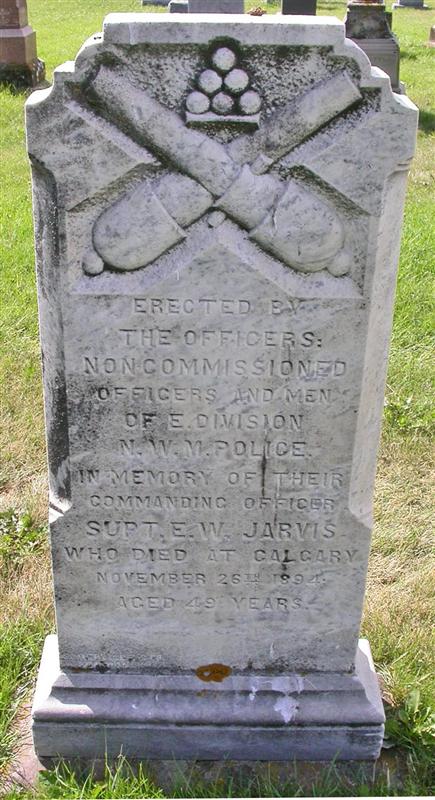
Text of tombstone: “Erected by the officers, non-commissioned officers and men of E. Division N.W.M. Police in memory of their commanding officer Supt. E.W. Jarvis who died in Calgary November 26th 1894 Aged 49 years.“ Photo courtesy of the Alberta Family History Society.
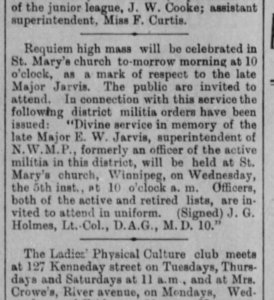
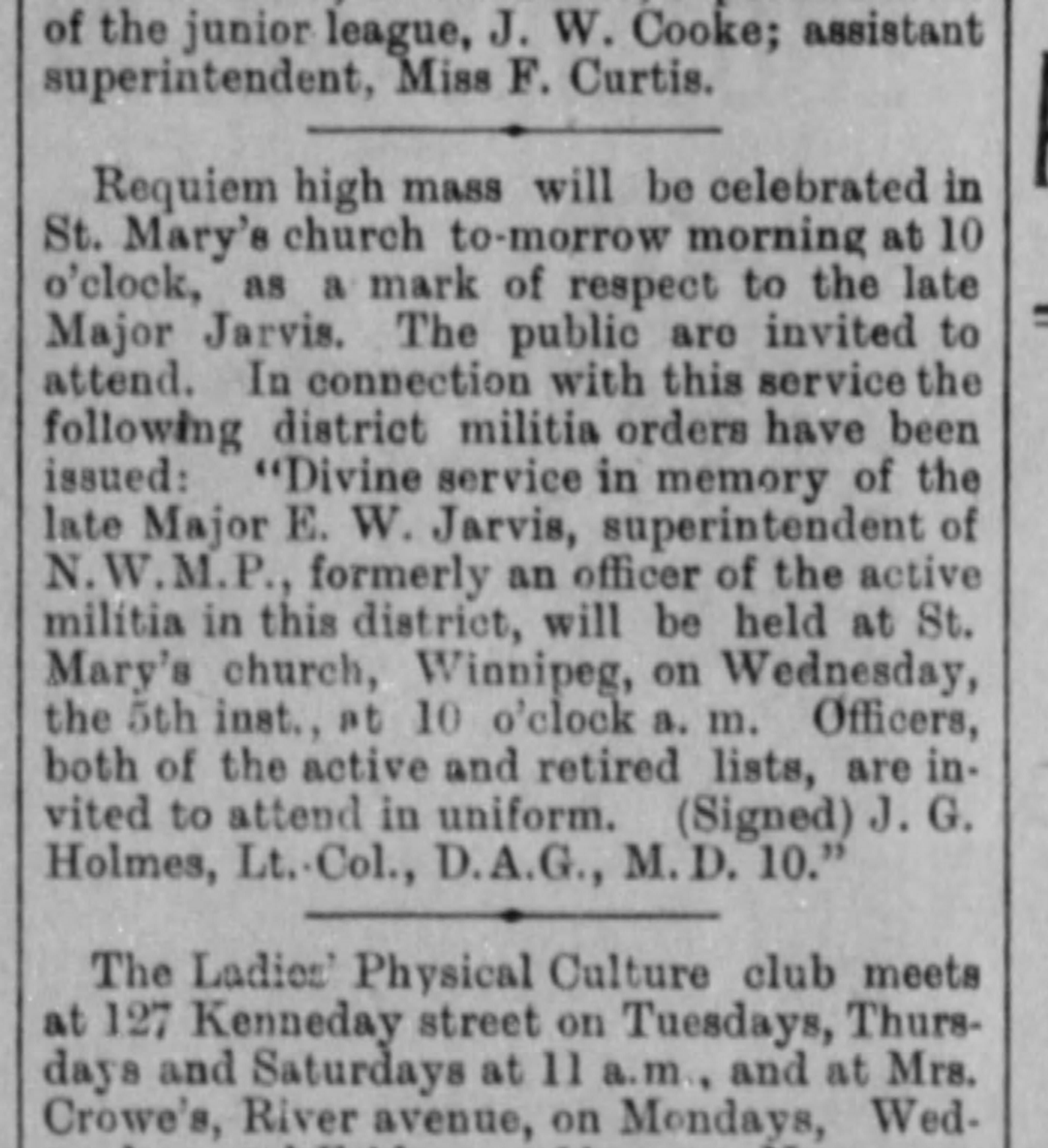
obituary from Winnipeg Tribune Dec. 4, 1894
Jarvis joined the NWMP in 1886 when the federal government decided to double the size of the force from 500 to 1,000 when they realized that additional policing resources were needed in the wake of the Riel Rebellion. Jarvis was among 29 new officers appointed in this expansion of the force. His military service was a factor in his selection as an officer, as was the fact that he was born in Prince Edward Island, because the government wanted the various regions of the country to be represented in the group of new officers. Superintendent Jarvis was one of five of the new NWMP officers to have served in the Riel Rebellion. Jarvis` experience with the NWMP is described in the book “Red Coats on the Prairies“ by William Beahen and Stan Horrall. In addition to his command duties, Jarvis was tasked with reviewing NWMP regulations, and testing new ammunition proposed for the NWMP manufactured by the Dominion Cartridge Co. of Montreal. He concluded that is was “impossible to shoot well with bullets supplied by the Dominion Cartridge Company“. When telephone service was introduced for the NWMP between Moose Jaw and Wood River in 1887, Jarvis designed and produced two receivers to be used with the new communication system. It was Jarvis who put forward the idea of a musical band for NWMP headquarters as a worthwhile form of recreation for the men in the NWMP, who otherwise often turned to drinking and associated misbehaviour when they were off duty. The men would not be paid extra for being in the band, but they would be excused from tedious duties. According to Beahen and Horrall, Jarvis was surprised when the NWMP commissioner approved his suggestion of a band. As it turned out, Inspector W.G. Matthews, who was appointed conductor of the band, was largely responsible for the first Mounted Police Musical Rides, which became an institution with the force that continues to the present day. The authors note that C.W. Dwight, an NWMP constable from a well-to-do family in Toronto, said in a letter that his Commanding Officer in “A“ Division (Supt. Jarvis) was “a thorough gentleman and his treatment of men at all times considerate and impartial.“

As an idea-oriented engineer with wide-ranging knowledge and capabilities, Jarvis was asked to make recommendations for improving the NWMP facilities and operations. In his first annual report submitted November 30, 1886 he expressed a vision for practical improvements to the uniform which are largely in line with how the NWMP and later the RCMP uniforms later developed. “The Police uniform fits too well for a man actively engaged in rough prairie work, and is soon spoiled by duties required a camp fire,“ Jarvis wrote, adding “I would suggest the issue of a `prairie dress` which would consist of dark brown cord or velveteen britches, long boots and spurs, a heavy blue flannel shirt (over which the stable jacket could be worn when required) and a broad-brimmed hat of soft felt to complete the outfit. By adopting this, personal comfort and a uniform appearance would be gained, while the regular uniform would be saved for parade and duty in settled districts. The forage cap is no use at all on the prairie.“
Tragically, Superintendent Jarvis died in Calgary on November 24, 1894 of cellulitis, a type of skin infection that can be fatal. Because of his popularity, NWMP men from other divisions were allowed time to come to his funeral. This ended badly, as many of the men gathered for the funeral got drunk and made a public exhibition of themselves, according to Beahen and Horrall. One officer was found to be completely drunk in uniform in the lobby of the hotel the next morning at 9 am.
Jarvis is buried in the St. Mary`s Pioneer Cemetery in Calgary. Jarvis Avenue in Winnipeg is named after him, as are Jarvis Creek in Alberta, Jarvis Creek in B.C., Jarvis Lake in Alberta, Jarvis Lake in B.C., Mount Jarvis in B.C., Jarvis Pass in B.C and Jarvis Street in Hinton, Alberta. A collection of his journals are held by the Archives of Manitoba.
CLUES FROM MIDDLE NAMES IN GRAY FAMILY
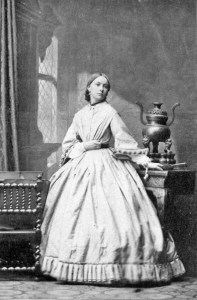
Harriett Worrell Gray, eldest daughter of John Hamilton Gray, in 1864.
Worrell (or alternate spelling Worrall) was also the middle name of his cousin Harriett Worrell Gray (first child of John Hamilton Gray and Susan Bartley-Pennefather), who was born three years earlier than Edward, in 1843. We know from Loyalist Robert Gray`s autobiographical notes that he named his youngest son John Hamilton Gray as a tribute to the Hamilton family in Scotland who trained and employed him in their tobacco trading business in Colonial America. One might assume that Robert Gray`s children John Hamilton Gray and Elizabeth Gray Jarvis also named children with middle names in appreciation for some special assistance or support for them at some time by the Worrell family. A possible link would be the Worrell Estates near St. Peters Bay on the north coast of Prince Edward Island, in the vicinity of land granted to original proprietor George Burns, who was maternal grandfather of John Hamilton Gray and Elizabeth Gray. See bio of Charles Worrell at http://www.biographi.ca/en/bio/worrell_charles_8E.html
Hamilton Edward Jarvis Gray (1880-c.1889) was the last child of Col. John Hamilton Gray and his third wife Sarah Caroline Cambridge (1842-1906). Col. Gray was 69 when his youngest son Hammy was born. Hammy is listed as a beneficiary in his father`s will dated January 1887, and is not listed on the 1891 British census, though his mother and brother Arthur are on the census, indicating that Hammy likely died sometime between 1887 in Prince Edward Island and 1891 in England, where his mother had moved with her son Arthur. The fact that Col. Gray would have Edward Jarvis as middle names for his son is perhaps a reflection of his admiration for the father E.J. Jarvis, his son E.W. Jarvis, or both.
THE TWO LADIES IN THE PHOTO
Margaret Gray Lord was the only one of Col. Gray`s five daughters to continue residing in Prince Edward Island through her lifetime. In October 1864 she accompanied her father to the Quebec Conference where proposals for confederation were thoroughly discussed and carried forward. By the 1930s, she was the last surviving partipant of the historic Quebec Conference. She was presented to the King and Queen when the Royal Tour came to Charlottetown in 1939. Through most of her adult life she kept a personal diary, which was the basis for the book “One Woman`s Charlottetown: the 1863, 1876 and 1890 Diaries of Margaret Gray Lord“ published in 1987. Margaret was active in the Womens Temperance Movement in the early 1900s, perhaps recalling with disdain the inebriation of many of the Fathers of Confederation when her father brought them home for an after-dinner party that followed a late afternoon feast and libations in Charlottetown Harbour. Margaret enjoyed excellent health until her death in Charlottetown at age 96 on December 31, 1941.

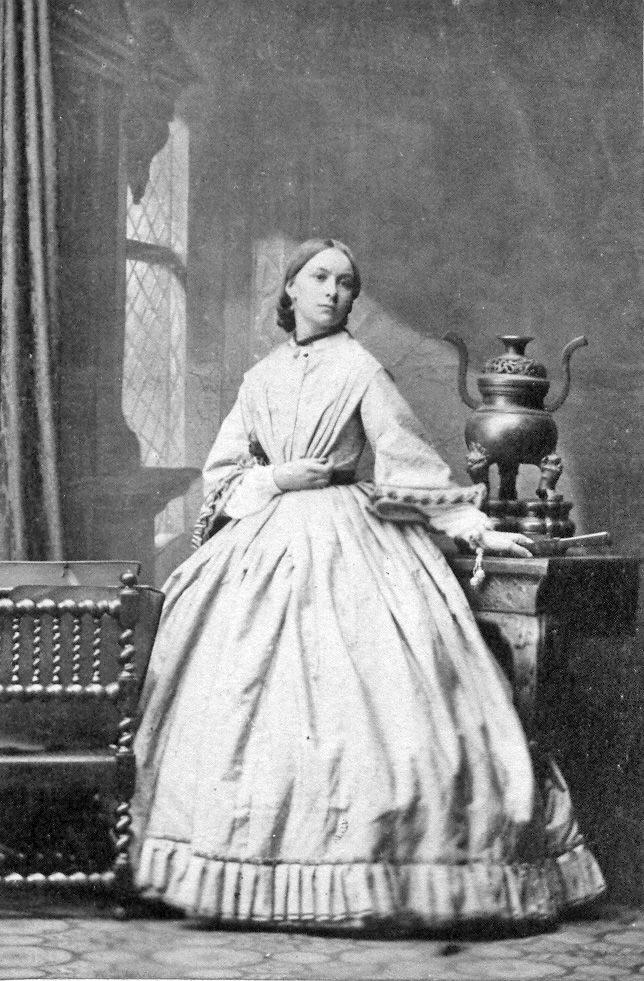
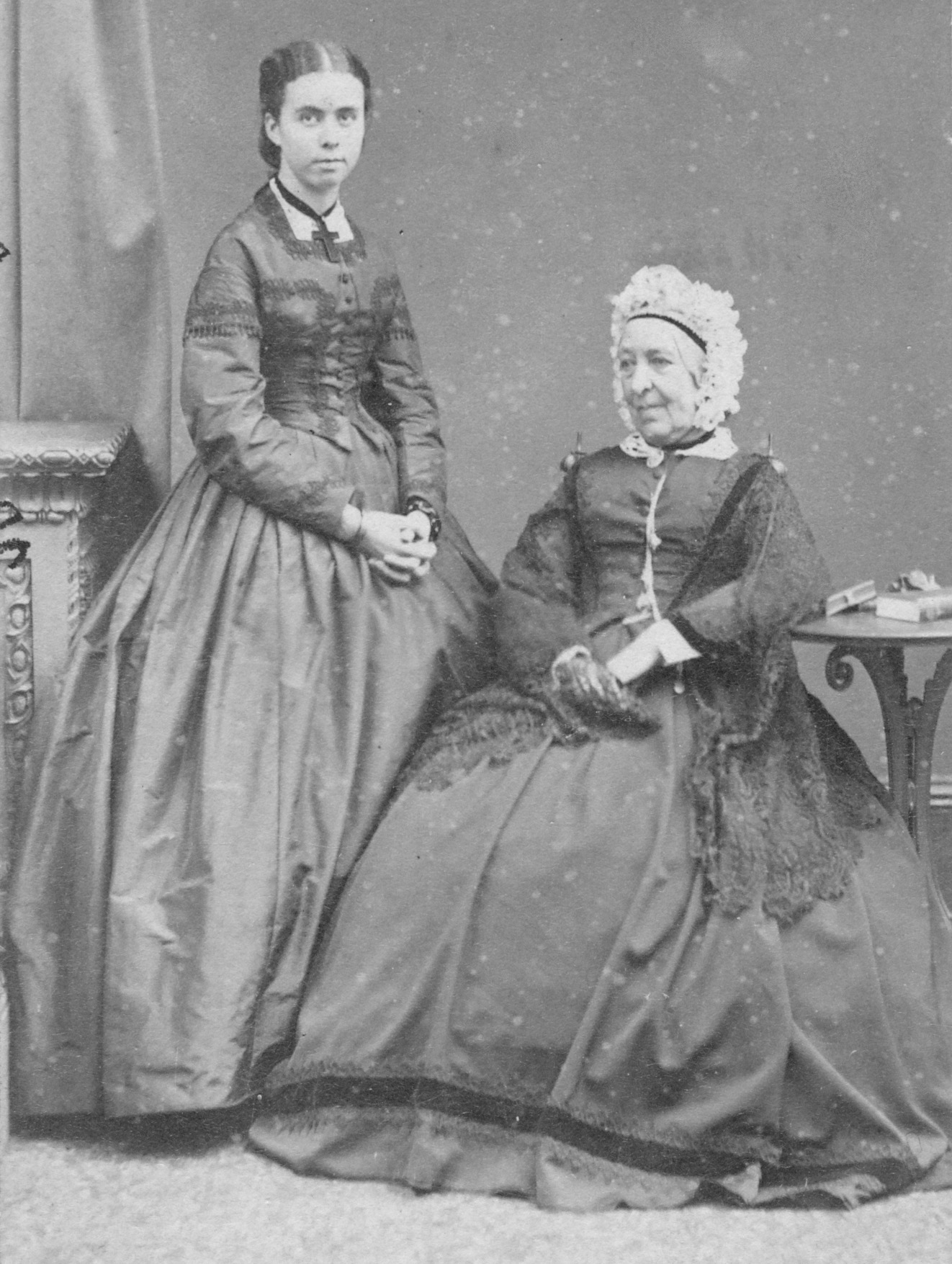
Florence Gray with her maternal grandmother, Lady Pennefather (Margaret Carr Bartley), who lived in Aldershot, England and came to PEI to visit her daughter Susan and her family every couple of years. Circa 1868. Peters Family Papers photo.
Florence Gray Poole was keen on family history, and conducted substantial research and associated correspondence regarding the ancestry of both her parents. Tragically, her son Eric Skeffington Poole, a second lieutenant with the British Army, was court martialled for desertion in the fall of 1916 after he was found to have wandered away in a daze from his assigned position in a front line trench. Despite testimony from medical staff that he was experiencing the lingering effects of shell shock from the Battle of the Somme a couple of months earlier, Eric was convicted and shot at dawn in Poperinghe, Belgium on Dec. 16, 1916. At the time, Florence`s husband Henry Skeffington Poole was very ill, and she worried that hearing of Eric`s fate would kill him. She reached an agreement with authorities that she would not contest the execution and they would not publicize it. Ironically, one of her other sons, Henry Raynaulde Poole, won a Distinguished Service Order (DSO) medal for valour in the Great War, and was an officer of the Order of the British Empire (OBE) and the French Legion of Honour. Florence died at age 75 in 1923 in Guildford, England, six years after the death of her husband Henry.
SOURCES
Link to Memorable Manitobans web site http://www.mhs.mb.ca/docs/people/jarvis_ew.shtml
link to an article in Manitoba History that focused on the families of Edward James Jarvis and Alexander Ross as examples of Victorians families of their era. http://www.mhs.mb.ca/docs/mb_history/13/victorianfamily.shtml
RCMP memorial web site
http://www.rcmpgraves.com/database/depotdynasty.html
British Engineering Society publication
http://www.gracesguide.co.uk/Edward_Worrell_Jarvis#cite_note-1
Link to Edward James Jarvis, chief justice, PEI in Canadian Dictionary of Biographies
http://ww.w.biographi.ca/en/bio/jarvis_edward_james_8E.html
Link to Charles Worrell in Canadian Dictionary of Biographies.
http://www.biographi.ca/en/bio/worrell_charles_8E.html

 thebravestcanadian