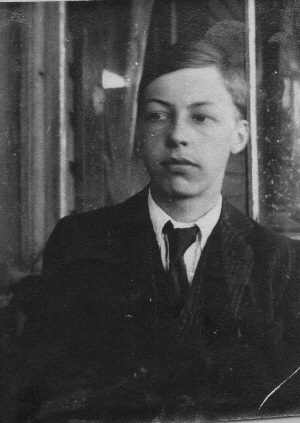
J.F. Peters
by Sam McBride
The first of the Peters boys to die in battle was Private John Francklyn “Jack” Peters, born October 19,1892 in Charlottetown, Prince Edward Island, the second son and third child of Premier Frederic Peters and Bertha Hamilton Gray.
The circumstances of his death in the Second Battle of Ypres on April 24, 1915 are one of the mysteries of the Peters Family History. He was in the thick of one of the fiercest battles in Canadian history, a conflagration made worse by the surprise use of poison gas by the Germans at a time when their opponents had no respirators or other protection against it.
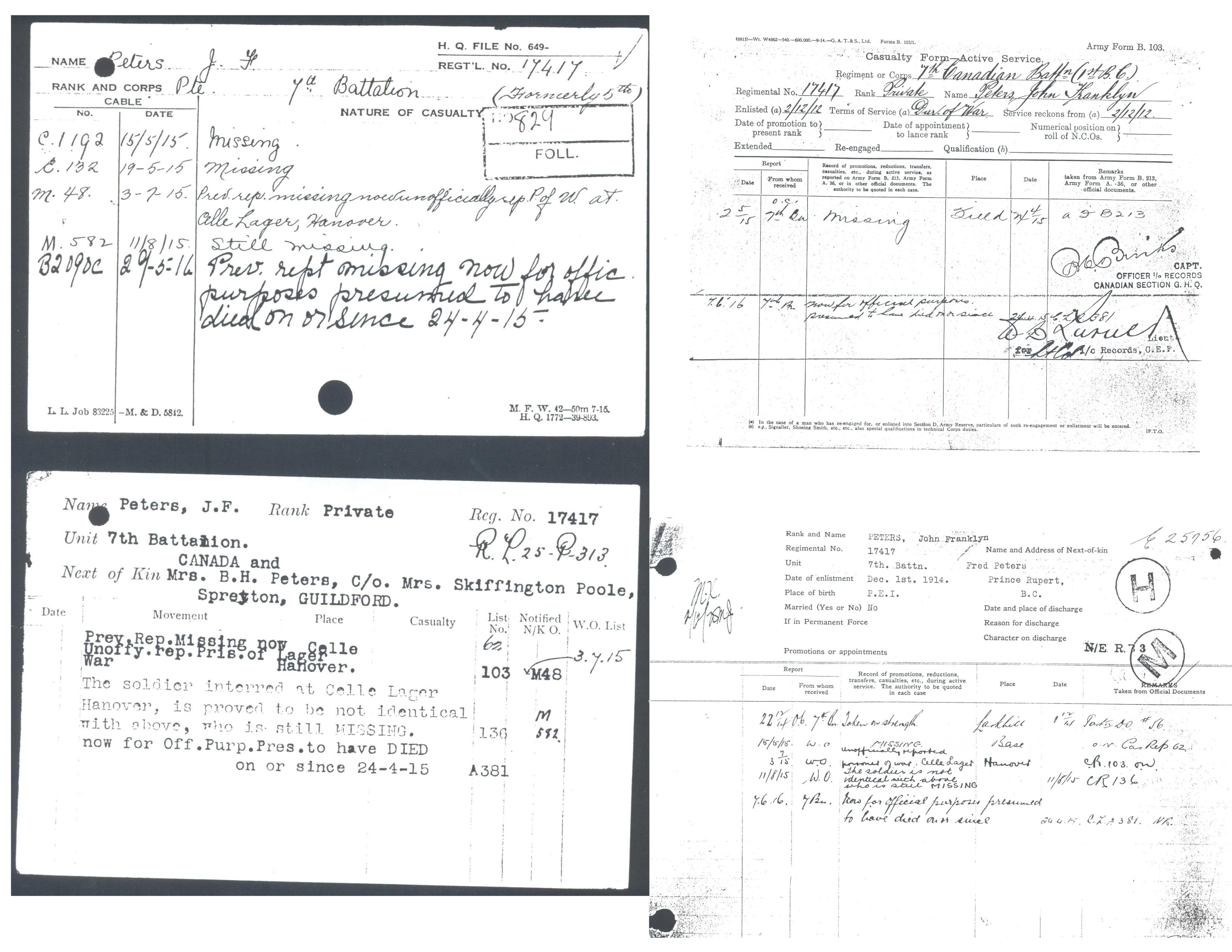
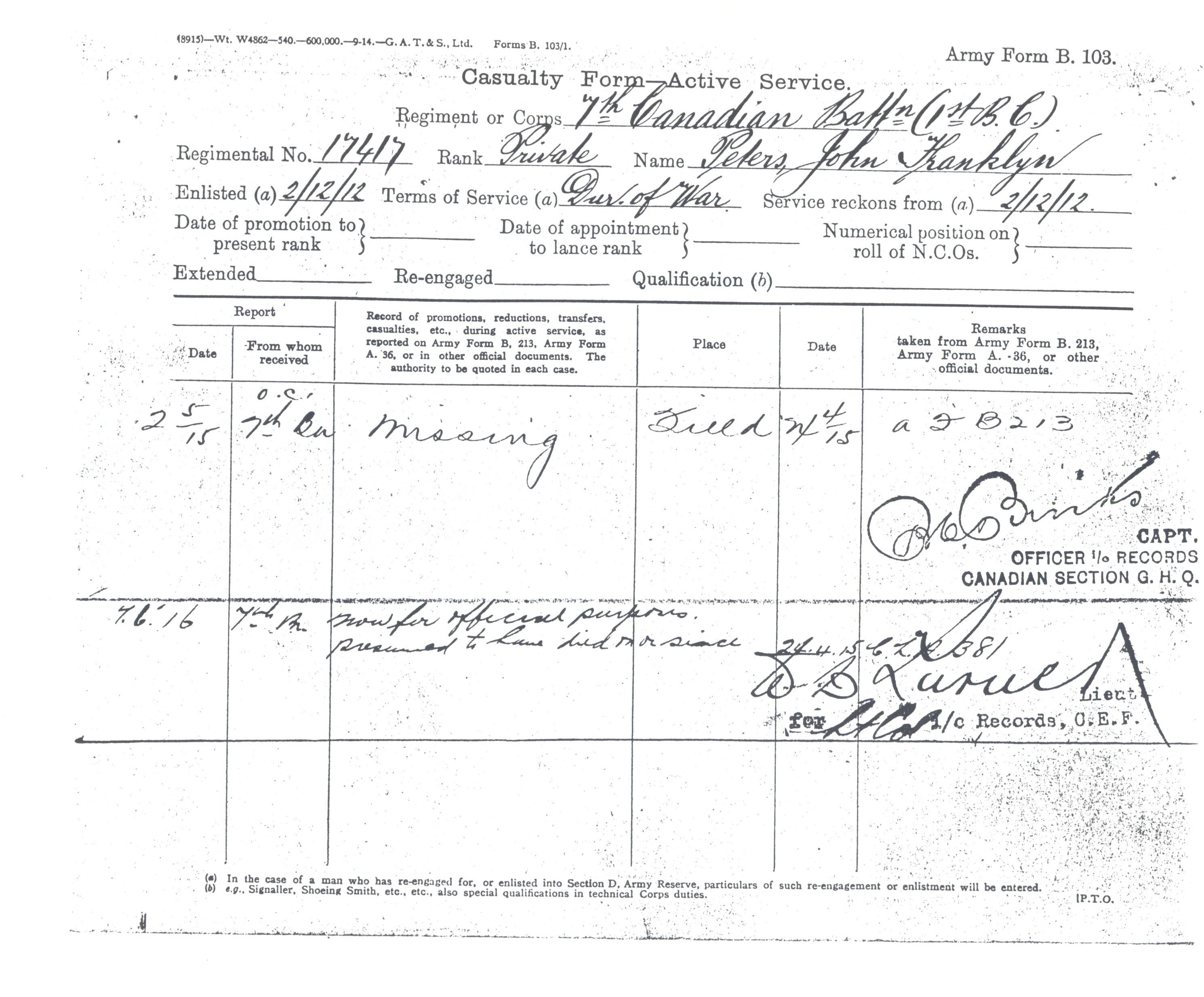
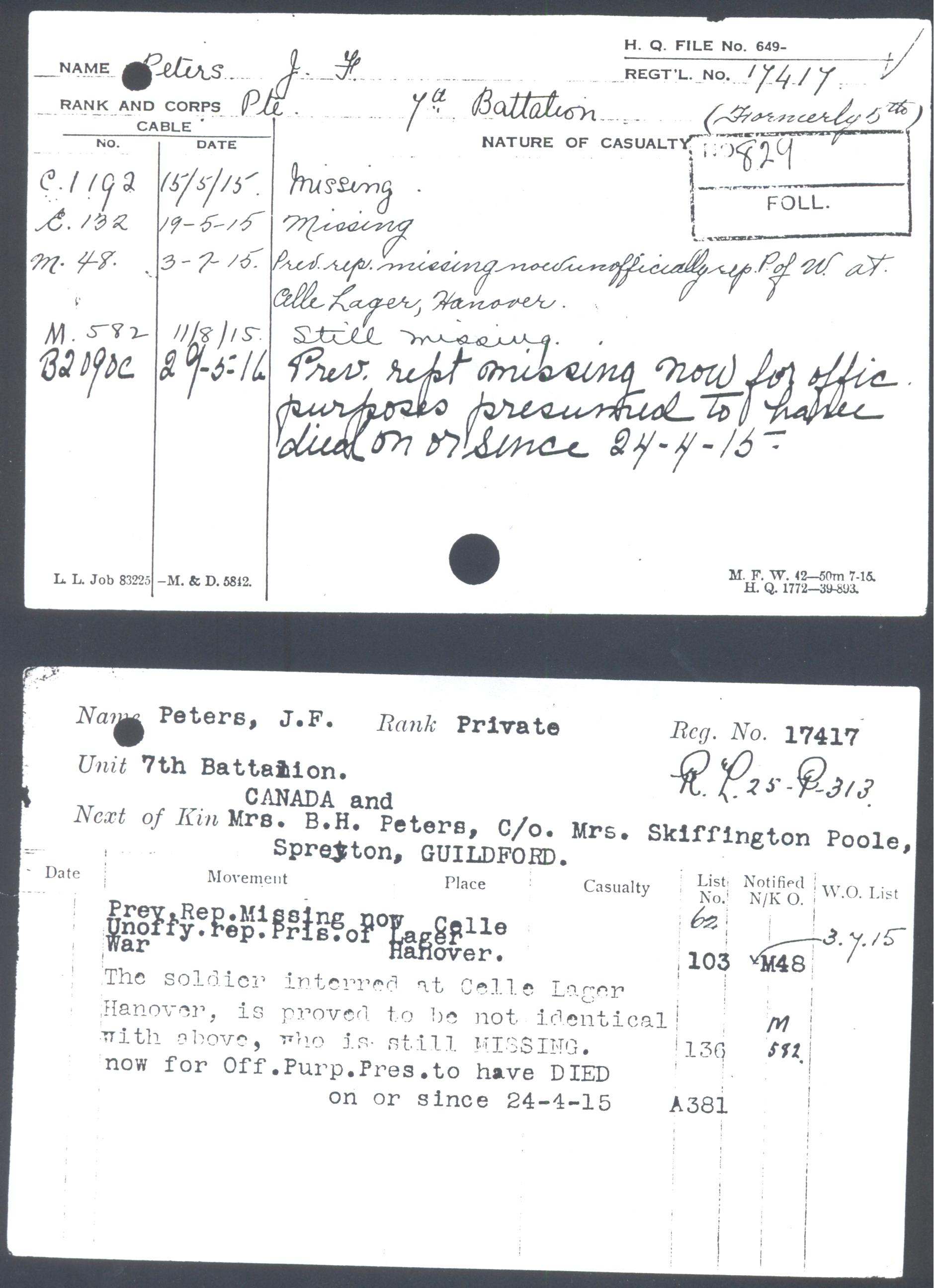
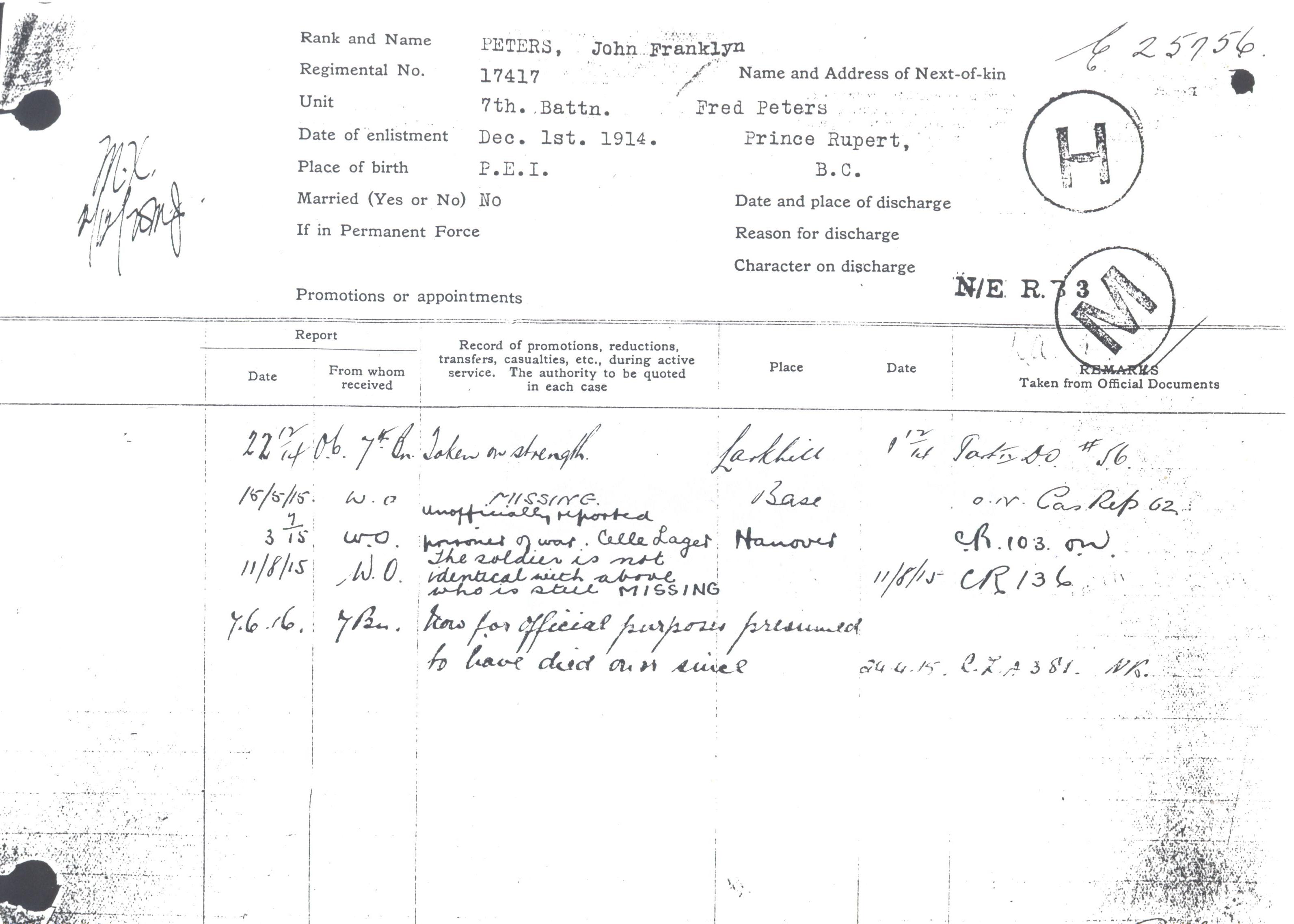
As a large number of Jack’s comrades in the 7th British Columbia Battalion were taken prisoner that day, Jack’s family hoped he was alive and safe as a prisoner while he continued to be listed as “missing”. Rumours that he was being held at the Celle Lager camp in Hanover proved to be wrong when the Red Cross reported in May 1916 that Jack was no among the POW’s.
His sister Helen Peters Dewdney (my grandmother) remembered Jack as a normal, happy-go-lucky boy, who would dutifully serve his country and Empire in wartime, but was happy to let older brother Fritz be the hero of the family. The Peters moved to Victoria, B.C. in 1898, and then to Prince Rupert, B.C. in 1911, as his father pursued better financial prospects.
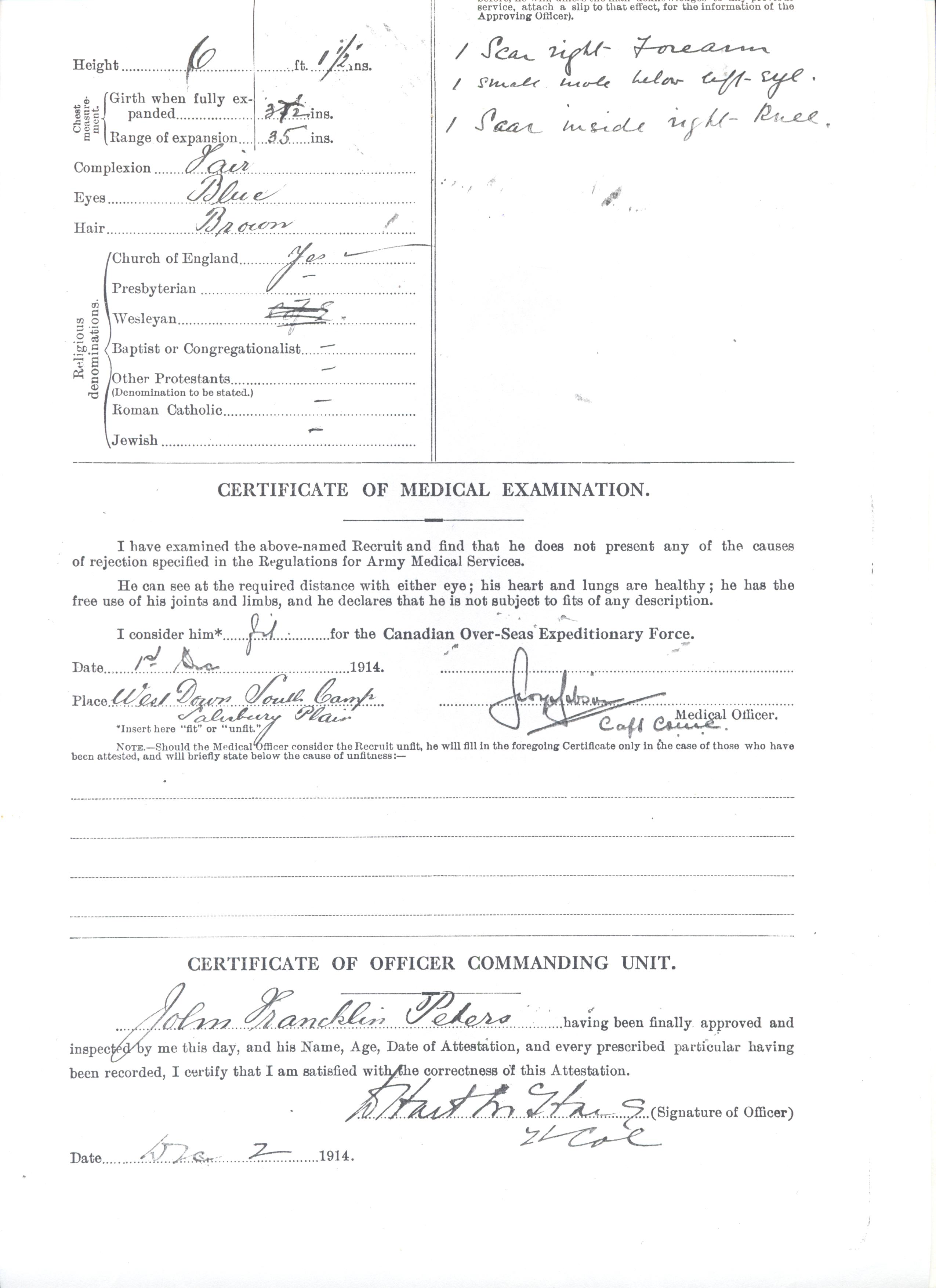
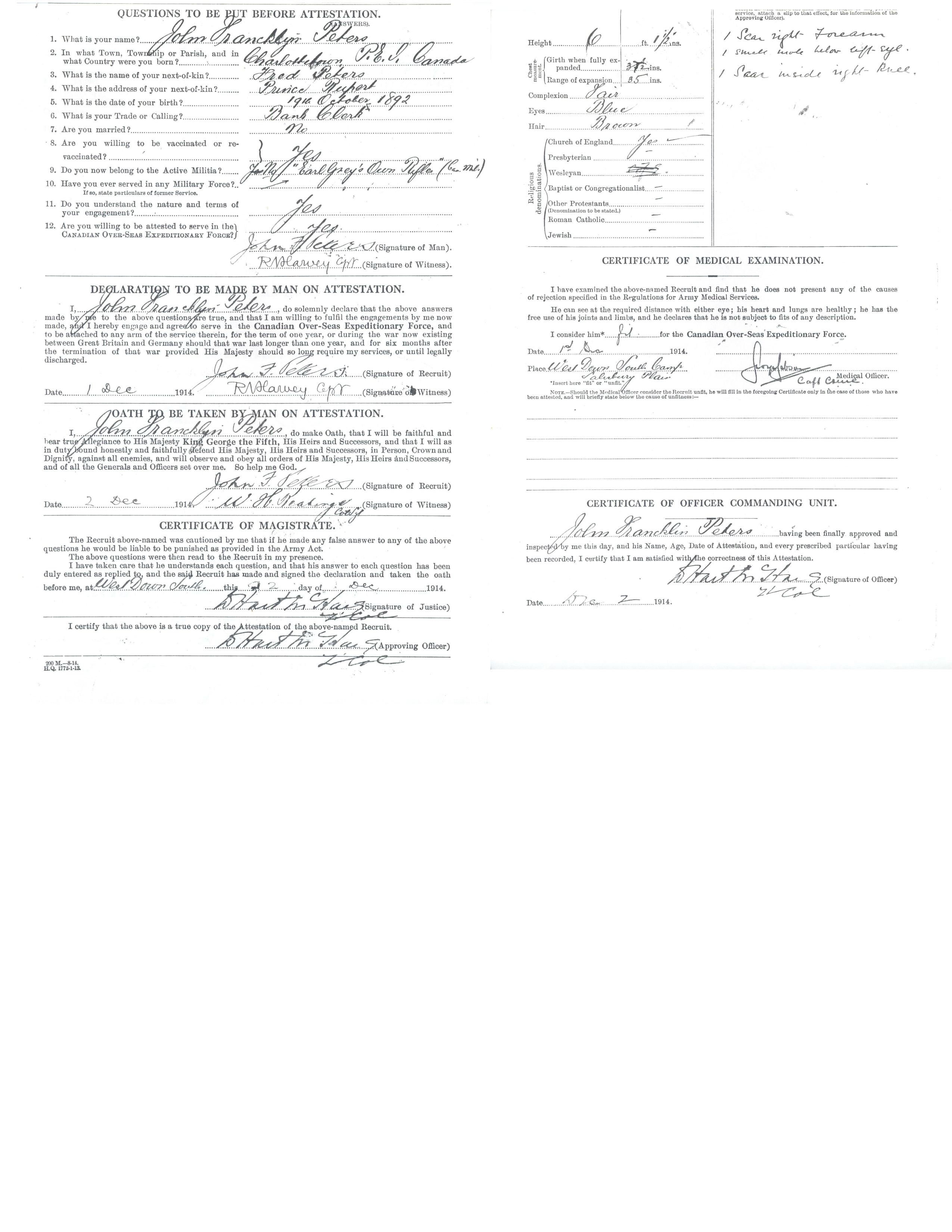
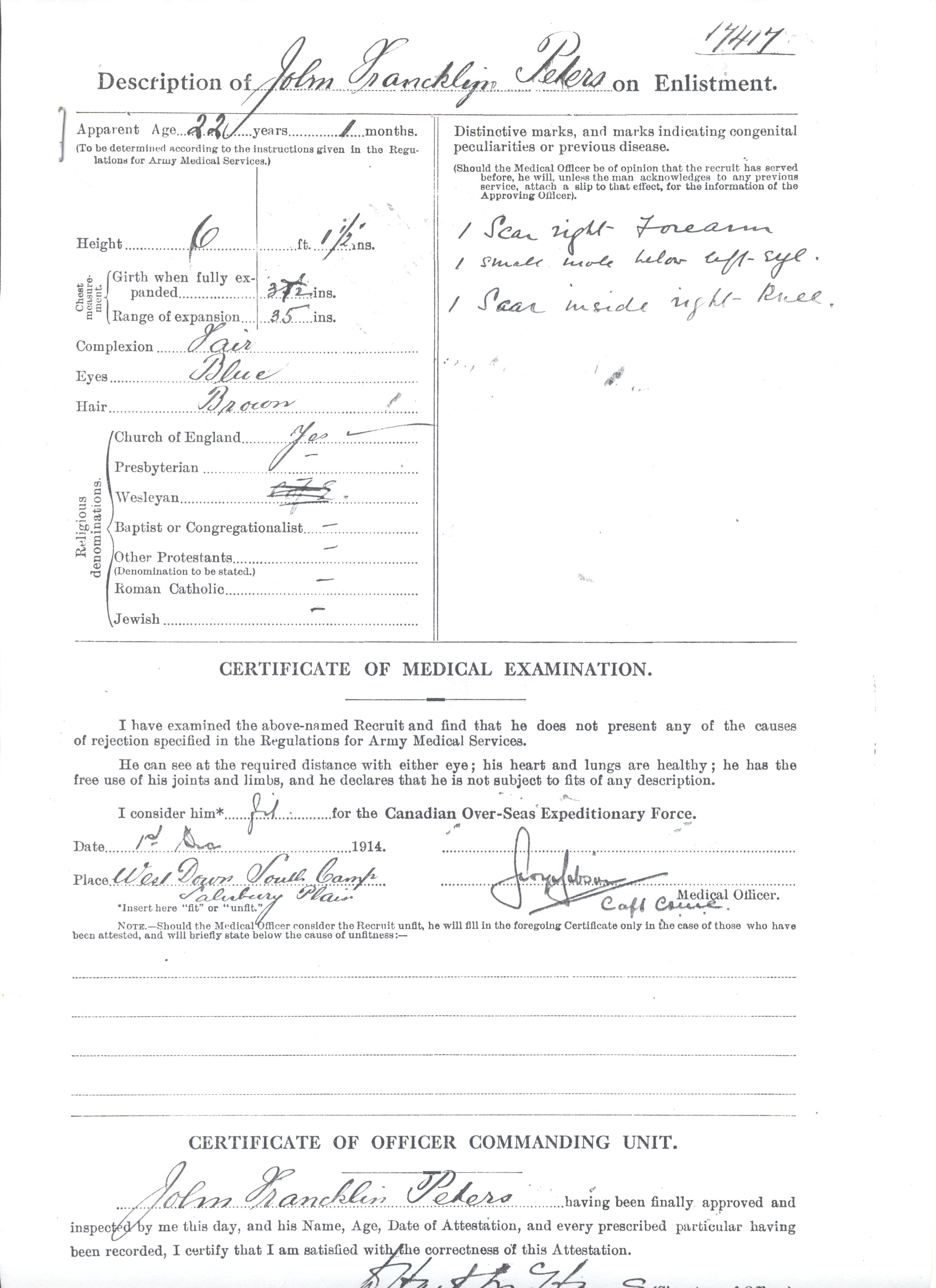
At the outbreak of war in August 1914 Jack was working as a bank clerk in Prince Rupert. Unlike his younger brothers Gerald and Noel, Jack had no difficulty passing the medical examination for army enlistment. He trained with the First Contingent through the winter of 1914-15 in Salisbury Plain in England, and embarked for France in February 1915.
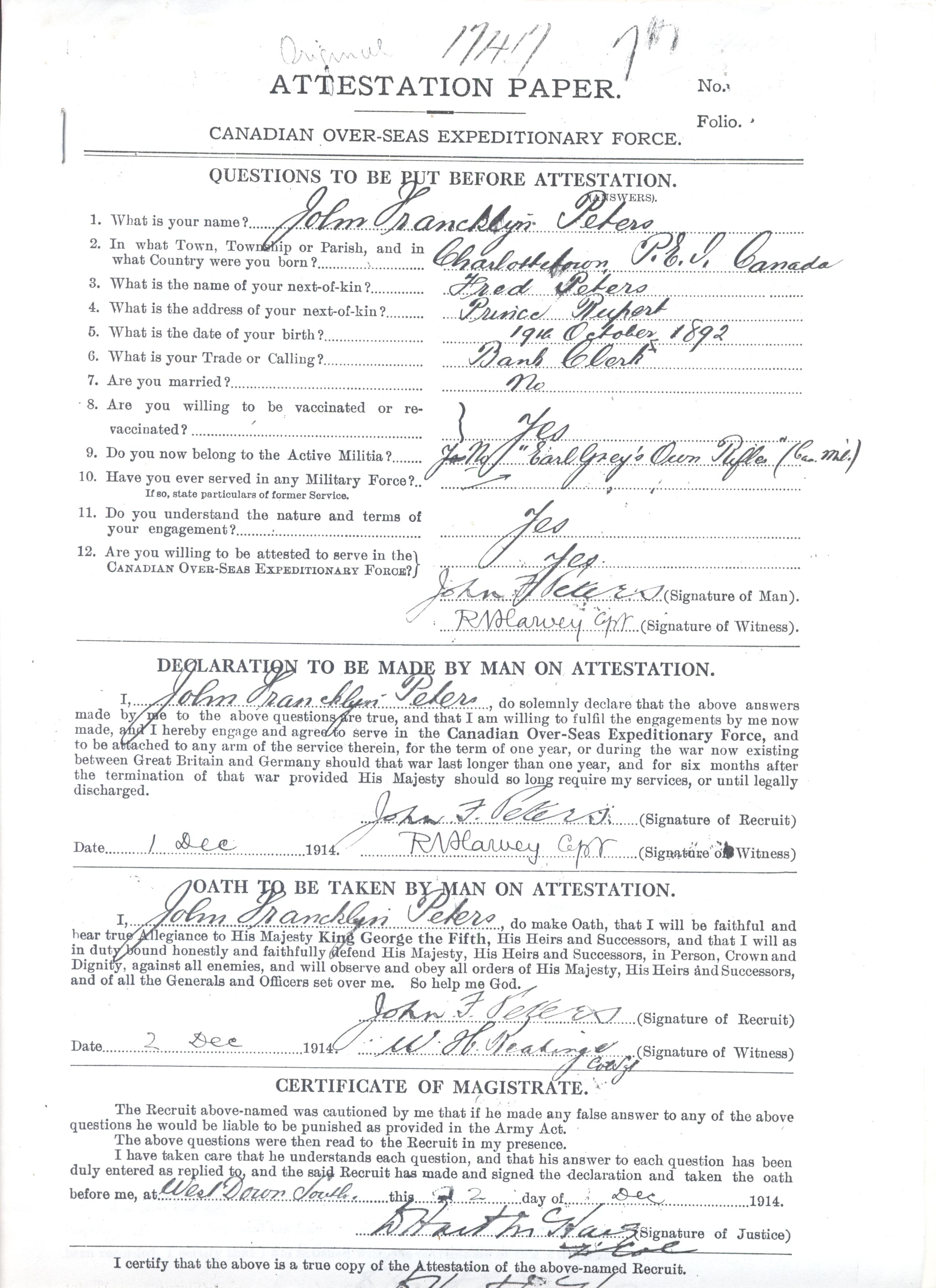
The following transcribed and annotated letters, as well as scans of photographs and military documents, reveal his character and personality and help tell his story. Note that the images become much larger and easier to read when you click on them.
Jack to his family in Prince Rupert December 18, 1914
{sent from England}
Just received yours of Nov. 23rd. As it is pouring with rain we can’t go out on parade so I’ve got a chance to answer it.
Capt. Harvey1 gave us a lecture on attacking a fortified position between 9 and 10 this morning. About which he doesn’t know much. All the old soldiers are busy imitating him now. They, of course, know what a real attack is like. Although, as a rule, they don’t say much about the Boer War.
I was very glad it rained today as I was feeling tired after a day’s work digging on the railway about five miles away from here. The pick and shovel work caused many casualties amongst the company. Mostly, the “lurking fever”. They all claimed it was vaccination, but the hard-hearted doctor sent them all back to work. Except one to whom he gave some medicine. The others all agree that it is lucky that he took it first before they tried it. My arm hasn’t bothered me at all. I hope to escape inoculation.
It’s awful to be ill at camp. “Sick Parade” sounds at 7:15 and you have to parade at the doctor’s tent then await his pleasure. Needless to say, it prevents anyone from going sick when they aren’t. The ones who really are ill, generally die. I believe I’m feeling quite well, so far. Eric Poole2 is in hospital as a result of trench digging on a wet night. Ray3 is a major now. We are all a bit excited owing to the bombardment of the East Coast. One fellow in the next hut whose house is in Scarborough had his home destroyed, and feels that his people may have been killed. The general nervousness in camp is not owing to anything like that, but whether Christmas leave will be stopped. All the old soldiers live for the huge bust that they go on when on leave.
I am down for leave from Dec. 30 to Jan. 4. I expect I’ll go up to Hodsocks4 and have a cheap holiday. London is a little expensive. I arrived in camp with 1/35. If I hadn’t been taken I would have had to work with pick and shovel to enable me to get back to London.
I feel sure that we will be in France by the time you get this. Of course, we will be at least eight weeks at the base or on the lines of communication. The 1st B.C. regiment are the cracks of the Contingent. Some of the Eastern men are awful looking mutts quite on a par with Kitchener’s rather scraggy army.
I’ll send you a photograph as soon as I can. My uniform will soon be all messed up. They provide us with slacks and a khaki shirt which I generally wear.
(continued Sunday)
We had parade on Friday afternoon. I saw the biggest aeroplane that I have ever seen. The plains are alive with them. They have a Union Jack painted on the bottom of the planes. I’ve seen as many as 5 in the air at once.
Saturday morning was the hardest on record. We paraded at 8:30 but had to go on fatigue instead and help the engineers build a heavy truck road. I had the job of carrying ties about 8 feet long weighing a terrific amount. It was pouring with coldsleet and rain as well. We labored for 3 hours. The hardest in my life. I was over to see Harris on Friday evening. The 72nd are about a mile away from here. I got lost coming back in the dark. Hundreds of huts all looking the same.
I had a two hour job finding my own hut. Harris goes on his holiday this week. So I can’t go to Yorkshire with him. Gus Lyons of Victoria fame is in the 50th Highlanders right near us. I haven’t found Willie Abbott6 yet.
We had a church parade this morning for the first time since my arrival. Mr. Barton I believe is our chaplain. It was cold out in the open air. I didn’t envy him in his thin surplice.
Fritz has written to me several times since I came. He can’t give any news.
The war in the opinion of most people will last for 18 months at least. The Russians have just been badly beaten by Von Hindenburg. The Germans again threaten Warsaw. So it is up to Kitchener to finish the war as neither France or Russia can. I expect you don’t hear anything about the Russian defeat in Rupert.
Kitchener rules…
1 Captain Rupert (aka Robert) Valentine Harvey (1872-1915) was born in Liverpool and taught school there before moving to Canada in 1899 to teach at Queen’s School in Vancouver. In 1901 he took over as headmaster and then in 1908 merged his school with UniversitySchool in Victoria that had been founded two years before by Rev. W.W. Bolton (who had taught Fritz Peters at his school on Belcher Avenue in Victoria before Fritz went to England for preparatory school in 1900) and J.C. Barnicle. Harvey became Warden of the UniversitySchool (now known as St. Michael’s UniversitySchool, the largest residential school in B.C.). In a 1917 letter to his father, Fritz Peters mentioned meeting Harvey several years earlier and discussing schoolmastering with him, which Fritz was considering as a career at the time. Harvey was a strong believer in cadet corps and scouting, but he didn’t serve in the Boer War. In 1914 he left with his regiment, the 7th Battalion, as Captain for overseas duty. On April 24, 1915 in the Second Battle of Ypres he and the No. 3 Company he commanded were surrounded by Germans in their full-scale assault on Canadian forces. Harvey was seriously wounded but refused medical treatment until injured men in his company were taken care of. He was taken prisoner, and died in a prison hospital in Germany on May 8, 1915. Captain Harvey’s signature is on Jack Peters’ attestation papers.
2 – Jack’s cousin Eric Skeffington Poole was a son of Bertha’s sister Florence Gray Poole. He was born in Nova Scotia and lived in England after the family moved there in 1905. He was a Second Lieutenant with the West Yorkshire Regiment in July 1916 when he suffered from shell shock during the Battle of the Somme. He had recurring periods of confusion after returning from medical treatment, and then on October 5, 1916 he wandered away from his platoon at the front. He was arrested by military police and faced a court martial for desertion. Despite evidence that he was still suffering from the shell shock (or what today could be referred to as Post-Traumatic Stress Disorder) which made him anxious and confused, he was found guilty and sentenced to death by firing squad. British Field Marshall Douglas Haig could have commuted the sentence, but chose to make an example of him to demonstrate that officers were subject to the same basic military rules as their men. In his diary entry of Dec. 6, 1916 Haig wrote “it is highly important that all ranks should realize that the laws is the same for an officer as a private.” Eric was shot at dawn on December 10, 1916 at Poperinghe, Belgium, about 10 km west of where his cousins Jack and Gerald Peters had died earlier in battles near Ypres. He was the first British officer in the war to be executed for desertion. The trial and execution were not publicized in the press at the time, apparently in deference to Eric’s father Henry Skeffington Poole who had aristocratic connections and was ill at the time of the court martial and would die in March 1917. It is possible that the family agreed to not contest the verdict if authorities kept it secret. The fact that Jack would comment on Eric being in hospital in a 1914 letter – two years before the “desertion” incident – is interesting because it shows that Eric had longstanding health problems.
3 – Major Henry Raynauld (Ray) Poole was Eric’s older brother. The obituary published after the funeral of his mother, Florence Poole, in 1923 listed a surviving son Major H. R. Poole, DSO, MBE, indicating he won the Distinguished Service Order medal and was accepted as a Member of the British Empire.
4 – Hodsock Priory, a stately manor and estate in Nottinghamshire, was the residence of Col. Henry Mellish, a bachelor who was an expert sharpshooter and enthusiastic amateur meteorologist. Mellish’s mother was Margaret Cunard, a daughter of Sir Samuel Cunard and sister of Fred’s mother Mary, so he and Jack’s father Fred Peters were cousins. One of the envelopes of letters that Fritz sent to Bertha in 1916 was addressed to her at Hodsock Priory, which was one of several addresses Bertha had while in England when she was there for about a year during the First World War. From these letters, the Peters family members appear to have had an open invitation to stay at the huge Hodsock estate virtually whenever they desired.
5 – The standard for stating British currency at the time (pounds/shillings).
6 – William Hamilton “Willie” Abbott was Jack`s cousin. His mother was Mary Stukeley Hamilton Gray, sister of Jack`s mother Bertha Gray. His father was William Abbott, son of the Canadian Prime Minister John Abbott. The Abbott home in Montreal was a regular stop for members of the Peters family travelling by rail from British Columbia to or from England. Willie, a civil engineer, survived the war. He was interviewed by the Montreal Gazette in 1943 after his cousin Fritz Peters received the Victoria Cross. Willie was a greatuncle of the Canadian actor Christopher Plummer.
Jack to his mother Bertha January 27, 1915
{sent from England}
Dear Mother.
Just got yours of Jan. 8. I am going right through it and answering the various questions in it.
Re mattress…Straw pallets were tried at West Down South1 but from reports that I heard they soon became rather unpleasant, “lousy” in fact. The cold does come whistling up through the chinks in the floor, to which many colds are attributed. It doesn’t bother me any.
My vaccination took very little. I haven’t been inoculated yet for anything at present. They inoculate for typhoid, tetanus and for something else, cholera, I think.
I’m glad that Clifford was able to see you at Christmas. I don’t think they can be having such a very tough time of it at the Willows. I think he is in luck not going to the front until the spring…
I suppose by the time you get this you will have read all about the naval battle2 in which Fritz figured when the “Meteor” had a shell put through her killing four and wounding one, putting her out of action. I’ll try and get an account off Fritz, if possible. It must have been pretty exciting while it lasted. I’m sending you a Mirror. These papers don’t give any news at all here. Not a paper has published any thing about the “Audacious”3 which was supposed to be lost off Belfast. We don’t know anything about it yet except what we see in the Colonist. If I come across any good account in the paper written by a “Meteor” man I’ll send it to you. The trouble is that we often don’t get any papers in this wilderness.
We were served out with our new “Webb” equipment and trenching tool. The latter reminds me of a toy shovel. Thank the Lord it is very light. The new equipment is made out of webbing like a football belt. Our old “Oliver”4 equipment was leather and the corners used to cut into my shoulder giving you awful pains and aches. It’s sheer will power that keeps a lot of us from falling out of the march sometimes.
We expect to leave here on Sunday or Monday. I believe this is the real thing this time. We hope to go to the South of France to recuperate for a month. I hope we do. It sounds warmer down there. Ten weeks in the cold and wet doesn’t suit you for the colder and wetter trenches. Much better to go to France in the sunny spring. If we do go to the front right away, of course, you needn’t worry about me because I don’t intend to put my head up above the trench to shoot the Germans. Me for where the earth is thickest and highest.
We may go to Winchester but I don’t think we’ll do more than just pass through.
My cold is better. All I want now is a change of air and a bunch of good food, which I’ll get if we go to Winchester. You can’t get it here. All leave has been stopped and everyone recalled who were away. Forty men from the base company were transferred into ours, to bring it up to full strength. All the sick being put in the base company and will be left behind. All these things make me think that the hour is approaching.
You speak of spinal meningitis. It has been in the other regiments for some time. We had a case at New Year’s in G Company and another one in B Company. I believe one died and the other recovered. Both huts were isolated and every precaution taken in fact anyone with a tickle in his throat was rushed to the hospital to be watched. I think all danger is over now. One hut will be out of quarantine before we go. No need for you to be alarmed. Although I felt a bit scared when I first heard of it myself and saw the rows of stretchers passing by. All containing men with colds who thought their last day had come. You know how rumours about these things spread. It was living in the wet that caused it. Well I must stop
– Jack
P.S….I notice you say that the cavalry and artillery have gone. They are still with us3. We fought a battle with the cavalry yesterday and won out. It was very easy as we were the supports and did nothing until the end when we doubled into action to help the others who didn’t need us. I only saw one of the enemy all day and he was sitting in a field firing at about 200 of us quite calmly. Unfortunately the Colonel made us skirmish all the way home which means doubling about two miles in our full equipment. I couldn’t speak for half an hour afterwards. I’m sure we’ll never be called up to do so much on active service.
I notice you ask for a timetable. I believe I sent you one.
Reveille 6:30 am
Breakfast 7:30
Parade 8:15-12:00
Dinner 12:30
Parade 2:15-4:00 pm
Supper 5:00
Lights out 9:45
1 – In Salisbury Plain southwest of London, the central training area for the British Army for many years. Jack had trained there with other forces of the Canadian First Contingent in the winter of 1914-15. The weather was the worst on record – so bad that many soldiers were looking forward to better conditions at the Western Front. Soldiers lost out on much of their training – most notably, training for life and combat in trenches — because the exercises could not be held in the mud and water of Salisbury Plain.
2 – This was the Battle of Dogger Bank in the North Sea on January 24, 1915 for which Fritz Peters was “mentioned in dispatches” for heroism in his service as lieutenant on the destroyer Meteor. He would later receive the Distinguished Service Order medal from King George the Fifth for the same action.
3 – The H.M.S. Audacious, a superdreadnought that was the third largest battleship in the Royal Navy, sank after hitting a German mine on October 27, 1914 off the Firth of Clyde in Scotland while temporarily away from its regular base which was undergoing repairs. The White Star passenger liner R.M.S. Olympic – sister ship of the R.M.S. Titanic which sank two years before – was only a few miles away when Audacious signaled for help. Thanks to the Olympic and other rescue ships, the entire crew of Audacious was saved before the ship went down. The Olympic tried to tow Audacious to a safe port, but the warship sank in the process. The British authorities tried to keep the sinking secret for security and morale reasons and did not admit to it until after the war, but many American tourists on the Olympic witnessed the rescue and took photographs and film footage that was shown in the United States and reached the rest of the world from there. Jack had seen reports of the sinking in clippings of the Victoria Colonist newspaper that someone mailed to him. This was one of many instances of clumsy censorship and propaganda during the war.
4 – There was a great controversy in the first two years of the war about the uniforms, equipment and rifles provided to Canadian troops. Canada’s hard-driving and outrageous Minister of Defence and Militia Sir Sam Hughes was using the war as an opportunity to showcase Canadian industry, including products of contractors who were among his political supporters. The Canadian soldiers and their British generals often found the equipment uncomfortable and faulty. The shovel Jack mentions could be one of the infamous MacAdam shovels with a large hole in the blade that a secretary of Hughes designed and patented. The idea was that a soldier could look through the hole at the enemy as he was shoveling above the top of the trench. However, the shovel proved to be useless for stopping bullets and also no good for shoveling, so the 20,000 purchased for use by Canadian soldiers were scrapped.</div>
Jack to his mother Bertha February 5, 1915
Lark Hill Camp1
Dear Mother,
Just received yours of January 13th. Our training is finished now apparently because we are practically doing nothing.
The King and Kitchener2 together with a small army of generals and a stray admiral reviewed us yesterday. We were stationed just opposite the royal stand so we were able to see nearly all the contingent march past. It certainly was a wonderful sight. Every regiment did well. The cavalry and the artillery headed the procession. The 1st B.C. were nearly at the end, the Highland regiments being behind us. Kitchener said that there had been a great improvement since he last reviewed the Canadians. He himself looked quite a mild, good-natured old man. His mustache is quite gray. He towered head and shoulders above the others. The King looks very worried and has rather a strawberry nose. I had a good view of him when he passed in the train. We all lined the track and cheered him as he slowly went by looking very depressed. This was our farewell review before going to France. All the men are reviewed by the King before they go out. Colonel McHarg3 reminded me very much of poor old Captain Stork4 when he said to us “Boys, you’ve done well.”
My cold has gone now. I cured it by going down to a small village nearly three nights in succession and getting enormous meals. The camp food seemed to sicken me for a while. My appetite is back now and I once more eat with relish. They won’t allow you to go into the villages, pickets being placed all around them but of course they are easily dodged.
We expect to go to France any day now. Ammunition has been served out to us. I think we are going to take the Ross Rifle5 to the front with us after all. The new Webb equipment is fine to wear and doesn’t hurt my shoulders at all. The old Oliver equipment used to be leather and would cut right into your flesh. I think we shall be billeted in South France. I hope so, anyhow. The chances are that my next letter will be censored so you can’t expect any news in it. In case they won’t allow us to write where we are, the following may come in handy. If I begin my letter “My Dearest Mother” it means that I am billeted in South France. “Mother” (alone) means that I am at the base. “Dear Mother” means that I am going to the front right away.6
I wrote to Fritz for an account of the battle but haven’t received any answer so far. I wish I could have seen him before I left. I’ll be gone before Gerald arrives.
The five hundred men from Canada including the 125 from Victoria have arrived. They are stationed at Tedworth about 6 miles from here. They were quite useless as far as I can learn, as a reinforcement for the P.P.L.I.’s7 as they were practically untrained. I expect they will be drafted into the various battalions. I haven’t come across any of the Rupert men yet.
I suppose Gerald has gone by now and you are feeling low. I hope you’ll be able to make it in the summer. Just about the time when I am invalided back to England.
We never went to the East Coast. I notice that you ask the question in your letter.
The rain has come back. I personally like it as I’m used to it. It’s the cold that bothers me. It is warm when it rains and we can’t have any parades either, which is a great thing. Good bye. I’ll drop you a card when we are en route.
– Jack
P.S. Socks and coloured (dull) handkerchiefs are always acceptable.
P.P.S. Aunt Helen8 has been very good and has sent some fine socks. Next time you write you might thank her.
1 – Salisbury Plain in England
2 — King George the Fifth and Britain’s Minister of War Lord Horatio Kitchener, whose stern likeness was on recruitment posters throughout the British Empire.
3 – Colonel William Hart-McHarg was commander of the 7th Battalion (British Columbia) in which Jack served. His signature is on Jack Peters’ attestation papers, along with Captain Harvey’s. Hart-McHarg was a sergeant in the Boer War and 46 in 1915. In about 1900 he was a lawyer in Rossland, B.C. and was an officer in the local militia known as the Rocky Mountain Rangers. This was the same time that Jack’s 20-year-old future brother-in-law Ted Dewdney was working as a clerk at the Bank of Montreal and active in the Rossland unit of the Rocky Mountain Rangers, so it is possible that they knew each other from that experience. By 1903 Hart-McHarg was living in Vancouver and was among the legal staff for the British/Canadian position in the Alaska Boundary dispute, as was Jack’s father Fred Peters. Hart-McHarg was a superb marksman, winning Canada’s national sharpshooting competition’s Palma Medal in 1908 and 1913 using the Ross Rifle. Unlike other senior officers who generally stayed safe in headquarters several miles behind the trenches, Hart-McHarg was in the battle zone on April 23, 1915 during the 2nd Battle of Ypres reviewing the new battle lines with two other officers when they encountered German soldiers in the open about 100 yards away. As he was running back to the Canadian line he was hit by rifle fire. He made his way to the medical centre, but died the next day on April 24, 1915, the same day Jack died. A viaduct in Vancouver and a scenic mountain in the Kananaskis Park in Alberta were named in his honor.[i]
4 – Originally from Bolton, Ontario, Alfred Stork was mayor of Fernie, B.C. before moving to Prince Rupert in 1908. He established a large hardware business and became Prince Rupert’s first mayor. He was commanding officer of the first military organization in the city, the Earl Grey’s Own Rifles, which Jack, Gerald and Noel Peters joined as cadets in their teens.[ii]
5 – Canada’s Defense and Militia Minister Sam Hughes insisted that Canadian soldiers use the Canadian-made Ross Rifle, against the wishes of British generals and Canadian soldiers who found the rifle jammed when hot after rapid firing, or if wet and muddy. It wasn’t even good for bayoneting, as the blade tended to break off. In man-to-man combat, Canadian soldiers were often only able to use the rifle as a club. When they could, Canadian soldiers took Lee Enfield rifles from dead British soldiers and used them instead of the Ross. After the 2nd Battle of Ypres, a quarter of the 5,000 surviving Canadian soldiers had replaced their Ross with a Lee Enfield. However, orders came through after battles that all Lee Enfields had to be returned, and the soldiers would receive new Ross Rifles. On orders from the Defence Minister, further use of the British rifle would be punished. In 1916 the rifle issue went to Commander in Chief Douglas Haig, who ruled that the Ross – though excellent for sharpshooting — was inferior for battle conditions and should be scrapped, except for use by snipers. Hughes, who had a strong base of support among Orangemen in southern Ontario, was finally dropped from cabinet by Prime Minister Robert Borden in December 1916.
6 – Letters Bertha received from her sons later in the war had a stamp “read by censor” on the envelope. Censorship became stricter as the war progressed. Under the Defence of the Realm Act in Britain and the War Measures Act in Canada, authorities were empowered to censor mail and do virtually anything in the interest of security and the war effort. Any use of codes such as Jack suggested were expressly forbidden. You could also get in trouble if you made disparaging remarks about soldiers or the nation’s military in general, so there was often a climate of fear as well as mourning in the homefront.
7 – Princess Patricia’s Light Infantry
8 – He is referring to his aunt, Helen Francklyn, residing near Bristol, England, whose mother was Sarah Cunard, daughter of Sir Samuel Cunard and sister of Fred’s mother Mary.
Jack to his brother Gerald March 11, 1915
France
Dear Gerald,
I was awfully glad to hear from you at last. I was wondering where you had got to. You’ve done the right thing alright in joining the Victoria Rifles1. I suppose you are in England by now. You’ll just get in on the war at the right time. I don’t think you’ll be sent to Egypt. That is just the usual rumour2.
You want to visit Aunt Florence and Aunt Helen and the Hodsock bunch if you get leave. They’ll treat you well. Only take my tip and just spend a day at each place, because they are rather boring after that time.
I’ve been in the firing line quite a while now. There hasn’t been much excitement. You remember Boggs3 who used to command the High School cadets. He was killed by a sniper a few weeks ago. He was a lieutenant in E Company. Pretty hard luck so early in the war.
I’m writing this letter in the actual firing trench. Shells whistle over me every minute and now and again a bullet hits the parapet above. Sounds exciting but it isn’t. Just a little monotonous. We go out for a rest tonight to our billets, which are generally barns. We get plenty of freedom and can go to the villages to buy what we can – which isn’t much because they only give us three francs a month. I’ve got nearly $50 to my credit now which I cannot draw. If I were you I’d have some pay assigned because it’s so easy to fritter it away in England.
I suppose you know about Fritz winning the D.S.O.4 and being mentioned in dispatches. Won’t Father and Mother be tickled to death! I dare say he is quite satisfied,
but I should think that it certainly should help his promotion a lot.
Any time you have a magazine or paper you might shoot them along to me, and milk chocolate always comes in handy. I’m going to send you money to buy things for me soon. The minute I can raise it from the Paymaster. If you want ₤5 I can easily spare it. Just say the word.
Good bye, Old Man
Jack
1 – Gerald initially joined the 24th Battalion (Victoria Rifles regiment) in Montreal and served as a private with them for four months in the Ypres trenches starting in September 1915. He went back to England in February 1916 for officer training and began as a lieutenant with the 7th Battalion in May 1916, 13 months after Jack went missing while serving in the same battalion.
2 – Weather and ground conditions were so bad in Salisbury Plain that soldiers were suffering and missing out on training because training programs were often cancelled. As a result, the Australian government took their soldiers away from England and had them trained in Egypt instead. But Canadian soldiers stuck it out in England. Unfortunately for the Australians, training in Egypt meant they were conveniently located for transport to the disastrous Dardanelles campaign.
3 – Lieut. Herbert Boggs, 22, of the 7th Battalion, son of Beaumont and Louise May Boggs of Victoria, B.C., died February 26, 1915 at the Battle of Neuve Chappelle in the Ypres Salient. He was among the first Canadian officers to die in the war. By coincidence, the Boggs family that the Peters boys knew in Victoria lived next door on Fort Street to Mr. and Mrs. Arthur W. Currie. When Herbert died Currie was Brigadier General in command of the 2nd Brigade, which included the 7th battalion. It was Currie’s responsibility to write personal letters of condolence to next of kin, who in this case were neighbours he knew well. Beaumont Boggs and Arthur Currie had both been realtors in Victoria before the war. Currie went on to lead Canadian forces in taking Vimy Ridge in April 1917 and command all Canadian forces in Europe. According to Pierre Berton, Currie was “the only great general Canada ever produced”. British Prime Minister David Lloyd George was reported to have said in 1918 that if Douglas Haig was to be replaced as head of the British Empire forces, he would nominate Currie. There are no references to Currie in the Peters letters, but as acquaintances of Herbert Boggs the Peters boys or their parents may have also known the Curries. This may have been one of the connections that the Peters family used to help get Gerald accepted for Officer Training in early 1916.
4 – On March 3, 1915 Fritz was awarded the Distinguished Service Order for his actions in the Battle of Dogger Bank in January 1915. The DSO at the time was the military decoration for the U.K. and Commonwealth countries, awarded for meritorious or distinguished service by officers in war time. The only higher decoration was the Victoria Cross, which he went on to receive in World War Two.
Jack Peters to his cousin Evelyn Poole April 4, 1915
Easter Sunday,
France
Dear Evelyn1,
Many thanks for your letter. Letters are one of our few excitements. At present we are in reserve behind the firing line after six weeks in the trenches. Three days in them and three to rest. Our stay there was very quiet. The Germans opposite to us generally preferring to let us rest as long as we didn’t bother them. During two days of the Neau Chappelle2 fighting we kept up a steady rifle fire and our artillery shelled their trenches. The German snipers are very good shots and once in a while they would account for one of our men. They have telescopic sights which is more than we have.
This town is out of shell fire [range] so beyond aeroplane bombs dropping now and then you would hardly realize that a war is going on. On a clear day there are aeroplanes to be seen being shelled — hundreds of shells seem to explode all around them but I’ve never seen one brought down. All our other billets have been within easy range of the enemy guns, shells used to fall in the streets but seldom hurt anyone. A few houses would be smashed up.
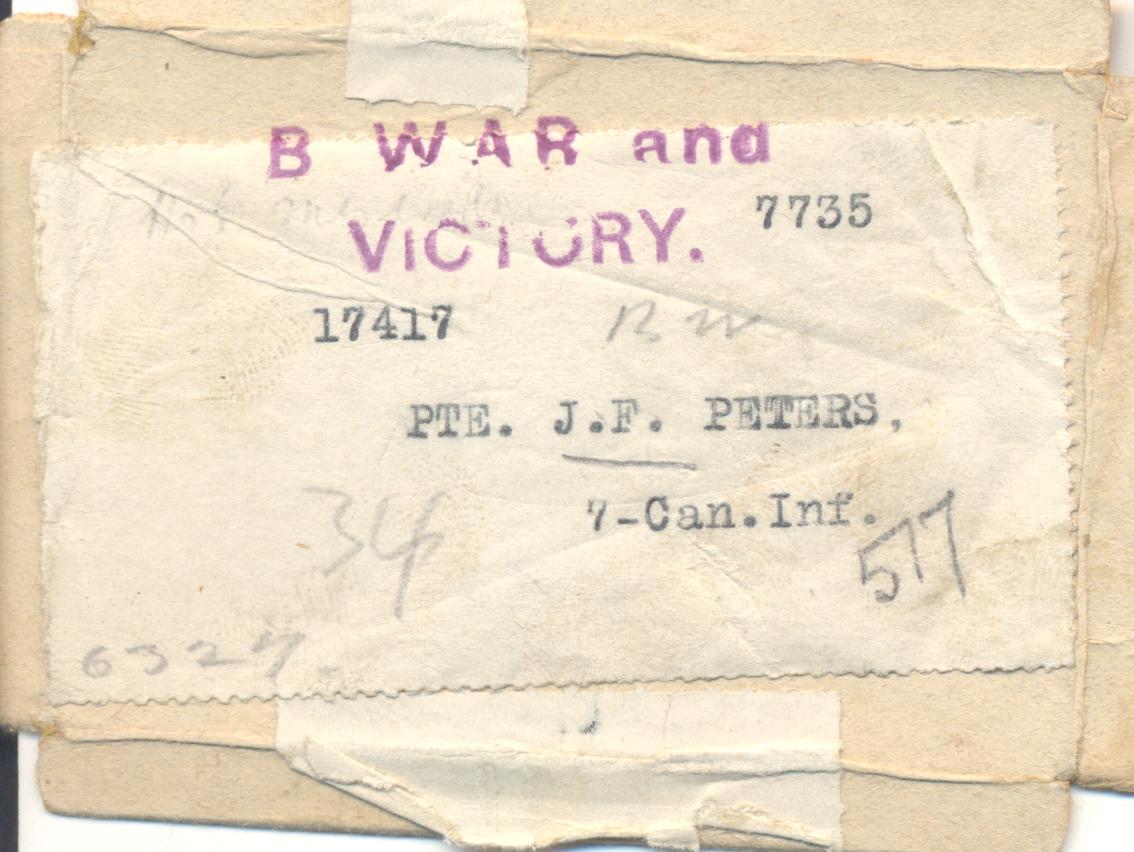
My correct address is Pte. J.F. Peters, 17417,
1st Canadian Division, British Exped. Force
2nd Infantry Brigade, 7th Battalion, No. 4 Company
I haven’t been able to find where Willie Abbott3 is although he must be nearby. I hope Eric4 is alright again by now. He has had hard luck in being stationed so long on the East Coast. I got your Punch – any magazines always come in handy. We are well-clothed, you needn’t bother about socks or anything like that.
Good bye for the present,
Jack
1 – Evelyn Poole was a daughter of Bertha’s sister Florence Poole in Guildford, southeast of London, England. Jack’s correspondence with her would have been much faster than letters to and from his family that had to go across the Atlantic by boat in wartime conditions. She was the same age as Helen Peters and they appear to have been close as cousins. It is possible that Helen’s daughter Eve was named after her.
2 – After leaving England for France in February 1915 the First Canadian Division had a quick introduction to trench warfare in performing a diversionary role in the Battle of Neuve-Chapelle in the Ypres Salient, which was the site of many battles during the war because it was the only part of Belgium held by the Allies. Allied troops were at a disadvantage in the Salient because its triangular shape often allowed the Germans to aim their artillery and guns at the Allied trenches from three sides. The enemy forces at the Battle of Neuve-Chapelle included Private Adolf Hitler who was a runner with the 6th Bavarian Reserve. Runners took messages from station to station in the era before radio communication. Telephones were used, but their lines were often broken by shelling. Hitler was one of the very few men on either side who actually enjoyed trench life and the battles. He only rose to corporal because of his inability to get along with people, but he did win the Iron Cross First Class for bravery. If Jack had lived until the Second World War years, it is likely he would have joined thousands of other veterans who wished they had shot Hitler in the 1914-1918 war.
3 – Jack’s cousin Willie Abbott was a son of Bertha’s sister Mary/Mim Gray and William Abbott, son of Canada’s second Prime Minister Sir John Abbott.
Jack to cousin Evelyn April 13, 1915
France
Dear Evelyn,
A few lines to thank you for your magazines which arrived today and are at present being eagerly read by everyone in the section. In the Illustrated London News you sent me, strangely enough, there is a picture of Plugsteert1, where we were first under fire in February. Plug-street is what we used to call it.
Our rest is over now for we leave for the firing line tomorrow, and from all reports we may really be up against something this time. Smith Dorrien reviewed us on Sunday, and General Alderson2 two days before. It’s been quite like Salisbury Plain again, what with Company drill and bayonet exercises. Every one of us are in good health after resting up, and I’m glad to move as it’s been rather monotonous at this billet as we are away out in the country. The nearest village only having about 8 houses in it. You can barely hear the guns from where we are. We’ve also all been broke owing to our last stay in a town where we spent all our money. Needless to say, the French people make as much out of the Canadians as they can. We only draw to 30 francs so we should be rich when the war is over, at least the ones that are alive.
I’ll have to stop now, as there is a select concert going on in the farm yard, which makes it impossible to do anything except listen to it.
Give my love to all. I’ll drop you a card from the trenches.
Your affectionate cousin,
Jack Peters3
1 – in the Ypres Salient in Belgium
2 – British General Sir Horace Smith-Dorrien (1858-1930, commander of the British 2nd Army, which included the Canadian 1st Division. He was fired and sent home after losing ground in the 2nd Battle of Ypres in which Jack died.[i] British General Sir Edwin Alderson (1859-1927), served under Smith-Dorrien in charge of Canadian troops. He lost his command as a result of losing ground in the 2nd Battle of Ypres, as well as other setbacks and disobeying orders in previous battles.
3 – This was the last letter from Jack. He died on Saturday, April 24, 1915 in the 2nd Battle of Ypres when Canadian troops were making a courageous stand against a German attack that used poison gas for the first time on the Western Front. The use of poison gas in artillery shells was forbidden by the Hague Conventions which both sides had agreed to in 1899 and 1906, but the German commander at Ypres thought he could get away with spreading the gas directly from canisters and piping from their own trenches, depending on the wind to take it to the enemy. The completely surprised French colonial troops on the Canadians’ left panicked and ran away from their positions upon experiencing the greenish-yellow cloud of chlorine gas late in the afternoon of April 22nd, which left the inexperienced Canadians to fill a four-mile gap in the Allied line protecting the headquarters at Ypres and the coastal ports. Reinforcements promised by the French never arrived. The Germans did not expect the gas to have such a dramatic impact – wind conditions and temperature were ideal for distribution of the heavier-than-air gas, unlike a previous attempt to use poison gas on the Russian front — and were not prepared with reserves to immediately take advantage of the break in the line. They were ready by the early morning of Saturday, April 24th, launching a full-scale offensive with gas directly against the Canadians. Jack in the 7th battalion would have been right in the middle of it. The Canadians found they could function somewhat under the gas by holding urine-soaked handkerchiefs against their faces and partially neutralizing the chlorine. Records show that relatively few soldiers died from just the poison gas; they would be hit by bullets and shells when drawn away from their trenches by the gas and unable to defend themselves. Flame-throwers were also introduced for the first time in the offensive, making a horrific situation even worse for the defenders. If the Canadians had not held the new battle line, the enemy could have easily encircled 50,000 Allied troops and marched to the North Sea to capture ports (as happened at Dunkirk in May 1940 in the Second World War), which would have been a devastating blow to the Allies. British General Sir John French gave the Canadians credit for extraordinary bravery and said they “saved the situation”. The Germans also began respecting Canadians as adversaries after this battle. While we don’t know exactly what happened to Jack in the battle (witnesses died too), it is noteworthy that he was a part of what was probably the most dramatic and important defensive stand in Canadian history. There were hundreds of Canadian prisoners taken in the shifting front that day, and for a period the military authorities thought Jack might be among prisoners in Belgium or Germany, but on May 29, 1916 he was officially presumed to have died “on or after April 24, 1915”. Of 900 men and 24 officers in Jack’s battalion, 580 men and 18 officers were casualties in the 100 hours of frantic action that followed the first gas attack. Four Victoria Crosses were awarded to Canadians in the battle, including Lieutenant Edward Bellew of Jack’s 7th battalion. John McCrae, a surgeon in charge of a field hospital, wrote his famous poem “In Flanders Fields” on May 3, 1915, inspired by the death of a close friend in the same battle in which Jack died.
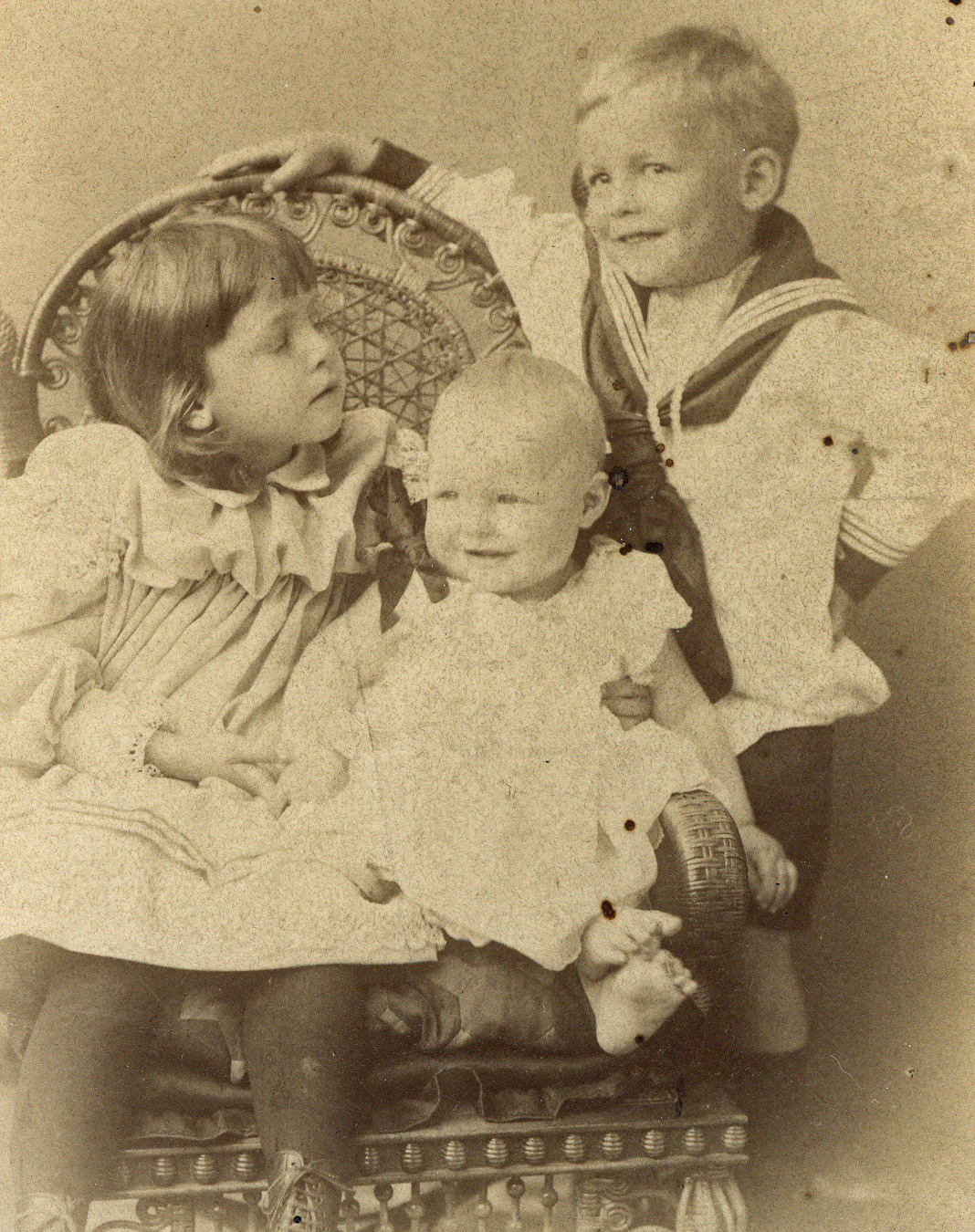
Helen, 5, baby Jack and Fritz, 3, in 1892

Jack with bike


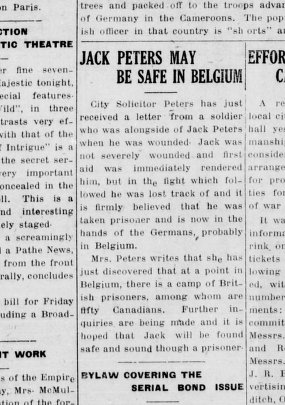
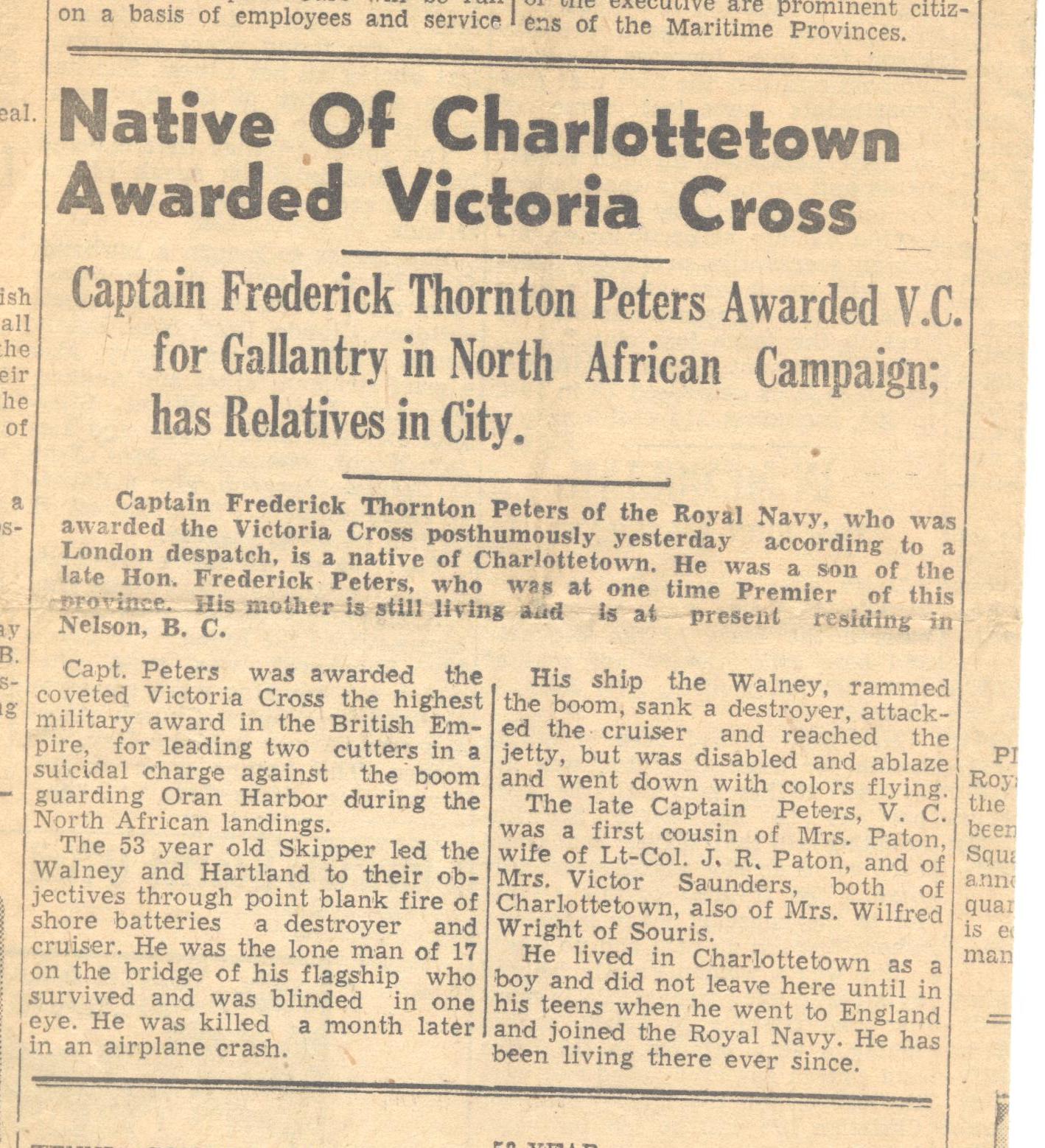
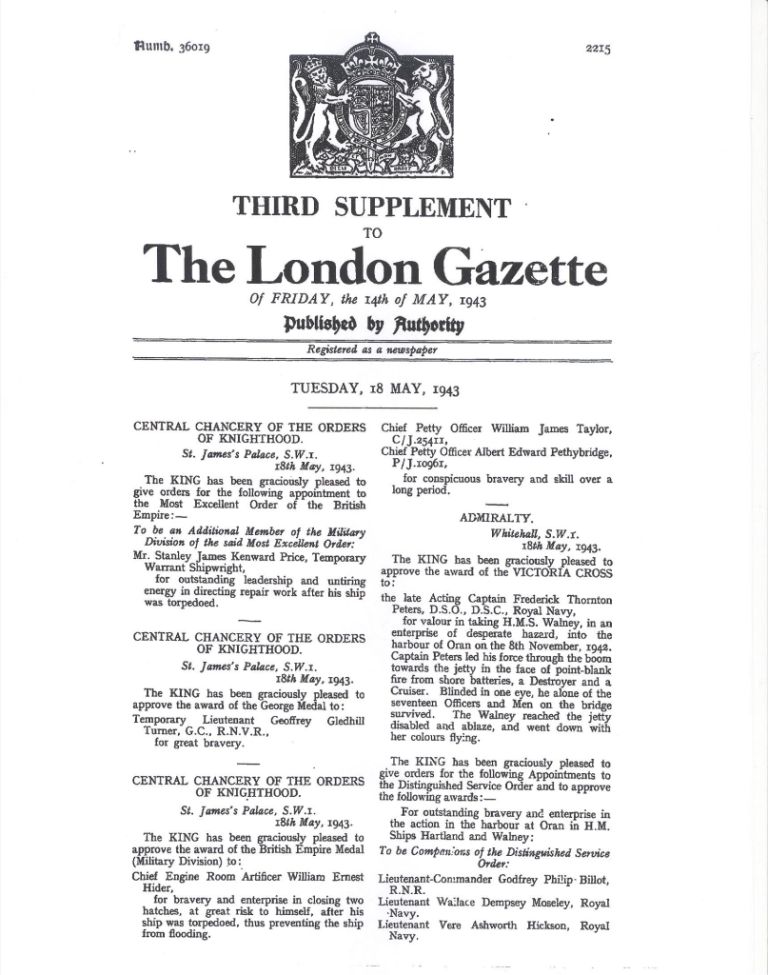
news report
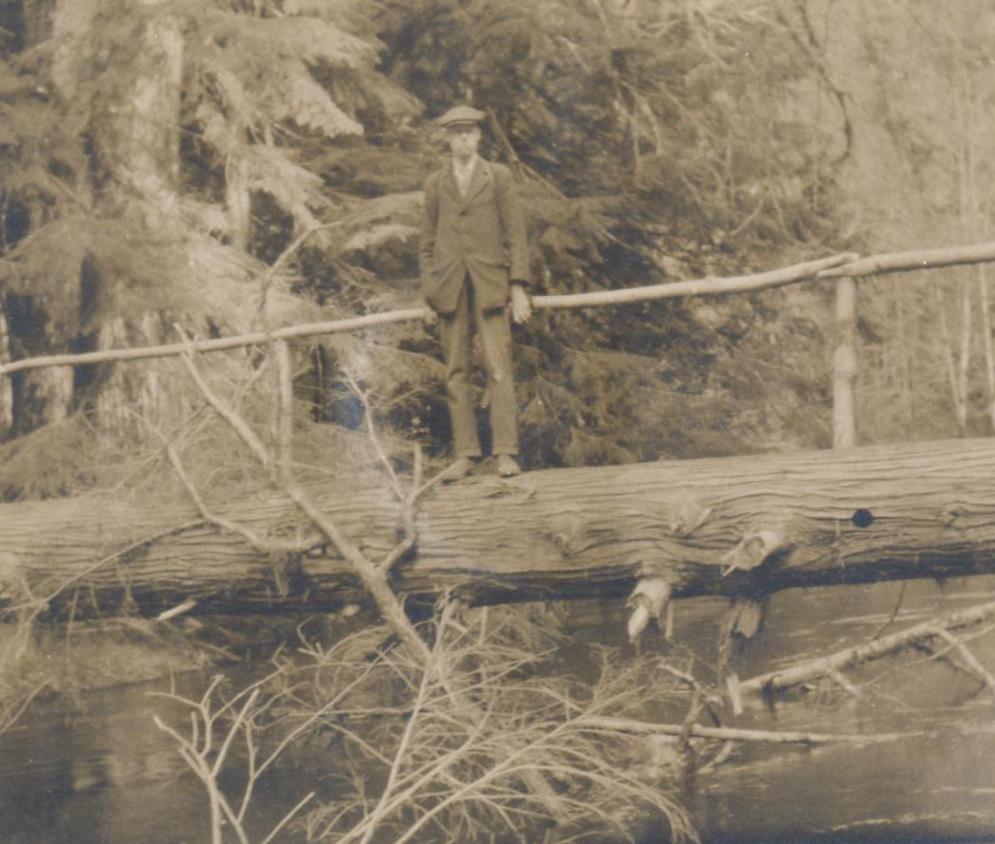
Jack in Prince Rupert, B.C.
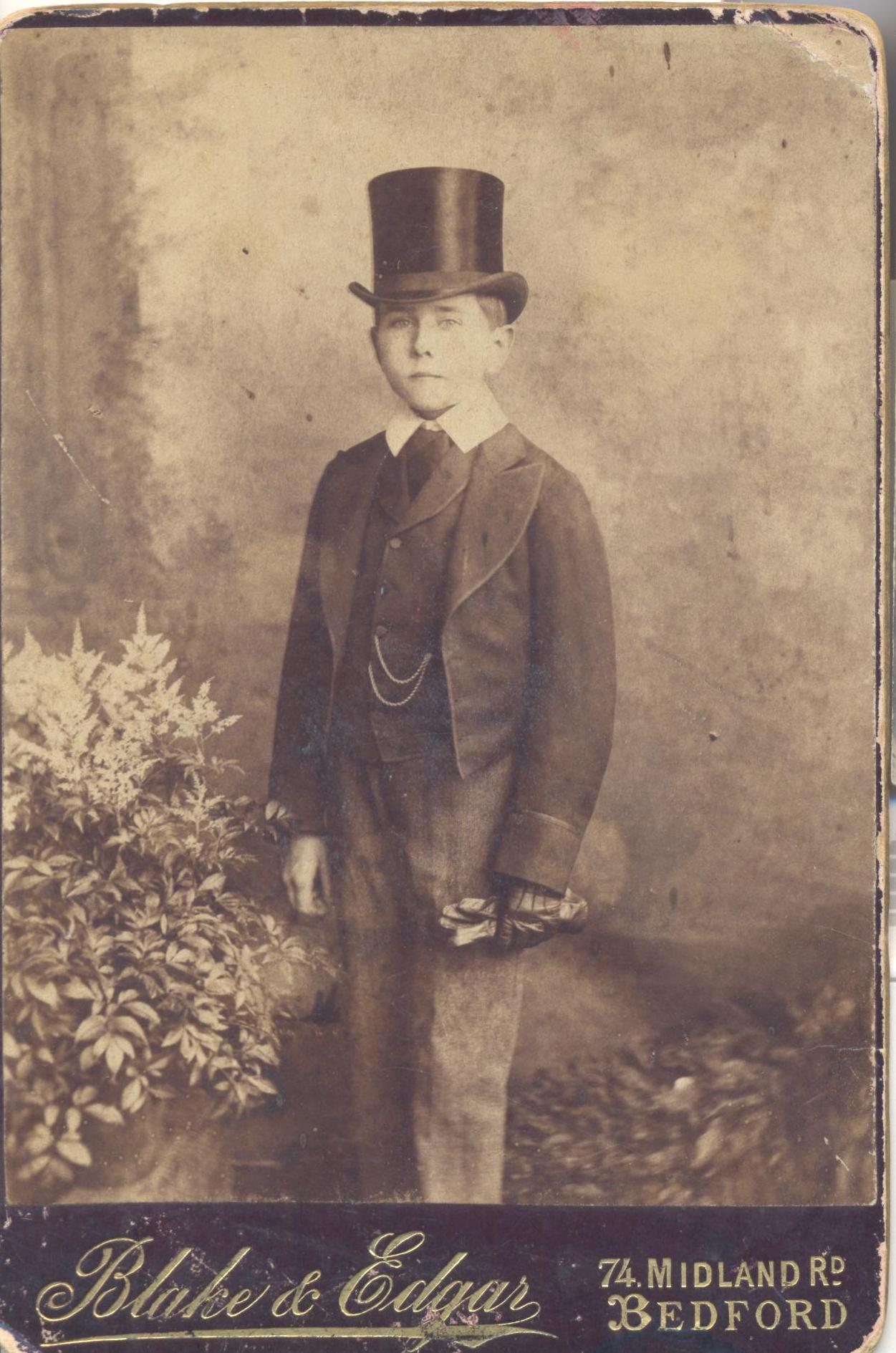
Jack as young boy at Bedford Grammar School north of London
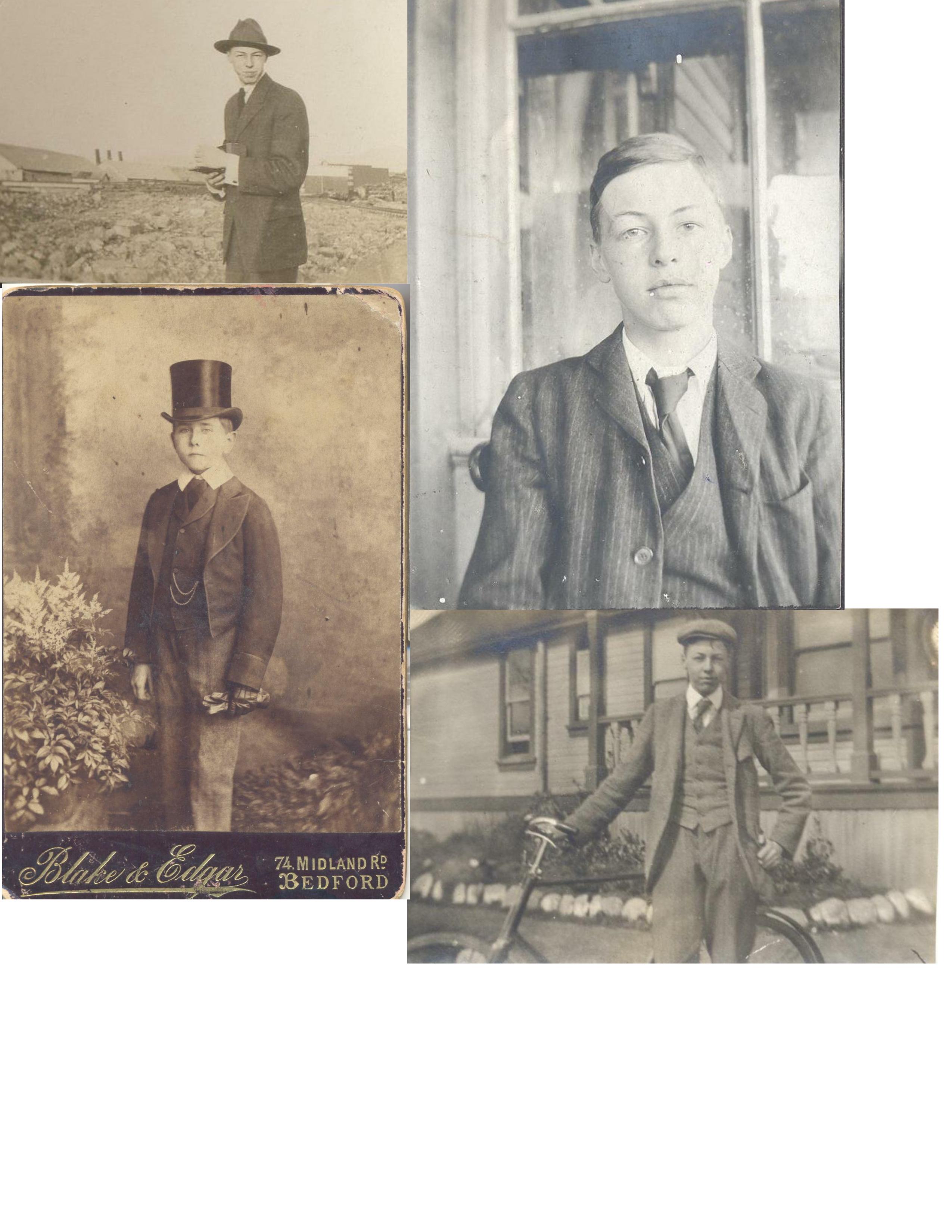
Jack photos through the years

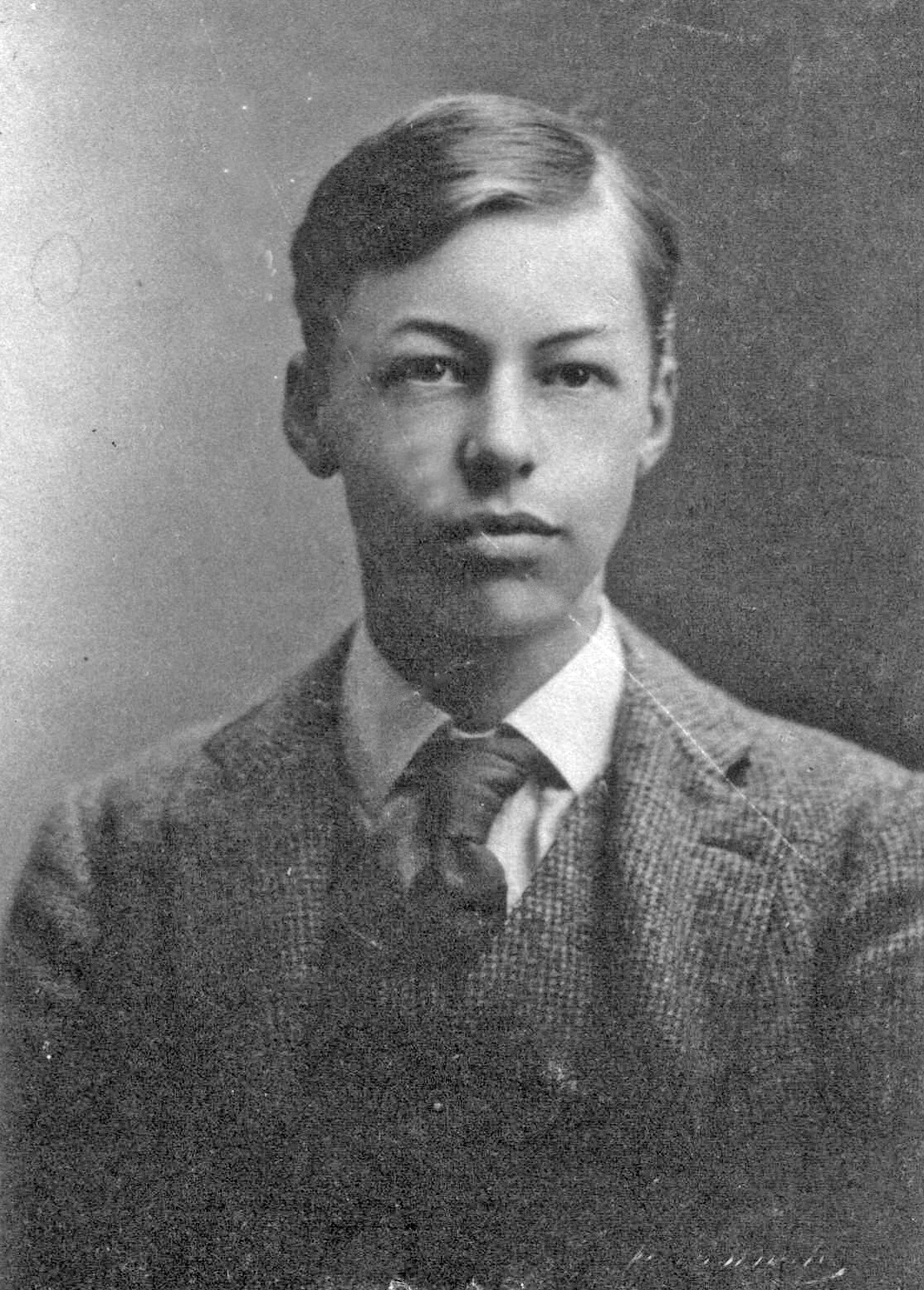





 thebravestcanadian